
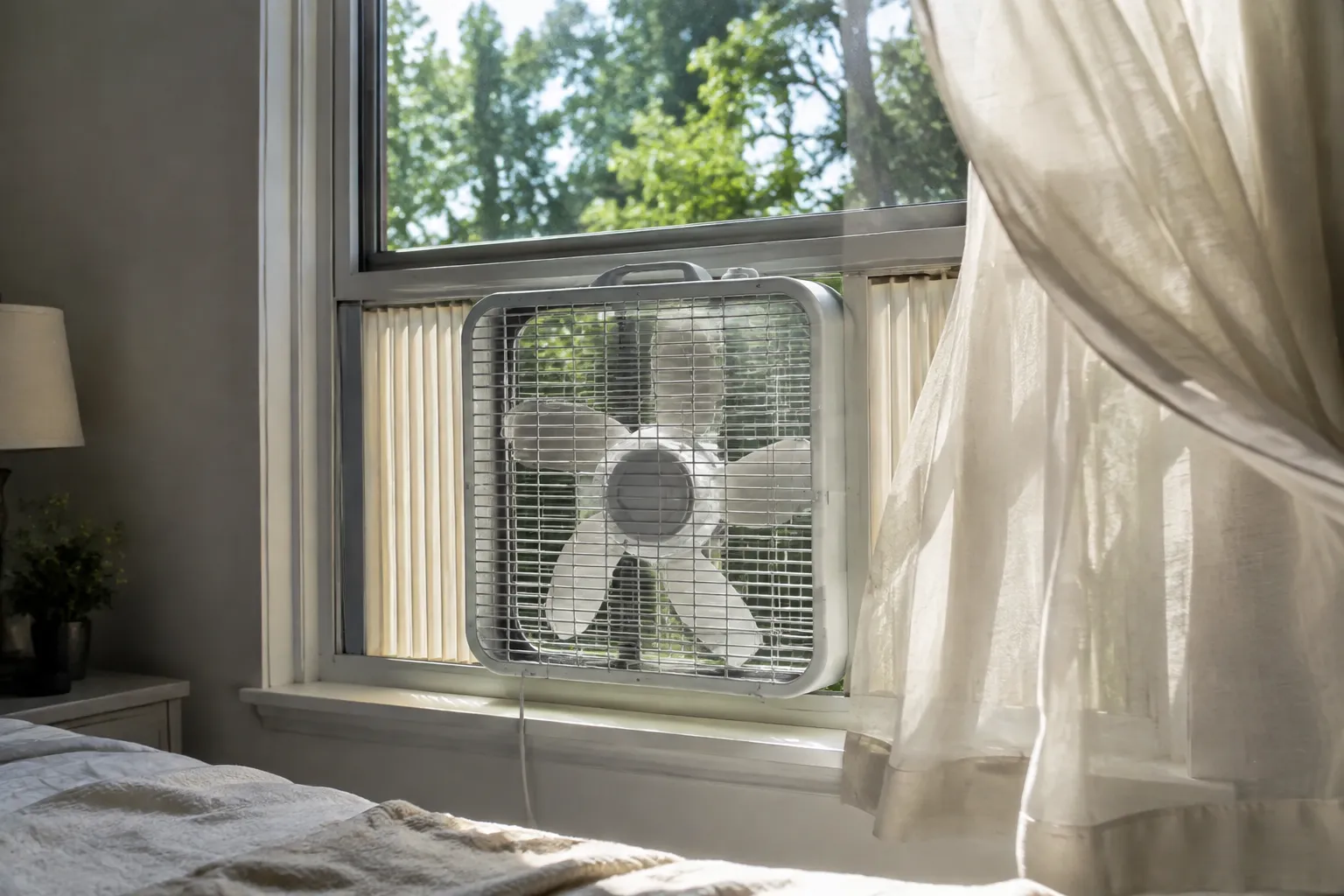
The window fan is the most disrespected piece of cooling equipment in American homes. Air conditioners get the attention, the energy bills, the dedicated circuits. Ceiling fans get the design treatment. The window fan sits in a aluminum frame, rattles at certain speeds, and gets packed away in September with the same grime it had in June. It deserves better. A good window fan, placed with some thought, can carry a surprising amount of a home's summer cooling load, and it does it for pennies a day.
The problem is that most people buy the wrong fan, or they buy the right fan and install it in the most useless possible way. They put one in the kitchen window facing inward, and then wonder why the house still feels like a parking garage in August. The fan itself is rarely the issue. The placement is.
The Two-Fan Rule That Changes Everything
A single window fan, even a powerful one, just churns air in one room. The real magic happens with two fans in different windows, set up to create a cross-breeze. One fan blows in, one blows out. That is the entire trick, and it is older than window screens.
The incoming fan should sit in a window on the side of the house where the air is cooler, usually the shaded side or the side facing the prevailing breeze. The outgoing fan goes in a window on the opposite side, ideally in a room with a door that can be left open. The house becomes a single duct. Air gets pulled in one side, pushed across the living space, and exhausted out the other. The whole structure breathes instead of just one room.
For a single-story house, the outgoing fan belongs in a hallway window or a bathroom window near the center of the house. That pulls air from the perimeter rooms through the middle and out. For a two-story house, the outgoing fan belongs upstairs. Heat rises, and the hottest air collects on the second floor by late afternoon. Forcing that air out through an upstairs window while pulling cooler ground-floor air up the stairwell is the closest thing to whole-house ventilation that a window fan can offer.
The direction of the fans matters more than the brand. A cheap fan blowing out of a high window, paired with a mid-range fan blowing into a low window, outperforms two expensive fans both blowing inward. The house needs an inlet and an outlet. Nothing else matters as much as that pair.
Why Reversible Fans Are Worth the Extra Money
Most window fans sold today have a reversible switch that changes the blade direction. That switch is not a gimmick. It turns one fan into two different tools depending on the time of day.
At night, when the outdoor temperature drops below the indoor temperature, the fan should blow inward across the bedroom. That draws the cool night air in and pushes the accumulated heat of the day out through other openings. In the morning, when the sun starts cooking the exterior walls, the fan reverses and blows outward. That pushes the overnight cool air out and exhausts the heat building up inside. The same physical fan does both jobs.
The alternative is owning two fans, one for each direction, and swapping them in the window twice a day. Nobody does that. The reversibility removes the friction, and the fan actually gets used the way it should. A non-reversible fan locks a person into one airflow pattern all day, which means it will be wrong for at least half of the day.
Pay the extra ten dollars for the reversible model. It pays for itself in the first week of not having to move furniture around to swap fans.
The Sizing Sweet Spot Between 20 and 24 Inches
Window openings vary, but the vast majority of double-hung windows accept a fan in the 20 to 24 inch range. That size exists for a reason. It matches the dimensions of a typical window track. A 20 inch fan fits almost everywhere. A 24 inch fan moves noticeably more air but needs a wider opening, and some older windows in pre-war houses simply will not accommodate it.
For most bedrooms and home offices, a 20 inch fan is the right call. It moves enough air to create a perceptible breeze across a bed or desk without sounding like a small aircraft taking off. For a living room or an open-plan ground floor, a 24 inch fan is better. The larger blade diameter pushes a wider column of air, which means it can move air across a larger room and still feel like a breeze rather than a directed jet.
There is a temptation to buy two 24 inch fans because bigger always seems better. Resist it. Two 20 inch fans in the cross-breeze configuration will cool a typical two-bedroom house more effectively than one 24 inch fan in a single window. Coverage matters more than raw output. The house needs air moving through it, not just a strong blast in one spot.
The Temperature Threshold That Decides Everything
Window fans have a hard limit, and respecting that limit is the difference between comfort and frustration. They work on nights when the outdoor temperature drops below about 75 degrees Fahrenheit. Once the night air stays above that, the fan is just recirculating warm air and pushing it around the room. That creates the illusion of cooling because of the breeze effect on skin, but it does not actually lower the room temperature.
In climates where summer nights regularly stay above 75, a window fan is a supplement, not a primary cooling method. It can still help by exhausting hot air from the kitchen after cooking or pulling cooler morning air through the house before the heat of the day arrives. But expecting it to beat a 90 degree night is asking too much.
In drier climates, the threshold stretches a bit. A desert night at 78 degrees with low humidity feels bearable with a strong breeze. In humid regions, that same 78 degrees feels oppressive because the air cannot evaporate moisture from the skin effectively. The fan works harder and delivers less relief. That is physics, not a fan deficiency.
Check the local forecast before investing in a serious window fan setup. If the overnight low in July stays above 78 degrees, the money is better spent on a portable air conditioner. If the overnight low drops into the 60s and 70s, which it does across much of the northern half of the country, a window fan setup can replace an air conditioner for most of the summer.
Where the Fan Goes in the Window Matters
Not all window positions are equal. A fan placed in the bottom half of a double-hung window pulls air from the lower part of the room, where the air is coolest. A fan placed in the top half pulls from the ceiling, where the heat collects. For an exhaust fan, the top position is better. It grabs the hottest air in the room and throws it outside. For an intake fan, the bottom position is better. It pulls the cooler air near the floor and lets it spread across the room.
Most fans come with an expandable side panel and sit in the bottom track by default. That works fine for intake. For exhaust, lifting the fan to the top of the window opening and blocking the gap below with a piece of foam board or a rolled towel makes a meaningful difference. The fan pulls from the ceiling where the heat lives, and the blocked gap prevents the exhausted air from being sucked right back in at the bottom.
That gap, by the way, is the reason some people think window fans are useless. A fan sitting in a window with gaps on both sides just pulls air from six inches away and pushes it back out. It short-circuits. The expandable panels help, but they rarely seal perfectly. A strip of foam weatherstripping along the edges of the fan frame closes the remaining gaps and forces the fan to pull from deeper in the room instead of from the window crack right next to it.
The Noise Problem and the Speed Control Fix
Window fans are loud. Not a gentle hum, but a blade-driven roar that gets old after about twenty minutes. This is the main reason people abandon them for air conditioners, even when the AC costs three times as much to run.
The fix is not to buy a quieter fan, because they barely exist. The fix is to buy a fan with a proper multi-speed motor and run it on low. A 20 inch fan on low moves enough air for a bedroom and produces a sound level that most sleepers can tolerate. On high, the same fan sounds like a box fan being tortured.
Some fans only have two speeds, and the low setting is still too loud. Look for a model with three speeds or a continuously variable dial. The motor quality matters more than the blade design here. A cheap motor on low speed produces a constant hum that grates after an hour. A better motor on low produces a white-noise rush that blends into the background and actually helps some people sleep.
The other noise fix is mechanical. A fan that rattles against the window frame or the expandable panels is a fan that was not installed carefully. Tighten the side panels, make sure the frame sits flush against the sill, and put a small piece of cloth or foam between the fan frame and the window track. That kills most rattles without any modification to the fan itself.
When a Single Fan in the Kitchen Is the Right Move
The cross-breeze setup is the ideal, but there is one spot where a single window fan earns its keep all by itself: the kitchen. Cooking generates an enormous amount of heat and humidity, and most range hoods either vent poorly or recirculate the air through a charcoal filter that does nothing for temperature.
A window fan mounted high in a kitchen window, set to exhaust, pulls the hot air and steam directly out of the room while cooking. It does not cool the whole house. It does something more useful in the moment: it keeps the kitchen from becoming a sauna, which means the rest of the house does not absorb that heat through open doorways.
This also works for rooms with lots of electronics or a home server setup. A single exhaust fan pulling hot air out of a small room, with an open door or a cracked window elsewhere for makeup air, prevents that room from becoming a heat trap. It is a targeted solution, and target solutions are often better than trying to cool the whole structure.
The Morning Flush That Cuts the Afternoon Peak
The single most effective routine with window fans happens before the sun gets high. In the early morning, when the outdoor air is at its coolest point, set the fans to intake and exhaust in the cross-breeze configuration. Run them hard for thirty to forty minutes. This flushes the overnight warm air out of the house and replaces it with the coolest air of the day.
Then close the windows, draw the curtains and blinds on the sunny side, and let the house coast on that cool air as long as it can. In many climates, this morning flush delays the need for any cooling by several hours. In a well-insulated house, it can keep the interior comfortable until the late afternoon.
This routine is free. It costs the same electricity as running the fans for half an hour, which is almost nothing. It requires waking up early enough to do it, which is the real obstacle. But the payoff is measurable. A house that starts the day at 74 degrees does not hit 85 as fast as a house that starts at 80.
The Storage Habit That Determines Next Year's Performance
Window fans get filthy. They sit in the window all summer, pulling in dust, pollen, and the fine grit that floats through the air. At the end of the season, most people pull the fan out, glance at the blades, and shove it into the basement or garage. That fan comes back the next June with a quarter-inch of dust compressed on the blades, and it moves noticeably less air.
Cleaning a window fan takes ten minutes. A vacuum with a brush attachment handles the front grill. A damp cloth wipes the blades and the frame. That is it. No disassembly, no special tools, no solvents. A clean fan moves more air, makes less noise, and does not smell like burnt dust for the first hour of operation.
The other half of good storage is protection. A fan thrown into an unheated garage or attic gets brittle plastic, corroded motor contacts, and a layer of grime that no amount of wiping will fully remove. A few minutes with a plastic bag or an old pillowcase keeps the dust off and the plastic supple. The fan comes out next year looking like it went in, which is a better start than most people will have.
The window fan will never be the glamorous option. It will not chill a room to 68 degrees on a 100 degree afternoon. But it does something an air conditioner cannot do as well: it moves a whole house's worth of air through the structure, replacing stale warm air with fresh cool air from outside. That exchange is worth more than a blast of recirculated cold air, especially on the mild nights that make up a good part of the summer. Put two fans in the right windows, set them in the right direction, and let the house breathe.