
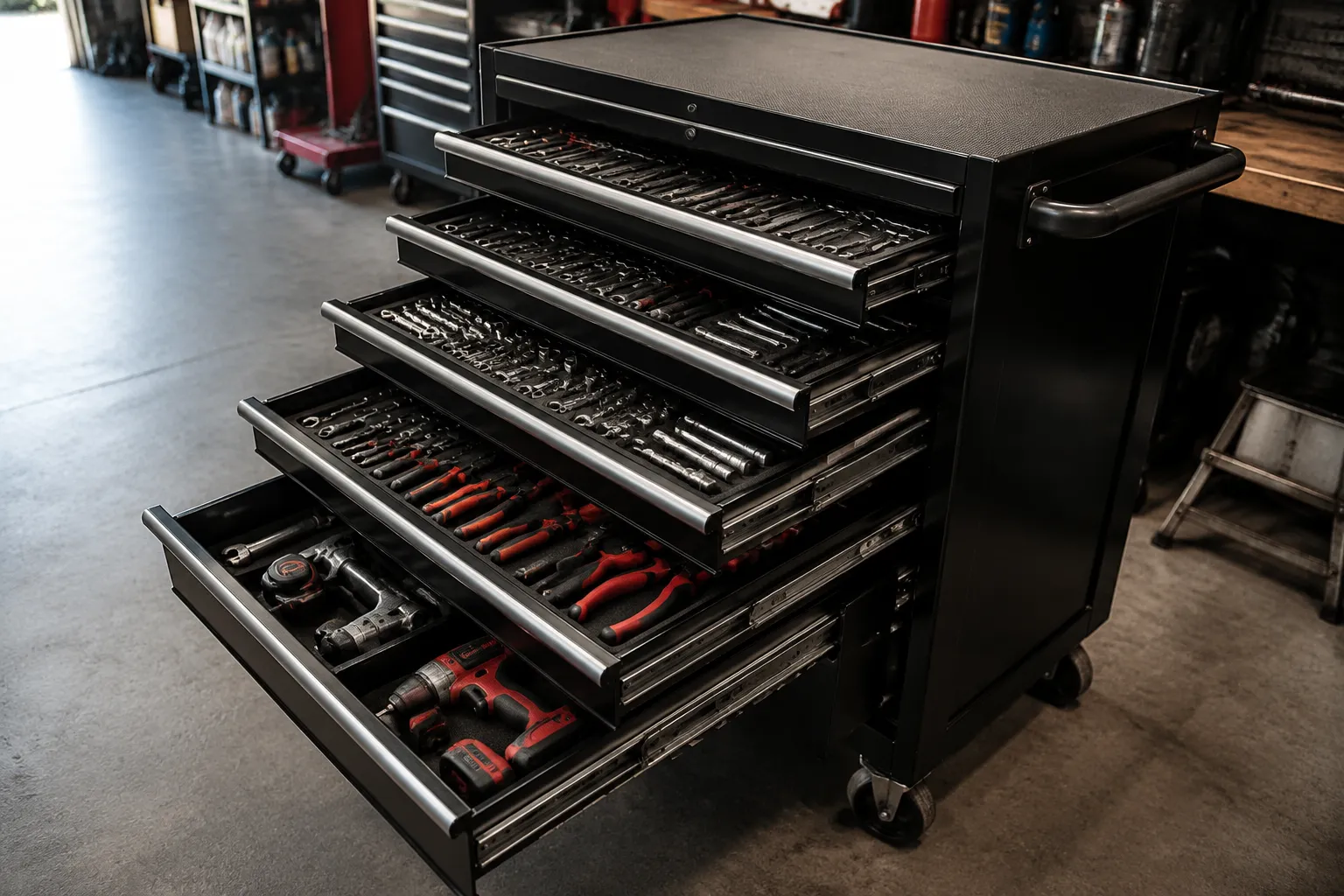
A rolling tool chest is the only piece of shop equipment that gets heavier every single year. The drawers fill. The top collects a second layer of frequently used tools that never made it into a drawer. The side shelves accumulate rags, tape, and the small parts that were going to be sorted later. At some point the chest stops being an organizer and becomes a very expensive container for chaos. The fix is not buying a bigger box. The fix is deciding what the box is actually for, then laying it out like a workstation instead of a warehouse.
The fastest way to understand a chest layout is to watch a person work out of it for an hour. Their hand goes to the same three drawers constantly. The other drawers open once a week, if that. The top is a jumble of things they reach for daily but never gave a proper home. Most layouts fail because they assign drawer space by tool category rather than by frequency of use. Sockets go in one drawer, wrenches in another, screwdrivers in a third. That looks tidy in a catalog photo. In practice, it means reaching into a low drawer for a 13 mm socket when a person needs it for the tenth time that morning.
The better starting point is a simple audit. For one week, a person pays attention to what they actually grab. Not what they think they should grab. What their hand finds on its own. The 10 mm socket appears constantly because it rounds off and gets replaced. The rubber mallet lives in three different places. The measuring tape never stays in its slot. These are not organizational failures. They are evidence of what the chest should be built around.
The top drawer is the most valuable real estate in the shop
The shallow top drawer of a roller chest is where most people store sockets or screwdrivers. That is a mistake. The top drawer sits at waist height, which is the natural working zone. It is the only drawer a person can use without bending, squatting, or taking a step. It deserves the tools that get picked up and set down a hundred times in a session. For most mechanics and fabricators, that means the everyday drivers and the common hand tools.
A person should be able to open that top drawer and immediately grab a screwdriver, a pick, a set of pliers, and a utility knife without looking. If they have to think about which drawer, the layout is wrong. The top drawer should contain the tools that are used so often they would otherwise end up on the top of the chest. Put the sockets in the second drawer. Sockets are used in bursts, and a person can bend slightly for them. The screwdrivers, the ones used every single day, belong at waist level.
This goes against the standard advice of organizing by size or by brand. It works anyway because it matches the body. The most comfortable reach is also the most used reach. The moment a person moves the everyday drivers up to that top drawer, the top of the chest clears itself of junk. The tools that were living on the surface finally have a home that makes sense.
Drawer depth should match the tool, not the brand's label
Chest manufacturers label drawers with generic categories: shallow for screwdrivers, medium for sockets, deep for power tools. Those labels are suggestions. The actual constraint is depth. A drawer that is 2 inches deep cannot hold a drill. A drawer that is 6 inches deep is wasteful for a set of wrenches. The person who ignores the labels and sorts by physical depth unlocks the real capacity of the chest.
The trick is to lay tools flat in single layers wherever possible. A drawer that is 3 inches deep can hold a full set of combination wrenches laid flat with room to spare. A drawer that is 4 inches deep can hold a socket set in a molded tray. When tools sit flat, a person sees everything at once. They do not dig. They do not shuffle through piles. The visual scan becomes the retrieval method, and it is fast.
Double stacking is the enemy of speed. A person who layers two sets of tools in one drawer has created a situation where retrieving the bottom layer takes twice as long. The drawer may look full and organized from above. It is not organized. It is a pile with a lid. If a drawer cannot hold a tool flat, that tool belongs in a deeper drawer or on a wall hanger. The chest should never require a person to remove one tool to reach another.
Weight distribution changes how the chest feels on the casters
A loaded roller chest is a moving object with a center of gravity. Put the heavy power tools in the bottom drawer and the chest rolls smoothly. Put them in the top drawer and the chest becomes tippy, especially when moving over a door threshold or a crack in the concrete. The casters are rated for total weight, but they cannot compensate for a top-heavy load. A chest that is heavy at the top feels unstable even when it rolls.
The bottom drawers should hold the tools that are heavy and rarely used. The angle grinder, the hammer drill, the large clamps, the spare batteries. These tools do not need to be at waist level because they come out for specific jobs, not for continuous use. They also deliver a secondary benefit: lowering the center of gravity makes the whole chest feel more planted. The top drawers can then hold the lighter, frequently used tools without compromising stability.
There is a practical test for this. When the chest is full, a person should be able to push it across a rough floor with one hand without it wanting to tip. If it does, the heavy items need to move down. Most people discover this the hard way, the first time the chest leans dangerously while rolling over an extension cord. The layout fix is simple, but it requires admitting that the grinder does not need to live up high just because it gets used weekly.
The side cabinet is for active projects, not for storage
Many roller chests come with a side cabinet or a smaller rolling unit that sits beside the main box. The instinct is to treat this as overflow storage. That wastes its purpose. The side cabinet is the only part of the chest that can hold an active project without contaminating the main drawers. It is where the in-progress work lives, the parts, the fasteners, the specific tools for the job at hand.
A person working on a car over the weekend can keep the niche sockets and the specialty puller in the side cabinet. When the job is done, the side cabinet gets cleared out and the tools return to their main drawers. This creates a routine that keeps the main chest stable and predictable. The side cabinet changes with the job. The main chest stays constant. The combination means a person always knows where to find the everyday tools, and the job-specific tools are always together.
This also prevents the common failure of tools migrating. A specialty tool that is used once a month tends to drift toward the back of a drawer, then get buried, then get bought a second time. The side cabinet, with its visible shelves, keeps specialty tools out in the open during a job. The visual reminder is often enough to prevent duplicate purchases.
Foam liners are a speed tool, not a vanity upgrade
Shadow boards and foam cutouts get dismissed as showroom flourishes, the kind of thing a person does for a YouTube video and then abandons. In practice, foam liners have a real speed benefit that has nothing to do with looks. A cutout tells the eye exactly where a tool belongs. The return motion becomes automatic. A person drops the socket back into its outline without looking, and the drawer stays organized without conscious effort.
The foam does not need to be custom laser-cut. A sheet of closed-cell foam and a utility knife work fine. The point is to create a visual boundary for each tool. A drawer full of sockets in a tray already does this. A drawer full of wrenches that are just thrown in does not. The foam is the difference between a drawer that stays organized for a week and a drawer that stays organized for years.
The other benefit is tactile. When a person reaches into a drawer, the foam gives a slight resistance that confirms the hand is in the right place. This matters in low light or when wearing gloves. The hand can feel the outline of the tool before the eye confirms it. That is a real speed gain, not a cosmetic one.
The top surface should earn its space every day
The top of the chest is the most contested surface in the shop. It is where a person puts the part they just removed, the coffee cup, the phone, the rag, and the tool they are using at that exact moment. It is also, in many shops, where a pile of miscellaneous items slowly accumulates until it becomes a permanent layer of clutter. The top should be treated as a small workbench with a strict capacity.
A magnetic mat or a small magnetic strip on the top catches the fasteners and the small steel parts that otherwise roll around. A pegboard panel or a magnetic rail attached to the back edge holds the tools that are in active rotation, the impact driver, the flashlight, the torque wrench. This keeps the flat surface clear for the actual work. The chest top is not a shelf. It is a landing zone.
There is a simple rule that keeps it honest. At the end of each session, the top should be clear except for the items that live there permanently. If a person cannot wipe the top with a rag without moving ten things, the top has become a storage shelf. The permanent items should be limited to what is used in every single job. Everything else goes back in a drawer.
Labeling matters more than it should, and that is fine
Drawer labels feel like overkill for a person who is the only one using the chest. They are not. A label serves two functions. The first is memory. After a week away from the shop, a person does not remember which drawer holds the files. The label removes the hesitation. The second is discipline. A labeled drawer is harder to violate. When a person sees the label that says "Sockets 3/8 drive", they are more likely to put a stray wrench back where it belongs instead of leaving it in an empty spot.
The label does not need to be fancy. A label maker with a clear tape is the standard. The key is to label the drawer front at eye level or on the top edge so it is visible without crouching. The label should name the contents and nothing else. "Wrenches metric" is better than "Metric combination wrenches 8-19 mm". The shorter label is easier to read at a glance.
The real payoff arrives when a second person uses the chest. A helper, an apprentice, a friend who is borrowing the shop. With labels, the second person can find tools and, more importantly, put them back. The chest stays organized even when the owner is not the only one touching it. That is when a layout goes from good to genuinely useful.
The bottom drawer is the graveyard, so give it a purpose
Almost every rolling chest has a bottom drawer that becomes a graveyard. It collects the tools that are used rarely but not rarely enough to throw away. The pullers, the odd adapters, the spare parts, the tools that came in a kit and were never used. This drawer is usually a mess because nobody wants to organize things that are used once a year. The solution is to give the graveyard a deliberate structure.
Use small plastic bins or divided trays inside the bottom drawer. Each bin gets a category: pullers, bearing tools, thread repair, cable tools. The bins keep the drawer from becoming a single pile. The categories give a person a place to start looking. The drawer still holds the odd stuff, but now it is odd stuff with a system.
The bottom drawer also benefits from a yearly purge. Every January, a person goes through it and pulls out anything that has not been touched in two years. Those tools either move to a storage cabinet, get loaned out, or get sold. The bottom drawer stays at a manageable size. A graveyard that is managed is not a graveyard. It is just a low-priority drawer with a plan.
A chest layout is a working document, not a final answer
The best layout from January will not be the best layout in June. Work changes. New tools arrive. Old tools wear out. The frequency of use shifts as a person takes on different projects. The chest should be rearranged without guilt. Moving a tool to a different drawer takes two minutes and pays for itself the first time it saves a reach.
The signal to rearrange is simple. If a person opens a drawer and does not find what they need, or if they have to move one tool to reach another, the layout is off. The fix is immediate. Move the tool to the drawer where the hand first looked. That is the only rule that matters. The hand knows where it wants to go. The layout just needs to agree.