
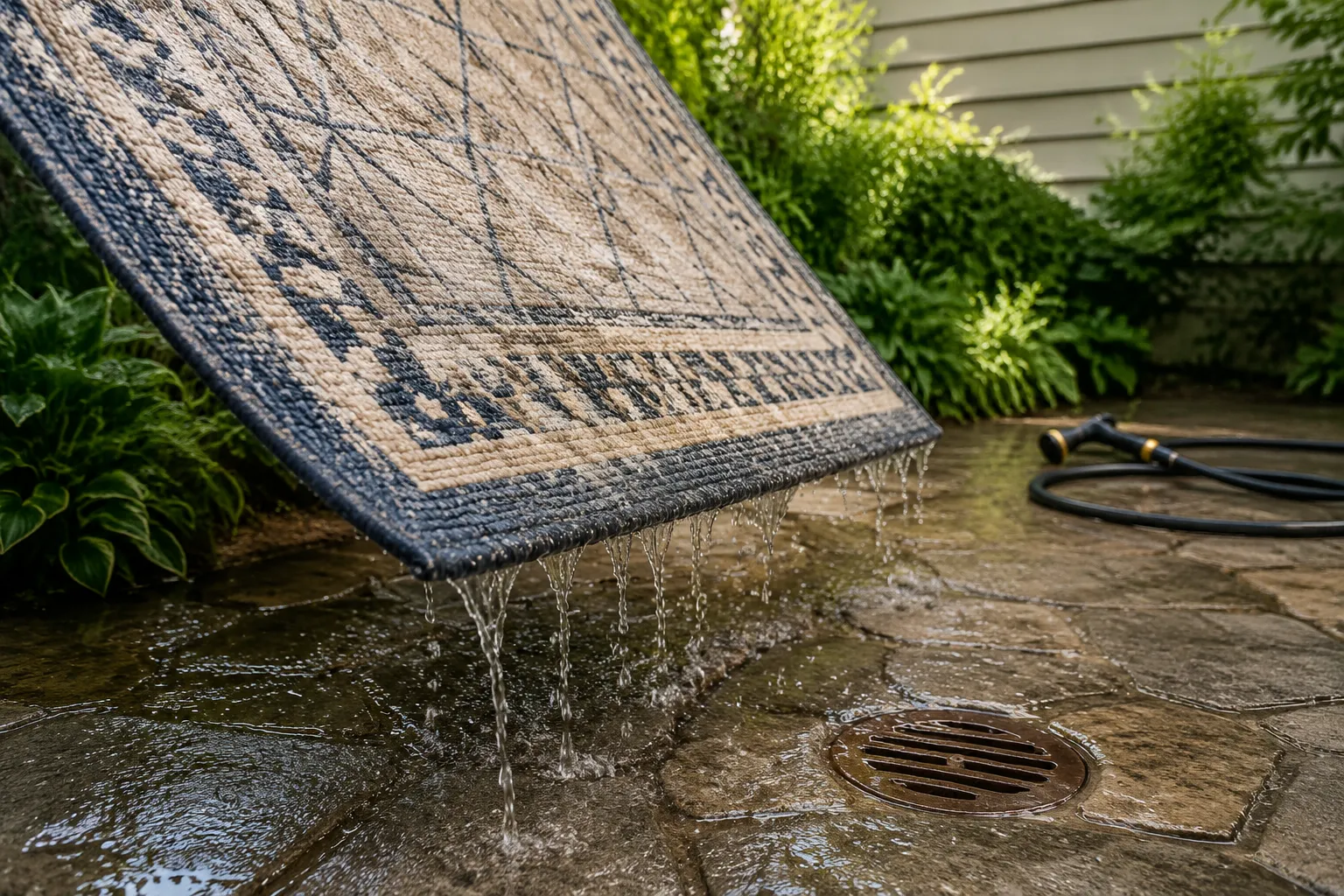
Mildew on an outdoor rug is a quiet failure. The rug sits there for months, taking sun and rain and foot traffic, and then one day the underside smells like a wet dog that found something dead. The top surface still looks fine. The damage is already done underneath, and once it starts, it compounds. The rug gets slippery, the fibers break down faster, and the smell becomes the only thing anyone notices. The cause is rarely a single dramatic event. It is almost always a slow accumulation of trapped moisture, and the good news is that the fix is mostly about how the rug gets set up in the first place.
Outdoor rugs are marketed as tough, weatherproof, and practically indestructible. The reality is more modest. They are made to get wet and dry out, not to stay wet. A polypropylene rug will not rot the way a natural fiber rug will, but the backing, the pad underneath, and the surface beneath that can all hold water for days. Mildew needs three things: organic material to eat, warmth, and moisture that lingers. A rug on a concrete patio in July has all three by default. The only variable a person controls is drainage.
Drainage for an outdoor rug is not the same as drainage for a yard. The goal is not to move water away from a foundation or to prevent a puddle from forming at the bottom of a slope. The goal is to keep the underside of the rug from staying wet long enough for spores to germinate. That means air has to move under the rug, water has to escape from the edges, and nothing under the rug should act like a sponge.
The Ground Below the Rug Is Half the Problem
The surface underneath an outdoor rug matters more than most people think. A rug thrown directly onto packed dirt or a thick lawn will hold moisture against the ground, and the ground will hold it right back. Dirt absorbs rain and then releases it slowly as vapor, which rises straight into the rug backing. Grass keeps the soil cool and damp, and the rug blocks the sun that would normally dry the lawn. A person ends up with a damp microclimate trapped under a synthetic carpet.
Hard surfaces behave differently. Concrete, stone, and composite decking all drain water across their faces, so a rug on those surfaces has a chance to dry from the edges. But concrete also sweats. In humid weather, moisture condenses on a slab and sits there, especially in shaded corners or spots near a house wall. A rug laid directly on a slab in a low spot will sit in that condensation all night and all morning.
The fix is to create a gap. A thin layer of air between the ground and the rug lets water escape and lets air circulate. That does not mean building a raised platform. It means choosing the right underlayment and checking the site for low spots before the rug goes down. A patio that holds puddles after rain will hold a puddle under a rug, and no pad in the world changes that.
Before laying anything, sweep the area and look at it after a hard rain. Does water pool in one corner? Does the surface stay dark for hours after the sun comes out? If the answer is yes to either, the site needs grading or a different location. Pouring a small amount of water from a bucket across the surface shows the natural flow. Water that sits for more than a few minutes in any spot will sit under the rug for days.
What a Rug Pad Should and Should Not Do
A rug pad under an outdoor rug is a double-edged tool. The right one lifts the rug off the ground, adds cushion, and keeps the rug from sliding. The wrong one holds water like a sponge and turns the space under the rug into a mildew nursery. The difference comes down to material and construction.
Rubber pads, specifically those made from recycled rubber or a rubber composite, are the standard choice for outdoor use. Solid rubber does not absorb water. Water beads on it and runs toward the edges. A rubber pad with a waffle or grid pattern adds airflow channels underneath, which is better than a flat sheet because it lets the underside of the rug breathe. The waffle pattern creates hundreds of small air pockets, and those pockets are enough to keep the backing dry between rain events.
Felt pads, even ones labeled for indoor-outdoor use, are a trap. Felt is made from compressed fibers, and fibers hold water. A felt pad under an outdoor rug will soak up rain, stay wet for days, and transfer that moisture directly to the rug backing. The same goes for foam pads with a fabric top layer. The fabric wicks water, and the foam holds it. Both materials belong indoors.
A person should also look at the pad's thickness. A thick, plush pad feels nice underfoot but creates a deeper pocket for water to collect. A pad that is too thick also makes the rug edge a tripping hazard. A thin rubber pad, roughly a quarter inch or less, is the sweet spot. It provides grip and airflow without creating a bowl.
One more detail: the pad should be cut slightly smaller than the rug, leaving a one to two inch border of rug exposed on all sides. This keeps the pad from wicking moisture up the rug's cut edges and gives water a clear path off the rug surface. A pad that extends to the rug's edge acts like a dam.
The Angle That Keeps Water Moving
Even with the right pad, a perfectly flat rug on a perfectly flat surface will still hold water near its center. Rain hits the rug, soaks through the fibers, and reaches the backing. From there it has to travel sideways to the edge. On a flat surface, it will do that slowly, and some of it will simply sit until it evaporates. The solution is a slight slope.
A slope of one to two degrees is enough. That is a drop of about a quarter inch per foot, which is barely noticeable underfoot but sufficient to make water run toward the lower edge. Most patios and decks already have a slight slope for their own drainage. The trick is to lay the rug so its lower edge points toward the existing drainage direction, not against it.
On a deck, the gap between boards already provides drainage, so the slope matters less. The boards act as a drainage grid, letting water fall through and air move up. But the boards also create a hazard: a rug on a deck with wide gaps can sag into the spaces, creating low pockets where water gathers. A rigid pad, or a rug with a stiff backing, bridges those gaps more effectively than a flimsy rug that drapes into every crack.
On concrete, the slope is everything. A person can test the direction of a slab's slope by pouring water on it and watching which way it runs. If the slab is flat or slopes toward the house, the rug should not go in that spot at all. Choosing the right location is cheaper than any drainage product.
Why the Rug's Edge Matters More Than Its Face
Most people inspect the surface of an outdoor rug when they shop for one. They run a hand across the fibers, check the color, maybe test a corner with a fingernail. Very few flip the rug over, and that is a mistake. The backing and the edge construction determine how the rug handles water.
Rugs with a tight, sealed edge are better than rugs with a raw cut edge. A raw edge has exposed fibers that wick water into the interior of the rug. A bound or overlocked edge seals the sides, forcing water to stay on the surface and run off. Many outdoor rugs sold in standard sizes have a simple cut edge with no binding, and those are the ones that stay damp longest at the perimeter.
The backing material matters too. Look for a rug with a latex or PVC backing that repels water, rather than a fabric backing that absorbs it. Some rugs advertise a "no-slip" backing, which is usually a textured rubber or latex layer. That layer is good for grip and good for water resistance. A rug with a plain woven backing, even if the face fibers are synthetic, will hold moisture against the ground.
There is also a case for skipping the backing question entirely and choosing a rug with an open weave. Flat-weave rugs, like those made in the classic indoor-outdoor style, let water pass through more easily than a dense, plush rug. The tradeoff is comfort. A flat weave is thinner and less soft underfoot. But for a space that gets heavy rain, the open construction dries dramatically faster.
How to Keep the Rug Itself From Holding Water
The material of the rug face is the next layer of defense. Polypropylene is the industry standard for outdoor rugs, and for good reason. It resists moisture, dries quickly, and holds color well in sun. Polyester is similar but slightly less durable. Both are synthetic and neither provides the organic food that mildew needs to grow. That is why a polypropylene rug can stay wet for days and never develop a mildew smell, while a jute or sisal rug in the same spot will turn musty within a week.
Natural fiber rugs, including jute, sisal, seagrass, and bamboo, are a poor choice for outdoor areas that get any real rain. They absorb water deeply, swell, and provide the organic matter that mildew spores feed on. A covered porch with no direct rain might tolerate a sisal rug, but it is a gamble. The humidity alone, especially in summer, can push those fibers over the edge. A person who loves the look of natural fibers should reserve them for a fully enclosed, climate-controlled space and use a synthetic alternative outside.
Even a good polypropylene rug benefits from a little help. Hosing down the rug occasionally is useful, not just for cleaning but for flushing out the dust and pollen that settle into the fibers. That organic debris is food for mildew, and rinsing it away removes the food source. The key is to do it on a dry, breezy day so the rug has a full cycle of sun and air before nightfall.
The Weekly Habit That Prevents the Smell
No amount of slope and pad selection eliminates the need for maintenance. A rug sitting outside in summer collects pollen, tree sap, bird droppings, and the general grime of the outdoors. All of that is organic material, and all of it feeds mildew. The habit that keeps a rug healthy is deceptively simple: flip it up and let the underside air out.
Once a week, or after any stretch of heavy rain, lift one edge of the rug and prop it up with a chair or a block. Leave it that way for a few hours. This exposes the backing to moving air and lets trapped moisture evaporate. It also gives a person a chance to inspect the pad and the ground beneath. A quick look takes five seconds and catches problems early, while they are still a damp spot instead of a spreading colony.
For deeper cleaning, a mild soap and water solution scrubbed into the rug and rinsed clean works well. Avoid bleach and harsh chemicals, which can break down the backing and fade the fibers. A stiff broom works better than a brush for outdoor rugs because it reaches deeper into the weave. After cleaning, the rug needs to dry completely before it goes back down. Rolling it up wet or folding it damp is an invitation for mildew on the inside of the roll, which is the hardest spot to reach.
Winter storage deserves its own mention. An outdoor rug that gets rolled up and stored in a shed or garage for the cold season should be bone dry first. Even a slightly damp rug stored in a dark, unventilated space will develop mildew over the winter, and spring will reveal black spots and an odor that no amount of cleaning fully removes. Dry it for a full sunny day, then roll it, and do not wrap it in plastic. A breathable cloth cover or nothing at all is better than a sealed bag that traps any residual moisture.
When the Rug Is Already Sour
If the underside already smells, the rug is not ruined, but it needs immediate intervention. The first step is to get it off the ground and into full sun. Ultraviolet light kills mildew spores, and dry air removes the moisture they need to survive. Lay the rug over a railing, a sawhorse, or a line of chairs so both faces get sunlight. Leave it for a full day, flipping it once.
After the rug is dry, brush the backing with a stiff broom to dislodge the dead mildew and any residue. Then clean the face with soap and water, rinse thoroughly, and let it dry again. If the smell persists after two full drying cycles, the rug has absorbed the musty compounds into its fibers, and it will likely need replacement. Synthetic rugs recover more often than natural fiber rugs, but there is a point of no return.
The pad underneath should be treated as the likely source of recurrence. A rubber pad can be hosed off and dried in the sun. A felt or foam pad that got wet should be thrown away. There is no practical way to fully dry the interior of a felt pad once it has absorbed water, and the mildew will keep spreading from the pad to the rug. Replacing a ten dollar pad is cheaper than replacing a two hundred dollar rug.
That pattern, where the pad is the culprit, is the most common one in outdoor rug failures. A person buys a decent rug, lays it on a proper surface, and then slides a cheap pad underneath that holds water like a bucket. Six weeks later, the rug smells. The fix was never a different rug. It was a different pad.
The discipline of outdoor rug care is mostly about paying attention to the invisible layer. The surface looks fine. The edges look fine. The problem lives underneath, where the air is still and the moisture gathers. A person who treats the underside as part of the system, rather than an afterthought, will have a rug that lasts years. A person who ignores it will keep replacing rugs and wondering why the smell keeps coming back.