
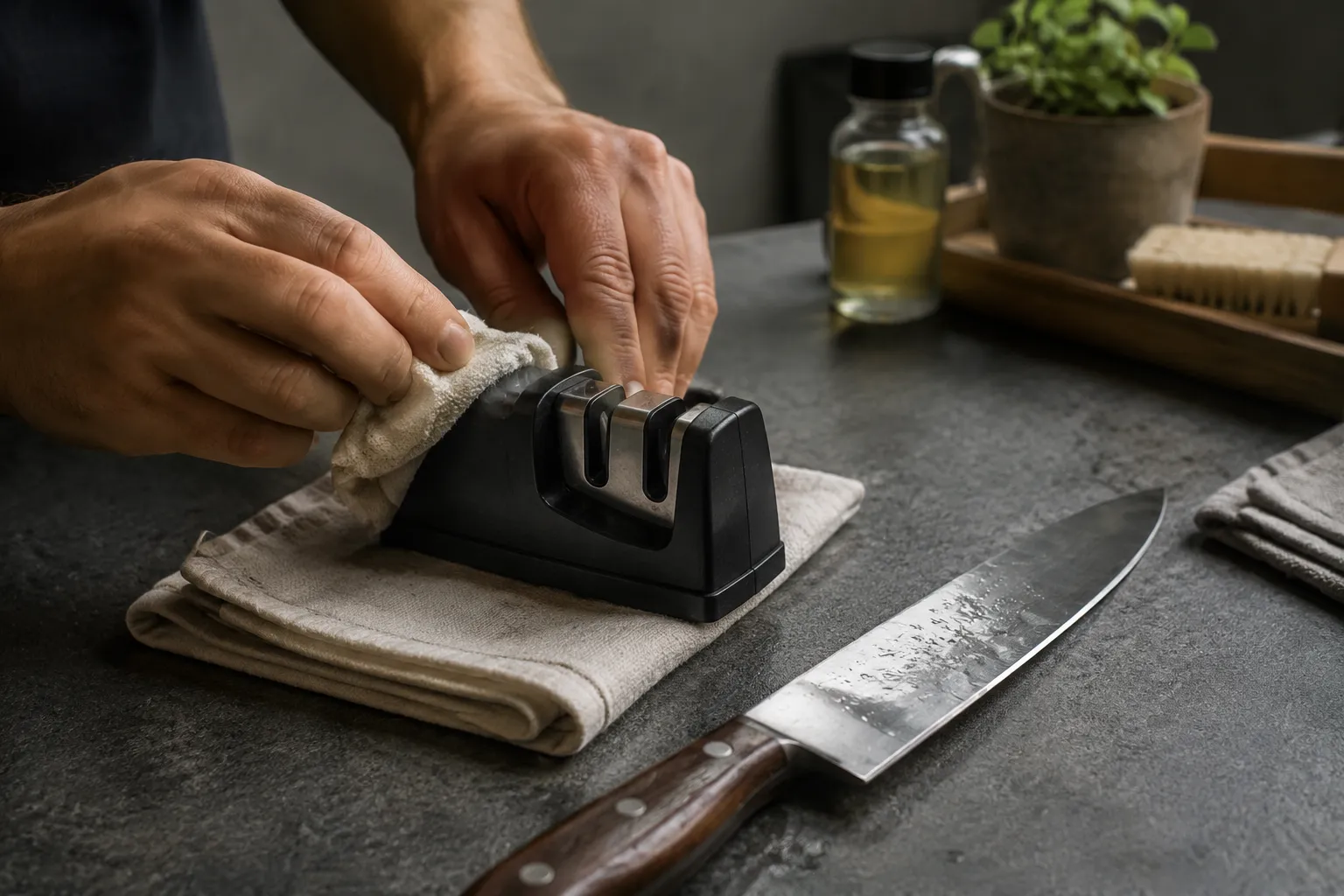
The dull knife is a quiet failure. It sits in the block, looking identical to its sharp siblings, and nobody notices anything is wrong until a tomato squashes flat instead of slicing. What most people never consider is that the sharpener, not the blade, is often the culprit. A $200 chef's knife reduced to a butter knife is rarely the steel's fault. It is the maintenance habits around the sharpening equipment that let the edge degrade, sometimes permanently.
Sharpening systems are treated like anvils. They are bought, used aggressively, and then ignored until the next blade needs attention. The reality is that these tools have their own tolerances, their own cleaning needs, and their own failure modes. A neglected sharpener does not just stop working well; it actively damages the very knives it is supposed to protect.
The Contamination Problem on Whetstones
Whetstones are the worst offenders in the maintenance category because they look self-cleaning. Water and friction seem like they should wash everything away. They do not. The stone surface becomes glazed with a slurry of metal filings, abrasive grit, and dried oil or water residue. This loaded surface acts like a buffer, polishing the edge rather than cutting it, and it generates heat that draws the temper out of thin blade steel.
The fix is boring and effective: flattening. A stone that develops a dish, a slight concave curve from repeated use, ruins the geometry of a blade. The edge rolls over the hollow, hitting high spots on the stone and missing the rest. Flattening with a coarse diamond plate or a dedicated flattening stone should happen every few uses, not once a year. A flat stone is the only way to get a consistent bevel angle from heel to tip.
After flattening, the stone needs to dry completely before storage. Storing a wet stone in a drawer or case invites mold and uneven wear. More importantly, a stone that is soaked with water will shed grit unevenly the next time it is used, leaving the surface rough and unpredictable.
The Hidden Cost of a Dirty Honing Rod
The honing rod is the most misunderstood tool in the kitchen drawer. It does not sharpen; it realigns the microscopic edge that folds over during use. That distinction matters because it changes how the rod should be treated. A rod covered in old metal dust and grease will micro-chip the edge it touches. The debris acts like a coarse abrasive, cutting random nicks into the steel.
Ceramic rods are the worst for this. Their surface is porous and traps particles deep in the texture. Washing a ceramic rod with soap and water is not enough. It needs a scrubbing with a stiff brush and a mild abrasive cleaner, something like a soft scouring pad, to pull the embedded metal out of the pores. Steel rods are easier, but they still collect grime in the grooves cut into their surface.
There is also the matter of rod storage. A rod rattling around in a drawer with other utensils will get dinged. Those dings become high spots that catch the blade edge and fold it over unevenly. A rod that has visible nicks or chips in its surface should be replaced, because no amount of cleaning will make it smooth again.
What Pull-Through Sharpeners Do to a Blade
Pull-through sharpeners get a bad reputation from serious knife people, but the hate is often aimed at the wrong target. The design itself is fine for cheap blades. The problem is the fixed angle. A pull-through sharpener sets the edge at a predetermined angle, usually around 20 degrees per side, and it forces every knife into that geometry regardless of the blade's original grind.
Maintenance for these devices is almost nonexistent in most kitchens, which is exactly the issue. The carbide blades inside the sharpener wear down and become uneven. One side cuts more aggressively than the other, and the edge gets lopsided. The abrasive wheels or rods inside also load up with metal dust, losing their cutting ability while still scraping the blade.
Cleaning a pull-through is simple, but nobody does it. A cotton swab with rubbing alcohol can pull the packed metal dust out of the slots. The carbide blades themselves should be inspected for chips. If a person relies on a pull-through as the primary sharpening method, they should replace the entire unit every couple of years, because the internal wear is invisible from the outside.
Electric Sharpeners Need a Cooling Period
Electric sharpeners are the most convenient option and the most dangerous for blade health. The motor spins abrasive wheels at high speed, generating significant heat. Running a knife through the slot repeatedly, or pressing too hard, overheats the edge steel. Heat above a certain threshold ruins the heat treatment, leaving a soft edge that dulls within a week no matter how well it is sharpened.
The maintenance habit that protects blades is patience. One pass through the coarse slot, one through the fine slot, and then the unit must rest. Running the same knife through four or five times in a row is the fastest way to destroy a blade. The sharpener needs time to cool, and so does the knife.
Cleaning electric sharpeners is a neglected task. The abrasive wheels shed grit and metal dust into the housing. Over time, this build-up changes the angle of contact between the wheel and the blade. A sharpener that used to produce a clean edge starts producing a wavy one. Vacuuming the slot openings and wiping down the guides with a dry cloth should happen monthly, more often in a busy kitchen.
Strop Dressing and the Leather Surface
Strops are the final step for many enthusiasts, and they are also the easiest to ruin through neglect. The leather surface loads up with the polishing compound and metal particles it removes from the blade. A loaded strop stops polishing and starts burnishing, which can round the edge over time.
The maintenance is counterintuitive. The strop needs to be cleaned by scraping the surface with a flat edge, a putty knife works well, to remove the embedded debris. Then it needs to be re-dressed with fresh compound. Many people apply compound once when they buy the strop and never refresh it. The leather gets glossy and hard, and the stropping action becomes useless.
Leather also dries out. A dry, cracked strop is abrasive in the wrong way. A light application of neatsfoot oil or a leather conditioner, applied sparingly and allowed to soak in, keeps the surface supple. An oily strop is a mess, so the key is a thin coat and plenty of drying time before the next use.
Storage and the Sharpener's Physical Alignment
All this cleaning matters little if the sharpener itself is not stable during use. A whetstone sliding across the counter because it lacks a rubber base or a damp cloth underneath will produce an inconsistent angle. The knife might hit the stone at 15 degrees on one pass and 20 degrees on the next. That inconsistency fatigues the edge steel and leads to micro-fractures.
Similarly, an electric sharpener that rocks on its rubber feet needs to be placed on a level, rigid surface. The motor vibration, amplified by an unstable base, causes the blade to bounce against the wheel. The result is a wavy bevel and a blade that does not cut straight.
The physical location of storage matters too. A sharpener stored in a hot cabinet above a stove, or in direct sunlight, will have its components age faster. The plastics in electric sharpeners warp. The glue holding leather to a strop degrades. Whetstones can develop hairline cracks from thermal stress if they go from a hot room to a cold water rinse.
The Frequency of Use Determines the Routine
A home cook who sharpens once a month can get away with basic cleaning. A professional kitchen sharpens daily, and the maintenance schedule has to be aggressive. The metal dust load on a whetstone after a week of service is visible. The grit in the water bath is gray and thick. Ignoring that build-up for even a few days creates a surface that grinds the blade sideways instead of cutting into it.
The honest assessment is that most people overestimate their sharpening frequency. They buy a nice stone, use it twice, and then let it sit for six months. When they finally pull it out, the stone is dry, dusty, and possibly warped from improper storage. The first sharpening session after a long pause should include a full cleaning and flattening cycle, not an immediate jump to grinding a blade.
A good rule of thumb is to treat the sharpener like a tool that needs its own prep time. Before sharpening any knife, inspect the sharpening surface. Run a finger across the whetstone to feel for grooves. Check the honing rod for visible debris. Listen to the electric sharpener for any change in pitch. Ten seconds of inspection prevents twenty minutes of accidental damage to a good blade.
The Test That Tells the Truth
The best way to know whether a sharpener is doing its job is to test it on a blade that is already known to be dull. A neglected sharpener will produce an edge that still fails the paper test or the tomato skin test. A well-maintained sharpener will bring that same blade back to working condition. If the sharpener cannot revive a dull blade, the sharpener is the problem.
This test needs to be done honestly. A blade that is chipped or has a rolled edge needs more work than a sharpener can provide. But a blade that is merely dull, unable to catch on a fingernail, should respond to a few passes on a clean, flat stone. If it does not, the maintenance routine, or the lack of one, is the issue.
The dull knife is a quiet failure, but the silent failure is the sharpener that damaged the blade while pretending to help. A few minutes of cleaning, a check for flatness, and a willingness to replace worn components are enough to keep both the sharpener and the knife in honest working order. The blade will thank the owner by slicing cleanly, and the owner will wonder why they ever put up with a dull edge for so long.