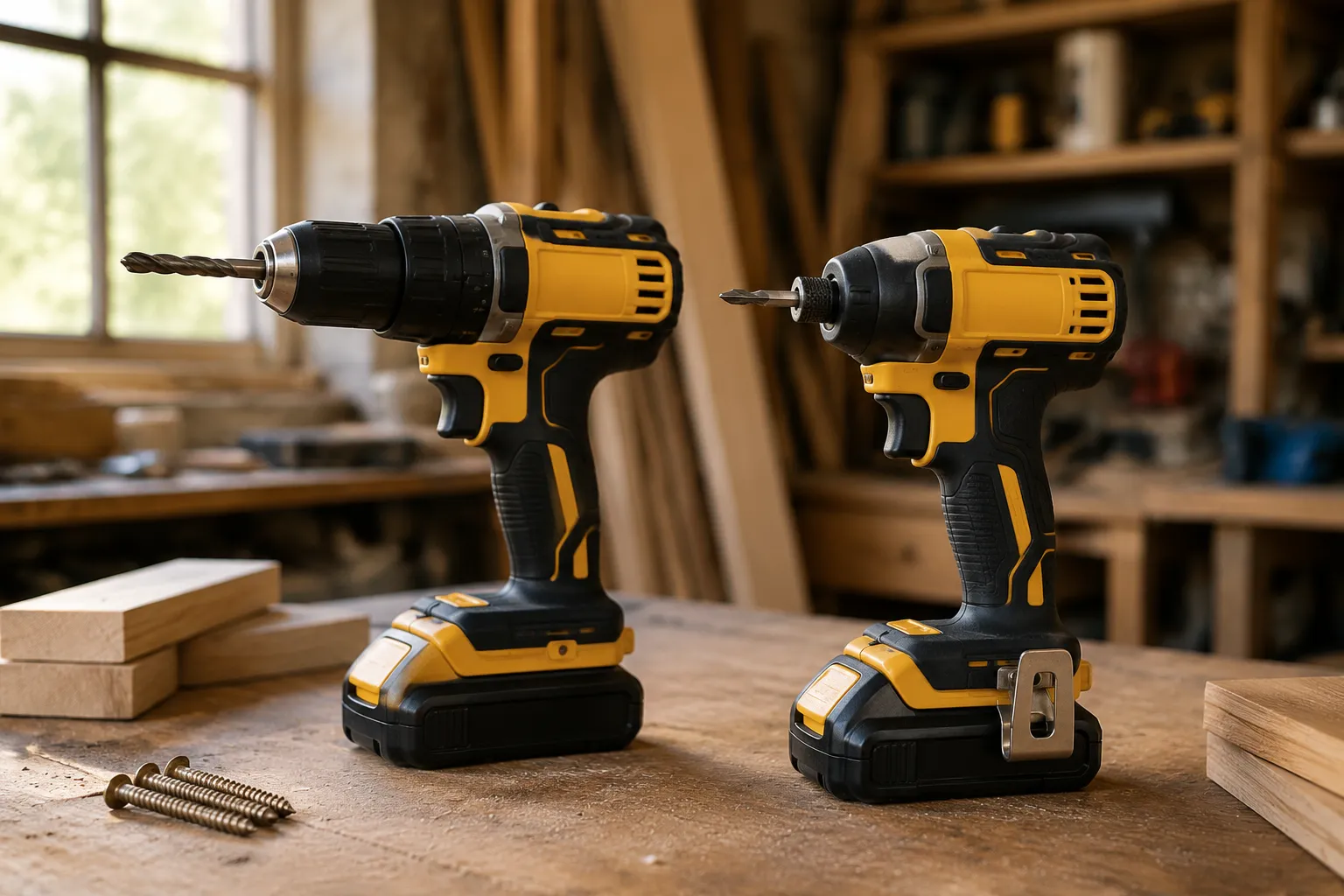
The first power tool most people buy is a drill. That is a shame, because for a huge share of the work a drill gets used for, it is the wrong tool. The impact driver, a cousin that shares the same basic shape and battery system, does those jobs faster and with less strain on the user's wrist. The drill is not obsolete, though. It still does things the driver cannot. The real question is which one belongs in a first toolbox, and the answer depends on what that person actually plans to build.
A drill bores holes. That is its primary talent. It spins a chuck that grips a round bit, and that bit chews through wood, metal, masonry, or plastic. The same spinning action, when fitted with a screwdriver bit, can also drive a screw. This is where the trouble starts. Driving a screw with a drill requires the user to push hard while the tool torques against the hand. When the screw seats fully, the drill kicks hard and can strip the head or snap the bit. An experienced person manages this by feathering the trigger, but it takes practice and a feel for the tool.
An impact driver works on a different principle. It hammers. Inside the tool, a mechanism delivers rapid, concussive blows to the bit, hundreds of times per minute, while the motor spins. This is not a subtle difference. The hammering action drives a screw with far less effort from the user. The tool does not kick back the same way, because the energy goes into the screw, not the wrist. For a long deck screw or a lag bolt, an impact driver will sink it faster and more reliably than a drill ever will.
The two tools are not interchangeable in the way most people assume. A drill is better at making clean holes, especially in metal or masonry, because it offers precise speed control and a chuck that accepts any round shank. An impact driver is better at anything involving screws, bolts, or fasteners. The confusion comes from the fact that both tools can do a bit of the other's job. A drill drives screws poorly. An impact driver drills holes poorly, or not at all, unless a person uses special hex-shank drill bits and accepts the wobble.
The physics of hammering versus spinning
Understanding why the impact driver feels so different starts with mechanics. A drill delivers continuous rotational force, called torque. That torque is highest at low speeds and drops off as the bit spins faster. When a screw encounters resistance, the motor bogs down and the user presses harder. The force builds until the screw breaks loose or the bit twists out of the screw head.
An impact driver stores rotational energy in a spring-loaded mechanism. When resistance builds, the mechanism releases, delivering a sharp rotational blow. This happens many times per second. Each blow is a tiny hammer strike that drives the screw deeper. The user feels a rapid thumping sensation, like a small jackhammer in the hand, but not the twisting kick of a drill. The tool does the heavy work. The hand just guides it.
This hammering action has a side benefit beyond screw driving. The impact mechanism reduces the chance of stripping screw heads. When a screw meets hard wood or a knot, a drill will often spin the bit out of the screw head with a sickening pop. The impact driver delivers its force in short bursts, so the bit stays engaged. The user also does not need to push as hard, which means less fatigue over a long day of assembly.
The trade-off is in the drilling department. An impact driver's hammering action, combined with a collet that only accepts hex-shank bits, makes hole drilling a rougher experience. The bit wanders more, the hole is less clean, and the user has less feel for what the bit is doing. For a pilot hole in soft wood, it works fine. For a clean hole in a cabinet face or a metal bracket, the drill wins every time.
The chuck, the collet, and the bits they accept
Walk into any hardware store and the difference is visible in the nose of each tool. A drill has a three-jaw chuck that opens and closes, gripping round shanks from around 1.5 millimetres up to 13 millimetres. This versatility is why drills are sold as the do-everything tool. Any round bit, any driver, any hole saw with a round arbor, anything with a straight shank. It all fits.
An impact driver has a collet, a hexagonal opening that only accepts bits with a 6.35-millimetre hex shank. This is the same size as standard screwdriver bits, so most driver bits slip right in. But drill bits with round shanks do not fit. A person needs hex-shank drill bits, which are common but less varied. Masonry bits, long augers, and specialty bits often only come with round shanks. This limitation matters more than people think when they are standing in the aisle with a specific hole to drill.
The collet has its own advantage. It is a quick-release mechanism. A person pushes a bit in, and a friction ring holds it. To remove the bit, pull the collar forward and the bit pops out. No chuck key, no spinning the chuck by hand, no fumbling with gloves on. Swapping bits on an impact driver takes under a second. On a drill, it takes several seconds and two hands. For a job that requires alternating between a pilot hole and a screw, this speed adds up.
There is one more hidden feature of the collet that gets overlooked. Because the hex shank locks firmly in place, there is no wobble at the bit tip. A drill chuck, even a good one, has a tiny amount of runout. The impact driver's hex shank seats solidly, which means the screw goes in straighter. This is most noticeable when driving long screws into framing lumber, where a wobbly bit can cause the screw to wander and miss the stud.
What actually happens on a first project
Consider the scenario of a person assembling a flat-pack bookshelf or a basic workbench. The instructions call for drilling pilot holes, then driving screws. With a drill alone, the process is slow. The user drills, switches the chuck, drives a screw, switches back, drills again. The wrist takes a beating over forty screws. With an impact driver alone, the pilot holes are rough but workable in soft wood, and the screw driving is effortless. The honest answer is that the impact driver makes the more common task, driving screws, feel like a joy.
Now consider hanging a curtain rod. The bracket needs screws into a wall stud or into drywall with anchors. The user has to drill a pilot hole into the plaster, then drive the screw. A drill does both, but the pilot hole and the screw are different sizes, so a chuck change is required. An impact driver does the pilot hole with a hex-shank bit, then drives the screw without breaking stride. The only problem arises if the wall is masonry or concrete. The impact driver lacks the raw spinning speed for a clean masonry hole, and a person ends up reaching for a hammer drill anyway.
The first project that truly demands a drill is anything with metal. Drilling through a steel bracket, a metal electrical box, or a piece of aluminum stock requires high speed and steady pressure. The impact driver's hammering action can work, but it produces a rougher hole and wears out bits faster. For cabinet hardware, door hinges, or any visible wood surface, the drill's clean hole is the difference between a professional result and a ragged one.
The deciding test is simple: what will the tool do most often? If the answer is driving screws, which it is for most household repairs, furniture assembly, and basic construction, the impact driver is the better first purchase. If the answer is drilling holes, which it is for anyone mounting things, installing hardware, or working with metal, the drill is the right call. Most people are doing more of the former than they admit.
The battery platform argument
The smartest strategy has little to do with picking one tool. Most major brands sell kits with both the drill and the impact driver, sharing the same batteries, chargers, and bag. This combo kit is frequently the best value in the store. Buying the pair together costs only slightly more than buying the impact driver alone with a battery and charger. The advice to buy one first is really advice for someone on a tight budget who cannot stretch to a two-tool kit.
For someone who insists on buying only one, the impact driver is the more capable tool for the broadest range of tasks. It handles screws of every size, and with hex-shank drill bits it handles light drilling. The drill is better at drilling but worse at driving. Since driving screws is a weekly task in most households and drilling clean holes is a monthly one, the driver wins on frequency. This is the opposite of the default conventional advice, which still pushes the drill as the universal first tool.
The auto manufacturers copy these tools for a reason. Every impact driver sold today is a descendant of the air-powered impact wrenches used in auto shops for decades. The mechanism has been miniaturized and electrified, but the principle is proven. An installer hanging drywall or building a deck will not touch a drill. The impact driver is the professional's choice for one simple reason: it does not exhaust the hand.
The model that does not exist yet
What many people want is a hybrid, a tool with an impact driver's hammering mechanism and a drill's adjustable chuck. Some brands have sold tools called impact drills, which combine a hammer function for masonry with a chuck for round bits. These are not the same thing. They are drills with a forward hammering action for concrete, not rotational impact drivers. The rotational impact driver with a chuck does not exist as a mainstream tool, because the engineering is difficult and the market has settled on two separate tools.
This absence is telling. If a single tool could do both jobs well, manufacturers would have built it. They have not, because the conflict is fundamental. The impact mechanism requires a hex collet for efficient energy transfer, and the chuck adds length and weight that dulls the impact driver's advantages. The market simply accepts that a person needs both tools, which is why the two-tool kit is the standard recommendation from every contractor and every brand.
The real answer to the question of which to buy first is to buy both, but not at once. Start with the impact driver for the screw driving that dominates everyday work. Use hex-shank drill bits for the occasional pilot hole. When a project comes along that demands clean holes in metal or visible wood, buy a drill. The second purchase will cost less, because the batteries and charger already exist from the first kit. The driver is the gateway tool, and the drill is the specialist that fills in the gaps.
A person who starts with the drill will not be stranded. It will bore holes and drive screws, painfully at times, but adequately. A person who starts with the impact driver will be surprised at how effortless the most common tasks become. The thumping sensation of the driver sinking a long screw with no wrist strain is a small but real pleasure. It is the feeling of having bought the right tool for the job, which is a feeling worth chasing.
The last consideration is the cost of a bad decision. A stripped screw head in a finished piece of furniture is a permanent scar. A wall anchor spun loose in drywall leaves a hole that needs patching. These mistakes happen more often with a drill in the hand of someone learning. The impact driver forgives these errors. It hammers through resistance rather than twisting against it. For a beginner, that forgiveness is worth more than the drill's cleaner holes. Buy the driver first, and let the drill come later when its strengths are actually needed.