
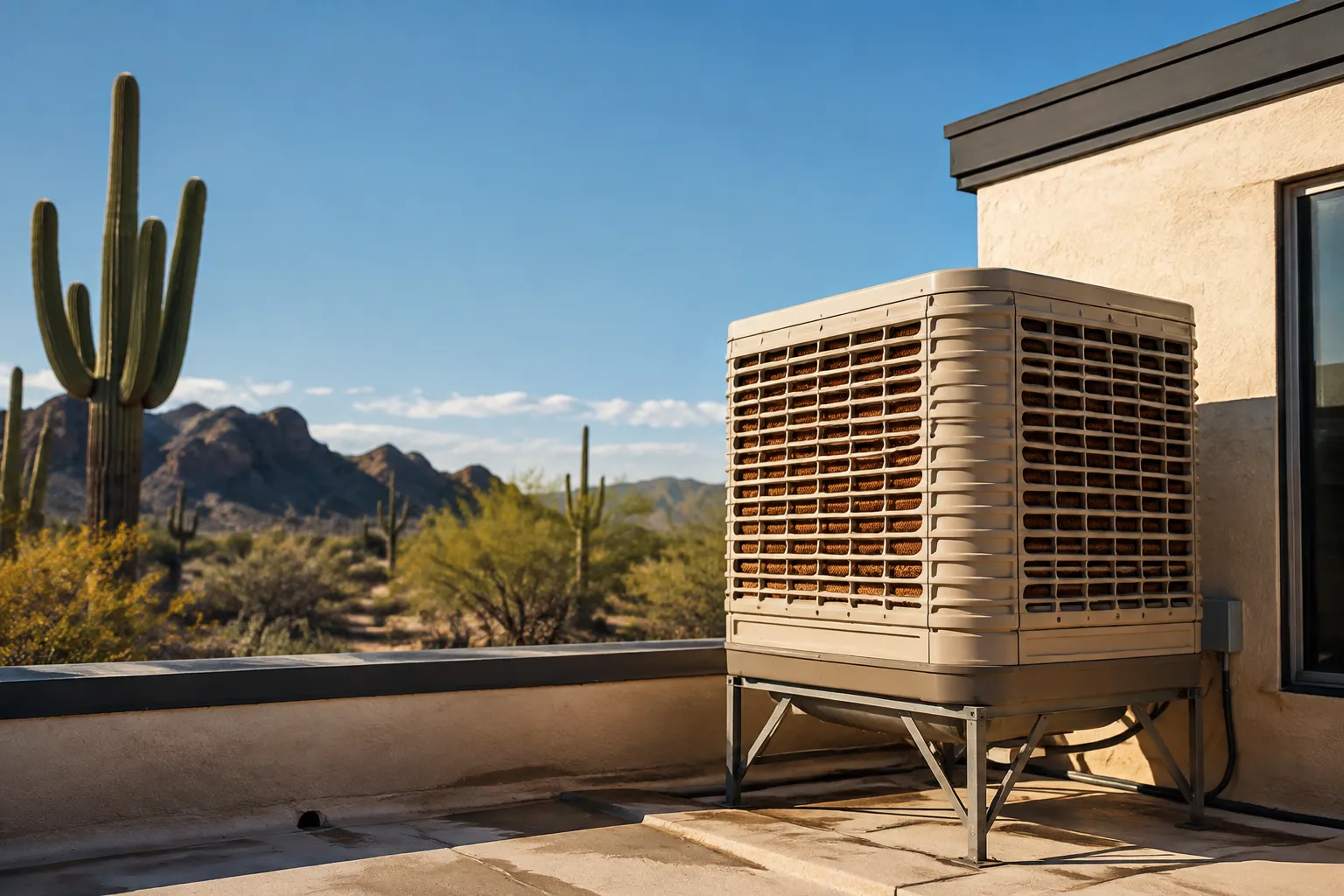
In Phoenix, the monsoon humidity lifts the dew point into the fifties for a few weeks every July, and air conditioners suddenly earn their keep. The rest of the year, the air is so dry that a wet t-shirt thrown over a chair can drop a room's temperature by five degrees. That simple physical fact is why evaporative coolers, often called swamp coolers, remain a stubborn fixture across the American Southwest, the inland West, and the dry plains of Australia and the Middle East. They are not a compromise or a relic. For a substantial portion of the year, they are the most efficient cooling machine a person can own.
The principle is old and almost embarrassingly simple. A fan pulls warm air through a wet pad. The water evaporates, absorbing heat from the air in the process, and the now-cooler air is pushed into the living space. The energy cost is just the fan motor and a small water pump. A whole-house unit typically draws somewhere between 300 and 900 watts, versus the 3,500 to 5,000 watts a central air compressor drinks on a hot afternoon. In a climate where the humidity sits below 30 percent for months at a stretch, that is not a niche efficiency figure. It is a monthly bill difference that covers the unit's purchase price in a single desert summer.
How the Pads Actually Do the Work
The heart of any cooler is the pad, and pad technology has changed more than any other part of the machine in the last twenty years. The old standby is aspen wood shavings, packed into a wire frame. Aspen pads are cheap and genuinely effective at evaporating water, but they are also gluttons. They demand constant water flow to stay saturated, they shed fibers into the air as they age, and they develop mineral crust quickly in hard water. A person who runs an aspen unit every day through a West Texas summer should plan on replacing pads at least twice a season, and the cost adds up.
The modern alternative is the rigid cellulose pad, a honeycomb of impregnated paper with a corrugated structure that forces air to take a zigzag path through the wet material. The geometry matters. The longer the air stays in contact with the wet surface, the more water it can absorb and the lower its temperature drops. A good cellulose pad can push cooling efficiency from the mid-seventies into the high eighties, meaning the air leaving the pad is within ten or twelve degrees of the theoretical wet-bulb limit. They also hold their shape, resist crumbling, and need replacing once a year rather than twice. The upfront cost is steeper, but the annual cost is lower.
The real difference shows up in the water distribution. A well-designed unit drips water from a header across the top of the pad, letting gravity pull it down through the channels. Cheap units use a simple perforated tube that clogs within weeks in any water with measurable hardness. Better units use a wider trough with multiple outlets and a float valve that maintains a small reservoir. Nobody thinks about the reservoir until the float sticks and the unit runs dry, but a stuck float is the single most common failure mode on a cooler that otherwise runs for a decade.
Why Ventilation Is Half the Equation
An evaporative cooler is a once-through machine. It takes fresh outside air, cools it, and pushes it into the house, and that same air has to leave somewhere or the room becomes a swamp. A window cracked three inches is not enough. The rule of thumb for a whole-house unit is one square foot of open vent area for every 300 to 500 CFM of cooler output, and most houses need a dedicated roof vent or a set of windows opened several inches in the rooms farthest from the cooler.
People who complain that swamp coolers make their homes feel damp are almost always running the unit without adequate exhaust. The cooler keeps pumping cooled air in, the humidity climbs, and the evaporation rate slows until the unit is just recirculating damp air. The machine still blows, but it stops cooling. The fix is not a different cooler. It is opening a window in the kitchen and one in the back bedroom, or installing a powered exhaust vent in the ceiling that switches on automatically with the cooler. With proper cross-ventilation, the indoor humidity stays comfortable, the air moves constantly, and the temperature drop is dramatic. A well-ventilated house in Tucson can hold 75 degrees indoors on a 105-degree afternoon.
This ventilation requirement is also the reason evaporative coolers fail in humid climates. When a monsoon storm pushes the dew point above the mid-fifties, the air arriving at the pad is already carrying so much water vapor that evaporation slows to a crawl. The cooler blows air that feels barely cooler than the outside, and the indoor humidity climbs into the range where skin feels sticky and wood starts to swell. That is the moment every swamp cooler owner recognizes: the week or two when the unit is useless and the backup refrigerator compressor or window AC unit gets switched on.
The Mineral Scale Problem and the Bleed-Off Valve
Evaporation leaves everything behind. The dissolved calcium and magnesium in municipal water do not evaporate with the moisture; they deposit on the pads, in the reservoir, and on the heat exchange surfaces of the pump. In areas with hard water, that scale is the reason pads crust over and lose efficiency within weeks. The countermeasure is a bleed-off valve, a small fitting that continuously drains a fraction of the recirculating water and replaces it with fresh supply. A unit with a bleed set to dump ten percent of the flow will go through more water, but the pads will last two or three times longer and the pump will not seize up mid-season.
Water consumption is the hidden operating cost. A large whole-house cooler running full tilt can evaporate fifteen to twenty gallons an hour, and that is water that leaves the property. In a city with tiered water pricing, a summer of daily cooler use can add a noticeable line item to the utility bill. A person in Scottsdale running a cooler eight hours a day will consume somewhere north of 2,500 gallons a month in evaporation alone. That is still dramatically cheaper than the electricity for a central system in most rate structures, but it is a real cost and worth planning around. Some municipalities now restrict cooler water use during drought years, and newer units have controls to shut off the water supply when the fan stops, eliminating the constant drip that older models wasted.
Whole-House Versus Portable Units
The portable evaporative cooler has become a popular item in hardware stores across the West, and most of them are disappointing machines. A portable unit with a 1,200 CFM fan and a decent cellulose pad can cool a single room well enough, but the physics works against it in a way that whole-house units avoid. A portable sits on the floor, pulling air from the same room it is trying to cool, and without a dedicated exhaust, that room gradually becomes the humid air pocket. The unit recirculates the same air, humidity climbs, and cooling fades. A person can crack a window right next to the unit, but then the cooled air leaves almost immediately.
The better portable design is the two-duct model, where the intake draws outside air and the exhaust vents out the window, making it functionally a small whole-house unit. These run roughly double the price of the single-duct versions, but they actually work in the same dry climates. The single-duct portables are best understood as high-powered fans with a mild cooling effect, useful for a garage or a workshop where a person does not expect precise climate control. For a bedroom or a living room, a window-mounted evaporative cooler, essentially a small whole-house unit in a box, is the more honest machine.
The whole-house unit itself comes in two common forms: the down-flow, which sits on the roof and pushes air down through ceiling ducts, and the side-draft, which mounts in a window and blows straight into a room. The side-draft is simpler to install, cheaper, and easier to service, but it is loud and it monopolizes a window. The down-flow is quieter, distributes air more evenly through the house, and keeps the noise outside, but it requires roof access, a reinforced curb, and a professional installation. For a single-story house in a dry climate, the roof unit is the better long-term investment. The side-draft is the right call for a renter or a person cooling one room.
Maintenance That Actually Matters
The annual maintenance routine on an evaporative cooler is short, but skipping it is how units die young. At the end of the season, the water supply should be shut off, the pump removed, and the reservoir drained and scrubbed. The pads should be removed and inspected. If they are cellulose and still hold their shape, they can be hosed off, dried, and stored for next year. If they are aspen, most people just throw them away and buy new ones next April. The pump should be disassembled, the impeller cleaned of scale, and the whole thing stored dry. A pump that sits in stagnant water for six months will seize or corrode, and a replacement pump costs nearly as much as a new unit.
The belt and the bearings on the fan motor deserve a look too. Many whole-house units use a belt drive between the motor and the blower, and a belt that has stretched over a winter will slip and whistle on the first hot day. One minute with a wrench to adjust the tension, and the noise disappears. The motor bearings, if they are the oiled type, take a few drops of light oil through the ports on the housing. Sealed bearings need nothing. A person who spends twenty minutes on this routine in April will almost never call a repairman in July.
The water quality is the variable that determines whether the maintenance is a quick check or a deep clean. A household on a private well with hard water will fight scale all season long, and the bleed-off valve should be set closer to fifteen percent. A household on soft municipal water can run a smaller bleed and stretch pad life considerably. Some people install a whole-house water softener primarily to protect their cooler, and that works, but a simpler option is a small inline filter on the cooler supply line that removes sediment and some scale-forming minerals.
The Hybrid Setup for Monsoon Weeks
The standard advice used to be that a household had to choose between a swamp cooler and a refrigerant system. The smart arrangement in the desert is to run both, and the controls industry has caught up. A modern thermostat can switch between an evaporative cooler and a central AC unit based on the outdoor humidity reading. On a dry 95-degree day, the cooler runs and the electric bill stays flat. When the monsoon pushes the dew point past the mid-fifties, the thermostat locks out the cooler and fires up the compressor.
This dual-system setup is not for everyone, because installing a central AC alongside an existing cooler requires ductwork modifications and a condenser unit, and that is real money. But for a homeowner in a climate with a defined monsoon season, the payback can be surprisingly fast. A central AC that runs only twenty or thirty days a year, instead of ninety, will last more than twice as long. The cooler handles the long dry stretch, and the compressor only bites during the muggy spells and the few weeks of extreme heat where the cooler simply cannot keep up because the air is too warm and too wet.
The other hybrid approach is simpler and cheaper: keep the evaporative cooler for the living room and the kitchen, and put a single high-efficiency mini-split in the bedroom. The cooler keeps the main living spaces comfortable in the dry heat, and the mini-split handles the bedroom during the few muggy nights when the cooler cannot get the air dry enough to sleep well. This is the most common arrangement in older Phoenix and El Paso neighborhoods, and it is a sensible way to get the efficiency benefit of evaporation without surrendering comfort on the worst nights of the year.
Reading the Humidity Before You Buy
The decision to buy an evaporative cooler should start with a wet-bulb calculation, not a trip to the hardware store. The wet-bulb temperature is the lowest point to which evaporative cooling can bring the air, and it is determined entirely by the moisture content of the outside air. A person can look up their local average afternoon humidity on a summer day, plot it against the average high temperature, and get a rough idea of whether a cooler will deliver 10 degrees of relief or 25. The rule of thumb: if the average summer afternoon dew point is below 50 degrees Fahrenheit, a swamp cooler will work well. Above 55, it becomes a fan with extra steps.
The second number to know is the cubic footage of the space to be cooled. A unit is rated in CFM, cubic feet per minute of air movement, and the industry guidance is roughly one air change per minute for a living space. A 20-by-15-foot room with ten-foot ceilings is 3,000 cubic feet, so a portable unit that pushes 1,200 CFM will manage about 24 air changes per hour, which is plenty. A whole house with 18,000 cubic feet of living space needs a unit in the 4,000 to 5,000 CFM range. Undersizing is the most common mistake. An undersized unit runs constantly, never quite reaches temperature, and the owner concludes the technology does not work.
The final consideration is the water supply itself. A cooler on a well with high iron or sulfur will stain pads brown and smell like rotten eggs when the season starts. A cooler on a municipal supply with heavy chlorination will degrade cellulose pads faster. The fix is simple, a carbon filter on the supply line handles chlorine, and an iron filter handles the well water, but it is a cost that should be budgeted. The water quality determines the pad life more than any other factor, and pad replacement is the recurring expense that separates a cheap cooling season from a costly one.
On a dry June afternoon in the high desert, when the relative humidity sits at 14 percent and the temperature pushes past 100, a well-maintained evaporative cooler turns that desert air into a stream of 72-degree air for the cost of a few light bulbs. The technology is older than the compressor, simpler than a heat pump, and for the right climate, it remains the most practical cooling machine a person can own. The pads will crust, the float will stick, and the monsoon will make it useless for a week or two, but the monthly electric bill tells the real story. A swamp cooler does not just cool the air. It makes the dry heat itself do the work.