
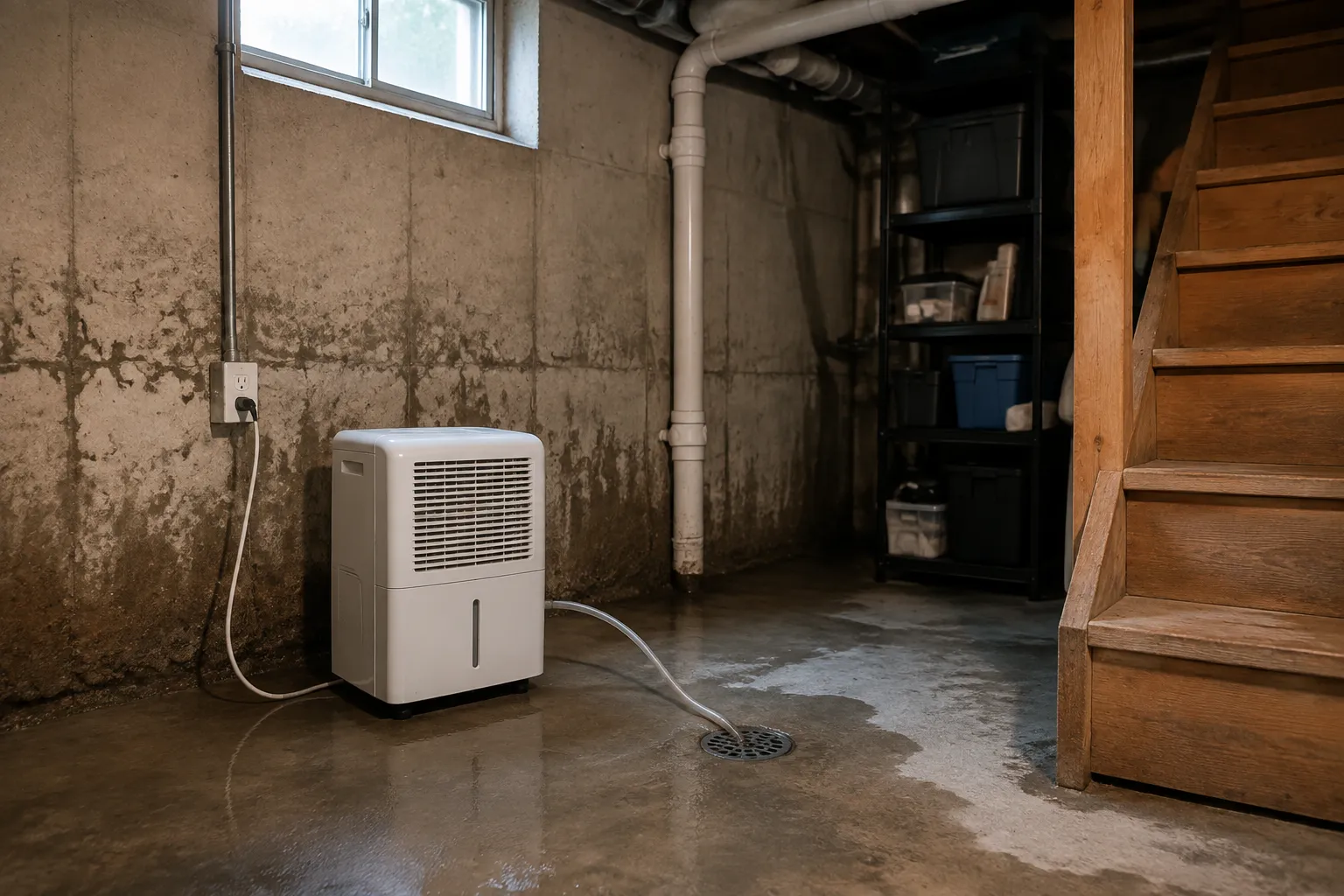
The basement air in summer reads about 70 percent relative humidity before a person even opens the door. The smell arrives first, a musty weight that settles in the sinuses. Then the concrete walls show their sweat in beads. A dehumidifier gets installed, the bucket fills, and most homeowners assume the problem is solved. It rarely is, because the machine is only half the system. The other half is everything a person does before plugging the unit in, and the way the machine gets treated after that first empty of the bucket.
Moisture in a basement is not one problem. It is three separate problems stacked on top of each other. There is liquid water pushing through the slab and the wall-floor joint. There is damp air migrating from outside through vents and cracks. There is the air already trapped inside, loaded with moisture from a dryer vent or a bare earth floor or a poorly sealed crawl space. A dehumidifier only handles the third category. A person who runs the unit while ignoring the other two is paying the electric bill to process water that should have been stopped at the source.
The machine works harder than it should
The first mistake is treating the dehumidifier like a furnace, something to set and forget. The typical unit pulls a specified number of pints per day at a given temperature and humidity, and that rating is measured in ideal conditions, usually at 80 degrees and 60 percent humidity. A basement sits cooler than that, often in the mid-60s through the summer. At lower temperatures, the coils frost up more easily and the extraction rate drops. A 50-pint unit in a 65-degree basement is realistically pulling maybe 35 to 40 pints a day. That gap matters when sizing the unit for the space.
Most basements need more capacity than the homeowner expects. The rule of thumb for a damp basement, not a wet one, is about 10 pints per 500 square feet. A 1,500-square-foot finished basement needs a 30-pint unit at minimum, and a 50-pint unit is the better call because it cycles less often and pulls the air down faster. The mistake is buying the cheap 20-pint model because it fits the budget. That undersized unit runs continuously, never reaches the target humidity, and burns more electricity than the larger unit would have used cycling on and off.
The bigger mistake is where the unit gets placed. People push it against a wall, out of the way, near the stairs. The dehumidifier needs airflow on all sides, particularly at the intake and the exhaust. A unit shoved into a corner recirculates its own dry exhaust into its own intake and effectively strangles itself. The ideal spot is roughly in the middle of the open area, at least six inches off the wall, with nothing blocking the front grille. That seems obvious until a person looks at how most basements are actually arranged, with storage bins and old furniture pushed against every wall.
The drain line is the real upgrade
The bucket is a trap. It fills up, the unit shuts off, and the humidity climbs back up. A homeowner who empties the bucket every day is managing the machine instead of managing the basement. The solution is a gravity drain line, a simple vinyl hose that runs from the unit's built-in drain port to a floor drain or a sump pit. That requires the unit to be elevated on a stand or a sturdy table so the hose has a downward slope. The elevation also improves airflow to the intake, so the unit runs more efficiently. Two birds, one piece of furniture.
When no floor drain exists, a condensate pump becomes necessary. These small pumps attach to the dehumidifier, collect the water in a tiny reservoir, and push it upward through a hose to a sink or a window. They add cost and one more mechanical part to fail, but they turn the dehumidifier into a genuinely set-and-forget appliance. The alternative is the cheap trick of running the hose into a 5-gallon bucket and checking it every other day, which is barely better than the built-in bucket and honestly worse, because the larger container makes a person forget about it longer.
The drain hose itself needs attention. A clear vinyl hose, 3/8-inch or 1/2-inch inside diameter, works fine. The problems start when the hose dips or kinks. Water pools in the low spot, algae grows, and the line clogs within a month. The fix is to run the hose as straight as possible, support it so it does not sag, and flush it with a little white vinegar every few weeks. That vinegar flush also prevents the slime that builds up in the unit's internal drainage channel, which is a common source of the musty smell that persists even after the air gets drier.
The humidity target is a number, not a guess
The built-in hygrometer on most dehumidifiers reads relative humidity, and the default setting is usually around 50 percent. That is too high for a basement. A finished basement with drywall and furniture should sit between 40 and 45 percent in the summer. An unfinished basement can run a bit higher, around 45 to 50 percent, because the concrete and exposed framing tolerate moisture better than finished materials. The number matters because mold and mildew start thriving above 60 percent, and dust mites, the allergy trigger that hides in carpets and upholstery, need above 50 percent to reproduce.
A person should verify the machine's reading with a separate hygrometer, because the built-in sensors drift. A cheap digital hygrometer, placed away from the dehumidifier's exhaust, costs about ten dollars and provides a second opinion. The discrepancy between the two readings can be 10 percentage points, and the machine might be working hard to reach a target it has already achieved. Calibration happens by placing the hygrometer next to the unit's sensor for a day, then adjusting the unit to match. That is a five-minute task that saves weeks of unnecessary running.
The set point should also change with the seasons. In winter, the basement naturally drops to 30 or 35 percent, and the dehumidifier should be turned off entirely. Running it in winter wastes energy and dries the air so much that wood framing and floors can develop cracks. The exception is a basement with a water problem that persists year-round, which means the source issue has not been fixed. The machine should run seasonally, not perpetually, and the drain line should be disconnected and flushed before the unit goes into storage for the cold months.
Filter cleaning is the maintenance people skip
The air filter on a dehumidifier sits behind the front grille and traps dust and lint. A clogged filter reduces airflow, which makes the coils frost up faster and cuts the extraction rate dramatically. The manufacturer recommends cleaning it every two weeks during heavy use. Most people clean it twice a season, if that. The filter slides out, gets rinsed under warm water, and dries in an hour. It is the single easiest maintenance task on the machine and the one most commonly ignored. A filthy filter is also a fire hazard in the worst case, because the compressor runs hotter when airflow drops.
The coils themselves need an annual cleaning. Dust accumulates on the aluminum fins and reduces heat exchange. A soft brush attachment on a vacuum cleaner handles the surface dust. A deeper clean with a commercial coil cleaner, the kind used on refrigerator coils, requires spraying the foam and rinsing it carefully. This is a 30-minute job done once a year, usually in the spring before the humid season starts. The payoff is a machine that pulls water at its rated capacity instead of operating at 70 percent efficiency while the owner wonders why the basement still feels sticky.
The source problems make the machine pointless
Here is the part most articles skip. A dehumidifier in a basement with active water intrusion is like a person mopping a floor while the faucet runs. The first inspection should be outside the house. Downspouts need to dump water at least six feet away from the foundation. The ground should slope away from the house for the first ten feet. Gutters need to be clean and free-flowing. These three fixes solve more basement humidity than any dehumidifier ever will, and they cost almost nothing beyond elbow grease.
Inside the basement, the check is simpler. Any damp spot on the wall or floor indicates a source that needs sealing or draining. A dehumidifier will pull the moisture out of the air, but it will not stop the water from damaging the wall over time. Hydraulic cement patches cracks in the slab. A vapor barrier, a heavy plastic sheet, covers a bare earth crawl space and stops the constant evaporation of groundwater into the basement air. These are not glamorous upgrades, but they reduce the load on the dehumidifier so dramatically that the machine starts cycling instead of running continuously.
One more source problem hides in plain sight: the dryer. A dryer vent that exhausts humid air into the basement instead of outside turns the dehumidifier into a futile appliance. The same goes for a bathroom fan that vents into a crawl space. These are code violations in most areas, but they happen, especially in older houses with amateur renovations. The fix is rerouting the vent to the outside through the rim joist. That single change can cut basement humidity by 15 to 20 percentage points.
The operating temperature changes everything
Dehumidifiers lose efficiency as the temperature drops. Below 65 degrees, the extraction rate falls off noticeably. Below 60 degrees, many units frost up and shut down on their own defrost cycle, cycling on and off without pulling much water. This is why a basement that stays cool in the summer might frustrate a homeowner who sees the machine running constantly but the bucket barely filling. The solution is either a low-temperature unit designed for cold basements, or warming the space slightly, or accepting that the dehumidifier will not work well below a certain temperature and addressing the moisture issue another way.
Many modern units come with a built-in humidistat that lets the machine run until it reaches the target, then shut off. That feature gets disabled when frost forms, because the unit needs to defrost. A person watching a unit cycle every ten minutes during a cool wet spring might assume it is broken. It is not. It is fighting the physics of cold air, which holds less moisture but also makes extraction harder. The workaround is to raise the set point slightly, to 50 percent, and accept that the basement will be comfortable enough even if the number is not perfect.
There is also the question of whether the unit is actually pulling water at all on cool days. A quick test involves placing the machine on a flat surface, setting it to continuous mode, and checking the bucket after two hours. At 60 degrees and 70 percent humidity, a 50-pint unit might pull only a cup of water in that time. That is normal. The moisture is there, but the extraction is slow. This is the point where a person decides whether to invest in a low-temperature unit, which uses a different compressor design and costs significantly more, or to address the underlying moisture source instead.
The last ten percent is the hardest
After the source problems are fixed, the drain line is connected, and the filter is clean, the basement humidity might sit at 52 percent. The dehumidifier runs less often but the last few percentage points are stubborn. This is where the machine's placement and the basement's layout start to matter. A closed-off room attached to the main basement space will stay damp because the dehumidifier cannot move air through the doorway effectively. A small fan placed in the doorway, pushing dry air into that room, solves the problem for the price of a few watts.
The same principle applies to the whole basement. The dehumidifier creates a dry zone around itself, maybe a 10-foot radius, and the rest of the space stays damper. A single unit in a large open basement might not be enough. In that case, the answer is either a second, smaller unit at the far end of the space, or a circulating fan to mix the air. The fan moves the dry air around, but it also moves the wet air toward the dehumidifier intake, which speeds up the drying process. A cheap box fan on low, placed opposite the dehumidifier, does more for overall comfort than buying a bigger unit.
The finished product, after all this work, is a basement that smells like clean concrete instead of old towels. The air feels lighter. A person can stand in the middle of the room without that prickly sensation on the skin. The dehumidifier cycles on for fifteen minutes, runs quietly, and shuts off. That rhythm, the off time, is the real indicator. A unit that never shuts off is a unit that is outmatched or misconfigured. A unit that cycles means the system is balanced. That is the goal, not a specific brand or a higher pint rating, but a machine that earns its rest.