
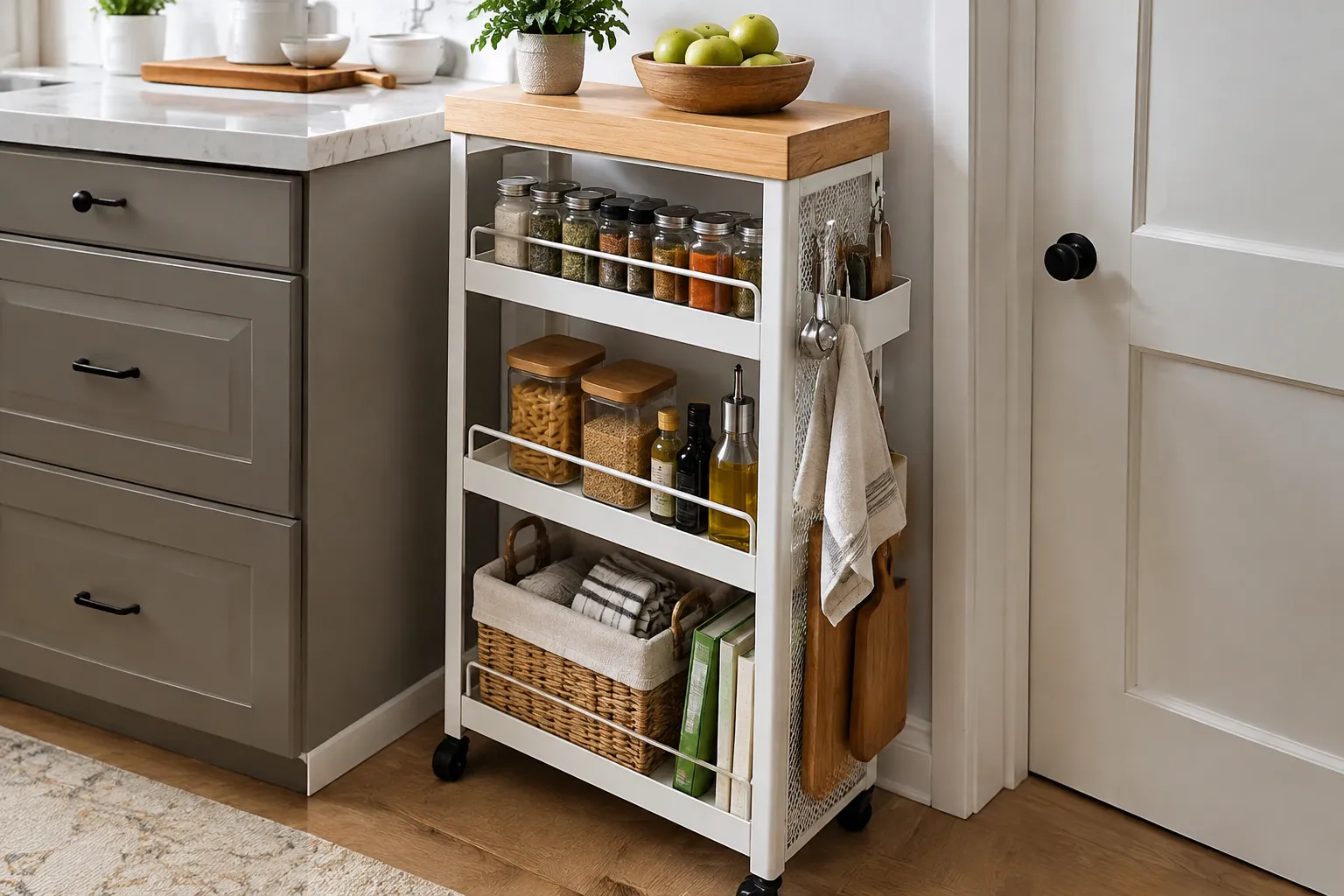
The kitchen cart occupies a strange middle ground in the world of small-space storage. It is not a built-in, so it lacks the permanence of cabinetry. It is not a piece of furniture in the traditional sense, so it rarely gets the design attention of a sideboard or a hutch. Most people buy one, roll it into a corner, and let it become a dumping ground for whatever does not fit anywhere else. That is a waste, because the cart is actually the most flexible storage unit a tight kitchen can have. It moves. It has multiple levels. It does not require demolition or a contractor. The problem is not the cart. The problem is that nobody gives it a job.
A cart with no assigned purpose will accumulate junk. A cart with a specific, narrow purpose becomes an extension of the kitchen itself, a piece of equipment rather than a catch-all. The distinction matters more than the number of shelves or the material of the top. Before thinking about baskets or hooks or labels, the owner has to decide what this cart is for. That decision drives everything else.
The Coffee and Tea Station That Stays Put
The most successful use of a kitchen cart in a small space is also the most obvious one, which is why so many people overlook it. A dedicated beverage station removes the kettle, the coffee maker, the grinder, the canisters, and the mugs from the main counter. That clears two to three feet of precious workspace. The cart takes the hit instead.
The key is to treat the cart like a piece of commercial equipment, not a display shelf. That means everything on it must be used within a twenty-four-hour cycle. The coffee maker sits on the top level, plugged in and ready. The beans live in a sealed canister on the middle shelf, right next to the grinder. Mugs hang from hooks screwed into the side of the cart, if the cart has a solid side panel, or sit in a wire rack on the lower shelf. A small trash bin hangs off one end for used grounds and tea bags.
This arrangement works because it respects the cart's mobility. On a normal morning, the cart stays parked near the sink for easy water access. During a dinner party, it rolls six feet to the dining area and becomes a self-serve bar. The owner is not carrying mugs across the room one at a time. The whole station travels.
The common mistake is treating the beverage station as a permanent installation. People bolt it into a corner, run the cord behind the cabinets, and never move it again. That defeats the purpose. A cart that cannot roll has no advantage over a shelf. The mobility is the entire point.
Vertical Storage for the Awkward Stuff
Every kitchen has a category of items that do not stack well and do not fit in drawers. Cutting boards, sheet pans, cooling racks, and large serving platters are the usual offenders. They are flat, wide, and frustrating. They slide around in lower cabinets, and pulling one out means pulling out everything in front of it.
A kitchen cart can solve this if the owner is willing to think vertically. The open sides of most carts, the space between the top and the first shelf, can hold a file organizer or a deep wire basket turned on its side. Cutting boards slide into the slots like records in a crate. Sheet pans stand upright, wedged between the cart's legs and a tension rod installed across the back. This turns dead airspace into the most functional storage in the kitchen.
The same principle applies to the bottom shelf, the one closest to the floor that everyone ignores because it requires bending over. This is prime real estate for heavy, infrequently used items: the stand mixer, the food processor, the Dutch oven. Putting these on the cart's lowest level gets them off the counter and out of the lower cabinets, but it also keeps them accessible. The cart rolls out from under the counter, the owner kneels, and the heavy item is right there at floor level. No more digging through a dark cabinet with both arms.
The Produce and Root Vegetable System
Potatoes, onions, and garlic do not belong in the refrigerator. They last longer in a cool, dark, ventilated place, and most small kitchens do not have a pantry that qualifies. A kitchen cart can become that place, but only if it is positioned correctly. It needs to sit away from the stove and the dishwasher, where heat and steam will shorten the shelf life of everything stored on it.
The best setup uses wire baskets, not solid bins. Airflow is the whole game with root vegetables. A stack of metal or coated wire baskets on the cart's shelves allows air to circulate around the onions and potatoes. A person can see what is left at a glance, which means fewer forgotten sprouting onions at the bottom of a bag.
This system has a rhythm to it. The top shelf holds the fruit that ripens on the counter, the bananas and tomatoes that should not be refrigerated. The middle shelf holds the onions and shallots. The bottom basket holds the potatoes and sweet potatoes. The cart rolls close to the prep area when a person is cooking, then rolls back to its spot against the wall.
The downside is real. A cart full of produce takes up floor space that a person might want for a trash can or a step stool. But for a cook who buys in bulk, the trade is worth it. The produce lasts twice as long, and the counter stays clear.
The Rolling Prep Station for Small Counters
Some kitchens have counters so small that there is no place to chop vegetables and cook at the same time. The cutting board takes up the entire workspace, and the skillet has nowhere to go. This is the situation where a cart earns its keep as a prep table, not a storage unit.
The cart needs a butcher-block top or a solid wood surface for this job. A marble or stainless top is fine for pastry work, but for daily chopping, wood is the forgiving surface that will not dull a knife as quickly. The cart rolls up next to the main counter, creating an L-shaped workspace. The cutting board goes on the cart. The stove and the sink stay free.
The shelves below the prep surface hold the tools of the current meal, not the entire kitchen inventory. A sheet pan with the prepped vegetables, a bowl for scraps, the oil and salt within reach. When the meal is done, the cart rolls back to its resting spot, and the prep surface becomes a landing zone for the mail or a plant. The double duty is what makes it work in a tight space.
One practical note: a prep cart with casters will roll slightly when a person bears down with a knife or a rolling pin. The fix is cheap and instant. Two locking casters on the cart, or a small rubber wedge under one wheel, stops the movement. A person should test this before buying a cart, not after, because some carts have flimsy wheels that wobble under pressure.
The Microwave Tower That Frees the Counter
A countertop microwave eats an enormous amount of space. In a small kitchen, that one appliance can consume a quarter of the available work surface. Moving it to a cart gives the counter back and solves a second problem at the same time.
The cart needs a lower shelf rated for the weight of the microwave, and it needs to be positioned near an outlet. The microwave sits on the middle shelf, leaving the top of the cart free for a toaster, a knife block, or a coffee maker. This stacks the appliances vertically instead of spreading them out horizontally.
The height matters more than most people expect. A microwave on a middle shelf sits at chest level instead of counter level, which makes it easier to see inside and harder for small children to reach. The cart can also roll closer to the dining table, so a person can plate food directly from the microwave without carrying hot dishes across the kitchen.
The safety consideration is straightforward. The cart should not wobble, and the microwave should sit flush on a flat surface. The cord should not drape across a burner or a walkway. These are common sense, but they are worth stating because a rolling cart with a heavy appliance on it can become a hazard if the wheels are not locked.
The Narrow Cart for the Gap Between Counter and Wall
Most kitchens have a gap somewhere, a space between the counter and the wall or between the refrigerator and the cabinet that is too wide to ignore and too narrow for standard storage. These gaps are usually six to twelve inches wide. They look useless. They are not.
A slim rolling cart, the kind with three or four narrow shelves, slides into these gaps and turns them into pantry space. It holds canned goods, spices, oils, and vinegars. The shelves are shallow, so nothing gets lost in the back. The cart rolls out for access, then slides back in, disappearing into the gap when not in use.
The specific advantage of this cart is that it does not compete with anything. It uses space that was already wasted. A person does not have to sacrifice a single inch of existing storage to add it. The only requirement is that the cart is narrow enough to fit the gap and tall enough to clear the counter overhang, if there is one.
These slim carts are not built for heavy loads. The wheels are small and the frame is light. They are best suited for jars and bottles, not for a stand mixer or a stack of cast iron. Keeping the load light preserves the cart's ability to roll in and out of the gap smoothly.
The Cleaning Supply Cart That Leaves the Kitchen
Kitchen carts do not have to stay in the kitchen. The ones with a handle and sturdy wheels can travel to other rooms, and that mobility solves a storage problem that no fixed cabinet can address.
A cart loaded with cleaning supplies, rags, sponges, and a small bucket can roll from the kitchen to the bathroom to the living room as a person cleans the house. It consolidates a dozen half-used bottles that would otherwise live under three different sinks. The top of the cart holds the spray bottle in current use. The shelves hold the backups and the rags.
This works best in a small apartment where a person does not want to walk back and forth to the kitchen a dozen times during a cleaning session. The cart comes to the room, does its job, and rolls back to its corner. It also keeps cleaning chemicals out of reach of small children, provided the cart has a locking mechanism or is stored in a closet.
The same principle applies to a laundry cart. A cart with a basket or a removable bin can collect dirty clothes from each room, then roll to the washer. In a small apartment with a stacked washer-dryer unit, this eliminates the need to carry armloads of laundry across the living space.
What to Skip and What to Attach
Not every cart accessory is worth the money. The clip-on paper towel holders that attach to the side of a cart are useful, but they ocassionally wobble and drop the roll. The hanging baskets that hook over a shelf edge are better, since they add storage without taking up shelf space. The magnetic strips for knife storage, if the cart has a metal side, are genuinely brilliant for freeing up drawer space.
Skip the carts with built-in cutting boards that slide out from under the top. The slide mechanism is the first thing to break, and the board is usually too thin to chop on properly. Skip the carts with wine glass racks unless the owner actually drinks wine at the cart. These features add cost and complexity to a piece of furniture whose main virtue is simplicity.
What deserves the investment is a good set of locking casters. Most carts come with wheels that lock only the swivel function, not the rolling function. Replacing them with casters that lock both costs under twenty dollars and makes the cart feel like a different piece of equipment. A cart that stays put when a person leans on it and rolls smoothly when pushed is a joy. A cart that drifts and wobbles is a nuisance.
The other worthwhile upgrade is a strip of thin rubber drawer liner cut to fit each shelf. It costs a few dollars and stops cans and jars from sliding around when the cart rolls. It also protects the shelf surface from scratches. This single addition makes the cart feel infinitely more stable.
A kitchen cart is not a place to store things. It is a tool for changing the shape of a kitchen. A person who treats it as a movable workstation, station, or pantry will find that it multiplies the usable space of a small room. A person who treats it as a shelf on wheels will find that it collects dust and clutter. The cart does not care which. It just rolls.