The most reliable way to ruin a batch of bread is not a bad oven or a cold kitchen. It is a measuring cup. A person can follow a recipe with total discipline, level off every scoop of flour with a knife, and still produce a dough that is too stiff or a loaf that never rises. The fault is not in the baker. The fault is in the system of measurement. Volume is a guess. Weight is a fact.
Professional bakers have known this for generations. Pastry chefs weigh everything from eggs to cocoa powder, and they do it for a simple reason: it works. The home baker has been slower to adopt the scale, partly out of habit, partly because cups and spoons are so deeply embedded in cookbook culture. But the gap between a mediocre cake and a truly good one is often just a few grams. A digital scale closes that gap faster than any other single piece of equipment in the kitchen.
The argument for weighing is not about precision for its own sake. It is about consistency. Flour is the most obvious culprit. A cup of all-purpose flour can weigh anywhere from 110 to 160 grams depending on how it was scooped, how long it sat in the bag, and how humid the air is. That is a 45 percent swing. No recipe can survive that kind of variation and still produce the same result every time. A scale eliminates the variable entirely.
The Real Problem With a Cup of Flour
Flour settles. It compresses in storage, and a bag that has been sitting in the pantry for two weeks will pack more tightly into a cup than a freshly opened one. The same measuring cup, filled with the same brand of flour, can deliver dramatically different weights depending on the day. This is not a matter of skill. It is physics.
The standard advice is to spoon flour into a cup and level it off, which assumes a gentle touch and a light hand. But even a careful person will get a different result at 9 in the morning than at 9 at night, simply because the flour has absorbed moisture from the air throughout the day. A recipe written by someone who weighs their ingredients is a recipe that contains no such hidden variables.
Consider a simple sponge cake. The ratio of flour to liquid determines whether the crumb is tender or tough. A difference of twenty grams of flour, the amount that sneaks into a cup through a heavy scoop, can turn a light cake into a dense one. The baker who weighs the flour will get the same cake every time. The baker who scoops will get a different cake each time, and never know why.
How Weight Changes the Math of a Recipe
Baking is a ratio game. The proportion of water to flour, fat to sugar, egg to liquid, all of it determines the structure of the final product. A recipe that lists weights makes those ratios visible. A recipe that lists cups and spoons hides them. This is why so many cookbooks from serious bakeries and pastry shops include weights even when they also print volume measurements. The weight is the truth. The cup is a convenience for people who do not yet own a scale.
Once a baker starts weighing, the underlying logic of recipes becomes obvious. A 2:1 ratio of flour to water is a stiff dough. A 5:3 ratio is a wet one. These relationships are impossible to see when a recipe says "three cups of flour and one and a half cups of water," because those cups do not represent the same kind of measurement. A cup of water always weighs 240 grams. A cup of flour does not. The volume system compares apples to oranges while pretending they are the same fruit.
The scale also simplifies scaling. Doubling a recipe with cups means doubling every scoop, every pinch, every half-teaspoon. Doubling a recipe with weights means multiplying a few numbers and measuring each ingredient once. Halving a recipe becomes equally trivial. A person who bakes for a crowd, or bakes just for themselves, gains a flexibility that volume simply cannot offer.
The Speed of Weighing Versus Scooping
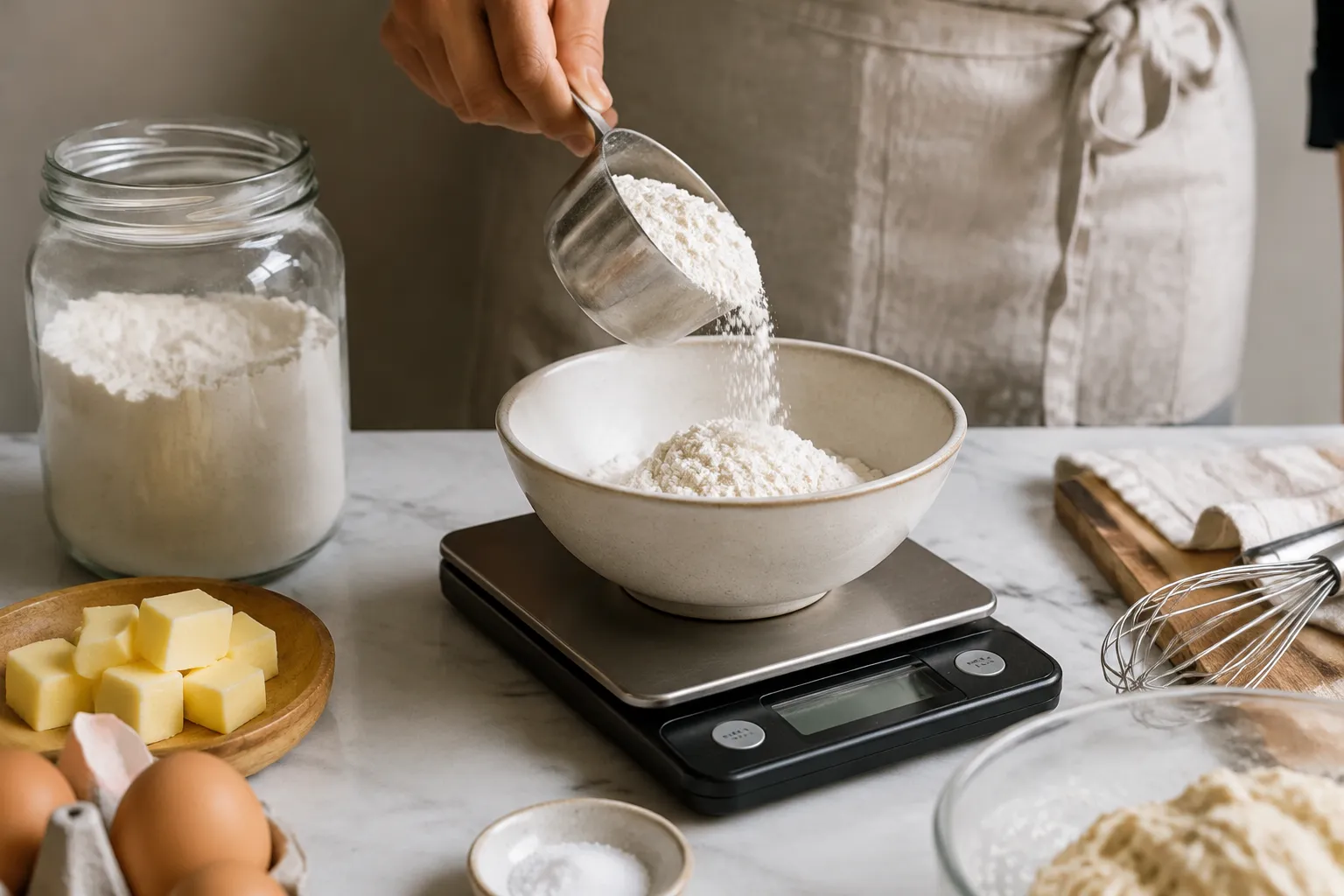
There is a common assumption that weighing takes longer. It does not. A person can set a bowl on the scale, zero it out, add flour until the number reads the target, then zero it again for the next ingredient. That entire process takes less time than finding the right measuring cup, filling it, leveling it, and shaking out the excess. And it leaves fewer dishes.
This is the quiet advantage of the tare function. Zeroing the scale between ingredients turns the whole mixing bowl into a single measuring vessel. Butter goes in first, then sugar, then eggs, then flour. The baker never touches a second container. The cleanup is shorter, the counter stays cleaner, and the recipe moves faster from start to oven.
For sticky ingredients the scale is an even bigger win. Molasses, honey, peanut butter, all of them cling to measuring cups and refuse to let go. The volume printed on the side of the cup rarely matches what actually ends up in the bowl. Weighing these ingredients directly into the mixing bowl eliminates the guesswork and the waste. A recipe that calls for 340 grams of honey simply gets 340 grams of honey, not 340 grams minus whatever stuck to the inside of a glass cup.
What a Scale Does Not Fix
Honesty requires a caveat. A scale will not save a bad recipe. It will not fix an oven that runs 50 degrees hot. It will not make stale baking powder behave like fresh. Some baking failures have nothing to do with measurement, and a person who blames their tools will keep blaming them long after the real problems remain unsolved.
The other limitation is that not every cookbook uses weights. Many home-oriented recipes, especially older ones, list only cups and spoons. Converting those recipes to weights requires a reference table and a little judgment, because not every ingredient has a standard conversion. A cup of chopped walnuts weighs something different than a cup of walnut halves. A cup of grated cheese depends on how finely it was grated. The scale is only as useful as the recipe's willingness to speak its language.
But the trend is moving in one direction. More and more cookbooks, even those aimed at beginners, include grams alongside cups. Baking blogs post weight-based versions of their recipes. Serious Eats, King Arthur Baking, and nearly every pastry chef with a public platform have been pushing the same message for years. The home baker who adopts a scale today is not adopting a niche technique. They are catching up to the standard.
The Cost of Entry Is Almost Nothing
A decent digital scale costs less than a good cast-iron skillet. A twenty-dollar scale with a 5-kilogram capacity and 1-gram resolution is enough for nearly all home baking. The cheap ones are accurate enough for bread, cookies, and cakes. They might drift slightly at the edges of their capacity, but they handle the everyday range of 10 to 500 grams with repeatable precision.
The scale does not need to be fancy. It does not need Bluetooth, a built-in timer, or an app. The features that matter are a flat surface, a readable display, and a tare button that works instantly. Everything else is decoration. A person who buys the cheapest scale on the shelf and uses it for every batch of cookies will see more improvement in their baking than a person who buys a premium stand mixer and keeps measuring flour with a cup.
There is also a durability argument. A scale is a simple device with no moving parts and nothing to sharpen or replace. It will last for years, and the only maintenance required is changing the battery every twelve months or so. The same cannot be said for a set of measuring cups, which get scratched, warped, and eventually lose their accuracy, or a measuring spoon that bends in the dishwasher.
Rethinking the Way Recipes Are Read
The deeper shift is mental. A baker who weighs ingredients starts to read recipes differently. The numbers take on meaning. A recipe that calls for 500 grams of bread flour and 350 grams of water is immediately recognizable as a 70 percent hydration dough, a wet dough that will produce an open crumb and a chewy crust. A recipe that calls for 100 grams of sugar and 100 grams of butter is instantly understood as a 1:1 ratio, a shortbread-like base that will be tender and slightly crumbly.
This understanding is what separates a cook who follows instructions from a baker who understands the craft. Weight-based recipes teach the underlying grammar. Volume-based recipes only teach the vocabulary. A person who bakes from weights for a few months will start to predict how a dough will feel before they even touch it. They will know when a recipe is poorly balanced. They will catch typos that would have ruined a batch.
None of that is mystical. It is just the difference between measuring with a constant unit and measuring with a variable one. The scale gives a baker a shared language with every other baker in the world, because a gram is a gram in Paris, in Chicago, and in a tiny apartment kitchen at midnight. The same cannot be said for a cup.
The First Week of Weighing Everything
The transition does not require a full kitchen overhaul. A person can keep the measuring cups in the drawer and simply stop using them. The first week will feel slightly awkward. The scale sits on the counter, the bowl goes on top, and the baker must remember to zero out between ingredients. It is a new rhythm, and new rhythms always feel slow at first.
By the second week, the rhythm becomes automatic. The baker stops reaching for the cup. They start trusting the numbers on the display more than the markings on a glass container. The third week brings the first real confirmation: a batch of cookies that tastes identical to the last batch, same texture, same spread, same browning. That consistency is the reward.
The first failure is the true test. A beginner who makes a dense cake with a scale might assume the scale failed them. It did not. The scale did exactly what scales do: it measured the ingredients honestly. The failure was in the recipe, the technique, or the oven. A scale cannot hold a baker's hand through the whole process, but it removes one entire category of error, and that category happens to be the most common one.
Precision Is a Habit, Not a Virtue
Some people hear "weighing ingredients" and imagine a lab coat and a pair of tweezers. They picture baking as a sterile act, drained of spontaneity. That image is false. Weighing is not about being fussy. It is about being free. A baker who knows exactly what went into the bowl can change things with confidence. They can add 20 grams more flour to fix a sticky dough. They can cut the sugar by 50 grams and know exactly how much they removed.
The scale is not a constraint. It is a release from guesswork. It turns baking from a gamble into a craft, and it does so in the span of a single afternoon. The first batch of bread made with a scale will be better than the last batch made with cups. The second will be better than the first. That is the fastest improvement a home baker can buy, and it costs less than the ingredients for a single failed pie. The scale sits on the counter, waits patiently, and never lies.