
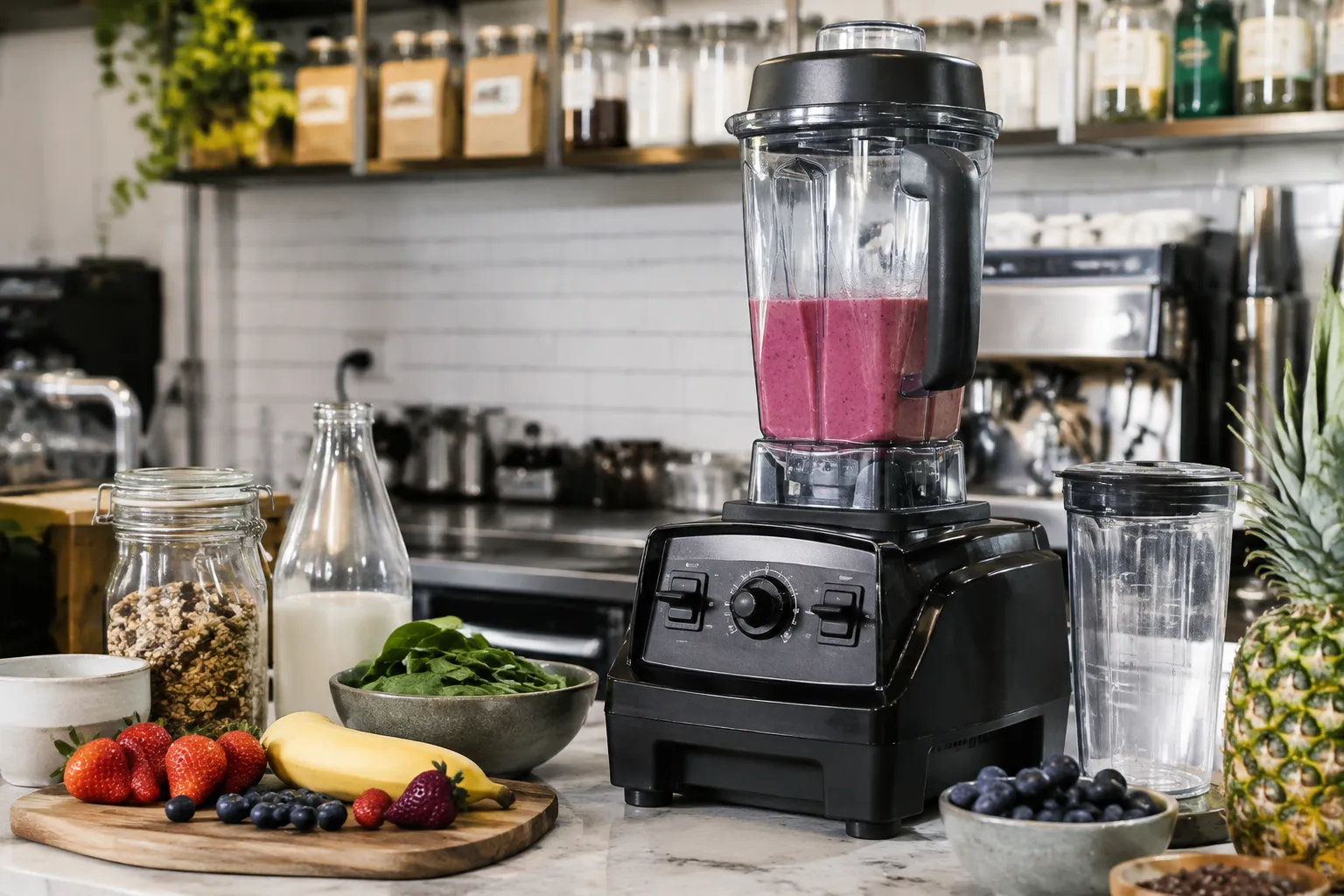
Commercial blenders crossed over into home kitchens years ago, but the pitch has always been a little fuzzy. The marketing says “café quality” and shows someone pulverizing kale into a drink that looks like a lawn clipping smoothie. The real question is narrower: when does a machine designed to run for hours in a busy shop actually earn its space on a residential counter? For most people, the answer is never. For a specific minority, the answer is that a commercial blender is the only thing that will stop them from giving up on smoothies entirely.
Home blenders and commercial blenders differ in ways that are not immediately visible from the spec sheet. The obvious differences are motor wattage and blade design, but those numbers hide the real gap. A commercial blender is built around continuous duty. The motor is wound tighter, the drive train is heavier, and the base is weighted so the machine does not walk across a wet counter at 6 a.m. A home blender, even an expensive one, is designed for short bursts with long rests. The difference shows up in the texture of the drink, not the label on the box.
The texture threshold that home blenders miss
Ice is the dividing line. A standard home blender with 1,000 watts will crush ice into small pieces, but it will not turn those pieces into a uniform slurry. The drink comes out with a grainy mouthfeel, a thin layer of icy slush floating on top of a denser fruit base. Commercial blenders reach a different result because they spin the blades fast enough to create a vortex that pulls the contents down into the blade plane repeatedly. The ice gets recirculated dozens of times per second, not just chopped once and pushed aside.
The practical difference is a smoothie that pours like a thick liquid rather than one that requires a spoon. For a person who likes a smoothie with some structure, a chunk of banana and a few ice shards are fine. For someone who wants a drink that is completely homogeneous, a commercial blender is the difference between a daily ritual and a daily compromise. The texture is not a minor aesthetic detail. It changes how often a person actually makes the drink.
The cost math only works for daily use
A commercial blender like a Vitamix in the professional line or a Blendtec sits in a price range that makes most home cooks flinch. The machines run from $400 to over $700, and that is before the quieter enclosures and extra containers that some models require. A decent home blender costs $100 to $200. The gap is not small, and it only closes if the machine is used with real frequency.
Consider the arithmetic. If a person makes one smoothie per day, seven days a week, that is 365 drinks a year. A commercial blender that lasts a decade without losing performance costs roughly $60 per year if it runs $600. A $150 home blender that needs replacement every three years costs $50 per year. The difference is a few cents per smoothie. The math flips when usage drops to twice a week. Then the commercial machine costs about $2.30 per drink over ten years, while the home blender costs about $0.50 per drink. The premium becomes hard to justify when the machine sits idle for four days out of seven.
The hidden cost of a commercial blender is not the purchase price. It is the noise. These machines are loud because they are doing real work. A typical commercial unit at full speed produces noise levels in the range of a motorcycle passing by, around 90 decibels. In a professional kitchen, that noise is absorbed by the general chaos of cooking. In a home kitchen at 6:30 in the morning, it is a guaranteed wake-up call for everyone in the house. The people who buy a commercial blender for home use and then complain about the noise have missed the point of the purchase.
Frozen fruit exposes the real motor difference
Fresh fruit blends easily in almost any machine. The test that separates blenders is what happens with frozen ingredients. A home blender with a modest motor will stall when it hits a solid block of frozen strawberries. The blades spin, the fruit sits on top of the blades in a frozen clump, and the motor strains. Most people respond by adding more liquid, which turns the smoothie into a thin, watery drink that tastes diluted.
A commercial blender handles a frozen load differently because it has enough torque to keep the blades moving even when the contents resist. The motor does not just spin faster. It maintains speed under load, which is a different engineering problem. The blade assembly on a commercial unit is also heavier and sharper, so it bites into frozen material rather than deflecting off it. The result is that a person can make a thick smoothie with frozen fruit and minimal liquid, which is the texture that most smoothie enthusiasts actually want.
This is the real reason some home users buy commercial equipment. They are not chasing a brand name or a status symbol. They are chasing the ability to make a smoothie with one frozen banana, a handful of frozen berries, and just enough liquid to get the blades moving. A home blender will turn that combination into a lumpy mess or require so much added juice that the drink becomes a different product. The commercial machine turns it into a thick, spoonable blend that holds its shape in a bowl.
The clean-up difference changes the habit
Nobody talks about the clean-up factor when they argue about blenders, but it is the detail that determines whether the machine gets used. A home blender with a rubber gasket under the blade assembly requires disassembly to clean properly. Food gets trapped in the gasket, and the gasket gets moldy if it is not removed and dried. The process takes five minutes, which does not sound like much until a person is standing at the sink at 7:15 a.m. with a commute ahead.
Commercial blenders handle clean-up differently. The blade assembly is usually a single piece that can be unscrewed, and most commercial containers are designed to be filled with warm water and a drop of soap, then run on the clean cycle for thirty seconds. The machine cleans itself. The operator rinses the container, lets it air dry, and puts it back on the base. The whole process takes under a minute. For a person who makes a smoothie every morning, that minute is the difference between a sustainable habit and a machine that gets pushed to the back of the cabinet by March.
The self-cleaning feature is not a luxury add-on. It is a core design consideration for commercial environments where staff do not have time to scrub containers between orders. In a home setting, it removes the single biggest barrier to daily use. A person who hates washing dishes will make a smoothie when the clean-up is thirty seconds. The same person will skip the smoothie entirely when the clean-up involves a gasket, a brush, and a drying rack.
A second container changes the morning routine
Commercial blenders are often sold with the option of multiple containers, which seems like overkill for a home kitchen. It is not. A second container allows a person to make a smoothie and store it directly in the blending container, then use the other container for the next batch without washing the first one mid-morning. This matters for households with two people who drink smoothies at different times, or for a person who wants to prep a smoothie the night before and drink it the next day.
The container material also matters more than most home users expect. Commercial containers are made from a polycarbonate or tritan plastic that is thick enough to survive being dropped on a tile floor. They are also designed to handle hot liquids, which matters for soup or for blending hot coffee drinks. A home blender jar is often thinner and more brittle, and many cannot handle temperatures above a certain range without cracking. The container is not an afterthought. It is the part of the machine that a person touches and handles every single day.
The warranty signals the intended lifespan
Read the warranty on a commercial blender and then read the warranty on a home blender. The difference is telling. A commercial model typically carries a three to five year warranty on the motor, and a seven to ten year warranty on the drive base and container in some brands. A home blender warranty runs one to two years, and it often excludes wear items like the blade assembly and the jar. The warranty is not a marketing gimmick. It is a statement about how long the manufacturer expects the machine to survive under continuous load.
That longevity matters for a specific kind of home user. Someone who hosts a lot of gatherings, makes nut butters, grinds grains, or uses the blender for hot soup will put wear on the machine that exceeds what a typical home user does. The commercial unit absorbs that abuse. The home unit does not. A person who uses a blender twice a year for a margarita batch will never see the difference. A person who uses it twice a day, every day, will burn out a home motor within eighteen months.
The people who should buy one anyway
There is a narrow profile of home user for whom a commercial blender is not a luxury. It is the correct tool. The profile includes a person who makes a smoothie or blended drink at least once a day, uses frozen fruit or ice as a core ingredient, hates cleaning complicated parts, and expects the machine to last longer than a decade. That person will get real value from a commercial unit, and the price per use will drop below that of a cheap home blender within a few years.
There is another profile that should not buy one. A person who makes the occasional smoothie with fresh fruit, does not mind a slightly grainy texture, and has limited counter space should stick with a capable home blender. The commercial machine will take up as much space as a small microwave, it will be loud enough to require planning around family schedules, and it will cost four times as much for no benefit that the occasional user can perceive.
The marketing tries to convince everyone that they need café quality at home. The truth is that café quality only matters to people who actually want a café result every single morning. A commercial blender does not make smoothies better in the abstract. It makes them better in a very specific way, a way that matters only if the texture, the convenience, and the longevity are all actually going to be used. For the person who fits that profile, the machine pays for itself in ways that have nothing to do with money. It pays for itself in the smoothie that actually gets made instead of skipped.