
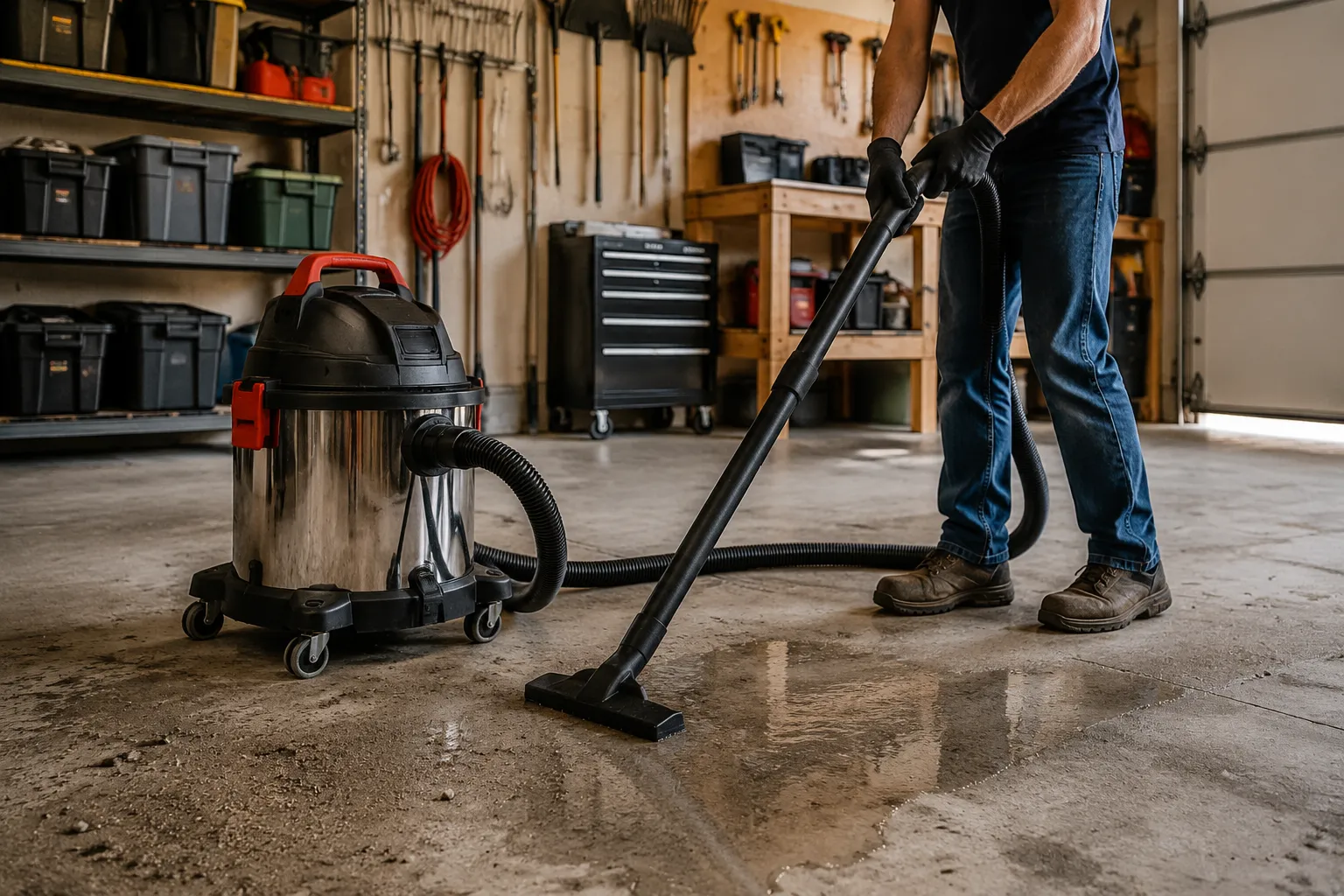
The garage floor of a typical American home accumulates a specific kind of filth that no broom can touch. Fine concrete dust from the summer heat, leaf fragments tracked in from the side yard, and that gritty black residue that peels off car tires all settle into the pores of the slab. A person can sweep for twenty minutes and watch the dust resettle two inches behind the dustpan. The wet dry vac solves this, but only when a person stops treating it like an occasional rescue tool and starts building it into the weekly rhythm of the house. Most garage cleanup routines fail because they depend on motivation. The ones that stick depend on placement, habit stacking, and a brutal honesty about what the machine can actually do.
The first mistake nearly everyone makes is buying a wet dry vac that is too small. The hardware store displays them in a row, starting with the little 4-gallon units that look cute next to the workbench. They are fine for sucking a puddle off the water heater pan. They are useless for a garage. The 4-gallon model fills up in one pass across a two-car garage floor, requiring the owner to stop, unclip the lid, wrestle the filter, and dump the contents into a trash bag. That interruption breaks the flow, and the routine dies before it ever becomes a habit. A 12-gallon or larger unit gives a person the buffer to finish the job before dealing with the debris.
But size alone does not save the routine. The machine has to live where the work happens. A wet dry vac stored in the basement or the back of a closet is a tool that gets used twice a year. A wet dry vac plugged into a ceiling outlet in the garage, parked against the wall with the hose hanging on a hook, gets used every weekend. This is not a secret of organization experts. It is simple friction. A person walks into the garage, sees the machine, and the thirty seconds of setup feels like nothing. The same person would walk to the basement, haul the machine up the stairs, and decide the floor can wait another week.
The Filter Decision That Changes Everything
Most wet dry vacs ship with a foam sleeve filter and a paper pleated cartridge. The foam sleeve handles dry dust. The paper cartridge handles wet pickup. The problem is that switching between them takes time, and time kills the routine. A person who has to swap filters before vacuuming a damp floor will simply skip the damp floor in favor of a mop, which is worse because a mop just pushes the dust around into a gray slurry.
The answer is a pleated cartridge filter that can handle both wet and dry, and a person needs to buy a spare so the machine is never down while one dries out. This is a small investment that pays off in the most important currency: the removal of excuses. With a wet dry filter in place, the machine can go from sucking up crushed leaves to slurping a spilled paint can without a single adjustment. The few extra dollars for a second cartridge mean the garage never hits a dead day when the filter is still damp and the floor is dirty.
There is a competing school of thought that says to leave the foam sleeve on for everything and just clean it out. That works for dry debris, but the moment the machine slurps up a cup of water, the foam saturates, and the next dry pickup blows a fine mist of damp dust across the garage. The foam sleeve dries slowly in a humid garage. The pleated cartridge dries faster and handles the transition without drama. This is not a premium upgrade for enthusiasts. It is the difference between a machine that fits into a weekly routine and a machine that fights it.
The Order of Operations That Prevents Double Work
A garage cleanup sticks when a person follows a sequence that does not create new messes. The order matters more than any tool. The routine starts with a quick pass to pick up loose items: the stray screw, the bottle cap, the leaf that blew in under the door. These items clog the hose if they get sucked up mid-sweep, so they go into a bucket or a pocket first. Then comes the dry vacuum pass over the whole floor, working from the corners toward the garage door. This pass picks up the dust and grit that a broom cannot trap.
Then comes the part most people skip: the wet pass. A garage floor that never sees water develops a layer of embedded grime that no dry vacuum can lift. The wet pass involves a spray bottle of plain water or a diluted all-purpose cleaner, a light misting of the floor in sections, and a second vacuum pass with the wet dry vac to slurp up the dirty water. This is not mopping. It is a rinse, and it takes four minutes for a two-car garage. The result is a floor that looks like it was poured last week.
The wet pass also solves the dust problem at the source. The fine concrete dust that makes a garage feel gritty is not just on the surface. It lives in the micro-pores of the slab. A dry vacuum gets the loose layer. The water breaks the surface tension and lifts the embedded dust. One wet pass a month keeps the garage from ever reaching the point where a person needs a pressure washer and a full Saturday afternoon.
Managing the Cord and the Hose So They Do Not Manage You
Every wet dry vac owner knows the tangle. The hose kinks in three places, the cord wraps around the hose, and the whole assembly looks like a pile of black spaghetti. This tangle is the silent killer of the routine. A person walks into the garage, sees the mess of hose and cord, and decides to delay the cleanup for the third week in a row.
The fix is a wall-mounted hose hanger and a cord reel. A simple two-hook hanger mounted at shoulder height keeps the hose in a loose coil that does not kink. A cord reel mounted on the wall or attached to the vac itself keeps the power cord out of the way. The total cost is under twenty dollars. The total time saved each week is about five minutes of untangling frustration. The routine survives because the setup time drops to near zero.
The hose itself deserves attention. Most stock hoses are 6 feet or 7 feet long, which means the vac has to move every few feet during a garage cleanup. A 10-foot or 12-foot replacement hose costs less than thirty dollars and cuts the number of times a person has to drag the machine across the floor. The longer hose also reaches into the corners and under the workbench without repositioning. This is the kind of upgrade that looks minor on paper and transforms the experience in practice.
The Weekly Reset That Takes Fifteen Minutes
The routine that sticks is not an annual deep clean. It is a weekly fifteen-minute reset that keeps the garage from ever descending into chaos. The person walks in, does a quick dry pass over the main floor area, hits the corners with the crevice tool, and takes the wet pass over the high-traffic zone in front of the car doors. Fifteen minutes, start to finish, and the garage looks like a person actually cares about it.
The key is to stop treating the whole garage floor as a single project. The area under the workbench accumulates sawdust and screws and does not need the same attention as the path from the house door to the car door. The high-traffic zone gets the weekly pass. The workbench area gets a monthly pass. The far corner where the holiday decorations sit gets a quarterly pass. This tiered approach respects the reality of how a garage gets used, and it keeps the routine from becoming a chore that a person dreads.
A person who tries to do the entire garage every week will burn out by the third month. A person who maintains the high-traffic zones weekly and cycles through the rest on a longer schedule will still be doing it a year from now. The difference is not discipline. The difference is designing the routine around a realistic scope.
The Liquid Spill That Ends the Debate About Water
Every wet dry vac owner eventually faces the moment of truth: knocking over a full bucket of water or paint or coolant and realizing the machine is the only thing that can save the afternoon. The person who has kept the machine ready, with the wet dry filter installed and the hose untangled, handles the spill in under a minute. The person who has neglected the machine spends the next twenty minutes disassembling the motor housing to fish out the dry filter that got soaked.
The routine pays for itself in that single moment. A gallon of water on a garage floor is not a disaster. A gallon of water mixed with the dust and grime that has been sitting in the floor pores for months is a gray mud that stains concrete. The wet dry vac with the correct filter pulls it all up in one pass, leaving behind a clean, dry floor that does not smell musty for the next week.
Cars leak. Water heaters weep. Kids knock over drinks. The garage is the room where these accidents happen, and the person who has a working wet dry vac with the right filter installed does not panic. The routine is not about perfection. It is about being ready for the inevitable mess without having to think twice.
The Discharge Hose Oddity Most Owners Never Notice
A little-known feature on most wet dry vacs is the exhaust port, sometimes located near the blower side. This port blows air out at a decent velocity, and most owners never think about it. That is a missed opportunity. A person can use the exhaust to blow the fine dust out from under shelving units and along the baseboards before vacuuming it up. This cuts the vacuuming time in half because the dust is gathered into a concentrated line instead of scattered across the whole floor.
This trick works best in the corners and along the garage door track, where dust accumulates in a thin line that a vacuum head cannot reach. A quick blow with the exhaust port, then a pass with the vacuum, and the area is clean. The technique takes practice to avoid blowing dust into the car or back into the face, but it turns an overlooked feature into a regular part of the routine.
The exhaust port also clears out the filter. A person who spends two seconds blowing compressed air through the filter via the exhaust port, with the filter turned upside down, keeps the suction strong between deep cleanings. The filter stays unclogged, the machine pulls harder, and the weekly routine stays fast.
The Emptying Ritual That Keeps the Smell Away
The wet dry vac tank is a magnet for smells. A person who vacuums up damp leaves, a little spilled coffee, and some dog hair, then leaves the tank sealed for a week, opens the machine to a smell that could clear a room. This smell is the reason many people abandon the routine entirely. The machine becomes something to avoid, and the garage gets dirtier, and the cycle feeds on itself.
The solution is an emptying ritual tied to the end of the weekly cleanup. The person empties the tank immediately after finishing the last pass, before putting the machine away. A quick rinse with the garden hose, a wipe down with a rag, and the tank is left open to air dry. This adds three minutes to the routine and eliminates the smell problem entirely. The machine is ready for the next week, not festering in the corner.
The same ritual applies to the filter. A person who leaves a wet filter sealed in the machine will find mildew growing within a few days. Pop the filter out, set it on a shelf or a hook near the machine, and let it dry overnight. In the morning, it is ready to snap back into place. The routine becomes a loop: use, empty, rinse, dry, store. It is mechanical, but it is also the difference between a tool that serves the household and a tool that creates another problem.
The garage floor will never stay clean on its own. The dust comes in on the car tires, through the side door, from the air vents. The wet dry vac is the only tool that can keep up with that continuous accumulation, but only if the person using it removes the friction from the process. A big enough tank, a wet dry filter left in place, a hose hanger and a cord reel, a fifteen-minute weekly pass, and an emptying ritual. None of these steps is remarkable. Together, they turn an occasional chore into a routine that a person can maintain without thinking.