
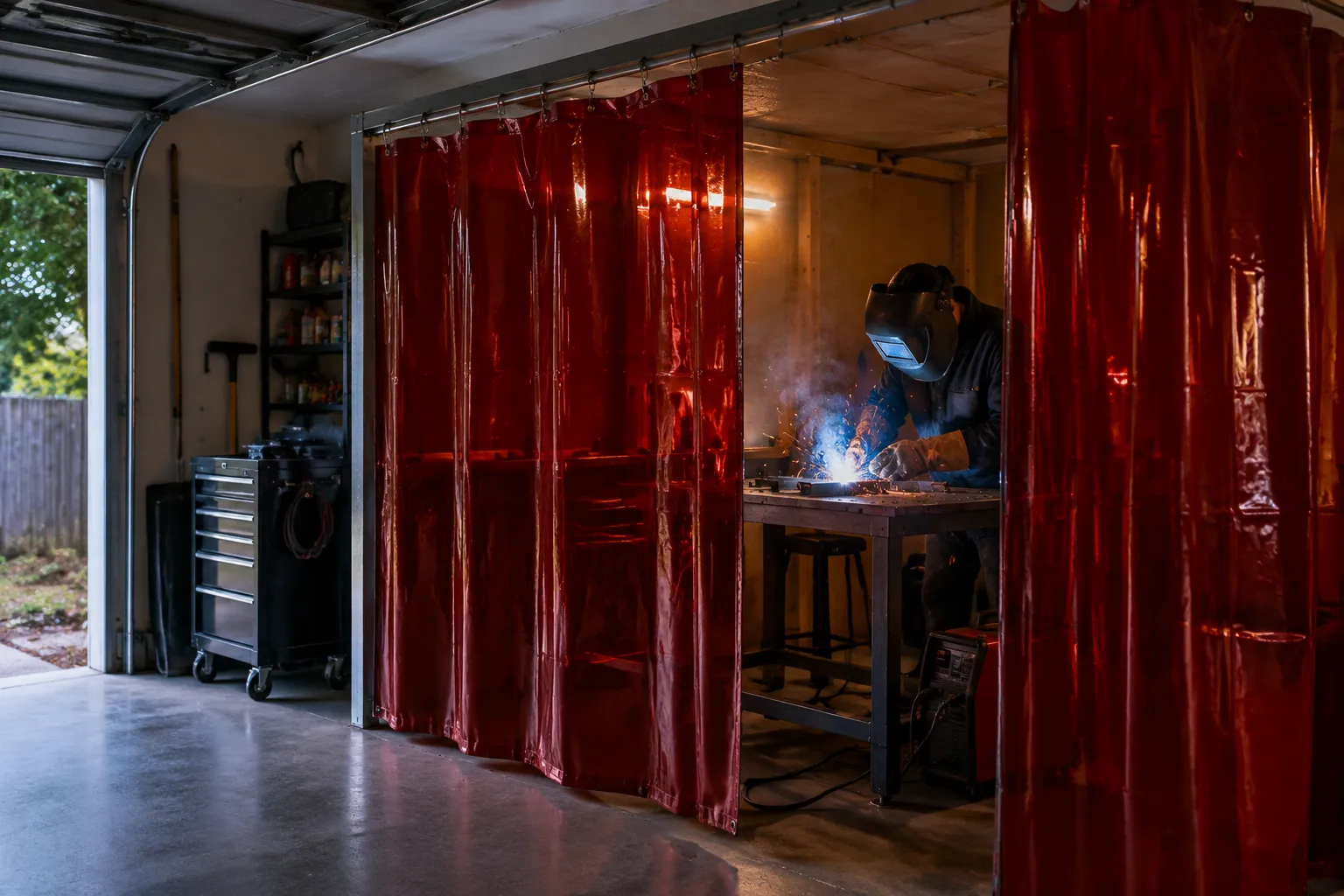
The first time a person fires up a welder inside a residential garage, the space immediately reveals its limitations. The walls are too close, the ceiling is low, and every reflective surface becomes a hazard. A bare concrete floor bounces arc light back up into the face shield. A white-painted tool chest throws a secondary flash that catches the eyes from an unexpected angle. The 10-foot distance between the workbench and the garage door suddenly feels like a compromise. This is the moment when a welding curtain stops being an accessory and becomes the difference between a usable hobby space and a genuinely dangerous one.
Home garages present a specific problem that professional shops never have to solve. A fabrication shop has designated bays, permanent partitions, and enough square footage to keep bystanders clear. The home garage is a multi-purpose room trying to be a workshop. The same floor that holds the welder also holds the lawnmower, the bicycles, the shelving unit with the paint cans. People walk through. Pets wander in. The curtain is the only real barrier between the arc and everything else.
What the Curtain Actually Does
The common misunderstanding is that a welding curtain protects the welder. It does not. The person running the torch wears a helmet with the proper shade lens, gloves, and a jacket. That gear handles the direct exposure. The curtain exists for everyone and everything else in the room.
Its primary job is to block ultraviolet and infrared radiation from the arc. These wavelengths do not need to be directly viewed to cause damage. UV light bounces off walls, off bare metal, off light-colored paint, and it hits unprotected eyes from angles a person never anticipates. The result is arc eye, the painful condition where the cornea feels sandpapered for a day or two. The curtain absorbs that radiation and stops the bounce.
It also catches sparks and spatter. A grinding wheel throws hot debris in a wide arc. Welding produces globs of molten metal that skitter across the floor and land who knows where. The curtain is a fire barrier. It keeps those sparks off the cardboard boxes stacked near the workbench and the gasoline can sitting by the door.
What it does not do is stop sound, contain fumes, or block the bright visible light completely. A person can still hear grinding through the curtain. The fumes from MIG welding and the ozone from TIG welding still drift into the rest of the garage. And the curtain glows visibly when the arc strikes, a dull orange backlight that signals welding is happening. None of this is a failure of the product. It is a matter of knowing what the curtain is for.
The Material Decision Comes First
Welding curtains are sold in a handful of materials, and the differences matter more than the price tag suggests. The two main options are vinyl and fiberglass cloth, each with a specific place in a home garage.
Vinyl is the most common and the most affordable. It is a translucent orange or green sheet, typically 6 to 8 mils thick, that hangs from grommets or a curtain track. The translucent quality is a feature: a person can see the general shape of someone moving on the other side, which prevents a person from walking into the welding area at the wrong moment. Vinyl resists UV damage well and cleans up with a damp rag.
Fiberglass cloth is heavier and more expensive. It looks like a tan or gray fabric, and it handles higher heat exposure without melting. This matters when the work happens very close to the curtain. A MIG welder running at 180 amps throws enough radiated heat that vinyl can soften and sag within a foot of the arc. Fiberglass takes that punishment without complaint. The tradeoff is that it is opaque, so no one can see through it, and it sheds tiny glass fibers when handled roughly.
For the typical home garage, where the workbench sits several feet from the curtain and the welder is not running at maximum settings all day, vinyl is the sensible choice. It costs less, it lets a person see movement on the other side, and it handles the occasional spark shower without issue. Fiberglass earns its keep in a tighter space or when the welding position puts the arc close to the curtain. A person who does both kinds of work might own one of each.
Sizing the Curtain to the Space
The most common mistake in a home garage is buying a curtain that is too small. The standard sizes are 6 by 6 feet and 8 by 6 feet, which sound adequate on paper and often prove insufficient in practice. The arc light sprays in every direction. A curtain that only covers the immediate workbench area leaves a gap above and to the sides that defeats the purpose.
The rule of thumb is to enclose the workspace on at least three sides, floor to ceiling. In an 8-foot garage, that means a curtain that hangs from near the ceiling to within a few inches of the floor. A 6-foot-tall curtain leaves a 2-foot gap at the top where UV light escapes and bounces off the ceiling. The math is simple: the curtain needs to be as tall as the space allows.
Width matters just as much. A single 6-foot panel might screen the welder from the rest of the garage, but it does not protect a person walking past the end of the panel. The solution is either a wider single panel or multiple panels arranged in a U-shape around the work area. The U-shape is better because it blocks the bounce from the sides, not just the front.
There is also the question of mounting height. The bottom of the curtain should not drag on the floor, because it will collect grinding debris and create a trip hazard. A 1-inch gap at the bottom is fine; sparks do not travel flat along the floor at that distance with enough force to be dangerous. The top should be as close to the ceiling as the mounting hardware allows.
Mounting Hardware That Holds
A curtain is only as good as the hardware holding it up. The home garage often has drywall ceilings and wall studs at 16-inch centers, which gives a person options. The cheap route is a tension rod across a doorway, but that only works in a door frame and does not handle the weight of a heavy vinyl curtain well.
The practical approach is a ceiling-mounted track system. These are sold as kits with a metal track, rollers, and mounting brackets. The track screws into ceiling joists or into drywall anchors if the joists are not conveniently placed. The curtain hangs from the rollers via grommets, and it slides back and forth for access. This is the professional solution, and it works at home.
Wall-mounted rods are the simpler alternative. A 3/4-inch steel pipe cut to length and mounted on flanges at each end will hold a curtain fine, and the cost is lower than a track kit. The curtain slides on shower curtain rings, which are cheap and easy to replace. This setup has a slightly rougher look, but it is honest and functional.
Whatever the mounting choice, the fasteners matter. A 6-foot vinyl curtain weighs around 5 pounds. A fiberglass curtain weighs more. The total load is not huge, but it is enough that a pair of drywall anchors rated for 10 pounds each will hold it fine. The failure point is usually the screw pulling out of the ceiling, which happens when someone grabs the curtain to steady themselves or gives it a hard yank to open it. Use the biggest anchors that fit the space and avoid the cheap plastic ones that crack at the flange.
The Gap Problem at the Corners
Once the curtain panels are up, the corners between them become the weak point. Two panels meeting at a 90-degree angle often leave a vertical gap where the edges do not overlap. This gap is at eye level for a person walking past, and it is exactly where the arc light will sneak through.
The fix is an overlap of at least 6 inches where panels meet. A person can achieve this by mounting a curtain rod at the corner and letting the panels overlap on the same rod, or by installing a hook-and-loop strip along the vertical edges to seal the seam. The hook-and-loop approach is better because it stays closed on its own and does not depend on the curtain hanging perfectly straight.
There is also the gap between the top of the curtain and the ceiling. This one gets ignored because it is out of sight. A 4-inch gap at the top allows UV light to bounce upward and hit the ceiling, then scatter back down. The practical fix is to mount the track high enough that the gap is under 2 inches. In a garage with an 8-foot ceiling, a standard 6-foot curtain leaves a significant gap. The solution is buying a custom-height curtain or accepting that the top gap exists and aiming the work so the arc points away from it.
Floor Protection Complements the Curtain
The curtain stops the sideways spray of sparks, but it does nothing about what lands on the floor. Concrete is mostly fine; it shrugs off the heat and the spatter. The problem is everything on the concrete. A dropped bolt, a puddle of oil, a piece of cardboard that drifted under the curtain edge. These are the fire starters.
A piece of 1/4-inch steel plate or a welding blanket laid flat on the floor in the work zone catches the spatter that would otherwise reach combustible material. This is a cheap addition that pairs well with the curtain. The curtain stops the horizontal spray; the floor plate stops the vertical fall.
The garage door itself deserves attention. If the garage door is steel, it reflects UV light like a mirror when it is down. The curtain should be positioned so the arc does not point directly at the door. If the door is up, the opening to the outside is an unguarded gap that lets UV light escape to the driveway. A person walking past the open garage door at the wrong angle can catch a flash from 20 feet away. The curtain should extend past the door opening or the work should be positioned so the arc faces away from it.
Improvised Curtains Are a Bad Bet
There is a temptation to skip the purpose-built curtain and hang an old bedsheet or a tarp. This is a mistake that usually reveals itself through a burned hole or a close call with fire. A bedsheet does not block UV; it lets most of it through and glows brightly while doing so. A plastic tarp melts when hit by a cluster of sparks and can drip burning plastic onto the floor. Neither one stops the radiation that causes arc eye.
The same logic applies to welding blankets used as curtains. A welding blanket is a different tool. It is designed to sit on the workpiece or the floor to catch sparks, and it is usually opaque and heavy. Hanging a welding blanket as a curtain works in a pinch, but it blocks visibility completely, and the fiberglass versions shed particles in a way that is unpleasant in an enclosed garage. The purpose-built curtain has the translucent quality that makes a shared space manageable.
Maintenance Is a Five-Minute Job
A welding curtain accumulates a layer of fine dust and smoke residue over time. This film reduces the transparency of the vinyl and makes the curtain look dingy. The fix is a damp cloth and mild soap, wiped down every few weeks. A curtain that receives heavy use every weekend will need this more often than one used once a month.
Small burn holes are inevitable. A direct hit from a large glob of spatter can melt a pinhole through vinyl. A few small holes do not compromise the UV protection; the material around the hole still blocks the radiation. If the holes multiply to the point where the curtain has a lacy appearance, it is time to replace it. A curtain with more hole than material has stopped being a barrier.
The grommets deserve a quick inspection too. They take the weight of the curtain and the stress of sliding. A torn grommet causes the curtain to sag at one corner and creates a gap. Replacing a grommet is a 10-minute job with a kit from a hardware store, and it is cheaper than replacing the whole panel.
The Real Test Is the First Night Weld
The quality of a curtain setup shows clearly in a dark garage at night. A person runs a bead and then lifts the helmet. The room beyond the curtain is dark. The garage door is a black rectangle. The tool boxes are dim shapes. This is the sign of a proper setup. The UV is contained, the visible flash is muted, and the space outside the work zone is safe to walk through without squinting.
A poor setup shows itself in the same moment. The curtain glows like a lantern, the light leaks from the top and the corners, and the walls reflect the flash back into the room. A person walking past the end of the curtain catches a strobing glare that lingers behind the eyes. That is the moment when a curtain upgrade stops being an expense and becomes a necessity.
The home garage will never be a professional fabrication shop. It does not have the space, the ventilation, or the separation. But the curtain is the one piece of equipment that makes it a legitimate welding space rather than a hazard zone. It is worth setting up correctly the first time.