
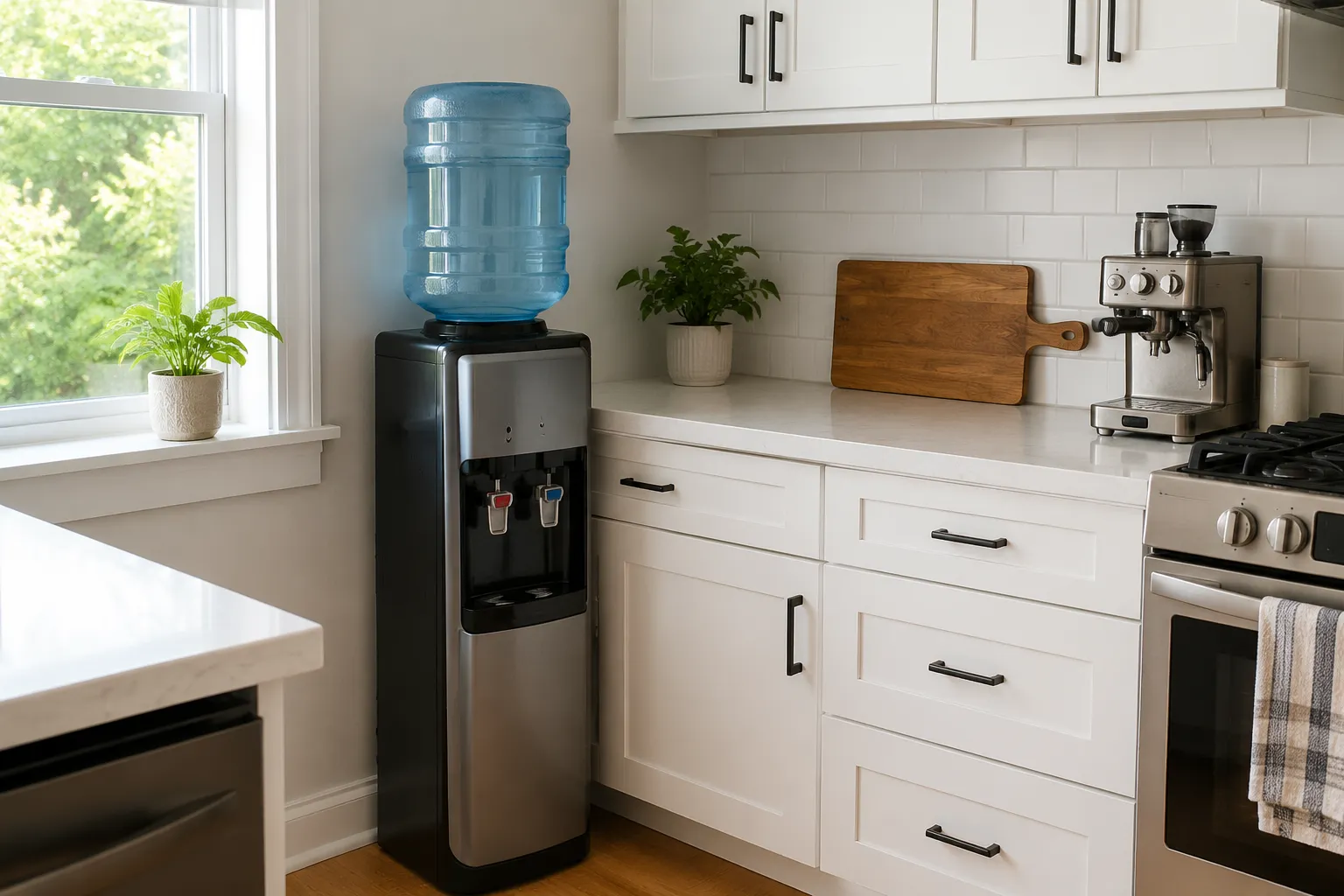
The kitchen corner is where good intentions go to die, and the water dispenser is usually the corpse. People buy a countertop model, set it next to the toaster, and then spend six months fighting the cord, the filter cartridge, and the puddle that collects around the base. The corner becomes a dead zone, a place where the morning coffee routine slows to a crawl. That setup is the default, and it is wrong for most homes. The fix is not a different machine. The fix is rethinking the corner itself.
A standing dispenser, the kind with a full-size bottle on top, has no place in a corner. It needs clearance behind it for the bottle to tip into place, which means pulling the whole unit out from the wall every time the water runs low. That process, repeated weekly, turns a simple refill into a wrestling match with a 40-pound jug and a cabinet door that will not fully open. The better answer is a compact countertop unit placed at the very edge of the counter, angled slightly toward the room, so the front face is accessible without reaching over the sink or the stove.
The angle matters more than most people think. A dispenser shoved flush against the back wall forces a person to lean over the counter, stretch the arm, and pour with the wrist bent at an awkward angle. The result is splashing, mostly on the countertop, sometimes on the floor. Angling the unit at about 30 degrees toward the open kitchen changes the pour line completely. The spout clears the front edge of the counter, the cup sits flat on the drip tray, and the hand stays straight. It is a small rotation that eliminates the most common complaint about these machines.
Power is the hidden constraint. Most kitchen corners have exactly one outlet, and it is usually shared with the microwave or the coffee maker. A water dispenser with a hot tank draws 500 to 800 watts when heating, and a microwave pulls twice that. Plugging both into the same circuit invites the breaker to trip at the worst possible time, usually mid-morning when the office is calling. The honest move is to measure the load before buying anything. A simple dispenser with only cold water needs almost nothing, about 60 watts. A three-temperature unit needs a dedicated circuit or at least a clear one.
Filtered units add another layer. A dispenser with an integrated filter needs the water line routed to it, which means either a hole in the countertop or a hose running along the backsplash. That hose is the thing that makes a corner setup look like a science experiment gone wrong. The cleanest approach is to place the unit within 12 inches of the sink's cold water line, so the tap-off valve and tubing stay hidden under the cabinet. Corners that sit far from the sink are better served by a bottle-fed unit, no plumbing at all.
The corner that actually works
Walk into a kitchen that has this figured out and it looks almost accidental. The dispenser sits on a 24-inch stretch of counter between the fridge and the upper cabinet, not jammed into the deepest part of the L. There is a clear 18 inches of open counter to the left of the spout, which is where the cup goes while filling. That landing zone is the secret. Without it, a person holds the cup in one hand, operates the lever with the other, and prays the dog does not bump the knee. With it, both hands stay free and the pour is steady.
The height of the unit matters too. Countertop models range from 12 to 18 inches tall, and the spout height varies even more. A dispenser whose spout sits 11 inches above the counter cannot fit a standard 8-inch tall water bottle underneath, which forces a person to tilt the bottle at an angle. That tilt is why so many people think these machines are messy. The machine is not messy. The geometry is wrong. Measure the tallest cup or bottle in the house before choosing a model, then add an inch of clearance to account for the drip tray.
Drip trays are the least loved part of the whole setup, and they deserve more respect. Most trays are shallow plastic inserts with a small grid on top, and they fill up faster than anyone expects. A family of four using the dispenser for drinking water alone will fill a standard tray in about three days. When the tray overflows, the water runs down the front of the unit and onto the counter, which is how the corner develops that permanent sticky film. The fix is to buy a dispenser with a removable tray that lifts out without sliding the whole machine forward. That single feature saves more frustration than any other specification.
Bottles versus filters versus direct lines
There are three ways to feed a corner dispenser, and each one changes the layout in a different way. The bottle system is the most portable. A 5-gallon jug sits on top, the pump line drops in, and the whole thing works anywhere there is a flat surface and an outlet. The catch is the jug itself. Storing a spare bottle takes up floor space, usually in the pantry or the garage, and hauling a full one from the car to the kitchen is a two-hand job. For a single person in an apartment, this is the right trade. For a family, the logistics get old fast.
A direct-line dispenser, connected to the home's water supply, is the permanent solution. The installation requires a saddle valve on the cold water line, a small hole in the cabinet base, and tubing that runs to the back of the unit. It is a two-hour job for someone comfortable with a drill and an adjustable wrench, or a service call for everyone else. Once installed, the corner becomes a true appliance, no refills, no jugs, no forgetting to order water. The downside is commitment. A direct-line unit stays in that spot until it dies or the kitchen is remodeled.
The middle path is a dispenser with a built-in reservoir that the owner fills by hand. These are the countertop models with a removable tank in the back, typically 2 to 3 gallons. They look like a standard dispenser but skip the plumbing and the bottle. The tradeoff is refill frequency. A household that drinks a gallon a day is filling the reservoir twice daily, and the tank is heavy when full. This option makes sense only for light use, a small office, a guest room, or a kitchen where hot water is the main draw.
The hot water question
Hot water is why many people buy a dispenser in the first place. Tea, coffee, oatmeal, ramen, sanitizing a cutting board. A unit with a 200-degree tank delivers near-boiling water on demand, and that changes morning routines in a real way. The kettle comes off the counter, the microwave stops being a water heater, and the stovetop stays clean. But the hot tank changes the corner requirements. The unit runs hotter, needs more ventilation, and should not sit directly next to the stove where ambient heat pushes the electronics past their comfort zone.
Child safety is the other part of the hot water equation. Modern dispensers have dual levers, one to unlock, one to dispense, and they require two hands. That design is good, but it does not solve the reach problem. A dispenser on a standard 36-inch counter with a hot tank is at perfect height for a toddler to reach. The unit needs to sit at the back of the counter, at least 6 inches from the front edge, or the whole thing needs to go on a raised platform. Some families choose a cold-only unit for the corner and keep the hot water in an electric kettle on a high shelf. That is a legitimate workaround.
The temperature consistency of a hot tank is the quiet luxury nobody mentions. A kettle boils and then cools. A tanked dispenser holds the water at a set temperature, usually around 195 to 205 degrees, and it stays there for hours. For tea drinkers who brew several cups across a morning, that consistency is the difference between a good cup and a great one. The unit idles, sipping power to maintain the temperature, and the cost shows up on the electric bill. The difference is small, a few dollars a month, but it is not zero.
Fitting the corner around the machine
Nobody plans a kitchen corner around a water dispenser. The corner is where the cabinet hinge meets the backsplash, where the countertop seam lands, where the outlet was placed by an electrician who was thinking about a microwave. Adapting the corner means accepting its constraints instead of fighting them. A corner with an outlet on the back wall is fine for a shallow unit, but a deep unit will push the power cord against the backsplash and create a bend that wears the insulation over time. A corner with the outlet on the side wall is better for a wider unit.
Lighting makes a surprising difference. A corner dispenser under a dim cabinet light is hard to use, not because the machine is hard to see, but because the cup and the drip tray disappear into shadow. A small LED strip under the upper cabinet, aimed at the dispenser's front, fixes the problem for about 20 dollars. The result is a corner that looks intentional at night instead of like a dark hole holding a plastic appliance. That light also reveals spills immediately, which means they get wiped up while still fresh.
Extension cords are the wrong answer, and they need to be said plainly. A dispenser with a hot tank draws enough current that a cheap extension cord will warm up, and a warm cord is a fire hazard, not an inconvenience. If the outlet is genuinely too far, the correct fix is a power strip with a built-in surge protector and a short, thick gauge cord rated for the load. Better yet, move the dispenser. A water machine is not a kitchen island. It can live on the counter, in a pantry, on a utility cart, or on a dedicated stand. The corner is a suggestion, not a mandate.
What the drip tray says about the household
A clean drip tray is the single most honest indicator of how a water dispenser setup is working. If the tray has a film of dried water and a few specks of dust, the unit is not being used regularly, or the user is wiping it down constantly. If the tray is wet with fresh water, someone used it recently, and the routine is healthy. If the tray is overflowing, the household is using the machine more than expected, and the corner setup needs a bigger tray or a more frequent emptying schedule. The tray holds the evidence of every pour.
Most people empty the tray by lifting it out and tipping it into the sink. That motion is fine when the tray is small, but a wide tray on a corner unit gets awkward. A tray that slides out toward the front, rather than lifting up, allows a one-handed empty over the sink without moving the machine. This detail is rarely listed in the product specs, and it is worth checking in person at a store before buying. The reviewers who complain about a dispenser being hard to clean are almost always complaining about the tray mechanism.
The bigger truth is that a water dispenser in a kitchen corner fails because the corner is treated as leftover space. The corner is not leftover. It is a location with specific dimensions, a specific electrical situation, and a specific relationship to the rest of the room. When the dispenser is chosen to fit that reality, the machine becomes almost invisible, just a quiet source of cold water and maybe hot water, sitting in the background of a functioning kitchen. When it is chosen without measuring, it becomes a monument to a bad decision.
A person should walk into the kitchen, fill a glass, and not think about the machine at all. That is the whole standard. The water comes out cold, the cup fits, the tray is dry, and the corner is just a corner again.