
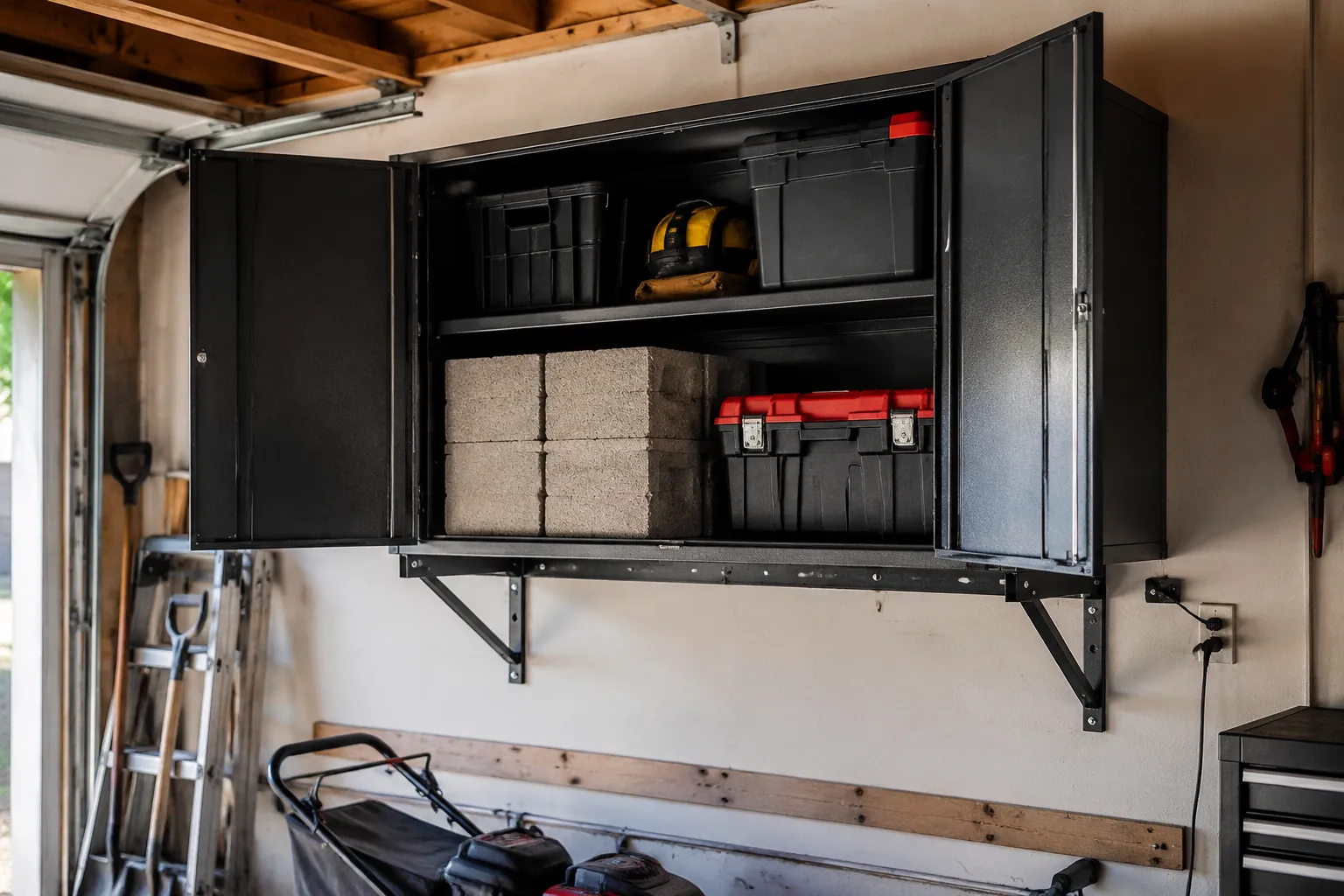
Garage wall storage has a dirty secret, and it is printed right on the box. That "250 lb capacity" sticker on a wall cabinet is a laboratory number, not a real-world promise. It assumes a perfectly flat wall, studs on exactly 16-inch centers, heavy-duty fasteners torqued into place, and a load spread evenly across the entire shelf surface. None of those conditions exist in a typical garage, which is why so many cabinets end up sagging, pulling off the wall, or dumping a box of engine parts onto a car hood.
The first thing to understand is that the cabinet itself is rarely the weak link. A welded steel box will hold whatever you can physically lift into it. The rating that matters is the one for the mounting system, the wall, and the fasteners, and that number is almost always lower than what the manufacturer advertises. A person who installs a 48-inch cabinet rated for 300 pounds and fills it with 200 pounds of tools is still gambling, because the rating assumes the wall does its job. Garage walls often do not.
Why the Sticker Number Is a Best-Case Fantasy
Manufacturers test wall cabinets against a solid wood substrate or steel studs with brand-new fasteners. The test rig is clean, dry, and perfectly plumb. The average garage wall is a mixed bag of drywall over metal studs, old plywood, painted concrete block, or drywall over wood studs that may have been installed decades ago with questionable spacing. A cabinet rated for 250 pounds on a test wall can fail at 80 pounds on a wall with degraded backing, oversize pilot holes, or a brittle drywall layer.
The rated number also assumes the load is static and evenly distributed. A garage cabinet filled with heavy items gets opened and closed repeatedly, and each pull on the handle applies a lever force that multiplies the load. A 30-pound box of nails sitting at the front edge of a shelf puts more torque on the top mounting screws than the same box sitting against the back wall. The rating sheet does not account for the daily rhythm of a person grabbing a drill, yanking it off the shelf, and letting the door slam.
There is also the matter of how the number gets printed. Marketing departments want a big figure on the box because it sells units. The engineering team runs a test, gets a number, and the packaging folks round up generously. A cabinet that actually tested at 212 pounds becomes a "250 lb capacity" product because it sounds better and nobody gets sued over a margin that large. The real-world safe working load is closer to 60 to 70 percent of the sticker figure.
The Three Hidden Numbers That Matter More
Instead of staring at the advertised capacity, a person should look at three things: the fastener spec, the wall mounting pattern, and the cabinet's own weight. The fastener spec is the most important. A cabinet that ships with #8 screws and plastic anchors is rated for light duty, no matter what the box says. A cabinet that calls for 1/4-inch lag bolts into wood studs is a different animal entirely. The mounting pattern matters because a cabinet with four mounting points spreads the load much better than one with two, and a cabinet with a top and bottom mounting rail distributes force across multiple studs.
The cabinet's empty weight tells a person something. A 45-pound steel cabinet with a 250-pound rating is a reasonable product. A 20-pound cabinet with the same rating is a sheet-metal shell relying entirely on the wall to compensate. Heavier gauge steel means the cabinet resists racking and twisting, which keeps the load against the wall instead of pulling the top screws outward. Push on the side of an assembled cabinet before mounting it. If it flexes easily, the rating is marketing, not engineering.
Stud spacing is the third hidden variable. Older garages and custom-built homes often have studs at 24-inch centers, not the standard 16. A mounting pattern designed for 16-inch centers leaves a 24-inch wall with one screw hitting a stud and the other three in drywall anchors. That changes the load path completely. A person needs to measure the actual stud locations before buying, not assume the garage follows the modern standard.
Drywall Anchors Are Not a Load-Bearing Strategy
For a cabinet holding anything heavier than light plastic bins, drywall anchors are a stopgap, not a solution. The best toggle bolts can hold a surprising amount of weight in perfect drywall, around 50 to 75 pounds per fastener, but garage drywall is rarely perfect. It has moisture damage, prior anchor holes, or a layer of paint that hides cracks. A toggle bolt depends on the drywall's integrity around the hole, and one bad section turns a secure mount into a pendulum.
The honest approach is to mount every wall cabinet into studs, at minimum at the two top corners, and preferably at all four corners. When the stud spacing does not align with the cabinet's mounting holes, a person should use a piece of 3/4-inch plywood as a backer board, screwed into the studs first, then the cabinet attaches to the plywood. This spreads the load across the full width of the board and eliminates the guesswork. It costs a few dollars and fifteen extra minutes, and it turns a 250-pound rated cabinet into something that genuinely holds 250 pounds.
For concrete block or poured concrete walls, the fastener changes again. Tapcon-style concrete screws work well when the pilot hole is drilled to the exact depth and diameter, and when the screw is not over-torqued. A person who drives a concrete screw too deep strips the threads in the hole and loses most of the holding power. The correct approach is to drill the hole, blow out the dust, and drive the screw so it seats firmly without cranking it down hard.
The Top-Heavy Trap: Where Cabinets Actually Fail
Wall cabinets fail in one of two ways. The first is the shelf itself collapsing, which happens when the shelf is particle board and the load exceeds its span rating. The second, and more dangerous, is the cabinet peeling off the wall at the top edge. This happens because a cabinet is essentially a lever. The weight of the contents sits several inches away from the wall, and the top mounting screws act as the pivot point. The heavier the load and the deeper the cabinet, the more the top screws pull outward instead of straight down.
A 24-inch-deep cabinet with a heavy load places far more leverage on the top fasteners than a 12-inch-deep cabinet with the same weight. This is why the depth of the cabinet matters as much as the advertised capacity. A person storing spray paint cans and small parts bins can use a shallow cabinet safely. A person storing power tools, oil jugs, and hardware bins needs a shallower cabinet or a reinforced mounting system, because the depth multiplies the force at the top mounting point.
The fix is to add a top tie-in. A cabinet mounted with lag bolts into studs at all four corners is good. A cabinet that also has a 2x4 or steel angle bracket connecting the top edge to a stud above is dramatically better. This converts the top edge from a pivot point into a shear point, redirecting the outward pull into a downward force along the bracket. It is the single most effective upgrade a person can make, and it costs almost nothing.
Reading the Actual Mounting Hardware
The hardware that ships in the box tells the real story. A cabinet that includes four toggle bolts and eight short screws is a light-duty product. A cabinet that includes six lag bolts, washers, and a paper template for stud location is a serious piece of equipment. The weight of the included fasteners alone is a reliable indicator. A person can hold the hardware packet and feel the difference between a 2-gram drywall anchor and a 15-gram lag bolt.
Replacing the included hardware with better fasteners is almost always the right move. The cabinet manufacturer has an incentive to keep the box price competitive, and fasteners are where they cut corners. A trip to the hardware store for a box of 1/4-inch lag bolts, proper washers, and a tube of construction adhesive transforms a mediocre mount into a solid one. The adhesive is an underrated addition, a bead along the top back edge of the cabinet bonds it to the wall and prevents the micro-movement that slowly works screws loose over time.
It is also worth tossing the plastic anchors in the trash immediately. No plastic anchor, regardless of the claimed rating, belongs in a garage wall cabinet. The temperature swings in a garage cause expansion and contraction, and plastic anchors loosen over time. Metal toggle bolts hold better, but even they need the drywall to be sound. The best fastener for a wood-stud wall is a lag bolt with a washer, driven into a pilot hole that is slightly smaller than the bolt's shank.
Reality-Checking the Contents Before Mounting
Before a person mounts a cabinet, it is worth weighing the actual contents it will hold. Most people underestimate by a factor of two. A gallon of paint weighs about 10 pounds. A cordless drill with battery weighs 5 to 7 pounds. A box of mixed screws and nails can easily hit 20 pounds. A typical garage wall cabinet filled with everyday items reaches 100 to 150 pounds without anything that looks heavy. Add a few power tools and a jack, and the cabinet is carrying 200 pounds without visible strain.
The shelf rating printed on the cabinet's spec sheet is separate from the weight the whole cabinet can hold. A cabinet might claim 100 pounds per shelf, which is fine, but the total mounting system still has to carry the sum of all shelves. A four-shelf cabinet rated at 100 pounds per shelf has a 400-pound theoretical capacity, and no wall mounting bracket in residential use handles that. The safe working load for the whole unit is far below the sum of its parts.
Heavy items belong on the bottom shelf, not because the shelf is stronger there, but because the lower mounting points have less leverage. A 40-pound box of bolts on the bottom shelf puts a fraction of the stress on the top screws compared to the same box on the top shelf. This is the single easiest rule to follow and the one most people ignore, because the top shelf is the most accessible.
When the Rating Is Actually Honest
Some manufacturers are honest about ratings, and they use different language. A cabinet described as "commercial grade" or "industrial" with a spec sheet listing the gauge of steel, the fastener type, and the test method is a different product from the big-box store special. These cabinets often come with pre-drilled mounting rails, reinforced back panels, and hardware that a person does not need to replace. The price is higher, but the rating is real.
The difference shows up in the details. A commercial cabinet has a back panel made of the same gauge steel as the sides, with welded or heavy-duty riveted joints. A consumer cabinet has a thin back panel that flexes when pressed. The commercial cabinet's doors are reinforced with internal bracing, and the hinges have sealed bearings. The consumer cabinet's doors are flat sheets of metal with simple pivot hinges. A person can see the difference in five seconds of inspection.
The honest rating also appears on the spec sheet as a "uniform load" or "distributed load" figure, with a footnote explaining the test conditions. A rating that says "250 lb distributed load on a 3/4-inch plywood backing, fastened with #12 screws into wood studs" is a real number. The same rating printed on a sticker with no test conditions is a suggestion.
The Stud Finder Lie and the Pencil Mark Test
A cheap stud finder in a garage is worse than useless because it gives false confidence. The same wall that holds the cabinet also has electrical conduit, plumbing, and possibly a steel beam or bracket behind the drywall. A stud finder beeping at a metal electrical box reads as a stud, and a person who mounts a 200-pound cabinet on a fixture box is setting up for a spectacular failure. The pencil mark test is slower but more reliable: tap the wall with a knuckle and listen for the solid, high-pitched sound over a stud versus the hollow sound over a cavity. Confirm with a thin finish nail at the suspected location before committing with a lag bolt.
A person should also check for the base plate and top plate. The horizontal framing at the floor and ceiling of the wall is the strongest part of the structure, and a cabinet mounted with one row of screws into the top plate is exceptionally secure. This is common in commercial garages but rare in homes because the cabinet height does not align with the plate location. A person with a tall cabinet can add a small steel angle bracket at the top, reaching up to the plate, and gain significant strength.
A Field Test for the Installed Cabinet
After the cabinet is mounted and before it is loaded, the installer should perform a pull test. Grab the top edge of the cabinet with both hands and pull downward and outward with full body weight. A properly mounted cabinet does not move at all, no creaking, no flexing, no give. If anything moves, the mount is inadequate and the cabinet comes back down. This test catches the vast majority of mounting errors, and it is far easier to fix an empty cabinet than one loaded with tools.
The pull test also reveals whether the cabinet is racking, twisting, or distorting. A cabinet that flexes diagonally when pulled is putting all the stress on one corner, and that corner will fail over time. The fix is a diagonal brace across the back of the cabinet, or a thicker back panel. Some consumer cabinets need this reinforcement even when properly mounted, because the sheet metal is too thin to maintain its shape.
The final test is time. A well-mounted cabinet stays put for years, and a poorly mounted one shows signs within weeks: the top edge starts to separate from the wall by a few millimeters, the door alignment shifts, or the screws begin to back out. A person who notices any of these signs should empty the cabinet immediately and re-evaluate the mounting. Catching it early means re-drilling a few holes. Catching it late means a toolbox through a windshield.
The rating on the box is a starting point, not a guarantee. The actual capacity of a wall cabinet is determined by the wall, the fasteners, and the discipline of the person loading it. A cheap cabinet mounted into real studs with good hardware will out-hold an expensive cabinet mounted into drywall anchors. The hardware store sells the rated capacity on a sticker, but the garage decides what the cabinet will really carry.