Every utility knife eventually gets dull, and the response to that dullness separates people who think about cutting tools from people who just use them. A retractable blade knife with a worn edge is not a minor annoyance. It is a safety hazard that gets treated like a personal failing, as if the user forgot some basic rule of hand-tool maintenance. The blade is not dull because anyone did anything wrong. It is dull because steel wearing down is the most predictable event in any workshop, and the only real question is what happens next.
The answer, for most people, is to snap off the scored end of the blade and push the fresh segment forward. That system works, mostly, and it has kept box cutters relevant for decades. But the snap-off method has quietly shaped how people think about blade changes, and that thinking carries a few assumptions worth examining. The way a blade gets changed matters as much as how often it gets changed, and both of those things depend on the kind of knife in a person's hand.
The snap-off habit and its blind spots
Standard utility knives use a trapezoidal blade with score lines every few millimeters. When the edge goes dull, the user pops the blade out, breaks off the used section with a pair of pliers or a specialized snap tool, and slides the blade back in. The exposed tip is always sharp because it is always new steel. That is the entire sales pitch, and it works.
But the snap-off system creates a particular rhythm of use that encourages people to push dull edges far longer than they should. Because the blade is segmented, a user can keep snapping for a long time before the blade runs out. The knife never feels completely dead. It just feels slightly worse, then slightly worse again, until the user snaps off another segment and gets a brief burst of sharpness. That cycle rewards waiting until the edge is truly miserable before doing anything about it.
Waiting is the problem. A dull blade does not cut cleanly. It tears, it catches, and it requires more downward force. That extra force is where the injuries come from. When a blade skips instead of cutting, the hand follows through with momentum that the user was not expecting, and the blade winds up somewhere it should not be. The snap-off design makes this worse by making the dull phase feel temporary and tolerable, when it is actually the most dangerous stretch of the blade's life.
Fixed blades force a different decision
An entirely different category of utility knife uses a fixed, non-scored blade. These blades are single pieces of steel with one cutting edge, and when they dull, the only option is to remove the blade and replace it with a fresh one. There is no snapping, no incremental progress, no way to squeeze out one more segment. The decision is binary: the blade cuts or it does not.
That binary choice changes behavior in a meaningful way. People using fixed-blade knives tend to replace blades earlier, not because they are more disciplined, but because the knife gives them no other option. A fixed blade that has been used for a few hours on cardboard starts to drag. The user notices, swaps in a new blade, and moves on. The whole process takes thirty seconds and does not require any special tools.
There is a reason many professional painters and drywall finishers prefer fixed-blade knives, and it is not nostalgia. Their work depends on a clean edge that does not tear the material. A scored blade that snaps off can leave a slightly irregular edge line. A fresh fixed blade lays down a consistent cut every time. These workers are not changing blades because they enjoy it. They are changing blades because the quality of their work depends on it, and that habit keeps them safer in the process.
How a blade change goes wrong
Even with a good blade in hand, the change itself can create injuries. The classic mistake happens when someone tries to swap a blade while the knife is still loaded with the old one. The blade is held in place by a mechanism, often a sliding button or a rotating collar, and releasing that mechanism while the blade is extended can send the old blade flying or leave it loose enough to slide out unexpectedly.
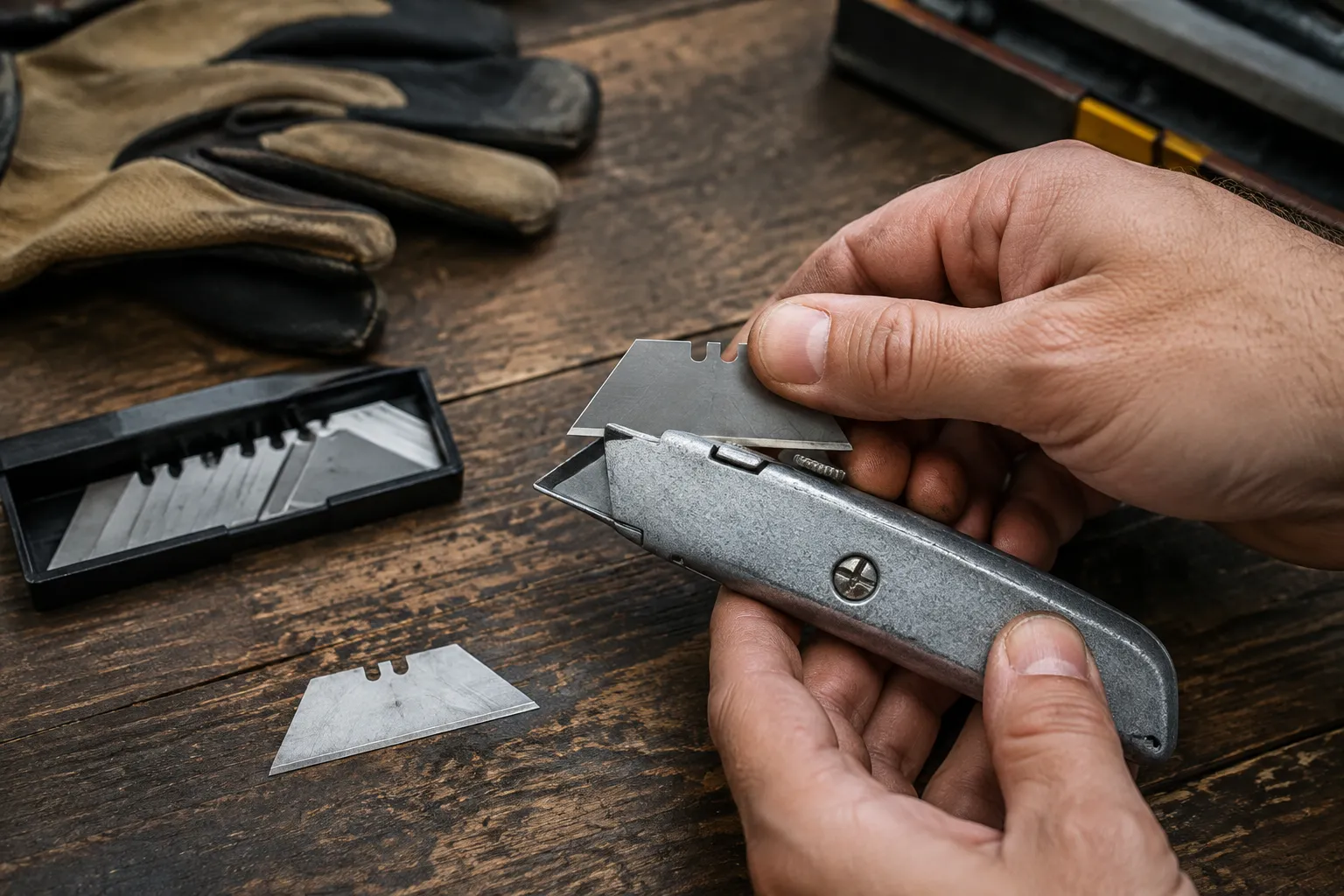
The safer sequence is simple but worth stating plainly. Retract the blade fully first. Then release the locking mechanism and remove the old blade, handling it by the blunt back edge, never by the cutting edge or the tip. Set the old blade down somewhere it cannot roll or fall into a pocket. Insert the new blade with the cutting edge facing away from the hand, push it until it seats fully, and engage the lock before extending the blade again.
That last step, engaging the lock before extending, is where people get sloppy. A blade that is not fully seated can slide forward or backward when pressure is applied, and a blade that slides while cutting is a blade that cuts the hand holding the knife. The mechanism should click or feel physically solid before any cutting begins.
Gloves and grip affect the whole sequence
People wearing work gloves face a separate set of problems. A thick glove reduces tactile feedback, making it harder to tell whether the blade is fully seated or whether the lock has engaged. The glove also makes the blade feel bulkier and harder to control during the swap. Some gloves have a grippy palm coating that can catch on the blade's scored edge, which is uncomfortable but not dangerous. The real hazard is rushing because the hands feel clumsy.
A person who needs gloves for the job should practice changing blades while wearing them, deliberately and slowly, until the motion becomes automatic. This sounds like overthinking a simple task, but it is the difference between a smooth swap and a fumbled one. Fumbling near a sharp blade is how the blade ends up against a finger.
The grip on the knife itself matters too. Some knives have a textured handle that provides traction even with sweaty or oily hands. Others have a smooth plastic body that gets slippery. A knife that slips in the hand during a cut is a knife that the user cannot control, and loss of control is the direct cause of most utility knife injuries. The blade change is not the only moment that matters, but it is the moment when the user's attention is on the mechanism rather than on the cut.
Disposal is part of the chore
Used blades are not harmless scraps. A spent blade is still sharp along most of its edge, and a blade thrown loose into a trash can becomes a hazard for anyone who handles the bag later. The people most likely to get cut by a used utility knife blade are not the people who used it. They are the person taking out the trash, the person sorting recycling, or the person reaching into a toolbox drawer where a loose blade has been sitting for weeks.
A dedicated blade disposal box solves this. These boxes are small, rigid containers with a slot in the top that accepts blades but makes it difficult to reach back in. They are cheap, they last for years, and they turn a recurring hazard into a non-event. A person who changes blades regularly should have one within arm's reach of the workbench, not in another room.
For snap-off blades, the used segments belong in the same box. The segments are small enough to get lost in a pocket or a crevice, and a lost blade segment is a future cut looking for a finger. Treat every used segment as if it will be encountered by someone who is not expecting it, because it probably will be.
Choosing between blade styles on purpose
The choice between a snap-off knife and a fixed-blade knife is often made at the hardware store based on price or habit, not on how the knife will actually be used. That is backward. The blade style should follow the work.
For heavy, continuous work like breaking down boxes all day, a fixed blade with a quick-change mechanism is the better tool. The blade stays sharp longer relative to the work, the change is fast, and the lack of score lines means the blade does not flex under pressure. For light, intermittent work like opening packages at a desk, a snap-off knife is convenient and compact, and the blade can be extended in small increments to match the depth of the cut.
Some people keep both. That is not redundancy. It is recognizing that a desk knife and a workbench knife serve different functions and have different maintenance rhythms. The desk knife gets changed rarely, because it gets used rarely. The workbench knife gets changed constantly, because it earns its keep. Neither situation benefits from using the wrong tool.
A stubby blade changes the feel of the cut
There is a less common blade style worth mentioning because it changes the entire safety equation. Some utility knives accept a shorter, trapezoidal blade that exposes only a small portion of cutting edge. These are sometimes called compact or stubby blades. They force the user to cut with the tip of the blade rather than the full edge, which gives more control for detail work but also makes the knife less effective for long, deep cuts.
The safety benefit is real. A shorter blade is harder to accidentally drive deep into a finger, and the reduced cutting depth means less force is needed to control the cut. For people who use a utility knife primarily for scoring, trimming thin material, or opening boxes without cutting too deep, a stubby blade is a legitimate choice that deserves more attention than it gets.
The trade-off is that stubby blades wear out faster because the same amount of cutting is concentrated on a shorter edge. That is not a flaw. It is a reminder that blade changes are the cost of doing business with a sharp tool, and the person who resists changing blades is the person who ends up forcing a dull edge through material it cannot handle.
Sharpness is a habit, not an event
The regulars at any construction site know the foreman who walks around with a visibly dull blade and still uses it, complaining about the material rather than the tool. Everyone else on the crew changes blades without thinking, because they learned early that the cost of a blade is nothing compared to the cost of a bad cut. The foreman's approach is not thrift. It is a refusal to accept a five-second interruption, and it creates a slow, grinding risk that never announces itself until the moment it turns into a trip to urgent care.
Building the habit means deciding ahead of time when a blade is done. A useful rule of thumb: if the blade needs more than a light pass to cut through a single layer of corrugated cardboard, it is time to change it. This is not an engineering standard. It is a practical threshold that keeps the blade sharp enough to work without forcing, and it is easy to check because the test material is everywhere.
That threshold works for both snap-off and fixed blades. With a snap-off knife, the user has a choice: snap a segment and keep going, or change the whole blade. Snapping is fine if the remaining segments are true and if the snap produces a clean edge. But snapping a segment is also the moment to check how much blade is left. A blade that is down to its last segment or two is a blade that should be replaced entirely, not nursed along.
The mechanics of the snap itself deserve attention. Snapping a blade by hand, by bending it back and forth with fingertips, is a way to get a jagged break and a stray shard. Using a dedicated blade snapper or a pair of pliers gives a clean break at the score line and keeps the fingers away from the edge. The tool costs a few dollars and removes the one step in the snap-off process that is genuinely risky.
Storage keeps blades predictable
New blades come in small cardboard packs or plastic dispensers, and those packages rarely survive contact with a messy toolbox. Blades that are loose in a drawer are blades that get found by accident. A simple metal or plastic blade holder, the kind that holds blades in a stack and dispenses one at a time, is worth the small space it takes. It keeps the blades organized, keeps them dry, and prevents the almost comedic but genuinely dangerous moment of a hand reaching into a drawer and finding a loose blade the hard way.
Moisture is a quieter problem. A blade left in a damp environment will develop rust, and a rusted blade is not just ugly. The rust creates microscopic pits along the cutting edge that make the blade catch and tear rather than slice. A blade that catches is a blade that can pull the knife in an unexpected direction. Storing blades in a dry place, and replacing any blade that shows rust, is a small precaution with a direct payoff in cutting behavior.
The cost of skipping the change
A pack of utility knife blades costs a few dollars and contains enough blades to last most home users for a year or more. A single emergency room visit for a hand laceration costs hundreds of times that amount, not counting the lost time and the inconvenience of doing anything with one hand for a week. The math is not close. The person who uses a dull blade to save a few cents is making the worst financial decision available in the entire hardware store.
The comparison is not abstract. A utility knife cut to the hand, especially to the palm or the fingers, is one of the more common workshop injuries, and it is one of the most preventable. The blade is the cheapest part of the system. The hand is not replaceable. Every time a user decides that the blade can go a little longer, they are betting a hand against the price of a single replacement blade. That is a bet that should never be taken.
The discipline of changing blades is not about being fussy or wasting material. It is about respecting the fact that a cutting tool does its job only when the edge is true. A sharp blade cuts with the weight of the knife and a light touch. A dull blade demands force, and force is what turns a controlled tool into an uncontrolled one. The fix takes seconds, costs almost nothing, and removes the single largest variable in how safely the knife behaves.
Next time the blade starts to drag, change it. Not when it stops cutting, not when it begins to tear, but the moment it stops feeling effortless. The new blade will feel almost too sharp, and that is exactly the point. The tool is supposed to feel capable. It is supposed to feel like it can do the job without a fight. The moment it stops feeling that way is the moment the blade was already past due.