
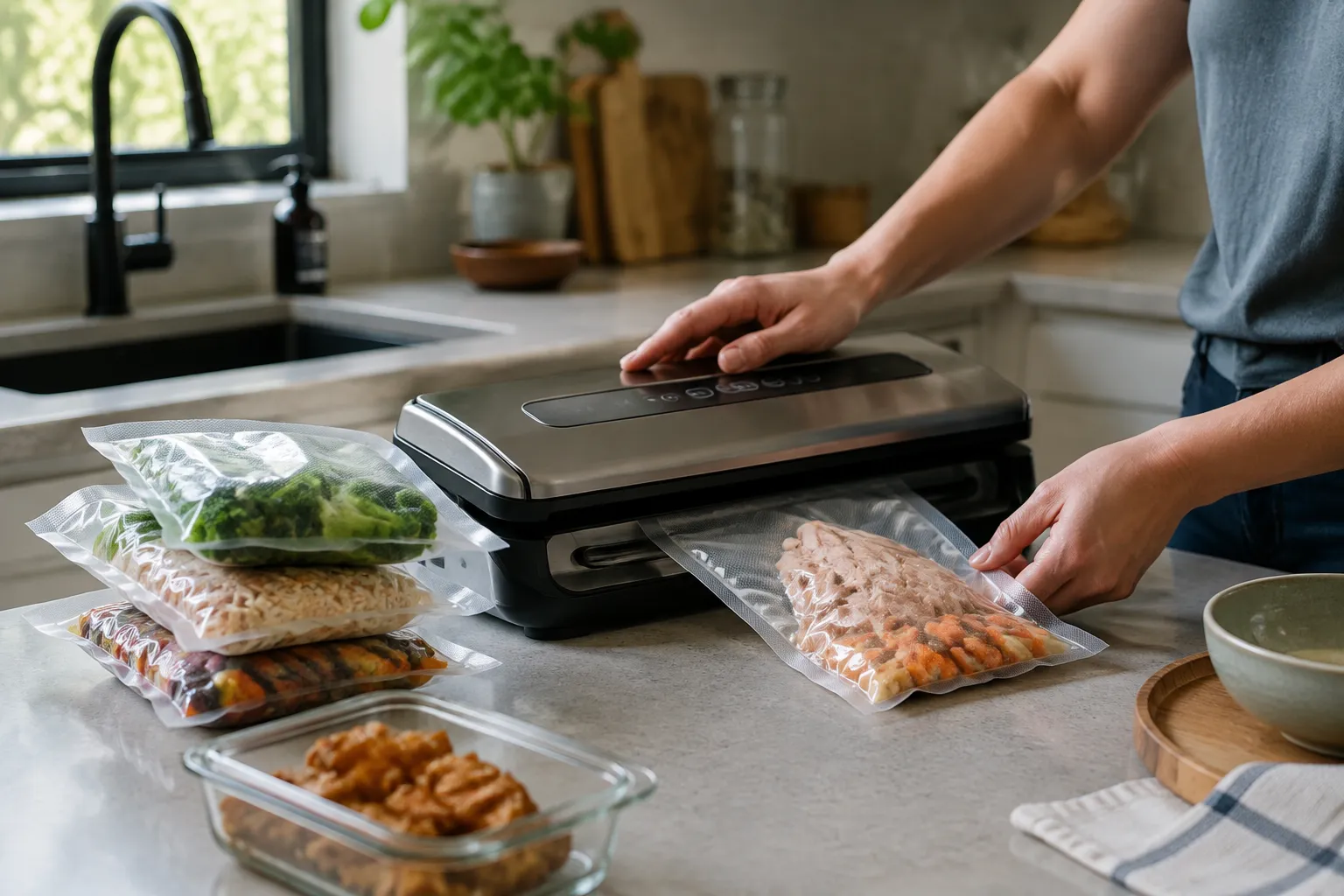
Vacuum sealers have a branding problem. The marketing photos show a raw ribeye, a sous-vide bath, a bag of frozen berries arranged like a still life. Nobody photographs Tuesday's leftover chili. Nobody photographs the half a lemon, or the three slices of roast chicken that will otherwise become a science experiment at the back of the fridge by Friday. For most households, the honest use case for a vacuum sealer is not the dramatic weekend cook. It is the unglamorous, ongoing fight against food that spoils before a person gets around to eating it. That fight is where the machine either earns its counter space or becomes another appliance that gets dragged out twice a year.
The first thing to understand is that a vacuum sealer does not preserve food the way a container does. A Tupperware lid traps air inside the vessel with the food. The food then sits in that trapped atmosphere, exchanging moisture and odors with the pocket of air around it. A vacuum sealer removes the atmosphere entirely. Without oxygen, the aerobic bacteria that cause most spoilage stop multiplying. The food is not refrigerated in the usual sense. It is arrested. A bag of cooked pasta sealed properly will last a week and a half in the fridge, where the same pasta in a deli container turns into a solid brick by day three. That difference is the entire point of the machine.
The mistake most people make on their first attempt is sealing food that is still warm. The machine draws a vacuum, the warm food releases steam, and the steam condenses inside the bag. The result is a bag half full of liquid and a seal that weakens as the moisture migrates toward the heat strip. The fix is a short waiting period. Let the food come to room temperature on the counter, or better yet, chill it in the fridge uncovered for an hour before sealing. This is not a gourmet technique. It is the difference between a bag that holds for ten days and a bag that leaks on day two.
Another early failure is overfilling the bag. A person seals a quart of soup, leaves two inches of headroom, and wonders why the liquid gets sucked into the machine's channel and ruins the seal. Liquids need a different approach entirely. The standard solution is to freeze the soup in a shallow container first, then vacuum seal the frozen block. This works, but it adds a step and requires planning. A simpler method for smaller portions is to roll the bag's open end over a spatula before inserting it into the chamber, which prevents liquid from reaching the sealing strip. Neither method is complicated. Both require the user to stop thinking of the sealer as a one-button device and start thinking of it as a tool with variations.
The Vegetable Problem
Vegetables are where most vacuum sealer owners give up. Raw broccoli sealed fresh goes bad faster than raw broccoli in a paper bag. This seems counterintuitive until the mechanics are clear. Many vegetables continue to respire after harvest, releasing ethylene gas. In an oxygen-free bag, that ethylene has nowhere to go, and the vegetable essentially suffocates in its own exhaust, turning mushy and sour. The solution is not to avoid sealing vegetables. The solution is to blanch them first.
Blanching is a two-minute dip in boiling water followed by an ice bath. Green beans get ninety seconds. Carrots get three minutes. The process deactivates the enzymes that cause deterioration, and once those enzymes are neutralized, the vegetable holds in a sealed bag for months rather than days. A person who blanches a pound of green beans on a Sunday afternoon has a salad ingredient, a stir-fry component, or a side dish ready on a Wednesday night three weeks later. It is a small ritual with an outsized payoff, and it is the difference between using the sealer for vegetables and abandoning it for vegetables.
Leafy greens present a special case. Spinach and kale, even blanched, crush into a wet paste when vacuum sealed with force. The gentle option is to use the pulse function, if the machine has one, sealing just until the air is mostly out and then stopping. The bag will not be perfectly flat. It will have a little give. That give is what keeps the leaves intact. Another approach is to roll the leaves into a tight cylinder before bagging, which lets the air escape along the roll's length rather than crushing the leaves into each other. Neither method is perfect. Both produce a usable product, which is more than can be said for the alternative.
The Leftover That Actually Rewards Sealing
The single best thing to vacuum seal is not a steak or a soup. It is cooked rice. A batch of rice cooked on Sunday, sealed in meal-sized portions, and refrigerated, holds for a full week. Reheated in the microwave with a damp paper towel over the bag's opened top, it comes out fluffy and separate, indistinguishable from freshly cooked rice. The same rice in a container develops that stale, clumped texture by the next evening. The mechanism is straightforward: the vacuum removes the moisture that would otherwise encourage bacterial growth and that same moisture loss prevents the starch from turning gluey. It is the kind of result that makes a person feel like they have discovered something that the appliance manufacturers forgot to mention.
Cooked pasta behaves similarly, though with one caveat. Pasta sealed with sauce becomes a single solid mass. Pasta sealed dry, tossed with a little oil, holds its shape and reheats well. The trick is to stop thinking of the leftover as a finished dish and start thinking of it as components. Sauce in one bag. Noodles in another. Reheat separately and combine. This is not a restaurant technique. It is the practical consequence of understanding what the vacuum does and does not do to different textures.
Meat leftovers are the most forgiving category, which is fortunate because they are also the most common. A roast chicken carved and sealed in individual portions keeps for five days without losing moisture. Sliced turkey from a holiday meal survives for months in the freezer, and it thaws in a bowl of cold water in under an hour because the vacuum-packed shape is thin and flat. The flatness is the advantage. A freezer full of round containers takes up twice the space of the same volume sealed flat, and it thaws in half the time. Anyone who has ever wrestled a frozen quart of stock out of a freezer while dinner waits knows how much that speed matters.
The Freezer Is the Real Destination
The refrigerator is where the sealer earns its keep for short-term storage. The freezer is where it changes a household's relationship with food. A person who seals leftovers before freezing them is not just preventing freezer burn. They are preventing the slow degradation of texture that makes frozen food taste sad. Freezer burn is dehydration, and dehydration is the result of air reaching the food's surface. The vacuum bag eliminates that air entirely. A sealed pork chop frozen for two months still has its original moisture when thawed. The same chop in a plastic wrap and foil package is a leathery disappointment by week three.
The economics work out too, though not in the way the marketing suggests. The bags are not cheap. A roll of the good stuff runs about fifteen dollars and yields roughly twenty feet. A household that seals three or four meals a week goes through a roll in a month. That is a real recurring cost. But the offset comes from the other direction. A person who seals leftovers actually eats them. A person who stores leftovers in containers watches a third of them go bad and throws them out. The sealer does not just preserve food. It converts food that would have been wasted into meals that get consumed. Over a year, that conversion pays for the machine and the bags several times over.
There is a particular satisfaction in opening the freezer and seeing a neat stack of flat, labeled bags instead of a jumble of frost-covered plastic tubs. Each bag represents a decision already made, a meal already cooked, a portion already portioned. The mental load is lighter. On a busy Tuesday, nobody needs to decide what to make. The decision was made three weeks ago, and the answer is sitting in a flat white pouch with the date written on it in permanent marker.
The Bag Question
Not all bags are equal, and the difference is not the brand name. The critical factor is the texture of the bag's interior. The cheapest bags have a smooth inner surface, which means the air cannot escape evenly as the vacuum draws, and the seal often ends up with wrinkles that leak. The better bags have an embossed or channeled interior that gives the air a path out. A person who buys the off-brand smooth bags will blame the machine. The machine was never the problem. The bag was the problem.
Reusable bags exist, and they are a reasonable choice for dry goods or for short-term refrigeration. For anything going into the freezer, the single-use bags are safer. The reusable bags have a zipper mechanism that is a potential failure point, and a failed seal in the freezer means the food gets air, gets frost, and gets thrown out. The waste from one ruined batch of food exceeds the cost of a dozen disposable bags. The disposable option is not laziness. It is the rational choice for anything that matters.
Sealing liquids requires the bag to be filled no more than halfway, and even then, the vacuum will pull liquid toward the seal. The standard workaround is to freeze the liquid into a block first. For smaller volumes, a person can stand the bag upright in a tall glass, fill it, and use the sealer's pulse function to draw out the air in short bursts, stopping before the liquid reaches the top. This takes practice. The first few attempts will fail. The fourth attempt produces a sealed bag of soup that holds for months, and that is the moment the machine becomes indispensable.
A Note on the Seal Itself
Most entry-level sealers come with two seal settings and a vacuum setting. The mistake is using the vacuum setting for everything. Delicate items, like bread or berries, get crushed by the full vacuum. The pulse setting exists for exactly this reason. A person who is sealing a loaf of bread should use the dry food setting, which pulls less air, and then watch the bag as it compresses. The goal is not a rock-hard brick. The goal is a bag with most of the air removed and the bread still intact. The learning curve is short, but it requires the user to pay attention rather than pressing a button and walking away.
The seal quality also depends on keeping the bag's opening clean. A single drop of liquid or a crumb of food on the sealing strip will cause the seal to fail, sometimes days later when the bag is already in the freezer. The habit of wiping the bag's open edge with a paper towel before sealing takes two seconds and saves a week of frustration. It is the kind of small, unglamorous detail that separates a person who uses the sealer regularly from a person who tried it once and put it in the back of a cabinet.
The Empty Drawer Problem
The vacuum sealer has a well-earned reputation as a wedding-registry gift that gets used three times and then lives in a drawer. That reputation is not the machine's fault. It is the fault of the expectation that the machine will transform cooking overnight. A vacuum sealer does not change how a person cooks. It changes how a person stores what they have already cooked. It rewards the batch cook, the meal planner, the person who looks at a package of chicken breasts and sees six future dinners instead of one immediate one. For someone who does not think in those terms, the machine will indeed collect dust.
The households that get real use out of a sealer tend to share one trait: they treat the machine as part of the cooking process, not as a separate task. The sealer lives on the counter, not in a cabinet. The bags are stored next to it. When a meal is cooked, the leftovers are portioned and sealed within the hour, while the impulse to save them is still fresh. The machine becomes a reflex, like rinsing a cutting board or wiping a counter. The gear that stays visible gets used. The gear that gets put away gets forgotten.
A person can spend forty dollars on a basic sealer or two hundred on a chamber model with all the features. For the purposes of leftovers, the basic model does everything necessary. The expensive models are faster and quieter and they handle liquids without the freeze first step, but they do not preserve food better. They preserve it at the same rate, with more convenience. A household that is still deciding whether to commit should start cheap. The bags are the real cost, and they are the same regardless of which machine draws the vacuum.
The measure of success is not the sealed bag on day one. It is the absence of the sad container at the back of the fridge on day six. It is the frozen soup that thaws in twenty minutes on a night when nobody feels like cooking. It is the green beans from a farmers market trip that still taste like green beans in February. The vacuum sealer does not make anyone a better cook. It makes a person a better planner, and for the people who adopt it, the weekly rhythm of cooking shifts from a series of daily battles to a system where the work happens all at once and the payoff stretches across the week. That is the real promise of the machine, and it has nothing to do with the sous-vide bath in the marketing photos.