
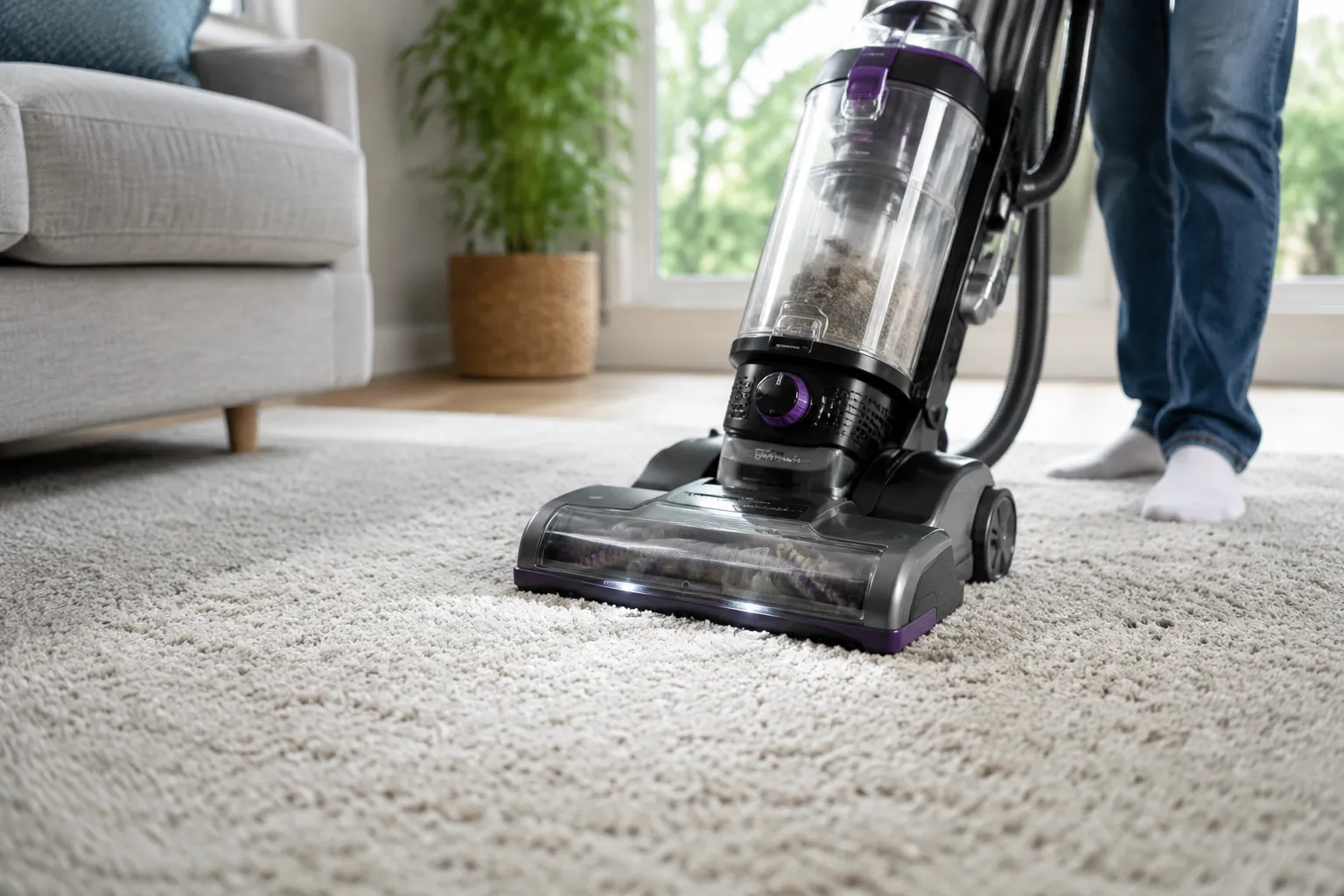
The upright vacuum cleaner is the most misunderstood appliance in the American home. People treat it like a trash bin on wheels, pushing it across the floor until the carpet looks uniformly flattened, then they empty the canister and wonder why the pile feels stiff and the colors look dull. The machine is not the problem. The technique is the problem. A person can spend eight hundred dollars on a German-engineered canister vacuum and still get mediocre results by pushing it the same way they would push a shopping cart. The difference between a carpet that looks clean and one that actually is clean comes down to a handful of physical principles that most owners never learn, mostly because nobody ever bothered to explain them.
The first thing to understand is that an upright vacuum is a tool for agitation, not just suction. The motor drives a brush roll that beats the carpet pile, and that beating is what loosens the grit, dust, and dander that settle deep into the backing. Suction only carries away what the brush has already freed. This is why a vacuum with weak suction but a good brush roll can outperform a powerful one with a lazy beater bar. The carpet fibers need to be physically disturbed, and the person operating the machine is the one controlling how much disturbance actually happens.
The Slow Pass Is the Only Pass That Matters
Speed is the single biggest mistake. Most people push an upright at roughly the pace of a brisk walk, covering a three-meter stretch of hallway in about four seconds. At that speed, the brush roll contacts each section of carpet for a fraction of a second, barely enough to flick the surface of the pile. The result is a carpet that looks vacuumed to the naked eye but still holds a surprising amount of embedded dirt. A simple test proves this: vacuum a high-traffic area at normal speed, then go over the same patch at a deliberately slow, almost exaggerated pace, maybe one meter every three seconds. The second pass will pull up visible dust, lint, and pet hair that the first pass missed. That visible material was sitting in the carpet the whole time, and the fast pass never touched it.
The physics here are straightforward. Deeper dirt needs more brush strokes to be lifted to the surface, and more brush strokes require more time per square meter of carpet. A slow, deliberate forward push gives the brush roll perhaps eight to ten full revolutions over any given spot, compared to two or three at normal speed. Those extra revolutions are what dislodge the fine particles that have been ground into the pile by foot traffic. The suction then has something to grab. It is not a dramatic difference in the first pass, but over the life of a carpet, the cumulative effect is enormous.
There is a practical limit to this. Going so slow that the vacuum sits in one place for many seconds can leave a visible brush mark on certain plush carpets, and it does not meaningfully improve pickup beyond a certain point. The right pace is somewhere between a funeral procession and a Sunday stroll. A person should be able to count one-one-thousand, two-one-thousand as they push forward, and the carpet should get about two seconds of contact per forward stroke.
Overlap Each Stroke by Half Its Width
The second technique is about coverage, and it requires a person to ignore the natural instinct to cover ground efficiently. Standard advice says to overlap each pass by about fifty percent, but most people overlap by maybe ten percent, if they overlap at all. The vacuum head is roughly thirty centimeters wide, and the effective cleaning zone under that head is narrower than the head itself. The brush roll has edges, and those edges do less work than the center. If a person runs each stroke so that the new pass only just kisses the previous one, the edges of both passes receive almost no agitation. A strip of carpet down the middle of each stroke gets properly cleaned, but the seams between strokes stay dirty.
Overlapping by half solves this. The center of the new stroke covers the edge of the previous one, and the brush roll gets a second chance to work the strip that was only grazed before. This doubles the time spent on any given square meter of carpet, but it also doubles the actual cleaning effectiveness. For a room that is four meters by five meters, the difference is maybe four extra minutes. That is a small price for a carpet that is uniformly clean rather than clean in stripes.
This overlap matters most in high-traffic zones: the strip in front of the sofa, the path from the door to the kitchen, the landing at the top of the stairs. Those areas have more embedded soil, and the edges of the vacuum head struggle the most there. A person who overlaps carefully in those spots will see a visible difference in pile color within a few weeks.
The Backward Stroke Does Half the Work
Uprights are designed to clean on both the push and the pull, but many owners treat the backward stroke as a formality, a way to get back to the starting point for the next forward push. That is wasted effort. The brush roll spins in one direction regardless of which way the machine travels, and the pile gets agitated just as effectively on the pull as on the push. The difference is that the backward stroke is easier to control slowly. A person naturally brakes on the pull, easing off the throttle to avoid yanking the machine over their feet. That slower pace gives the brush roll even more revolutions per meter than the forward push.
The trick is to use the backward stroke as a deliberate cleaning pass, not a repositioning move. Pull the machine back at the same slow pace as the forward push, and let the brush do its work. This effectively doubles the cleaning time without any extra steps. A room that takes ten minutes with lazy pulls takes the same ten minutes with deliberate pulls, but the carpet gets twice the agitation.
One caution: on very plush or high-pile carpets, the backward stroke can sometimes grab the pile and cause the vacuum to resist or stall. When that happens, a person should shorten the stroke rather than speed it up. Short, slow pulls are better than long, fast ones. The goal is agitation, not distance.
Adjust the Height Setting Like the Manual Says, Not Like a Neighbor Says
The height adjustment on an upright is the most ignored feature on the entire machine. Most owners set it once when they buy the vacuum and never touch it again, even when they move from a low-pile hallway to a plush bedroom. The result is a brush roll that either slams into the carpet too hard, wearing the fibers prematurely, or floats above the pile, barely touching it at all.
The correct setting is the one where the brush roll just barely touches the carpet pile with the vacuum resting at its natural angle. A person can check this by pushing the machine forward slowly and listening. A rhythmic slapping sound means the brush is hitting the carpet too hard. A high-pitched whine with no brush contact means the head is floating too high. The sweet spot sounds like a soft, continuous brushing, with no slapping and no whine.
A practical test: set the height to the lowest position, then raise it one click at a time until the vacuum is noticeably easier to push but still makes that brushing sound. That is the right setting for that particular carpet. When moving to a different room, check again. Carpet pile height varies more than most people realize, even within the same house.
Running the brush too low for an extended period is the quickest way to ruin a carpet. The bristles grind against the backing, fraying the fibers and creating a fuzzy, worn appearance that no amount of cleaning can fix. The people who complain that their carpet "aged" in two years are often the same people who never touched the height dial.
Empty the Canister Before It Looks Full
Bagless uprights have a dirty little secret: their suction drops off long before the canister looks full. The fine dust that passes through the cyclones clings to the filter and the inner walls of the canister, and that buildup restricts airflow even when the visible debris only fills a quarter of the container. A person who empties the canister only when it looks full is running the vacuum at reduced efficiency for most of its life.
The fix is simple but counterintuitive: empty the canister every time the debris reaches about a third of its capacity, or after every two or three rooms, whichever comes first. The extra minute it takes to pop the canister off and dump it into the bin is cheaper than buying a new vacuum motor. Low airflow also makes the brush roll work harder, because the carpet fibers are not being lifted into the suction path as effectively. The agitation happens, but the dirt stays put.
The filter deserves the same attention. Most uprights have a pre-motor filter that catches fine dust before it reaches the motor, and a post-motor filter that scrubs the exhaust air. Both need periodic cleaning. A clogged pre-motor filter is the fastest way to kill suction, and it is almost invisible to the casual user because the canister still looks empty. A person should check the filter every month, rinse it if it is washable, and replace it every six to twelve months depending on how much the machine gets used.
The Second Pass at a Right Angle
For a truly deep clean, one pass in a single direction is never enough. Carpet pile has a natural grain, a direction it leans in, and dirt tends to settle along that grain. Vacuuming parallel to the grain lifts the surface debris but leaves the deeper particles nestled between the fibers. A second pass perpendicular to the first, crossing the room at a right angle, attacks the pile from the other direction and lifts the dirt that the first pass missed.
This is the technique professional carpet cleaners use, and it is the one homeowners skip because it feels wasteful. Going over a room twice, in two directions, doubles the time and effort. But for a room that gets heavy foot traffic, it is the difference between a carpet that looks tidy and one that is actually free of embedded grit. The perpendicular pass does not need to be as slow as the first. A normal pace on the second pass is fine, because the brush is now working against the grain and the dirt is already loosened.
This matters most in entryways and hallways, where people track in fine outdoor soil that acts like sandpaper underfoot. That grit grinds against the carpet fibers with every step, cutting them and dulling their sheen. A perpendicular pass once a week will remove the majority of that abrasive material before it does lasting damage.
Edges, Corners, and the Gap Under Furniture
The wide head of an upright cannot reach into corners, and it cannot slide under low furniture. Most owners accept this and let the edges accumulate dust and pet hair until they become visible, then they break out a handheld vacuum or a broom. A better approach is to treat the edges as part of the regular routine, even if it takes an extra minute per room.
The tool for this is the crevice tool, that narrow plastic tube that lives in the accessory holder and rarely gets used. Running the crevice tool along the baseboards every second or third vacuuming session catches the dust bunnies and hair that the main head never touches. This is not glamorous work, but it is what separates a room that looks clean from a room that is clean.
For the gap under furniture, the trick is to use the vacuum's adjustment. Many uprights let the handle recline fully, allowing the head to slide under a sofa or bed. A person who skips this step is leaving an entire zone of the room untouched, and that zone is where dust accumulates most because it is never disturbed. Once a month, pull the couch out from the wall and run the vacuum underneath, or use the reclined position to reach as far as the head will go.
The Brush Roll Needs a Haircut
The brush roll is the beating heart of the upright, and it gets strangled slowly by hair, thread, and carpet fiber. Human hair and pet hair wrap around the bristles and the central spindle, and over time they form a thick rope that prevents the brush from spinning freely. A brush roll that is wrapped in hair does not clean; it just skids across the carpet, leaving a greasy smear instead of a proper agitation.
Most modern uprights have a brush roll that can be removed with a coin or a screwdriver, and the removal process takes about two minutes. The hair and thread can be cut off with scissors and discarded. This maintenance task should happen every two to four weeks for a household with long hair or pets, and at least monthly for everyone else. The difference in cleaning performance after a brush roll clean-out is dramatic. The vacuum suddenly pulls noticeably harder, and the carpet feels different underfoot, fluffier and less packed.
Ignoring the brush roll is the fastest way to shorten the life of the vacuum itself. A wrapped brush roll puts extra strain on the belt and the motor, and those are the two most expensive parts to replace. A pair of scissors and five minutes of attention is cheaper than a new motor assembly.
The Last Pass Should Be in the Direction of the Pile
After the perpendicular pass, the room will look clean but slightly rumpled, with the carpet pile pointing in conflicting directions. The final pass should be a single slow sweep in the dominant direction of the pile, which is usually the direction of the main traffic flow. This pass is not about dirt removal; it is about presentation. It lays the pile down evenly, giving the carpet a uniform sheen and a smooth, freshly-installed appearance.
This is the difference between a carpet that has been cleaned and a carpet that has been cleaned and finished. The finishing pass takes less than a minute per room, and it is the step that makes the whole effort visible to anyone walking in with shoes off. A person can see the difference in the way light reflects off the carpet. A properly finished carpet has a consistent, soft glow. One that has been vacuumed in random directions looks patchy and dull.
This final pass, more than any other, is what separates a routine chore from an act of care. The machine is doing the same work it always did, but the person operating it is paying attention to the material, to its grain, and to the way it responds to the brush. That attention is the entire secret. Everything else is just mechanics.