
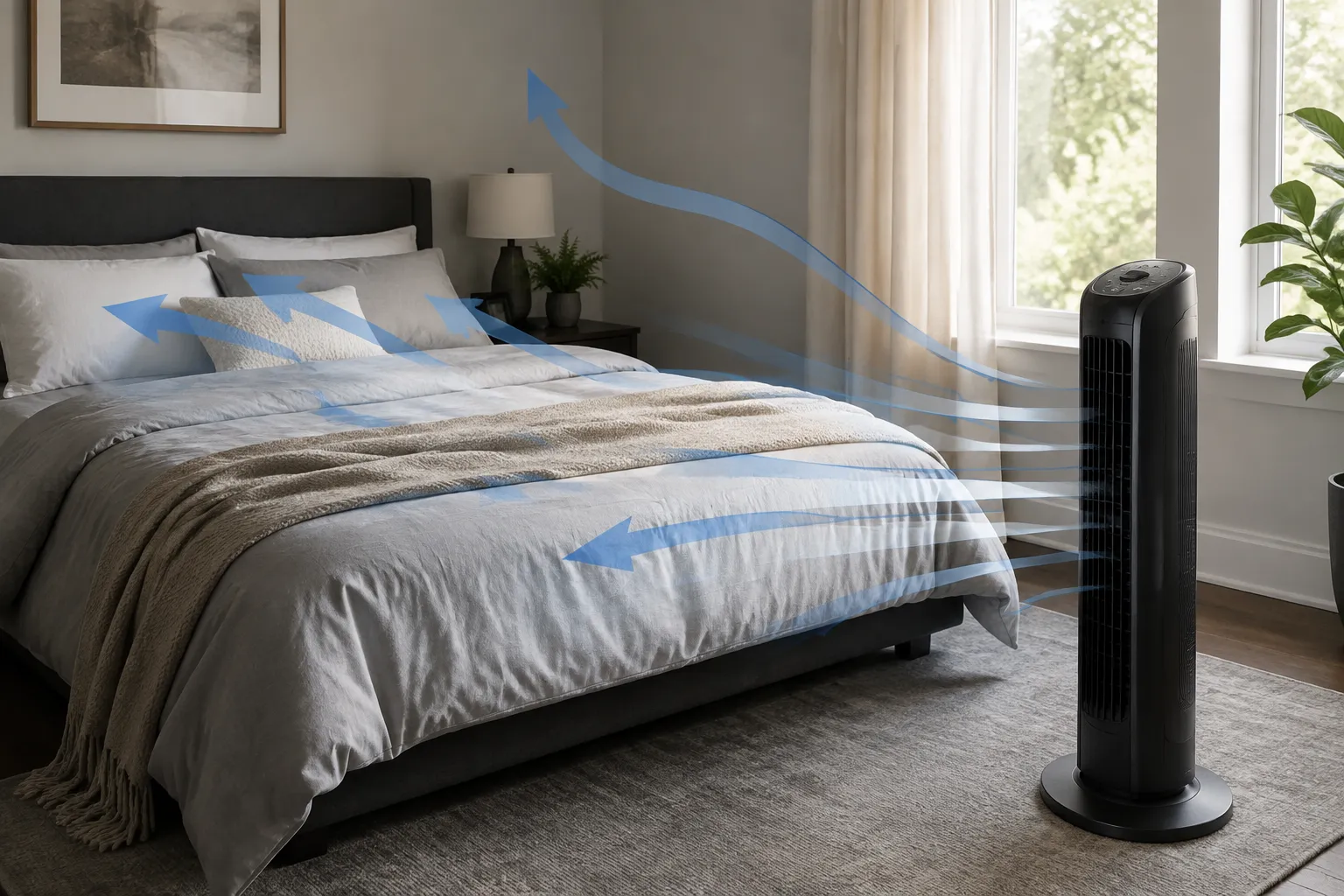
Most people set a tower fan next to the bed, point it at the mattress, and call the job done. That placement works about as well as putting a speaker in a closet and wondering why the room sounds empty. A tower fan is a column of moving air, and how that column interacts with the walls, the bed frame, and the ceiling determines whether the room feels like a breeze or just a noisy corner. The difference between a bedroom that cools down and one that stays stuffy is rarely the fan itself. It is almost always the geometry of the room and the stubbornness of the person who refuses to move the fan three feet to the left.
Before getting into specific spots, it helps to understand what a tower fan actually does well. The tall, narrow housing and the oscillating head create a wide, vertical sheet of air. That sheet is excellent for pushing air across a long distance along a single plane. It is terrible at creating the chaotic, swirling turbulence that a pedestal fan or a ceiling fan generates. A tower fan is less a mixer and more a courier. It takes air from one place and delivers it to another. Placement should respect that job description. The goal is to give that courier a clear, unobstructed route and a useful destination.
The Corner Trap and Why It Fails
The most common mistake is tucking the tower fan into the corner of the bedroom, often behind a chair or beside a dresser. The logic is usually about aesthetics or keeping the cord out of the walking path. The result is that the fan pulls air from a dead zone and pushes it into a wall. The oscillating head sweeps through a 90-degree arc, and for most of that arc, the air is slamming into drywall or the side of a wardrobe. The room gets a faint stirring near the fan and nothing else.
Corners are where air stagnates. They are also where dust collects and where the airflow is most restricted by furniture. A tower fan in a corner is effectively recycling the same pocket of stale air, over and over. The temperature reading on the thermostat might drop a degree or two from the motor's heat, but the bed stays warm.
The fix is to pull the fan out of the corner entirely. It does not need to be centered in the room, but it needs at least two feet of clear space on both sides. That clearance lets the fan draw fresh air from two directions instead of sucking against a wall. The difference is immediate. A fan with open intake draws more volume, moves air faster, and sounds less strained in the process.
Aiming Across the Bed, Not at It
Pointing a tower fan directly at the bed from the foot is the second most common setup. It feels logical. The fan is close, the breeze is felt on the legs and torso, and the noise is a familiar white noise. But a tower fan aimed straight at a sleeping person has a narrow effective zone. The vertical sheet of air hits the body, gets deflected, and then dissipates. The rest of the room remains unmoved.
A better approach is to position the fan at the side of the bed, aimed across the mattress rather than down its length. The air sheet then travels over the entire surface of the bed, catching the whole body and carrying heat away from the skin across a wider area. It also creates a gentle cross-breeze that works with the body's natural cooling mechanisms instead of blasting one patch of skin until it feels cold and then leaving the rest to sweat.
This placement also solves a practical problem. A fan at the foot of the bed is often in the way, getting kicked by feet or bumped during the night. A fan at the side, tucked slightly behind the headboard line, is out of the way and still delivers air across the sleeping surface. The tradeoff is that the breeze is less intense on the face, which some people miss. For those who need direct airflow on the face, the answer is not to move the fan back to the foot. It is to angle the fan slightly upward so the air touches the pillow area before the column drops.
The Ceiling as a Distribution Tool
There is a trick that works better than almost any other placement, and it relies on physics rather than proximity. A tower fan placed on a low dresser or a sturdy nightstand, aimed upward at a 30 to 45 degree angle, turns the ceiling into a giant air deflector. The air hits the ceiling, spreads out, and then falls gently across the entire room. This creates a soft, even circulation that feels like a natural breeze rather than a mechanical blast.
This setup is especially effective in rooms with high ceilings or in rooms where the bed is positioned against a wall with no good side access. The fan does not need to be aimed at anything in particular. It just needs to push air into the ceiling at a sharp enough angle to deflect it. The result is a room that feels several degrees cooler without any direct blast on the body.
The downside is that this placement requires a stable, elevated surface. A tower fan on the floor cannot achieve the angle properly because the ceiling is too far away and the air has too much time to dissipate. A low dresser or a wide nightstand works well. The fan should be secured so it does not vibrate off the edge, and the power cord needs to reach. This is not a setup for a cramped room, but for a standard bedroom, it transforms the airflow dynamics completely.
The Window Inlet and the Exhaust Moves
Bedrooms that get hot at night often have a window that faces the evening sun or a room that sits above a garage. In those cases, the fan needs to work with the outside air, not against it. The classic move is to set the tower fan in front of an open window, blowing inward. That works, but only if the fan is close enough to the screen and the window is open a specific amount.
The tower fan's air intake is on the back of the unit, which is a problem for window placement. Most tower fans draw air from the rear panel, not the front. If the fan is placed with the back facing the window, it pulls cool night air into the room and pushes it out the front. If the back is facing the room, it just recirculates indoor air. The correct orientation is back to the window, front to the room.
For an exhaust setup, the fan goes in the window opening itself or directly in front of it, blowing outward. This pulls hot, stale air out of the bedroom and draws fresh air in through whatever other opening exists in the room, even a slightly open door. The exhaust method is more effective when the outside temperature is lower than the indoor temperature, which is typical in the late evening. It is also the best setup for clearing out the heat that accumulates during the day.
A single tower fan cannot do both jobs at once. A person has to pick one mode. The window-inlet mode is better for direct cooling of the body, while the exhaust mode is better for reducing the overall room temperature. For most people, the exhaust mode is the more useful one, because a cooler room means the body can shed heat through the night without relying on direct airflow.
Doorway Positioning for Cross-Flow
Bedrooms with a door and a window on opposite walls have a built-in airflow path that most people ignore. The door and the window create a pressure difference, especially at night when the rest of the house is cooler or warmer than the bedroom. A tower fan placed in the doorway, not inside the room, takes advantage of that pressure differential.
The fan should sit in the doorframe, aimed into the room or out of it, depending on the temperature difference. If the hallway is cooler, the fan blows into the bedroom. If the bedroom has been baking all day and the hallway is warmer, the fan blows out of the bedroom to vent the heat. The key is that the fan is in the flow path, not off to the side. Doorway placement turns the entire hallway into an air source or an air sink.
This is the one placement where the fan's height and narrow profile are advantages. A box fan does not fit cleanly in a doorway without blocking it. A tower fan takes up minimal floor space, leaves the top half of the doorway open for people to step over, and still moves a substantial volume of air. It is not a permanent solution, but for a hot evening, it is the most effective use of a tower fan in the entire house.
Oscillation Settings Are a Placement Decision
The oscillation function on a tower fan is often treated as a gimmick, but it is actually a placement tool. The fan's position determines what the oscillation arc covers. A fan placed in the center of a wall, oscillating, sweeps across the whole room. A fan placed in a corner, oscillating, sweeps across two walls and a chair. The placement should be chosen with the sweep in mind.
For a bedroom, the best use of oscillation is to cover the bed and the walking path. That means the fan should be placed such that the oscillation arc includes the foot of the bed and the area near the dresser. A person gets up in the middle of the night, walks across the room, and hits a patch of moving air. That is a small comfort, but it matters.
Fixed, non-oscillating mode is better when the fan is aimed at a specific target, like the ceiling or the bed. Oscillation scatters the airflow and reduces the force at any single point. If the goal is a gentle room-wide circulation, oscillate. If the goal is a defined breeze, lock the fan in place. Most tower fans have a button that stops the oscillation, and most people never use it. Using it changes the character of the room entirely.
Low Placement vs. Elevated Placement
Tower fans are marketed as floor units, but the floor is the worst possible height for cooling a bed. The bed sits at 18 to 24 inches off the ground. A tower fan on the floor pushes air across the carpet, where it gets trapped by the bed skirt, the dust ruffle, and the low-profile frame. The air never rises to the mattress.
Elevating a tower fan changes its effectiveness more than any other single adjustment. A fan on a sturdy stool, a low table, or a wide nightstand puts the output at mattress level. The air sheet then travels across the sleeping surface instead of underneath it. The difference is dramatic. A room that felt warm with the fan on the floor feels cool with the fan raised just 12 inches.
The stability concern is real. Tower fans are top-heavy, with the motor and the blades at the bottom but the tall housing creating leverage. A fan on a wobbly stool is an accident waiting for a sleepy stumble. The elevated surface needs to be solid and wide enough that a bump does not send the fan crashing. A thick wooden stool or a low bookshelf works. A plastic bin or a stack of books does not.
The Fireplace and the Heat Source Problem
Bedrooms with a wall-mounted heater, a radiator, or a vent on the floor have a specific complication. A tower fan placed near a heat source will push that warm air around the room, which is the opposite of cooling. The fan does not care where the air came from. It just moves it. Placing a fan near a radiator or a heat vent turns the fan into a convection oven for the bedroom.
The solution is to keep the fan as far from any heat source as the room allows. That often means placing the fan near the coldest exterior wall or the window. The fan pulls air from that cooler zone and distributes it. This is a case where the placement is dictated entirely by the negative space, by where the heat is not, rather than by where the bed is.
It also means being honest about the time of day. A bedroom with a south-facing window is an oven at 6 PM and a refrigerator at 2 AM. The fan placement that works at midnight, blowing air from the window across the bed, is wrong at 7 PM when the window is still radiating heat. The best setup is one that can be adjusted. A fan on a low cart or a dolly that can be moved a foot or two throughout the evening is more useful than a perfectly placed fan that never moves.
The One-Foot Rule for Walls and Furniture
Every tower fan manual mentions clearance, but the number is usually buried in the fine print. The practical version is that a tower fan needs at least 12 inches of clear space on every side except the front. The intake is on the back, so that rear clearance is critical. A fan pressed against a wall is suffocating itself, drawing air through a half-inch gap instead of the full intake, and making a whining noise while doing it.
Furniture is the bigger problem. A tower fan wedged between a bed and a nightstand has less than the required clearance on both sides. The fan still spins, but the airflow is reduced to a fraction of its capacity. The motor runs hotter, the noise increases, and the cooling effect drops. People assume the fan is weak or cheap. The fan is just choked.
The one-foot rule is a good habit to adopt. If the fan cannot be placed with a foot of breathing room on the back and sides, it needs to move. This often means the fan cannot live in the tight spot that seems convenient. That inconvenience is the price of actual airflow. A fan with proper clearance moves more air at a lower speed setting, which means less noise and a longer motor life.
The Remote Control Is a Clue
Most tower fans come with a remote control, and the remote is a strong hint about intended placement. The IR receiver on the fan is usually a small window near the bottom of the housing. For the remote to work, the fan needs to be within a direct line of sight from the bed. That means the fan should be placed so that a person lying down can point the remote at it without sitting up.
The remote requirement often conflicts with the ideal airflow placement. A fan placed near the ceiling, aimed upward, might be perfect for circulation but the IR receiver points at the wall. A fan placed at the foot of the bed is remote-friendly but less effective for cooling. The workaround is to accept that the fan will be controlled manually, or to find a placement that satisfies both. A fan on a dresser across from the foot of the bed, aimed upward at the ceiling, often hits both marks. The remote works, and the airflow is room-wide.
This is a small detail, but it is the kind of detail that determines whether a fan gets used to its full potential. A fan that cannot be turned off without getting out of bed gets left running all night, wasting energy and overcooling the room. A fan that can be adjusted from the pillow gets tuned to the right setting, and the room stays comfortable.
The real lesson is that a tower fan is not a set-and-forget appliance. It is a tool that responds to its environment. Moving it one foot to the left, raising it onto a stool, or turning it to face the ceiling changes what it does for the room. The best placement is the one that gets adjusted, tested, and moved again until the air feels right. That process is the entire game, and most people never play it past the first setup.