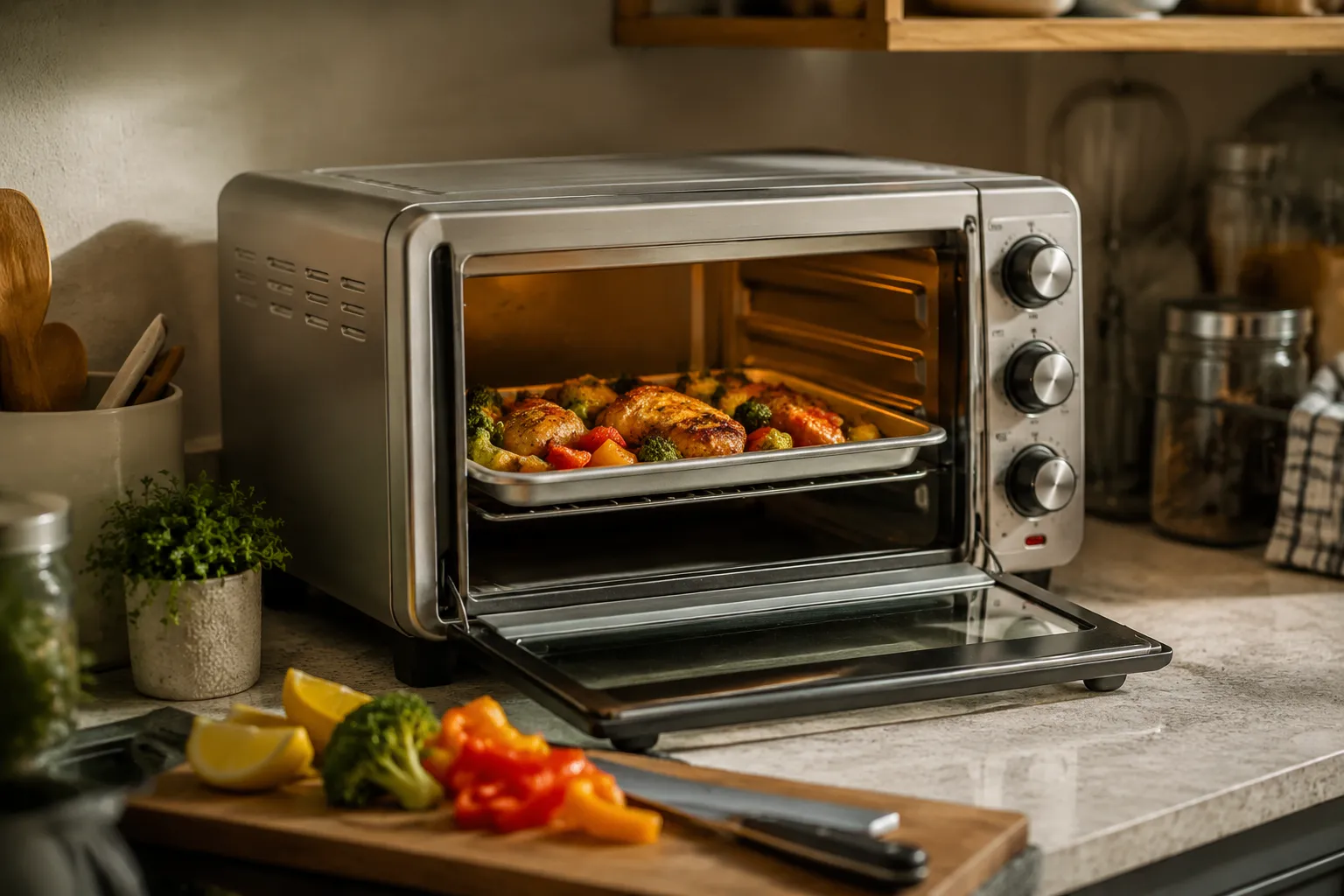
The apartment toaster oven is a machine built on a lie. Manufacturers sell it as a compact alternative to the full-size oven, a little box that reheats pizza and toasts bread without heating up the whole kitchen. That is true as far as it goes. But the real value of a toaster oven has nothing to do with toast. It is the only appliance in a small kitchen that can actually replace the stove, the broiler, and the oven at once, provided a person stops treating it like an oversized slot toaster and starts treating it like a small, furious kiln.
The problem is that most apartment cooks buy the wrong machine and then use it wrong. They buy a $40 model with a dial that goes from "warm" to "dark" and expect it to roast a chicken. Then they abandon it after one burnt batch of frozen waffles. The toaster oven deserves better, and so does the person paying city rent for a kitchen with two square feet of counter space.
The Size Calculus Most People Skip
Before any strategy matters, the machine itself has to be right. The single most important specification is not wattage or price. It is the interior volume measured in slices of bread. A four-slice model is the minimum for any real cooking. A six-slice model is better. Anything smaller is a toy that will struggle to fit a single chicken breast without the meat touching the heating element on top.
The counter space trade-off is real. A six-slice toaster oven takes up roughly the same footprint as a large microwave, about eighteen inches wide and twelve deep. That is a significant chunk of a cramped counter. But the math changes when a person considers what it replaces. A dedicated air fryer, a microwave, and a toaster all disappear. The toaster oven does all three jobs with one plug and one footprint.
The other overlooked spec is the position of the heating elements. The best machines have elements on top and bottom, independently controlled. Cheaper models only heat from the top, which means the bottom of food never browns properly and baking is nearly impossible. A person should check this before buying, not after the first batch of cookies comes out pale and doughy on the underside.
Preheat Like the Machine Is Bigger Than It Is
The most common failure with toaster ovens is impatience. People slide food in the moment the timer starts, treating it like a microwave that happens to make things crispy. A toaster oven is a real oven. It needs time to reach temperature, and it needs more time than a full-size oven because the heating elements are closer to the food and the temperature swings are wilder.
The rule is simple: always preheat for at least five minutes, and ten is better. The little indicator light that says the oven is ready is a lie. It turns on when the element reaches temperature, not when the air inside the cavity is actually at that temperature. A person should set the dial, wait twice as long as the light suggests, and only then put food in.
The preheat matters most for baking. Cookies, muffins, and small cakes need stable heat from the moment they go in. A cold oven means the butter spreads before it sets, the leavening activates too early, and the structure collapses. The same batter that works in a full-size oven will fail in a toaster oven if the preheat is rushed.
The Rack Position Is the Real Control
Full-size ovens have racks that sit in fixed slots, usually three or four positions. Toaster ovens have a rack that slides in at different heights, and this single feature does more to control cooking than the temperature dial. The distance between the food and the top element is the difference between melting cheese and burning it, between browning a crust and incinerating it.
For most cooking, the middle position is the default. This gives about two inches of clearance above the food, enough for hot air to circulate without direct radiative heat scorching the surface. For melting cheese over a casserole or finishing a gratin, the top position works better, pulling the food close to the element for a quick blast of browning. For anything that needs gentle, even heat, like a whole fish or a batch of roasted vegetables, the bottom position helps avoid a burnt top before the interior cooks through.
The rack position also changes the effective temperature. Food on the top rack cooks faster and browns harder. Food on the bottom rack cooks slower and more gently. A person who learns to move the rack instead of changing the dial will get more consistent results with less guesswork.
Single-Serving Cooking Beats Batch Cooking
The temptation with a toaster oven is to treat it like a small version of a big oven and cook a full sheet pan of food. That works for vegetables, but it fails for almost everything else. The air circulation in a toaster oven is not as even as a convection full-size oven. Food at the edges cooks faster than food in the center, and crowding makes the problem worse.
The smarter strategy is to cook for one or two people at a time, in small batches, and accept that the toaster oven is a sequential machine. A single chicken breast on a small pan cooks beautifully. Two chicken breasts side by side cook unevenly, one dry and one underdone. The same logic applies to fish fillets, burgers, and even roasted potatoes. Small batches, more attention, better results.
This is not a limitation to fight. It is the whole point. A person living alone does not need a full sheet pan of roasted vegetables. A single portion, cooked properly in fifteen minutes, beats a large tray of mediocre food that takes forty minutes and heats up the entire apartment.
The Broiler Function Is the Hidden Superpower
Most toaster ovens have a broil setting that people ignore because they do not know what to do with it. This is a mistake. The broiler in a toaster oven is closer to the food and more powerful relative to the cavity size than any full-size oven broiler. It is the fastest way to get a hard sear, a melted cheese crust, or a caramelized sugar topping without turning on a stove.
A person can broil a salmon fillet in eight minutes, skin side up, with no oil and no pan flipping. The high heat renders the fat and crisps the skin while the interior stays rare. The same technique works for thin pork chops, lamb chops, and even flank steak cut into strips. The broiler is not just for melting cheese on soup. It is a legitimate cooking method that replaces a cast iron skillet on a screaming hot burner.
The broiler also rescues leftovers. A slice of pizza under the broiler for three minutes comes out with a crisp bottom and molten cheese, better than the microwave version and faster than a full oven. A day-old baguette section, split and broiled, becomes a proper crusty vehicle for butter or olive oil. The broiler turns the toaster oven from a reheating appliance into a finishing tool.
Matching Pan Size to the Machine
The pans that come with a toaster oven are usually flimsy, dark-coated sheets that conduct heat unevenly and stick to everything. Most people either use them and deal with burnt bottoms, or they buy a cheap cookie sheet that does not fit. The right approach is to buy pans that match the interior dimensions exactly, and to choose light-colored, bare aluminum or steel over dark nonstick.
Dark pans absorb heat and brown food faster on the bottom. For cookies and pastries, that means burnt undersides. For roasting, it means the bottom of vegetables chars while the tops stay pale. A light-colored pan reflects heat and produces more even browning. The difference is noticeable on the first batch of anything.
A small cast iron skillet, eight inches or smaller, is the best investment for toaster oven cooking. It fits in most six-slice models, it holds heat like a brick, and it goes from stovetop to toaster oven without a problem. A person can sear a steak in the skillet on the stove, then transfer the whole thing to the toaster oven to finish. This two-stage method produces results close to a restaurant kitchen's approach, and it takes up almost no storage space.
Ventilation and Smoke Management
Toaster ovens smoke. This is not a malfunction. The tight cavity and close heating elements mean fat and oil reach smoking temperature quickly, and the small interior has nowhere for the smoke to go except out the vents and into the kitchen. Apartment dwellers without a range hood over the stove, which is most of them, need a plan.
The first line of defense is an open window and a fan pointed outward, placed near the toaster oven. The second is to keep the oven cleaner than feels reasonable. Grease buildup on the walls and the crumb tray smokes at the start of every preheat, and it makes the whole apartment smell like a diner. Wiping down the interior after every use, especially after broiling anything fatty, cuts the smoke dramatically.
For high-fat cooking, a person can also reduce smoke by lowering the temperature and extending the time. A chicken thigh at 400 degrees will smoke and spatter. The same thigh at 375 degrees takes ten minutes longer but produces far less smoke and an equally crispy skin. It is a trade worth making, especially in a building with thin walls and a sensitive fire alarm.
The Cooling Rack Is Not Optional
Most toaster ovens include a wire cooling rack, and most people lose it within a month. This is a mistake because the rack is not just for cooling. Placing food on the wire rack instead of directly on the pan keeps the bottom of the food out of the pooled fat and juices. This single trick improves roasted vegetables, bacon, and anything breaded.
Bacon cooked on the wire rack over the pan renders evenly and crisps on both sides without flipping. The fat drips away instead of frying the bottom of the strips. Vegetables roasted on the rack get caramelized on all sides instead of steaming in their own juices. The rack turns the toaster oven into a mini convection oven, and it costs nothing since it comes in the box.
The rack also solves the problem of reheating fried food. Leftover french fries, chicken tenders, and onion rings go on the rack at 375 degrees for five minutes, and they come out nearly as crispy as fresh. The same food reheated on the pan comes out soggy on the bottom because it sits in the oil that renders out. The rack is the difference between a disappointing leftover and a meal worth repeating.
Small Baking Without a Full Oven
Baking in a toaster oven works, but it requires adjusting expectations and recipes. A full-size oven has thermal mass, meaning the walls absorb heat and radiate it back evenly. A toaster oven has thin metal walls that lose heat quickly. The result is a wider temperature swing, with the oven cycling from too hot to too cold and back again.
Small baked goods handle this better than large ones. Muffins, scones, and individual cookies work well. A full cake or a loaf of bread is a gamble. The edges will bake and brown before the center sets, leaving a burnt crust and a raw middle. A person who wants to bake in a toaster oven should stick to items that are no more than an inch thick, or use small ramekins for individual portions.
The other adjustment is rotation. Every toaster oven has hot spots, usually at the back where the elements are strongest. A person baking anything for more than ten minutes should rotate the pan halfway through, turning it front to back. This is not optional. It is the difference between even browning and a muffin that is dark on one side and pale on the other.
The Energy Argument for Never Turning On the Big Oven
For a person living alone or with one other person, the full-size oven is a waste of energy and time. It takes twenty minutes to preheat, it dumps heat into a small apartment, and it requires a full-sized pan and a full-sized recipe to justify itself. The toaster oven preheats in five minutes, uses a fraction of the electricity, and cooks a portion sized for actual need.
The full-size oven has one advantage: capacity. But capacity is only useful when a person is cooking for a group, roasting a whole chicken, or baking a large casserole. Those occasions happen a few times a month at most. The rest of the time, the big oven is a heavy, slow, wasteful machine that heats up a small kitchen and makes the air conditioner work harder.
The toaster oven is not a compromise. It is a targeted tool for the way a person in a small apartment actually eats. Quick weeknight dinners, reheated leftovers, single portions, and the occasional small batch of cookies. It does all of these better than the big oven, in less time, with less heat, and with less cleanup. The people who dismiss it as a college dorm appliance are the same people who eat most meals out because their kitchen is too hot to cook in.