
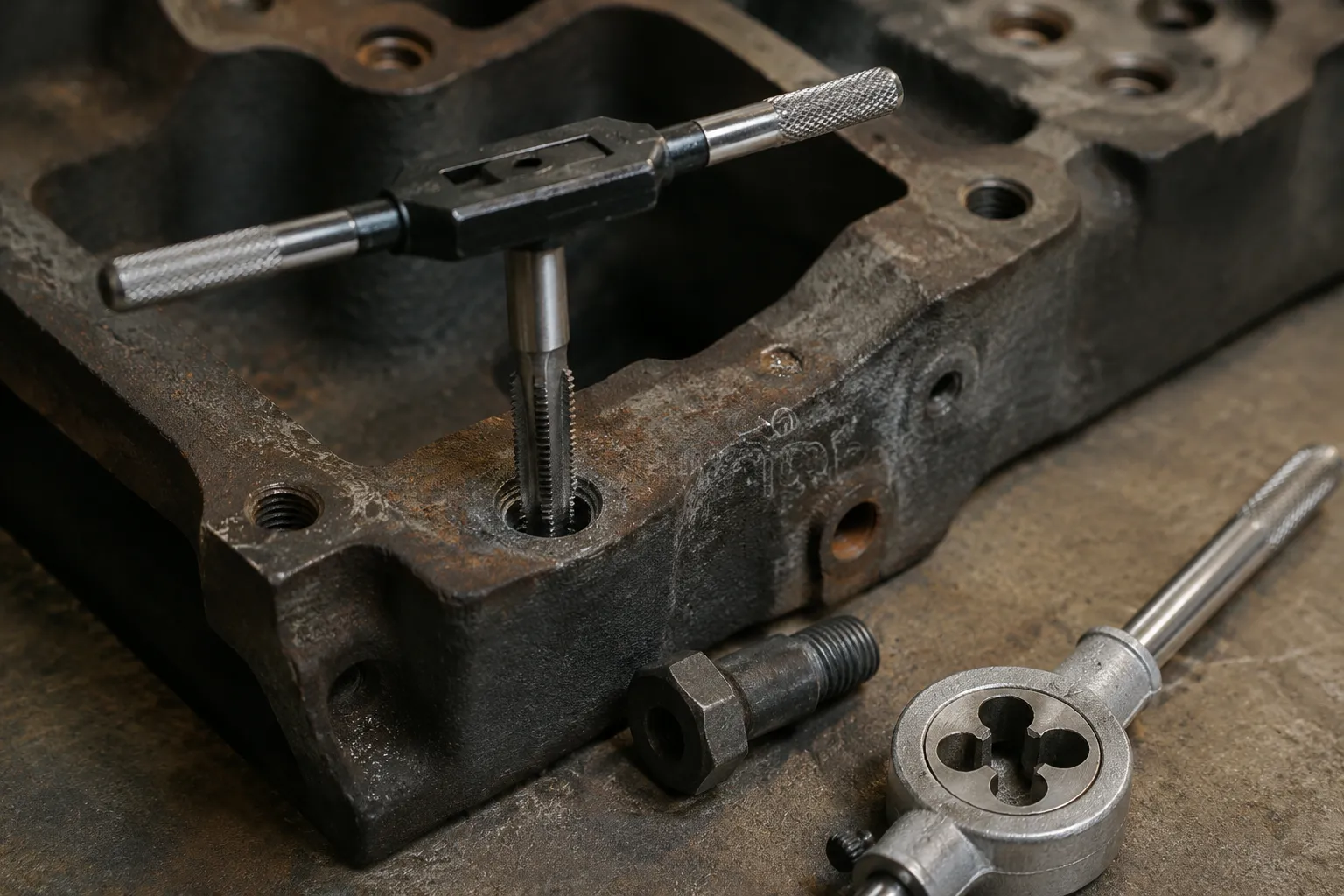
Stripped threads are one of the most common frustrations in any workshop or garage, and they usually arrive at the worst possible moment: when a part is already disassembled, or a fastener is holding something critical. The hole looks fine from the outside, but the bolt spins freely, and the job comes to a halt. The conventional response is to reach for a larger bolt and drill the hole out to fit it, but that approach ruins the original fastener and often creates a new problem down the line. A tap and die set offers a cleaner path, one that preserves the original thread pitch and returns the hole to working condition without redesigning the whole assembly.
The tap and die method is not a single operation. It is a family of operations, and the right one depends entirely on how much material is left in the hole and whether the threads are merely damaged or completely gone. A person who understands the difference between chasing threads, cutting new threads, and installing a threaded insert will save themselves hours of frustration. Most people who own a tap and die set only ever use the taps, and only on holes that are already partially threaded. They are missing the more useful half of the kit.
What the Tools Actually Do
A tap cuts internal threads. A die cuts external threads. That sounds simple enough, but the geometry matters. Taps have flutes that carry chips out of the hole, and the cutting edges are ground at specific angles for different materials. A hand tap set typically includes three taps for each size: taper, plug, and bottoming. The taper tap starts the thread with a long lead-in, the plug tap continues it, and the bottoming tap finishes threads close to the bottom of a blind hole. Each one does a distinct job, and skipping the sequence is the most common reason threads come out crooked or shallow.
Dies work differently. They are essentially a ring of cutting teeth that can be adjusted slightly with a screw to open or close the diameter. A die stock holds the die and provides the handles to turn it. Cutting external threads with a die is a skill in itself, because the die must start perfectly square to the rod or the threads will be lopsided. Most people who use a die for the first time end up with a bolt that looks fine for the first few threads and then goes visibly off-angle.
The real distinction that matters for repair work is between a cutting tap and a forming tap. Cutting taps remove metal. Forming taps displace it, squeezing the material into the thread shape without cutting. Forming taps produce stronger threads because the grain of the metal is compressed rather than severed, but they require more torque and a larger hole. For repair work on existing holes, cutting taps are the standard choice because they work in any material and do not require the precise hole sizing that forming taps demand.
Chasing Threads Versus Cutting Fresh Ones
The easiest repair is one where the threads are still mostly intact but have a burr or a bit of damage near the opening. Running a tap through such a hole is called chasing, and it is a gentle operation. The tap follows the existing thread path and cleans up the imperfections without removing significant material. The key to chasing is lubrication and patience. The tap goes in with a slight back-and-forth motion, a quarter turn forward and a half turn back to break the chips, and it never forces its way through. If the tap meets hard resistance, it is either cutting new material or fighting a burr, and forcing it will snap the tap.
Cutting fresh threads is a different situation. This is what happens when the original threads are gone entirely, or when a person is tapping a new hole. The tap has to remove material, and the hole diameter has to be correct for the tap size. A tap drill chart exists for this reason. The drill bit for a 1/4-20 tap is not a 1/4 inch bit. It is a number 7 bit, which is smaller, leaving enough material for the tap to cut threads into. Using the wrong drill size is the single most common mistake in thread repair. Too large a hole leaves shallow threads that strip easily. Too small a hole risks breaking the tap.
For stripped holes, cutting fresh threads usually means the hole is already close to the right size, but the thread profile is gone. A person can run a tap through at the original size and hope there is enough material left for the tap to bite. This works only when the damage is light. If the hole has been wallowed out, if a bolt was cross-threaded and pushed metal around, or if the hole was previously repaired with a helicoil that has since failed, the hole is simply too big for the original tap. A larger tap will not fix it either, because the next standard size up requires a drill bit that will likely break through the wall of the part.
When the Hole Is Too Far Gone
There comes a point where tapping the original size is no longer an option. The material around the hole is gone, or the hole has been ovalled out by a loose bolt that rattled for months. This is where threaded inserts come into play. A threaded insert is a metal coil or sleeve that gets installed into a drilled and tapped hole, and the bolt threads into the insert rather than the original material. The two most common types are the helicoil and the solid insert, and they serve different purposes.
Helicoils are wire coils made of stainless steel or phosphor bronze. The installation process involves drilling the damaged hole to a larger size, tapping it with a special tap that matches the insert, and then winding the coil into the hole with a special tool. The coil has a tang at the bottom that gets broken off once the coil is seated. The result is a thread that is often stronger than the original, because the coil distributes the load across a larger surface area. Helicoils work well in aluminum, which is soft and prone to stripping, and they are the standard repair for spark plug holes in cylinder heads.
Solid inserts, sometimes called key-locking inserts, are machined cylinders with external and internal threads. They install into a drilled and tapped hole and are locked in place with small keys or pins that deform into the surrounding material. They are more expensive than helicoils and require more careful installation, but they are the better choice for applications where the fastener is removed and reinstalled frequently. The solid insert does not have the flexibility of a coil, so it does not fatigue the same way over many cycles.
The choice between a helicoil and a solid insert comes down to the application and the person's tolerance for risk. For a one-time repair on a piece of equipment that sees occasional use, a helicoil is perfectly adequate. For a critical joint on an engine or a suspension component, the extra cost of a solid insert is worth the peace of mind. Either way, the drill and tap for the insert must be selected carefully. The insert manufacturer provides specific dimensions for the drill size and the tap, and those are not negotiable.
The Die Side of the Equation
Thread repair is not always about the hole. Sometimes the bolt itself is the problem. A bolt with damaged threads can be chased with a die, which cleans up the external threads and restores the bolt to working condition. This is a common repair for bolts that have been cross-threaded during installation, or for bolts that have picked up rust and scale that makes them hard to thread into a nut. Running a die over the bolt removes the rust and burrs, and the bolt threads smoothly again.
Chasing a bolt with a die is simpler than tapping a hole, because the work is visible. The die is placed on the end of the bolt, the stock is held square, and the die is turned with steady pressure. The same quarter-turn-forward, half-turn-back motion applies, and the die should never be forced. A die that is started crooked will cut a spiral thread that will not fit a nut properly. The solution is to start the die carefully, checking the squareness constantly, and to back it off and restart if there is any resistance.
For bolts that are stripped beyond repair, cutting new threads is possible only if the bolt has enough material to accommodate a smaller diameter. That is rarely a good idea on a structural fastener. A 12mm bolt that is re-threaded to 11mm will have weak threads, and the load rating of the bolt changes. A better approach is to replace the bolt. Dies are most useful for cleaning up salvageable hardware, not for converting bolts to new sizes.
The Lubrication Habit
Anyone who has snapped a tap inside a hole knows the value of cutting fluid. Tapping without lubrication is like cutting metal with a dull blade. The tap gets hot, the chips pack into the flutes, and the tap seizes. Cutting fluid serves two purposes. It cools the cutting edge, and it carries chips out of the hole. A good cutting fluid is not the same as motor oil or WD-40. It is formulated to handle the high pressures and temperatures of thread cutting, and it makes a measurable difference in the ease of the cut.
For aluminum, a light oil or a dedicated aluminum-cutting fluid works best. Aluminum is gummy, and it tends to load up on the cutting edge of the tap. For steel, a heavier sulfur-based cutting oil is better. The sulfur acts as a high-pressure lubricant that prevents the chip from welding to the tap. For cast iron, which is brittle and produces dusty chips, a light oil or even kerosene works well. The point is to match the fluid to the material and to apply it generously.
A person who is repairing a single stripped hole might be tempted to skip the cutting fluid and use whatever oil is on the bench. That works in a pinch, but it is false economy. A snapped tap is a nightmare to remove. The tap is harder than almost any drill bit, and extracting it requires a specialized tool or a very careful application of a carbide burr. The cost of a bottle of cutting fluid is trivial compared to the cost of a ruined part.
The Broken Tap Extraction Problem
Broken taps happen. They happen when a tap is run in too fast, when the hole is undersized, when the tap hits a hard inclusion in the metal, or when the flutes clog. The extraction methods range from simple to desperate. A tap extractor, which is a tool with fingers that slide down the flutes of the broken tap and grip it from the inside, works well when the tap is broken deep in the hole. The extractor is inserted, the collar is tightened, and the tap is backed out with a wrench. This works only if the tap is not seized too tightly.
Another method involves using a small punch and a hammer to tap the broken tap in reverse, which can loosen it if the tap is not wedged too hard. For taps broken flush with the surface, a welder can build up a small nub on the broken tap and then use a wrench to back it out. This is a last resort, because it risks welding the tap to the surrounding material. The final option is to drill out the broken tap with a carbide drill bit, which is a slow, delicate operation that often destroys the hole anyway.
The best strategy is to avoid breaking the tap in the first place. Use sharp taps. Use the correct drill size. Use plenty of cutting fluid. Back the tap out frequently to clear chips. And never, ever force a tap that is not cutting freely. A tap that is turning but not advancing is not cutting. It is rubbing, and rubbing generates heat and pressure that will eventually snap the tap.
The Real Cost of the Quick Fix
The appeal of drilling out a stripped hole and using a larger bolt is speed. It is faster than tapping and inserting a helicoil, and it uses fasteners that are likely already in the toolbox. But the larger bolt changes the torque specifications, it may interfere with adjacent components, and it permanently enlarges the hole in the part. If the part is a bracket or a cover, that might be acceptable. If the part is a cylinder head or a transmission case, the larger bolt can create a stress concentration that leads to cracking.
The helicoil method takes longer, but it restores the original thread size and preserves the original fastener. That matters for parts that have a specified torque spec, because the friction characteristics of a larger bolt are different. It matters for parts that are exposed to vibration, because a correctly sized fastener with the proper thread engagement is more resistant to loosening. And it matters for parts that might need to be replaced later, because a future owner or mechanic will expect the original thread size.
Beyond the engineering case, there is a satisfaction in doing the repair properly. A person who installs a helicoil and watches the bolt thread in smoothly, at the original size, with the original torque spec, has done the job right. The part goes back into service and performs exactly as it did before the damage. That is the outcome that justifies the extra time and the specialized tools. The cost of a helicoil kit is modest, and the tools are reusable. The skill is the thing that carries over from one repair to the next.
A Few Practical Rules for the Bench
Clean the hole before tapping. Debris and old thread sealant will interfere with the tap and produce poor threads. Use a solvent and a brush, then blow the hole out with compressed air. A clean hole is the foundation of a clean thread.
Start the tap square. A tap that enters at an angle will cut a spiral thread, and the bolt will bind halfway in. A tap guide or a drill press with a tapping attachment removes the guesswork. For hand tapping, use a small square and check the tap from two directions before applying pressure.
Count the turns. A blind hole needs a tap that has been marked with tape or a stop to prevent bottoming out. The tap should never hit the bottom of the hole, because it will break. The tape serves as a depth gauge, and it is worth the thirty seconds it takes to apply it.
Test the fit. After tapping, thread a bolt into the hole by hand. It should go in smoothly with only light resistance. If it binds, run the tap through again to clean up the threads. A bolt that requires a wrench to install is a bolt that will strip the threads on removal.
The tap and die set is not a magic tool. It is a set of precision cutters that requires practice, clean technique, and respect for the material. A person who learns to use it well will never fear a stripped hole again, because the repair is always possible. The first time a helicoil is installed in a damaged aluminum part and the bolt torques down to spec, the value of the skill becomes obvious. The second time, it becomes routine. The third time, it is just another job done right.