
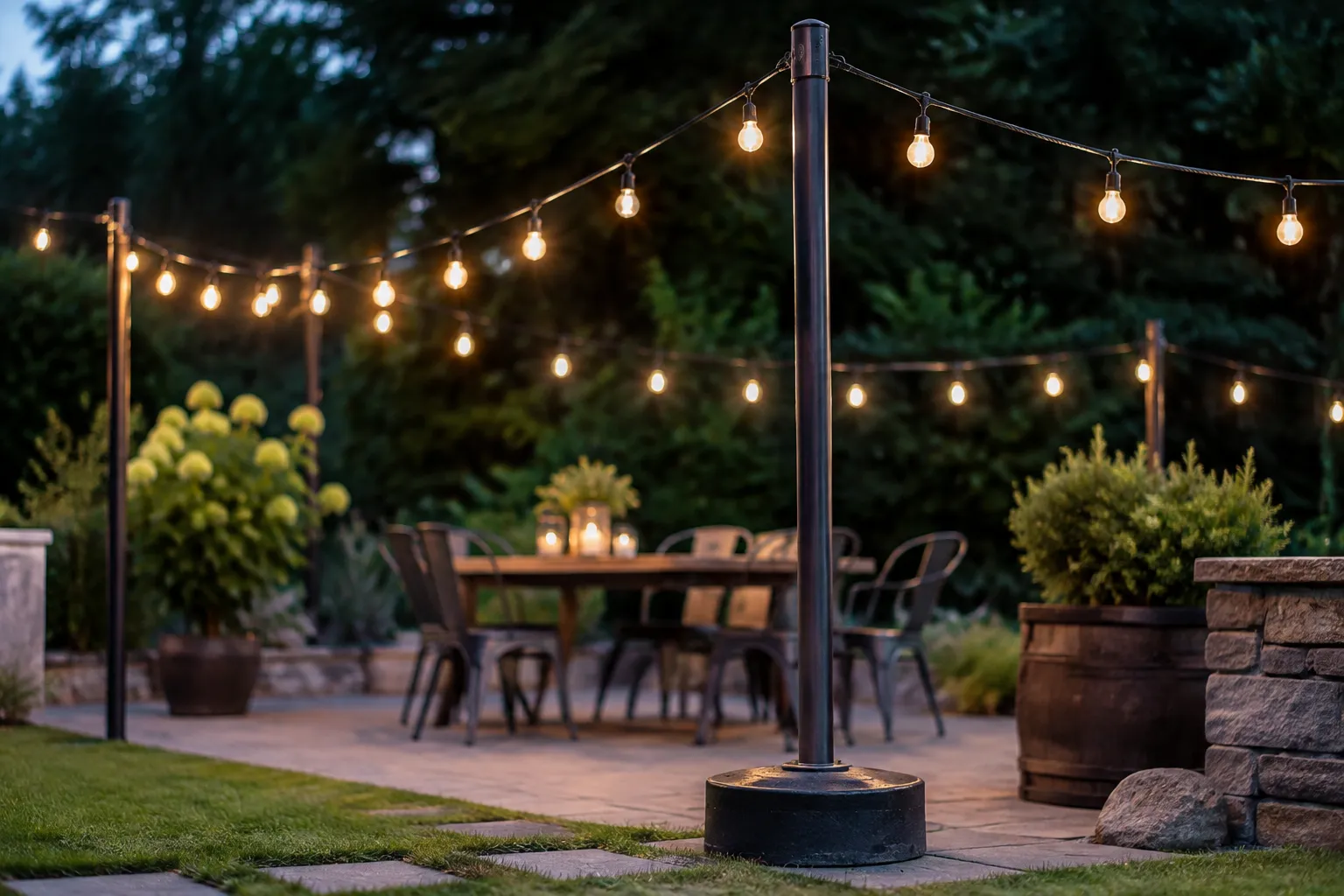
Every September, the same scene plays out on suburban decks and in backyard bars: a string of warm LED bulbs sags between two flimsy aluminum poles, the whole assembly leaning at an angle that suggests a mild disagreement with physics. By October, one pole has tipped entirely, the lights are dragging through wet grass, and somebody has wedged a cinder block against the base in a gesture that solves nothing. The problem is not the lights. The problem is that most patio poles are designed for a gentle breeze and a flat, forgiving surface, and neither of those things describes an actual backyard.
The market is crowded with poles that look sturdy in a product photo and flex like a fishing rod the moment the wind picks up. The honest ones, the poles that stay put through a storm and a season of careless guests, share a few specific qualities. Knowing those qualities matters more than any brand name, because the difference between a pole that holds and a pole that folds is almost always a matter of engineering, not marketing.
The Weight of the Base Is the Whole Game
A pole is only as good as its foundation. The slender aluminum tube could be forged from unobtainium, but if it sits in a plastic base that weighs four pounds, a gust of wind will lift the whole thing and lay it on the lawn. The physics are unforgiving: a string of lights acts like a sail, catching air and translating that force into leverage at the base. A heavier base resists that leverage, but weight alone is not the answer, because a base that weighs forty pounds is a base nobody will move.
The better designs use a wide footprint and a low center of gravity. A base that spreads out to eighteen or twenty inches in diameter distributes the load far better than a narrow cylinder of the same weight. Some manufacturers offer hollow bases meant to be filled with sand or water, which is a practical compromise. A person fills them once at the start of the season, lets them sit, and drains them in the fall. The fillable approach lets the pole weigh almost nothing in the box and everything in the yard.
The catch with fillable bases is that most people never fill them properly. Sand is heavy and awkward to pour through a small opening. Water freezes and expands. A base that gets filled halfway and then left to wobble is worse than a solid base that was honest about its weight from the start. The practical advice is to buy a base that weighs at least fifteen pounds empty, or to commit to filling one properly and checking it twice a season.
Ground Stakes Are Not Optional Accessories
For permanent or semi-permanent installations, the ground stake is the difference between a pole that survives a thunderstorm and a pole that becomes a projectile. The best poles come with a steel spike that drives into the soil through a hole in the base plate, anchoring the entire assembly to the ground. This is not a decorative feature. A pole with a driven stake can handle wind speeds that would topple the same pole sitting on a flat surface, and the math is not subtle.
The stakes themselves vary in quality. A thin, painted spike that bends on the first hammer strike is worthless. A thick, galvanized spike with a decent point and a flange for hammering is a tool. Some designs use a screw-in auger style stake, which twists into the ground and offers even better holding power in soft soil. The screw-in type takes longer to install but holds more firmly, especially in loamy or sandy ground. In clay, the hammer-in spike often works better because it displaces the dense soil rather than fighting it.
One honest note about stakes: they only work if the ground is soft enough to accept them. On a concrete patio or a wooden deck, a stake is useless. For those surfaces, the base weight is the only defense, and the pole needs to be chosen accordingly. A person with a concrete patio should buy the heaviest base they can tolerate moving twice a year, because no stake is coming to save them.
The Pole Itself Needs Thicker Wall Than the Spec Sheet Suggests
Pole diameter gets quoted on every product page, and it is a nearly useless number on its own. A two-inch diameter pole with a paper-thin wall will flex and fatigue, while a one-and-a-half-inch pole with a proper wall thickness will stand firm for a decade. The number that matters is the gauge of the metal, and that number is almost never published. The workaround is to look at the weight of the pole, not the diameter. A six-foot pole that weighs less than four pounds is probably too thin. A pole that weighs six or seven pounds has enough metal to resist bending.
Material matters too. Galvanized steel is heavy, rust-resistant, and the safest choice for a pole that will live outside year-round. Aluminum is lighter and easier to move, but it dents and can fatigue at the joints over time. Powder-coated steel splits the difference, offering a finish that resists scratching and fading, though the coating can chip if the pole takes a hard knock. The real enemy is rust at the base, where water pools and the coating wears thin. A pole with a rubber boot or a plastic collar at the bottom will outlast one that lets water sit against bare metal.
The joint construction is another hidden variable. Many poles come in two or three sections that thread together or lock with a twist. These joints are the weakest point in the entire system. A poorly machined joint will wobble from day one, and the wobble only gets worse as the metal wears. The better designs use a sleeve system, where one section slides inside another and is secured with a pin or a set screw. Sleeves distribute stress over a longer section of the pole, rather than concentrating it at a single threaded point.
Guy Wires and the People Who Refuse to Use Them
For anyone who lives in an area with genuine wind, the only real solution is a guy wire system. These are thin steel cables that run from a point near the top of the pole down to stakes or anchors in the ground, usually three wires spaced at 120-degree intervals. The wires hold the pole in tension, and a properly guyed pole can handle winds that would snap an un-guyed pole in half. The system is ugly if done poorly and nearly invisible if done well, because the cables are thin and dark.
The resistance to guy wires is understandable. They add installation time, they create a trip hazard at the anchor points, and they look like something from a radio tower installation rather than a backyard. But the alternative, for exposed locations, is a pole that keeps falling over. A person who has replaced a bent pole twice in one season is ready for guy wires. A person who has never dealt with real wind thinks they are overkill. Both are right, based on their circumstances.
There is a middle ground: poles that come with a built-in tension system using a shorter set of stakes and a lower profile. These are less effective than a full three-wire guy, but they add meaningful stability without turning the yard into a suspension bridge. For most suburban settings, this compromise is enough. For exposed hilltops, waterfront properties, or anywhere the wind comes off open ground, the full guy wire setup is the honest answer.
The Height Question and the Temptation to Go Tall
Taller poles create a better light display, draping strings at a height that feels magical and casts a warm glow over a wide area. They also catch more wind, because the leverage increases with the square of the height. An eight-foot pole is not twice as stable as a four-foot pole. It is four times less stable, given the same base and wind conditions. The math pushes toward shorter poles, but the aesthetics push toward taller ones.
The compromise is a pole in the seven-to-eight-foot range, which is tall enough to create a proper canopy of lights and short enough to stay manageable in moderate wind. Anything over ten feet should be treated as a serious structural project, with concrete footings or a permanent anchor system. The people who sell twelve-foot poles with a small round base are selling a product that will fail in the first real storm, and they know it.
There is also the question of how the lights attach at the top. A simple hook or eyelet is fine for a single string, but a crossbar or a loop that distributes the weight of multiple strings across the top of the pole is much better. The crossbar design also allows for a tauter string, which reduces sag and, in turn, reduces the sail effect. A loose string catches more wind and puts more stress on the pole. A taut string cuts through the air with less resistance.
Concrete Footings for the Serious Installation
The step beyond guy wires and heavy bases is the permanent concrete footing. This involves digging a hole, setting a metal post anchor or a sleeve into wet concrete, and letting it cure for a few days. The pole then drops into the sleeve and is secured with a pin. This is not a weekend project for most people, and it permanently commits a spot in the yard to the pole. But a pole set in concrete will outlast the house, and it will never tip over, no matter the wind.
The concrete footing route is worth considering for anyone who plans to stay in their home for a long time, or anyone who has already watched two cheaper poles fail. The cost is comparable to buying a premium freestanding pole, but the result is permanent. The downside is that moving the pole later means breaking up concrete, and that is a job nobody wants to do twice. A person should be certain about the location before pouring.
For renters, the concrete footing is a non-starter. The best option in that situation is a freestanding base with a fillable interior and a wide footprint, combined with a willingness to take the whole thing down during the worst of the winter. A rented home is not worth a permanent modification, and a seasonal takedown is a small price for keeping a deposit intact.
The Wind Rating Numbers Are Mostly Fiction
Product listings love to cite a wind rating, usually something like "tested to 45 mph" or "withstands winds up to 60 mph." These numbers are almost never backed by a standardized test, and they are usually measured under ideal conditions that do not match reality. A pole rated for 45 mph will fail at 25 mph if the base is not weighted, or if the ground is soft, or if the lights are strung loosely, or if the wind comes from the wrong angle. The rating is a marketing number, not an engineering guarantee.
The honest approach is to ignore the number and assess the physical characteristics: base weight, base width, stake quality, pole wall thickness, and joint construction. A pole that scores well on those five criteria will handle wind far better than a pole with an impressive rating and a thin base. The proof is in the hardware, not the spec sheet.
One more thing to check: the warranty. A company that offers a multi-year warranty on its poles is making a bet that the product will hold up. A company that offers a 30-day warranty is making a different bet. The warranty is not a guarantee of quality, but it is a signal of confidence, and it is worth reading the fine print to see what is covered. Some warranties exclude wind damage entirely, which tells a person everything they need to know about the product's expectations.
The Real Test Happens in March, Not July
The summer installation is always easy. The ground is warm, the wind is mild, and the pole stands straight and true. The real test comes in late winter, when a storm rolls through with sustained winds and gusts that rattle windows. The pole that stays upright through that storm is a keeper. The pole that ends up leaning against the fence is a lesson.
The people who buy cheap poles often replace them every year or two, and the cost adds up faster than a single quality purchase. A pole that costs eighty dollars and lasts one season is more expensive than a pole that costs two hundred dollars and lasts ten years. The math is simple, but the upfront price is what most people see.
The final consideration is the string itself. A heavy, commercial-grade string of lights with thick insulation and real glass bulbs puts more strain on the poles than a lightweight string of plastic LED bulbs. The poles need to be matched to the string, not just to the wind. A person who buys the cheapest string and the cheapest poles is building a system that fails on two fronts. A person who buys a quality string and a quality pole has a setup that works for a decade.
On a calm July evening, with the lights glowing and the neighbors walking over to ask where they were bought, the difference between a good pole and a bad one is invisible. The good pole stands quietly, doing its job. The bad pole stands too, for now. The wind will sort them out eventually, and it always does.