
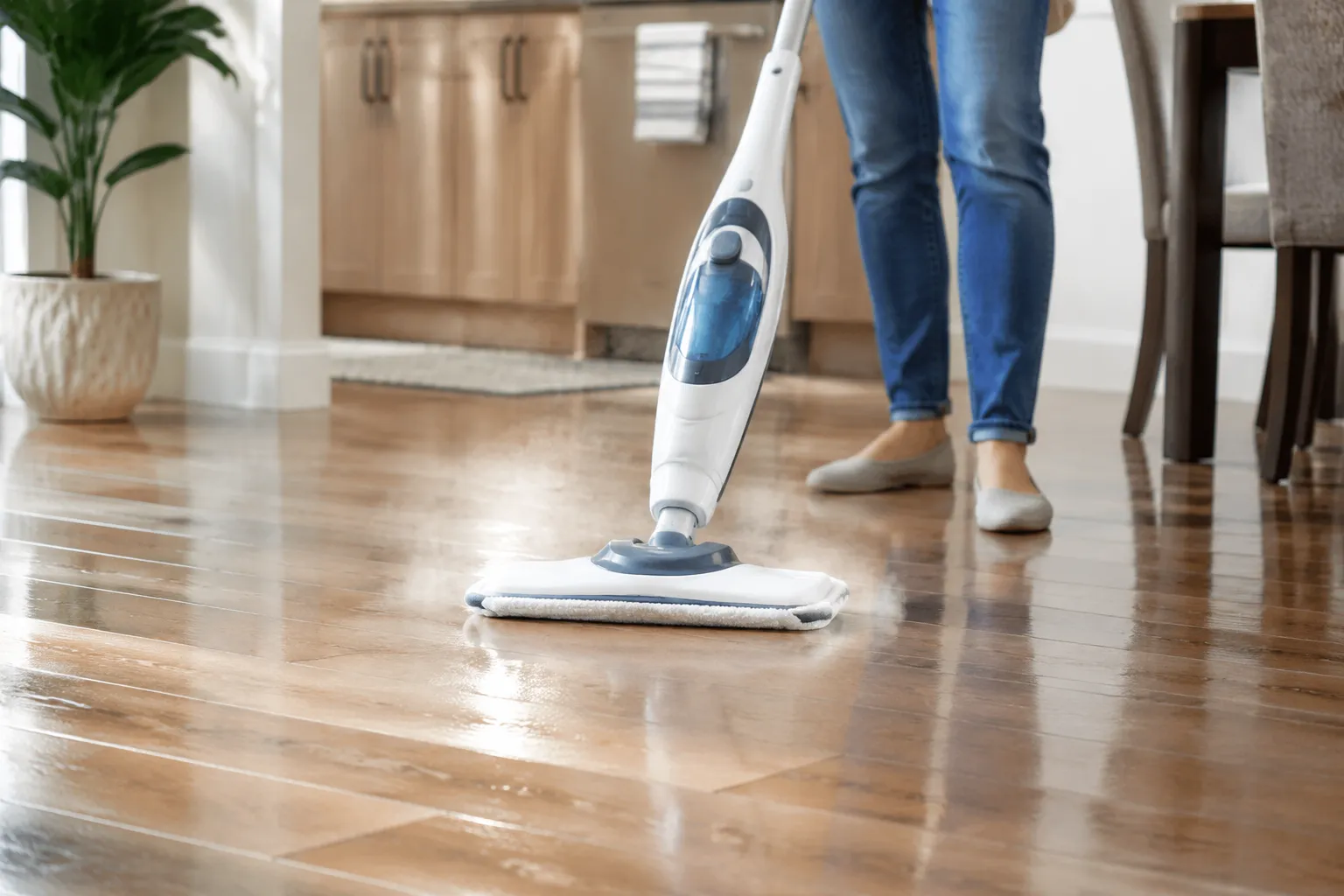
Streaks on hard floors are not a cleaning problem. They are a water problem, and until that distinction lands, every pass with a steam mop will keep producing the same smeared result. The machine heats water into vapor, the vapor loosens soil, and the pad wicks it up, but the moment any of that water sits long enough to evaporate on its own, it leaves behind whatever minerals and residue it was carrying. Streaks are what is left when water does the drying instead of the mop.
Most people blame the detergent, or the floor finish, or the machine itself. The floor finish does matter, and so does the pad, but the dominant variable is how much water actually reaches the surface. A steam mop that is working correctly deposits very little water. A steam mop that is struggling, clogged, or misused deposits a lot. The difference between a clean floor and a streaked floor is usually the difference between a mop that is putting out a fine, hot mist and one that is essentially dribbling.
The first thing to understand is that steam mops are not floor washers. They are not designed to flood a surface with hot water and then squeegee it off. They are designed to flash water into vapor, and that vapor condenses on the floor in a thin, barely visible layer. That layer loosens dirt, and the microfiber pad absorbs both the dirt and the moisture. If the pad is doing its job, the floor is left nearly dry. If the pad is saturated, or the steam output is too high for the speed of the pass, the floor stays wet, and everything that follows is a gamble.
The Pad Is the Whole Story
No other component of a steam mop gets as much abuse as the microfiber pad, and no other component matters as much. A fresh, correctly damp pad holds soil in its fibers and releases water evenly across the surface. A worn pad, or a pad that was left to dry stiff after the last use, does neither. It skips, it bunches, and it pushes water into streaks instead of absorbing it.
Most manufacturers suggest replacing pads every three to six months depending on use. That advice is conservative for light duty and optimistic for heavy use. A household with dogs, kids, or a high-traffic kitchen should treat pads as a consumable, like a sponge, not as a permanent accessory. When the fibers start to look matted, or when the pad no longer glides smoothly over the floor, it is spent. There is no washing routine that restores a microfiber pad once the fibers have collapsed.
Washing matters too. Fabric softener is the enemy of microfiber. It coats the synthetic fibers with a waxy residue that seals the microscopic hooks and loops that do the actual cleaning work. A pad washed with softener will push water around rather than absorb it, and the streaks will show up immediately. The same goes for dryer sheets. Hot water and a basic detergent, then air drying or a low-heat tumble, keeps microfiber alive. High heat in the dryer melts the fibers and turns a good pad into a smear stick.
One more pad detail: a single pad is rarely enough for a large floor. Once a pad picks up a meaningful load of dirt, its absorbency drops fast. The water it can no longer hold gets left behind. For anyone steaming more than a small bathroom or kitchen, the routine should be two pads minimum, swapped mid-pass. The first pad does the heavy lifting, and the second one gets the floor to a dry finish. Trying to do an entire house on one pad is a direct invitation to streaks.
Hard Water Leaves Mineral Ghosts
Tap water is full of dissolved minerals, and steam mops concentrate them. As water flashes to vapor inside the boiler, the minerals stay behind, building up as scale on the heating element and, eventually, getting carried out with the steam. That fine white dust settles on the floor and reads as a haze or a streak pattern that reappears no matter how often the floor is mopped.
Distilled water is the standard fix, and it works, but it comes with a caveat. Some steam mop manuals warn against distilled water because it can corrode certain boiler materials over time. The safer middle ground is a 50-50 mix of tap and distilled, or a demineralization cartridge if the mop supports one. The point is not to eliminate minerals entirely, it is to keep them below the level where they become visible on the floor.
For floors that already have a mineral haze, a plain water rinse with a traditional mop, no soap, will usually remove it. The haze is water-soluble; it just needs enough liquid to dissolve it and a clean implement to lift it. A steam mop cannot do this job because it does not deliver enough water to dissolve the deposit. This is one of those cases where the fix involves putting the steam mop away and using the old-fashioned bucket.
The Speed of the Pass Sets the Dry Time
Steam mops assume a certain pace. Too fast, and the vapor does not have time to loosen the dirt. Too slow, and the floor gets more moisture than the pad can absorb. The sweet spot is a slow, steady push with no pause at the end of the stroke. Pausing, even for a second, lets steam concentrate on one spot and condense into a puddle. That puddle is a streak waiting to happen.
The correct motion is continuous and overlapping, like mowing a lawn. Each pass should overlap the previous one by a couple of inches, so no strip of floor gets skipped and no strip gets double-steamed. Double-steaming is the classic cause of visible lines running parallel to the direction of the mop. The overlap is not a race; it is a rhythm. A person who steams a floor the way they would sweep it, quick strokes with gaps in between, will get poor results every time.
Floor temperature matters too. A floor that is cold, like a garage-adjacent laundry room in winter, causes steam to condense too quickly. The vapor turns to liquid on contact, and the pad saturates faster than it can absorb. The fix is to let the floor warm up, or to adjust the mop to a lower steam setting so the water has a chance to vaporize rather than pool.
Sealed Floors and Bare Wood Are Different Games
Steam mops are safe on sealed hard floors: ceramic tile, vinyl, laminate, sealed hardwood, stone. They are not safe on unsealed wood, unsealed cork, or any floor with cracks where moisture can seep through. The distinction is not about the surface, it is about the integrity of the seal. A floor with worn finish, or gaps between tiles, will take in moisture and show damage months later as swelling, discoloration, or lifting planks.
Laminate is the trickiest case. Many laminate floors are sealed well enough to handle steam, but the seams between planks are vulnerable. Steam forced into a seam can penetrate the core of the plank, which is usually a compressed wood product that swells on contact with water. The result is a raised seam that no amount of drying will fix. For laminate with visible gaps, or for any floor of unknown age and condition, a damp mop is the safer tool. The steam mop belongs on floors with continuous, intact surfaces.
Stone floors add another wrinkle. Natural stone, like travertine or slate, is porous even when sealed, and the sealer wears off over time. Steam itself is not the problem, but the heat can accelerate the breakdown of an old sealer. A stone floor that has not been resealed in years will absorb the steam's moisture and develop dark patches. These patches dry out, but they may take on a dull, water-stained appearance that requires stripping and resealing to correct.
Scale and Clogs Change the Spray Pattern
A steam mop that sputters, spits, or produces uneven vapor has a scale problem. The mineral deposits build up inside the boiler and partially block the steam outlet, which causes pressure to build and release in bursts. Those bursts are what create the little wet spots that show up as dots and dashes across the floor. The mop is not failing; it is announcing that it needs descaling.
Descaling is simple and most manuals cover it, but the timing is usually vague. A practical schedule is every three months for households with hard tap water, or every six months for those using distilled or softened water. The process involves running a vinegar-and-water solution or a commercial descaler through the boiler, letting it sit, and then flushing with clean water. A mop that has never been descaled will eventually reach a point where no amount of pad swapping fixes the streaking, because the water is not coming out as a fine vapor anymore.
There is also the clog that is not scale. Lint, dust, and residue from the floor can get pulled up into the mop head and block the steam ports. This happens most often with old, shedding pads or on floors that were not swept before steaming. The ports are small, and a single piece of debris can redirect the steam to one side, creating a permanent-looking streak on the left side of every pass. Cleaning the ports with a pin or a paperclip, while the mop is cold and unplugged, is a five-minute fix that solves a problem most people blame on the floor.
Overlapping Swirls and the Drying Stroke
Even with a clean pad, distilled water, and a descaling routine, streaks can still appear if the motion pattern is wrong. The most common bad pattern is the swirl: small circular motions that overlap like a scribble. This pattern deposits water in layers and pushes it in multiple directions, which guarantees visible lines once the floor dries. The fix is to abandon circular motions entirely and work in straight, parallel passes.
The finishing stroke is the part most people skip. After the floor is steamed, a final pass with a dry microfiber pad, no steam, picks up the last bit of moisture and buffs the surface. This is the difference between a floor that is clean and a floor that looks clean. The dry pass does not need to be thorough; a quick sweep over the whole area is enough to catch the residual film that would otherwise dry into a haze.
For large floors, this means two passes total: one with steam, one without. The dry pass takes half the time because it is only collecting moisture, not loosening dirt. Anyone who has ever steamed a floor, watched it dry, and then seen the telltale swirls knows exactly what this finishing stroke prevents. It is the single most effective habit for streak-free results, and almost no one does it.
When the Mop Comes Out at All
Steam mops are not daily tools. They are weekly tools, at most, and for many homes they are monthly tools. Using one every day strips whatever protective finish the floor has, and it forces the pad to work harder than it should on floors that are only lightly soiled. For daily maintenance, a dry dust mop or a vacuum with a hard-floor setting is the right call. The steam mop is for the deeper clean, the one that lifts ground-in grime and leaves the floor feeling smooth under bare feet.
There is also the question of whether the floor needs steaming at all. Tile and stone tolerate it well. Sealed hardwood tolerates it occasionally, but a damp mop with a pH-neutral cleaner is gentler and equally effective. Vinyl and laminate handle steam fine at low settings, but they do not need it; a microfiber mop with a spray cleaner does the same job with less risk. The steam mop earns its place in the closet, but it does not have to earn its keep every week.
The hard truth about streaks is that they are almost always self-inflicted. Too much water, a saturated pad, a clogged port, a floor that was not swept first. Each one is a small, correctable error, and each one produces the same frustrating result. The mop is rarely the problem. The water, the pad, and the technique are the problem, and all three are fixable in a single afternoon.