
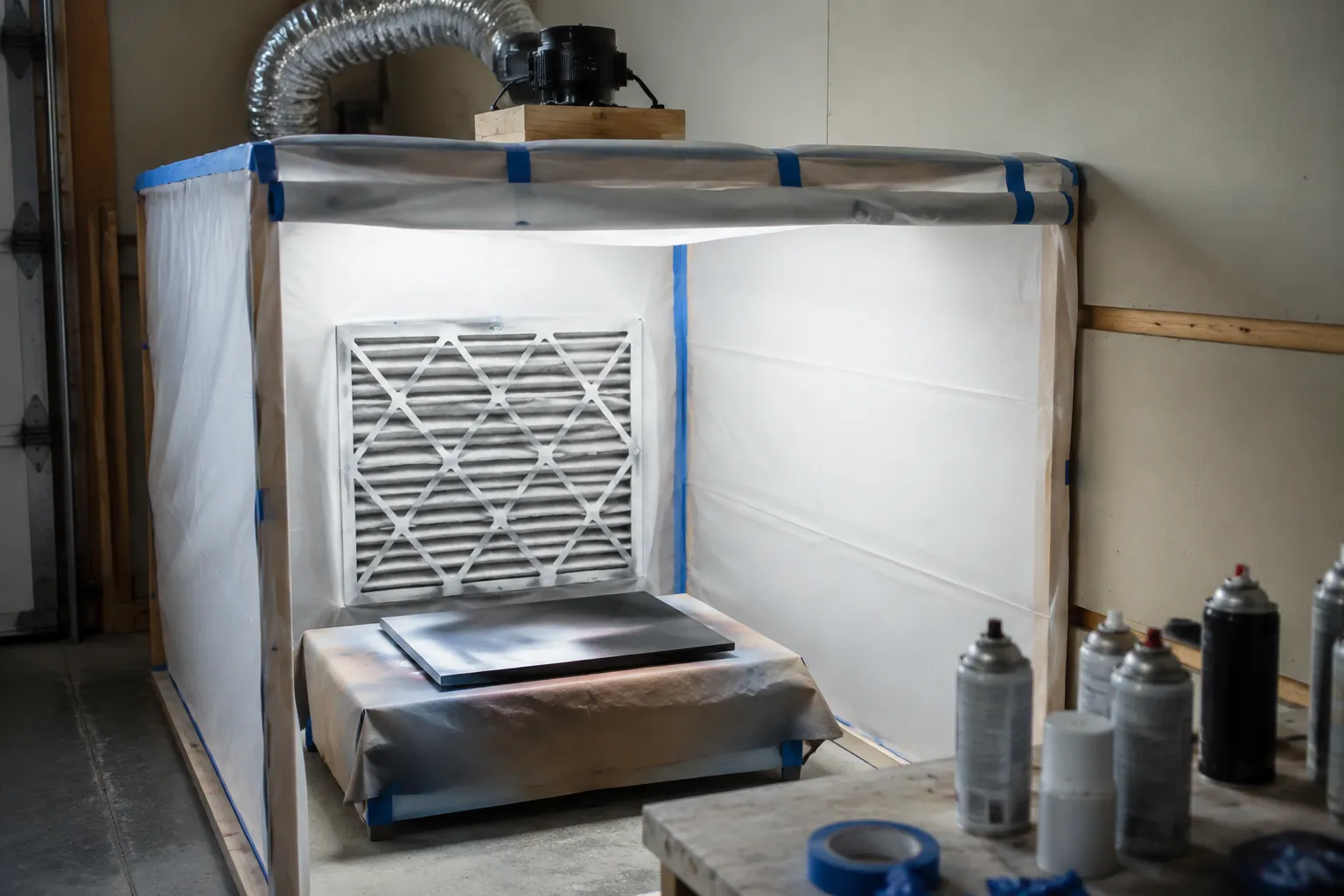
The smell of spray paint carries a particular promise. It signals that something ordinary is about to become something finished, that a raw surface is getting a coat of intention. For years, that promise lived only in professional shops, behind exhaust stacks and insurance premiums. That changed when affordable HVLP turbine systems reached the hobby market, and suddenly the question stopped being whether a person could spray at home and started being how to do it without coating the garage, the car, and the neighbor's cat in overspray.
The answer is a booth, and building one at home is more practical than most people assume. A proper setup costs less than a single trip to a professional painter, takes a weekend to assemble, and produces results that land somewhere between rattle-can frustration and showroom quality. The catch is that the word "booth" conjures images of industrial steel boxes with fire suppression systems and million-CFM exhaust fans. The home version looks different, works differently, and demands respect for a few non-negotiable safety rules.
The Core Problem Is the Fog, Not the Paint
Anyone who has sprayed a single coat of lacquer indoors understands the real enemy. It is not the paint that lands on the workpiece. It is the paint that misses, the fine aerosol mist that hangs in the air and settles on every horizontal surface within twenty feet. That mist is called overspray, and it is the entire reason booths exist. A booth is not a painting surface. A booth is an air management system with walls around it.
The physics are straightforward. Spray guns atomize paint into droplets so fine that they behave almost like a gas. They drift, they follow air currents, they cling to surfaces by static charge. Without a directed airflow, that cloud goes everywhere. With a directed airflow, the cloud gets pulled away from the workpiece and out of the room. The entire art of booth design comes down to creating that directional flow and keeping it consistent while a person works.
Gravity plays a role too. Overspray falls, but slowly, because the droplets are light. A booth needs to capture that falling mist before it lands. That means the exhaust point needs to be behind and below the workpiece, creating a flow that moves horizontally and then drops. Vertical booths, where air moves straight down through a grated floor, are the gold standard in professional finishing. Home setups rarely achieve true downdraft, but a good cross-draft configuration gets close enough for most projects.
What the Home Booth Actually Needs
A functional home booth breaks down into four components: a frame, a filter wall, an exhaust fan, and a makeup air path. That is the whole system. Everything else, the lights, the turntable, the hooks, is convenience. Getting these four elements right is what separates a booth that works from a box that just contains a mess.
The frame can be PVC pipe, aluminum extrusion, or even 2x4 lumber. PVC is cheap and easy to cut, but it flexes and can sag under filter weight. Aluminum extrusion costs more but stays square for years. Lumber works but introduces the risk of the frame itself absorbing overspray and becoming a fire hazard. For most home users, a sturdy shelving unit or a purpose-built PVC frame with diagonal bracing is sufficient. The frame does not need to be airtight. It needs to hold the filter material securely and survive the occasional bump.
The filter wall is where the booth earns its keep. The standard approach is a two-stage system. The first stage, closest to the spraying area, is a cheap fiberglass furnace filter that catches the bulk of the overspray. The second stage, behind it, is a higher-efficiency filter that catches the fine mist the first stage misses. This two-stage setup extends the life of the expensive filter and keeps the fan blades clean, which matters because paint buildup on fan blades throws off the balance and eventually destroys the motor.
The filter wall needs to cover the entire exhaust opening, with no gaps. Duct tape along the edges is the difference between a booth that filters 95 percent of overspray and one that filters 70 percent and deposits the rest on the garage wall behind the booth. A person should check the seal before every session, because filters settle and tape dries out.
The Fan Math That Most People Get Wrong
Fan selection is where home builders either succeed or waste money. The common mistake is buying a bathroom exhaust fan, which moves maybe 100 to 150 cubic feet per minute and gets overwhelmed by a single pass of a spray gun. The correct tool is an inline duct fan, the kind used for grow rooms or dust collection, rated for 400 to 800 CFM. That rating matters, but only in the context of the booth's cross-sectional area. The relevant number is face velocity, the speed of air moving through the filter wall, measured in feet per minute.
Professional booths target 100 to 150 feet per minute at the filter face. To calculate the home equivalent, divide the fan's CFM rating by the area of the filter wall in square feet. A booth with a 2-foot by 3-foot filter wall has six square feet of face area. A 400 CFM fan delivers about 66 feet per minute, acceptable for hobby work. A 600 CFM fan delivers 100 feet per minute, which is where results start looking professional. Going higher is possible, but the air movement starts to create turbulence that pulls dust into the finish.
The fan needs to be on the exhaust side of the filters, pulling air through them, not on the intake side pushing air into the booth. Pulling creates negative pressure inside the booth, which means any leak in the booth draws air inward rather than letting contaminated air escape. That negative pressure is also why the booth needs a makeup air path, an open door or window in the room that lets fresh air replace what the fan evacuates. Without makeup air, the fan starves and the face velocity drops by half or more.
The Exhaust Routing and Fire Reality
The exhaust air has to go somewhere. Venting into the garage is possible for small projects with water-based paints, but solvent-based finishes demand routing outside. A flexible dryer vent hose, 4 to 6 inches in diameter, runs from the fan to a window or a hole cut in the wall. The hose should be as short and straight as possible because every bend costs airflow. A 90-degree turn in a 4-inch hose can reduce flow by 30 percent.
This is the point where safety stops being theoretical. Solvent-based paints, lacquers, and automotive clears produce flammable vapors. A spark from a light switch, a pilot light on a water heater, or even static discharge from a synthetic jacket can ignite those vapors. The classic home workshop rule applies: never spray solvent-based finishes near an ignition source, and never run the exhaust hose near a pilot light or an electrical panel. Water-based acrylics and urethanes are dramatically safer, which is why many home finishers have switched entirely to them.
Explosion-proof fans exist, but they cost several hundred dollars and are overkill for most hobby work. A standard inline duct fan works fine with water-based paints and with solvent-based paints if the user exercises judgment about ventilation and ignition sources. The honest assessment is that a home booth is a calculated risk. The user trades absolute safety for affordability and accepts the responsibility of knowing what is in the can and how much vapor that chemistry produces.
Lighting and the Dust Trap Problem
A booth that filters well but lights poorly produces finishes that look terrible. The human eye needs even, shadow-free illumination to see orange peel, runs, and dry spots while they are still fixable. Fluorescent shop lights mounted outside the booth, shining through a clear plastic sheet or just positioned above and beside the opening, work well. The lights should not be inside the booth, because they will accumulate overspray and because the bulbs can become an ignition source in a solvent-rich environment.
The dust trap problem is subtler and more frustrating. A booth that pulls air through filters is also a booth that pulls dust from the surrounding room toward those filters. That dust gets deposited on the wet finish. The fix is not more filtering. The fix is cleanliness around the booth. The floor should be damp-mopped before every session. The surrounding area should be free of sawdust, pet hair, and lint. A person who sprays in a dirty garage gets a finish that looks like it was painted in a dirt storm, no matter how good the filters are.
Some finishers add a third filter layer at the intake side, a simple furnace filter that catches dust before it enters the booth. This works well but reduces airflow, which means the fan needs more headroom. For a 600 CFM fan, adding an intake filter drops effective face velocity by roughly 20 percent, which is tolerable. For a 400 CFM fan, that drop pushes performance below the useful threshold.
Turntables, Hangers, and the Small Parts Problem
Large flat panels are easy to spray in a booth because they sit still on a stand. Small parts, brackets, knobs, and fittings are harder because they need to be sprayed from multiple angles. A lazy Susan turntable, the kind used in kitchen cabinets, solves this. The workpiece sits on the turntable, the finisher rotates it with one hand while spraying with the other, and the whole part gets covered without the finisher walking around it. A turntable rated for 50 pounds is enough for most hobby work.
Even better for many parts is hanging them. A wire hook through a pre-drilled hole or a piece of mechanics wire wrapped around the part lets the finisher spray all sides in one pass. The hanging part also benefits from the booth's airflow because overspray falls away cleanly. The downside is that the wire leaves a small bare spot where it touches the part, which the finisher touches up after removing the part from the hook.
The small parts problem extends to the drying phase. A part that comes out of the booth wet is vulnerable to dust for the entire drying time. A simple solution is a drying rack placed near the booth's intake, where the air is cleanest. Some finishers build a second small booth, essentially a filtered box with a fan, just for drying. That doubles the cost and the space, so most people start with a rack and upgrade only if dust becomes a recurring complaint.
The Filter Replacement Cadence
Filters are consumables, and treating them that way is the difference between a booth that works for years and one that slowly loses effectiveness. The cheap fiberglass pre-filter should be replaced whenever it looks discolored, usually every two to four full painting sessions. The high-efficiency secondary filter lasts longer, often several months, but only if the pre-filter is doing its job. A person who skips pre-filter changes will find the expensive filter clogging in weeks.
There is a temptation to flip a filter over and use the other side, or to shake it out and put it back. That temptation should be resisted. The captured overspray is wet when it hits the filter and dries into a film. Flipping the filter just exposes the film to the incoming airstream, where it can flake off and land on a wet finish. Shaking a loaded filter releases that same dried paint as dust. Replacement is the only reliable move.
The exhaust hose also accumulates paint over time. A clear hose makes this visible, which is helpful. When the hose interior shows a solid buildup, the hose should be replaced. They are inexpensive enough that cleaning them is not worth the solvent exposure or the time.
The Difference Between a Booth and a Box
Plenty of people spray without any booth at all, using a cardboard box as a makeshift spray chamber or just pointing the gun at a part in the driveway. The results are predictable. The finish collects bugs, dust, and pollen. The overspray drifts onto the car, the house siding, or the neighbor's property. The painter inhales a cloud of atomized solvent and pigment. A booth is not a luxury. It is the minimum viable workspace for anyone who wants a finish that looks like it was sprayed by a professional rather than a person with a can of Krylon and high hopes.
The home booth described here is not a substitute for a professional spray booth in a collision shop. It will not handle a full car repaint or a high-volume production run. What it does handle, and handle well, is the weekend project: a motorcycle tank, a set of wheels, a guitar body, a piece of furniture, a custom computer case. For those jobs, the gap between a home booth and a professional booth narrows to almost nothing, provided the user respects the airflow math and keeps the filters fresh.
The first time a person pulls a finished part out of a home-built booth, runs a thumb across a glass-smooth clear coat, and sees a reflection with no orange peel and no dust specks, the whole project justifies itself. That moment is the payoff. It is also the moment when the hobbyist starts planning the next project, the next color, the next finish that a rattle can could never deliver. The booth makes that possible, and it costs less than the paint gun that feeds it.