
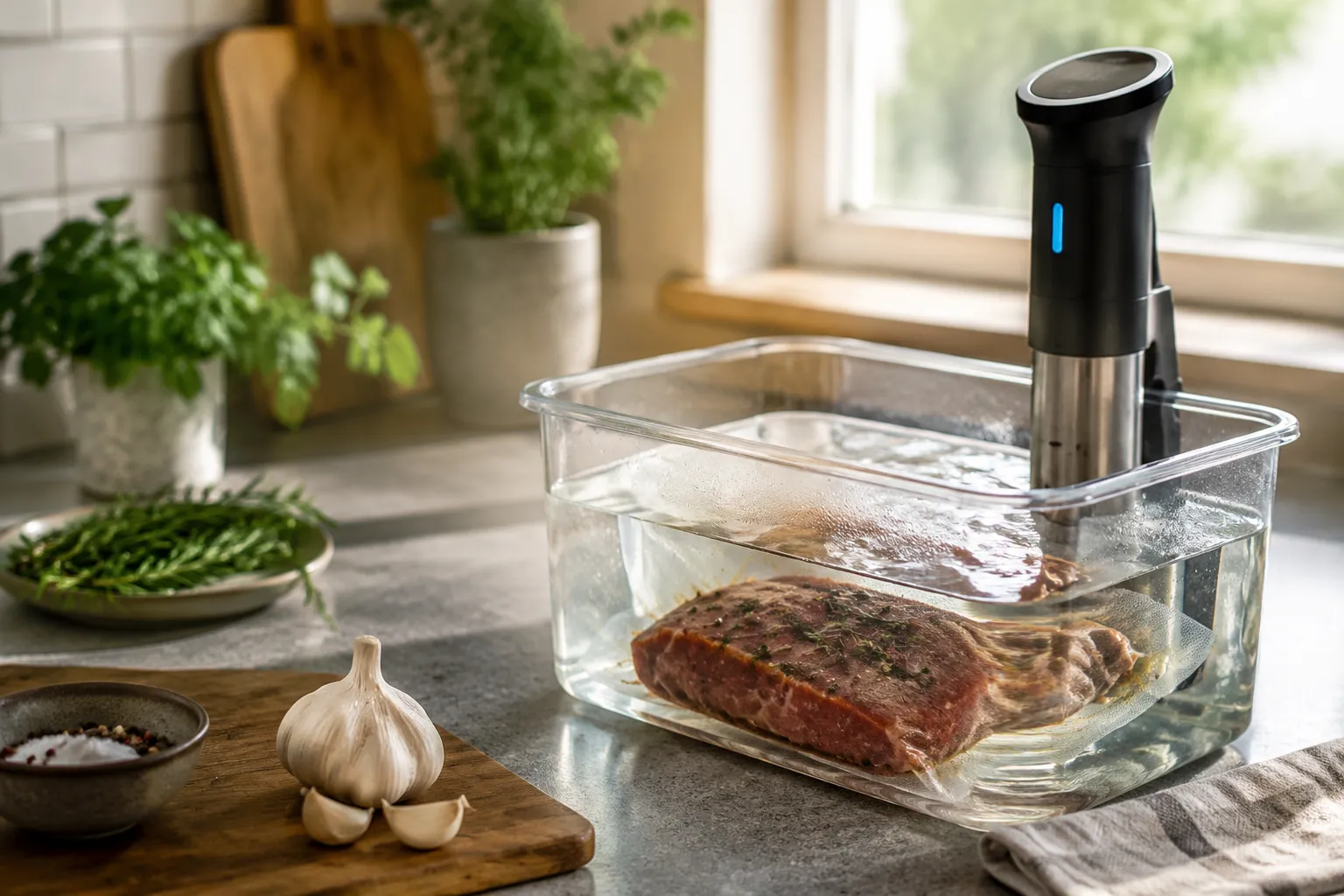
The first thing to accept about sous vide is that it will not make anyone a better cook by itself. The machine holds water at a precise temperature, the food cooks until it reaches that same temperature, and no amount of expensive hardware changes the basic arithmetic. What the technique does offer is a shift in priorities: time becomes a forgiving variable instead of a nervous countdown, and the margin for error shrinks to almost nothing. For a home cook who has ruined one too many chicken breasts on a busy weeknight, that trade is worth making. The problem is that the market offers hundreds of immersion circulators, tubs, bags, and accessories, most of which exist to solve problems the beginner does not have yet.
This piece is a filter for that noise. The goal is a working setup that fits on a counter, costs less than a dinner out for four, and produces food that tastes better than what most restaurants serve. No vacuum sealer is required. No $400 chamber machine. No silicone mats, no magnetic racks, no dedicated sous vide containers with lids cut to fit. A person needs four things, and the fourth one is optional but cheap enough to include anyway.
The circulator: pick the one with simple controls
Every immersion circulator on the market does the same core job. A heating element warms the water, a pump keeps it moving, and a thermostat holds the temperature within a degree or two of the target. The differences between a $60 unit and a $300 unit are mostly about power, noise, and app connectivity. For a beginner, power matters less than people think. A 750-watt model will take a little longer to bring a pot of water up to temperature, but it will hold that temperature just as well as a 1,200-watt machine once it gets there. The pump matters more, since a weaker pump means less consistent temperature across the pot, but even the cheapest models circulate adequately for a home pot.
The real decision is between a dial model and an app-connected model. The dial models have a physical wheel or buttons on the unit itself. They display the temperature, the cook adjusts it, and that is the whole interaction. The app models require a phone, a Bluetooth or Wi-Fi connection, and a login. The apps offer timers, presets, and the ability to monitor from another room, but they also offer firmware updates and connectivity issues. A person who wants to sear a steak after work does not need to check the water temperature from the couch. The dial model is faster to use, harder to break, and cheaper. It is also less likely to make a person feel like they need to learn a new piece of software to cook an egg.
One brand stands out for beginners, and it is not the flashiest. The Anova Precision Cooker Nano is a small, 750-watt circulator that clips to any pot. It has a simple dial and a clear display, and it costs around a hundred dollars. The Joule by Breville is smaller and more powerful, but it has no on-board controls at all; everything runs through the phone app. That is a dealbreaker for anyone who wants to cook without a screen in their hand. The Inkbird units are cheaper and perfectly serviceable, though the build quality is a step down. Any of these will work. The recommendation is the Anova Nano because it does exactly what a beginner needs and nothing else.
Whatever the choice, the circulator should be the last piece of equipment purchased, not the first. The rest of the setup is cheap and easy to gather. The circulator is the only item that requires a real decision, and it is worth taking a day to read a few reviews before committing.
The water vessel: a pot is fine, a cooler is better
Most sous vide guides insist on a dedicated plastic container with a cut-out lid and a silicone gasket. These containers are nice, but they cost forty to sixty dollars and take up cabinet space for a single purpose. A stockpot works perfectly well for most cooks. A four or five quart pot holds enough water for a chicken breast or a few steaks, and the circulator clips to the side. The only real requirement is that the pot be deep enough that the water level sits within the circulator's minimum and maximum fill lines. Most pots meet this easily.
The one upgrade worth making is a cooler, and not a fancy one. A plastic picnic cooler, the kind that holds six cans and a sandwich, makes an excellent sous vide vessel for larger cooks. The insulation keeps the water temperature stable, which means the circulator runs less often and the electricity bill stays small. The cooler also holds more water, which means more food. A whole chicken, a rack of ribs, or a large batch of eggs fits in a cooler where a stockpot would overflow. The lid can be clamped down over the bag to hold it in place, and the spout, if there is one, makes draining easy.
A person who plans to cook for more than two people should skip the dedicated container and buy a ten dollar cooler instead. A person who cooks only for themselves can use a pot and never think about it again. Both approaches are valid. The point is that the water vessel is not where money should go.
The bag: freezer-grade zip bags beat a vacuum sealer
The vacuum sealer is the most overrated piece of sous vide equipment. It is loud, it takes up drawer space, and it requires special bags that cost more per use than the zip bags sitting in the kitchen drawer. The sealer does offer one genuine advantage: it removes air completely, which means the bag sinks in the water without a clip or a weight. That is the whole benefit. For most home cooks, the convenience of a zipper bag and a binder clip outweighs the convenience of a machine that seals meat into plastic with a loud whir.
Freezer-grade zip bags are the right choice. They are thicker than sandwich bags, they handle temperatures up to boiling, and they are cheap. The technique is simple. Food goes in, the bag is sealed almost all the way, and then a person lowers the bag into the water with the unsealed corner above the water line. The water pressure pushes the air out through the gap, and when the bag is mostly submerged, the seal is closed. This is called the water displacement method, and it works reliably for anything that is not too tall for the pot.
The only food that genuinely needs a vacuum sealer is something with a lot of air pockets, like a whole fish or a high-moisture vegetable that floats no matter how much air is removed. For a beginner, those cases are rare enough to ignore. A zipper bag and a clip work for chicken, steak, pork chops, eggs, carrots, potatoes, and most seafood. The cost is a few cents per cook, and the cleanup is a rinse in the sink.
One caution applies to all bags: the bag must not be overstuffed. A bag that is too full will not seal properly, and the water displacement method will not work. Leave an inch or two of space between the food and the seal. This is the most common beginner mistake, and it is easily avoided with a little attention.
The sear: a cast iron pan and a high smoke point oil
Sous vide does not brown food. It cooks food to a precise internal temperature, and then the cook must brown the outside. This step is where sous vide meals either shine or fail. A steak that comes out of the water bath and then spends a minute per side in a screaming hot pan has a crust that beats anything from a grill. A steak that comes out and sits on a plate while the pan heats up is a sad, gray piece of meat. The sear is not optional, and it is not a place to improvise with a nonstick pan.
A cast iron skillet is the right tool. It holds heat, it gets hot enough to brown without burning the oil, and it costs about twenty dollars. The pan should be preheated for a full five minutes on medium-high heat before the meat goes in. The oil should be something with a high smoke point, like avocado oil or canola. Butter burns at sous vide searing temperatures, so it should be added at the end, off the heat, as a baste if a person wants that flavor.
The sear should be quick. Thirty seconds to a minute per side is usually enough for a steak. The interior is already at the target temperature, so the goal is only to brown the exterior. A longer sear will cook the meat past the point of perfection. This is the other common beginner mistake: treating the sear like a regular pan fry. It is not a pan fry. It is a quick, aggressive pass that adds color and flavor without touching the interior.
For chicken and pork, the same approach works, though the oil can be swapped for a flavored one and the pan can be used to make a quick pan sauce afterward. A splash of stock, a squeeze of lemon, and the fond from the pan make a sauce that tastes like a restaurant in about two minutes.
Three beginner recipes that build the habit
The best way to learn sous vide is to cook the same three things until they become routine. Chicken breast is the first because it is the food that sous vide improves the most. A chicken breast cooked at 145 degrees for an hour is juicy, tender, and completely safe to eat. It does not have the chalky texture of a pan-cooked breast that had to be overdone to be safe. The difference is dramatic enough to convert a skeptic.
Steak is second because it is the food that most people buy an immersion circulator to cook. A one and a half inch thick ribeye or strip steak cooks at 131 degrees for one to two hours. The timing is flexible; the temperature is not. A person can hold the steak for an extra half hour without harm, which means dinner does not need to be timed to the minute. The sear is the only part that requires attention.
Eggs are third because they are cheap, fast, and surprising. An egg cooked at 145 degrees for forty-five minutes has a yolk that is jammy and a white that is just set. It is a different thing than a poached or boiled egg, and it is the easiest way to impress someone who thinks they have seen everything. The eggs go in the water bath in their shells, no bag required, and they come out ready to be cracked over toast or rice. This is the recipe that makes people feel like the machine was worth the money.
The timing myth and the 130 to 140 degree zone
Most people assume that sous vide requires planning a meal hours in advance. The reality is more forgiving. A chicken breast needs about an hour, which is longer than a pan fry but shorter than a full roast. A steak needs one to two hours, but it can stay in the water for several hours without getting worse. This is the magic of the technique: the window of doneness is wide. A pan-fried steak is perfect for about thirty seconds before it crosses into overcooked territory. A sous vide steak is perfect for two hours.
The temperature range that covers most foods is narrow. Poultry cooks at 140 to 150 degrees, beef and lamb at 125 to 135 for rare or medium-rare, pork at 135 to 145, fish at 120 to 130, and eggs at 140 to 150. This range is the whole map. A person who memorizes these numbers can cook almost anything without a recipe. The rest is seasoning, searing, and patience.
The one thing that sous vide does not do well is cook food that needs a dry, crispy exterior. Anything breaded, anything that relies on a hard crust, anything that needs to be roasted in a hot oven, these foods are better done in a pan or an oven. Sous vide is a tool for food that rewards precise internal temperature, not for food that rewards a blast of dry heat. Understanding this boundary is what keeps a person from trying to sous vide a chicken wing and being disappointed.
The safety rules that matter and the ones that do not
There are three safety rules that matter, and they are simple. The first is to cook at a temperature above 130 degrees for most foods, because that is the point where harmful bacteria stop growing and start dying. The second is to keep the cooking time reasonable, between one and four hours for most foods, because the temperature alone does the work only if the food spends enough time at it. The third is to cool or sear food quickly after it comes out of the bath, because the food is at a temperature where bacteria can multiply if it sits around.
The rules that do not matter are the ones that fill internet forums and product manuals. A person does not need a food-grade silicone mat to keep the bag off the bottom of the pot. The bottom of the pot is not hot enough to melt a freezer bag. A person does not need a special rack to hold multiple bags, because the water circulation keeps the temperature even, and bags can overlap without harm. A person does not need to worry about the circulator running dry, because the unit shuts off automatically if the water level drops too low. These are non-issues dressed up as features.
The water bath does need to be covered, especially for long cooks. Evaporation is real, and a six hour cook can lose two inches of water if the pot is open. A sheet of aluminum foil over the top, or the cooler's lid, solves this completely. The cover also keeps the heat in, which means the circulator works less and the temperature stays more stable. This is the one piece of advice that saves real money over time, since a covered bath uses noticeably less electricity than an open one.
The 200 dollar setup and the 40 dollar starter
For anyone who wants the full setup without shopping around, the list is short. The Anova Precision Cooker Nano costs about one hundred dollars. A four quart stockpot is already in most kitchens, and if not, a basic one costs twenty. A box of freezer-grade zip bags costs five dollars for fifty. A cast iron skillet costs twenty, if the kitchen does not already have one. The total is about one hundred and forty-five dollars, and the only item that is strictly necessary is the circulator.
The leaner version skips the cast iron, since a nonstick pan works for a sear if the heat is high and the meat is patted dry. That brings the total to about one hundred and five dollars. The truly minimal version is a used immersion circulator from a resale site, which can be found for forty dollars, plus the pot and bags already in the kitchen. The technique is the same at every price point. The water does not know how much the circulator cost.
The most expensive item in the setup, by far, is the food. A good steak costs more than the circulator that cooks it. This is the real economics of sous vide: the machine is a one-time expense, and the food is a recurring one. A person who buys a cheap circulator and then cooks inexpensive cuts that benefit from the technique, like chuck roast or pork shoulder, will save money compared to buying the same cuts from a restaurant. The equipment pays for itself in two or three cooks.
The last thing to buy is a timer, because the phone timer is always tempting to check, and checking the timer means opening the phone, and opening the phone means scrolling, and scrolling means the steak gets a minute too many on the sear. A ten dollar kitchen timer with a loud beep removes the phone from the equation. It is the cheapest insurance in the whole setup.