
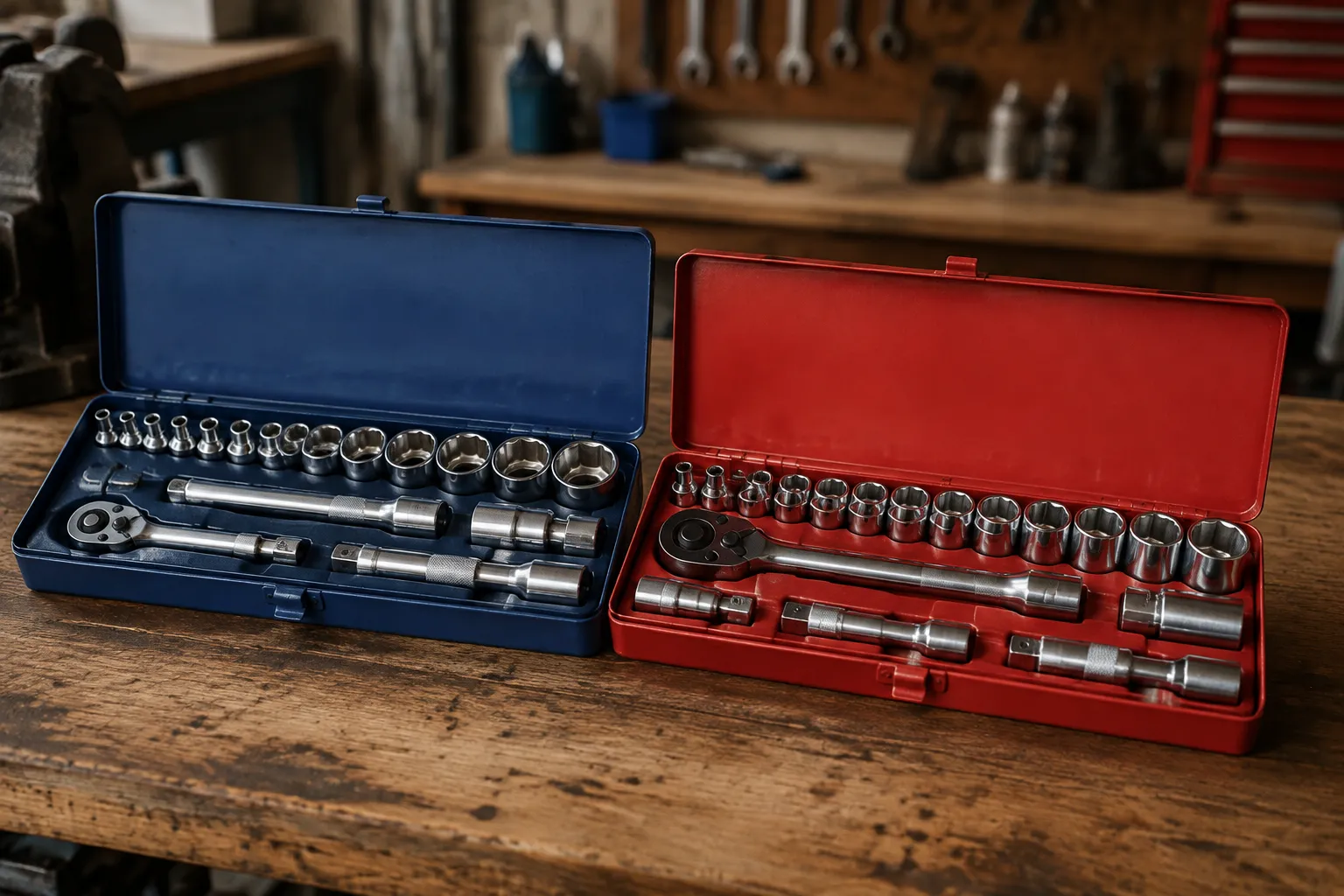
The garage drawer full of loose sockets is a kind of confession. A person starts with one set, usually whatever was on sale, then buys a second set for a specific job, then inherits a third from somebody's estate sale. Before long there are two rails of chrome and one plastic case with a broken latch, and none of it is organized, and some of it is missing. The reason this happens is the metric/SAE split, which is the longest-running practical nuisance in home mechanics. The question is not which system is better. The question is what belongs in the drawer at all.
Most passenger vehicles built since the 1980s use metric fasteners almost exclusively. That includes every major American brand. A 2024 Ford F-150, a 2025 Chevrolet Silverado, a 2023 Ram 1500, all of them are metric down to the last body bolt. The SAE sizes survive in older vehicles, in certain heavy-duty truck applications, in trailers, in lawn equipment, and in a few stubborn places like the driveshaft bolts on some Jeep models. For someone who works on modern cars, metric is the daily language. SAE is the dialect spoken by machinery that refuses to retire.
The real problem is that neither system covers everything, and the overlap is where people get hurt. A 13mm socket fits a 1/2-inch bolt head almost perfectly, close enough that it will go on, close enough that it will round the corners if there is any rust or torque involved. The 1/2-inch socket is exactly 12.7mm. The 13mm is 13.0mm. That 0.3mm of slop is the difference between a clean removal and a stripped fastener at 9pm on a Sunday. The reverse happens too: a 1/2-inch socket will sometimes fit a 13mm head and behave the same way. These near-misses are why a person needs both sets, not because both are used constantly, but because the wrong one is always tempting.
The Sizes That Actually Matter
For metric work, the practical range runs from 8mm to 19mm. That covers almost everything a home mechanic will touch: 10mm for interior trim and small brackets, 12mm and 13mm for suspension links and caliper bolts, 14mm for strut nuts, 15mm and 16mm for various engine accessories, 17mm and 19mm for larger suspension and drivetrain fasteners. The 10mm socket is a running joke because it is both the most common size and the most frequently lost. Every serious toolbox contains at least four of them, scattered in different drawers, because a person knows better than to rely on one.
SAE work centers on 3/8, 7/16, 1/2, 9/16, 5/8, and 3/4 inch. These sizes appear on older American vehicles, on many trailer hitches and couplers, on boat trailers, on some snow blowers and generators, and on the suspension hardware of classic trucks. The 1/2-inch and 9/16-inch sizes are the workhorses; they show up on everything from leaf spring shackles to tie rod ends. The 3/4-inch socket matters for axle nuts on older cars and for some lug nut applications, though most modern lug nuts have moved to 19mm or 21mm.
One size does double duty. The 6-point 1/2-inch socket and the 6-point 13mm socket are both necessary, but the 12-point versions of those same sizes are a trap. Twelve-point sockets are for fasteners with twelve corners, which are rare, and for reaching nuts in tight spaces where a 6-point cannot align. In practice, a 12-point socket on a rounded or corroded fastener will slip. A 6-point socket grabs the flat of the head and holds. The rule is simple: buy 6-point sockets. Skip the 12-point sets unless there is a specific fastener demanding them.
Why the 3/8 Drive Should Lead the Drawer
Socket sets are sold by drive size: 1/4, 3/8, and 1/2 inch. The drive is the square hole where the ratchet attaches, and it determines how much torque the tool can handle. A 1/4-inch drive set is for small work, interior panels, electronics, small bolts. A 1/2-inch drive set is for heavy work, axle nuts, suspension bolts, anything that needs a breaker bar. The 3/8-inch drive sits between them and covers more ground than either.
A good 3/8-inch drive set with both metric and SAE sockets will handle 90 percent of the maintenance a person does on a car. Caliper bolts, sway bar links, strut top nuts, alternator brackets, motor mounts, most under-car work, all of it fits within the 3/8 drive envelope. The ratchet is small enough to fit into engine bays, strong enough to break loose most rusted fasteners when paired with a short length of pipe for extra leverage. The sockets themselves are compact, which matters when working behind a wheel well or inside a frame rail.
The 1/2-inch drive set earns its place for exactly one reason: torque. Suspension components like lower control arm bolts and axle nuts require more force than a 3/8 ratchet can deliver without risking a broken tool. A 1/2-inch drive breaker bar with a 19mm or 21mm socket will crack loose a bolt that a 3/8 setup would round off or snap. For anyone working on their own vehicle, the 1/2-inch set is the insurance policy, not the everyday tool.
The Shallow and Deep Argument
Shallow sockets handle most work. They fit where deep sockets cannot, they provide more leverage per inch of length, and they are less likely to snap under sideways force. The tradeoff is reach. A deep socket extends past a long stud, reaches down onto a nut set into a recess, or grabs a spark plug. For anyone doing their own maintenance, a deep set matters for exactly a handful of jobs: spark plugs, certain exhaust manifold studs, some caliper bracket bolts, and the occasional alternator nut that sits deep in a bracket.
The practical move is to buy a set that includes both shallow and deep in the common sizes. Most mid-range brand sets offer this, and the price difference over shallow-only is modest. Deep sockets do not get used often, but when they are needed, nothing else substitutes. A person can get away with a shallow-only set and a few individual deep sockets in the sizes that matter for their specific vehicle.
What the Name Brands Charge Extra For
The difference between a $30 socket set and a $150 socket set is not the metal, or not only the metal. It is the manufacturing tolerance. Cheap sockets are stamped and machined to looser standards. The drive end may fit the ratchet with a little wobble. The fastener end may be slightly oversized, which means more play on the bolt head, which means a higher chance of rounding. Premium sockets are broached to tighter tolerances, so they grip the flats of a fastener more completely.
For a person doing occasional maintenance, mid-range sockets are the right value. Brands like Tekton, GearWrench, and Husky offer sets with lifetime warranties and tolerances that are perfectly adequate for home use. The money saved over Snap-on or Matco is better spent on a torque wrench, which will do more to prevent damage than any premium socket. The one place to spend extra is on the ratchet mechanism. A cheap ratchet with a coarse tooth count and a sloppy selector switch ruins every job it touches. A mid-range ratchet with 72 teeth or more feels dramatically better and will last for years.
The other thing the premium brands sell is thinness. A standard socket has a certain wall thickness. A thin-wall socket is machined down so it fits over rusted or swelled fasteners, or into tight clearance spots. This genuinely matters on older vehicles where corrosion has made every fastener head a little larger than spec. But thin-wall sockets are fragile and expensive. The better approach is to buy a cheap set of standard sockets, use them until one rounds out on a stubborn bolt, and replace that single socket with a premium one as needed.
The Impact Socket Question
Impact sockets look like regular sockets, but they are made of a different material, usually chrome molybdenum, and they have a thicker wall. The black finish is a clue: the oxide coating helps them resist the shock of an impact wrench. Chrome sockets, by contrast, are harder and more brittle. Using a chrome socket on an impact gun can shatter it, sending sharp fragments across the shop. This is not a theoretical risk; it is the standard warning printed on every quality chrome socket set.
For home use, impact sockets matter for exactly one tool: the lug nut gun. Anyone who has ever used a battery-powered impact wrench to remove wheels needs impact sockets in 17mm, 19mm, and 21mm, in both metric and SAE if the household runs older vehicles. These three sizes cover nearly every lug nut on the road. A set of six impact sockets in these sizes costs less than a single premium chrome socket and will never crack under normal use.
Impact sockets are also worth having for suspension work, where a breaker bar is not enough and an impact wrench is the only thing that will move a rusted bolt. In that situation, the impact socket is not a convenience. It is the difference between getting the job done and spending two hours with a torch and a hammer. A modest impact set in both systems is a permanent addition to the toolbox.
The Strip and Replace Economy
Every socket drawer eventually contains a few sockets that have been ground down, sharpened, or otherwise modified to fit a specific rounded fastener. This is the natural evolution of the tool collection. A 12mm socket that has slipped once on a rounded bolt head becomes the designated sacrifice. A person can carefully grind the inside of a socket to a slightly smaller size, effectively creating a custom tool for one specific fastener. This is not elegant. It works.
The smart approach to sockets is to treat them as consumables in the way tires are consumables. They wear out, they get damaged, they get lost. Buying a cheap full set every few years is less expensive than buying premium sockets one at a time and crying each time one walks off. The premium ratchet stays. The sockets get replaced in bulk. This is the economic reality of home mechanics, and it is the reason the drawer is never tidy.
The Minimal List That Covers a Modern Garage
For someone starting from nothing, the honest minimum is a 3/8-inch drive set with both metric and SAE, shallow and deep, in the common sizes. That means roughly 8mm through 19mm for metric and 3/8 through 3/4 inch for SAE. Add a 1/4-inch drive set for small work. Add a 1/2-inch drive breaker bar and a handful of impact sockets in 17mm, 19mm, and 21mm. That is the whole kit. It fits in one tray, weighs under twenty pounds, and will handle everything from an oil change to a brake job to a suspension overhaul.
The mistake people make is buying the 200-piece set with every possible size, then discovering that 140 of those sockets never leave the case. The unique sizes, the oddballs like 5.5mm and 11/32 inch, are rarely needed. The common sizes get used and lost. The better strategy is to start with the common sizes, then buy individual sockets as a specific job demands. The 5.5mm socket only enters the collection when a European car shows up with that exact hex head on a plastic trim screw.
The Last Sockets in the Drawer
Every generation of vehicles leaves behind a few fasteners that defy the system. Late-90s GM cars used a mix of metric and SAE on the same engine. Some Jeep models use 13mm for most things but 1/2-inch for the driveshaft. Older Harleys are almost entirely SAE, but the newer ones are metric. The practical response is not to memorize a chart. It is to keep both sets accessible and to accept that a 13mm socket and a 1/2-inch socket will always sit side by side, each one occasionally rescuing a job the other one started.
The true test of a socket drawer is not whether it is complete. It is whether a person can reach in without looking, grab the right tool, and get the bolt out the first time. That confidence comes from knowing which sizes appear on the vehicles in the driveway, not from owning every size ever manufactured. The metric set handles the daily work. The SAE set handles the stubborn old machinery. The combination, messy and overlapping as it is, is the only honest answer to the question.