
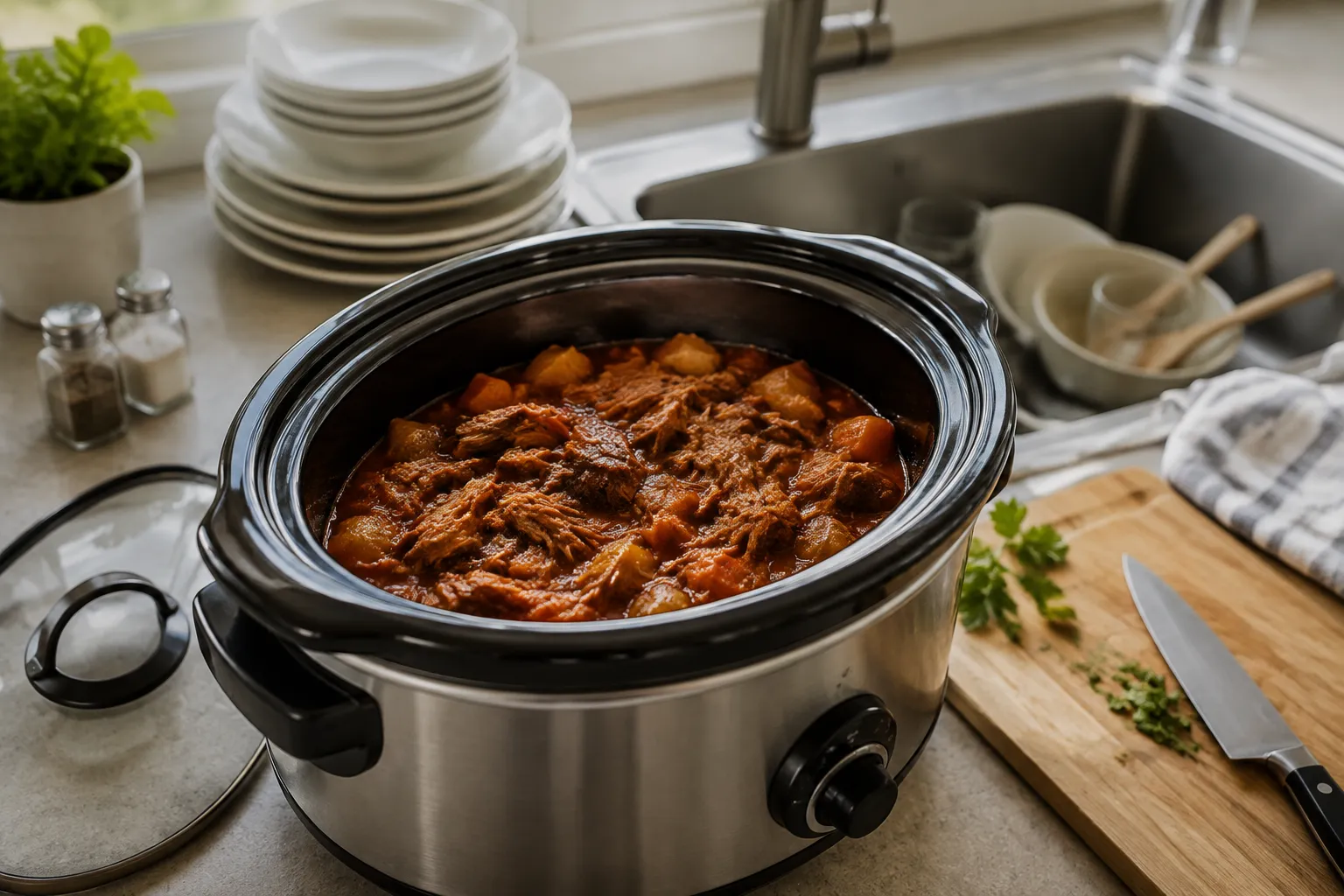
The slow cooker has a dirty secret, and it is not the pot. It is the pile of dishes that accumulates around it: the cutting board, the skillet used to sear the meat, the colander for rinsing beans, the measuring cups, the chef's knife, and the second cutting board for the vegetables that cannot share space with the raw chicken. By the time dinner is served, the counter looks like a crime scene and the sink looks like a hoarder's paradise. The whole point of the appliance was supposed to be that it does the work, yet the prep often creates more mess than cooking a meal entirely on the stovetop. The solution is not a better slow cooker. It is a fundamental rethink of what goes into the pot in the first place.
The most effective path to fewer dishes is not buying more gadgets. It is changing the format of the meal itself. A whole chicken dropped into the crock with a jar of salsa and a can of black beans creates exactly two dirty items: the pot and the jar. That is the entire trick. The recipes that work best for this are the ones that treat the slow cooker as a single-vessel braising station, not as a component in a multi-step production. The moment a recipe asks for a separate saucepan for a sauce or a separate skillet for a garnish, the cleanup math collapses.
The One-Pot Format That Actually Works
Meals that succeed at this are built on a simple structural principle: everything goes in at the beginning, and nothing comes out until serving. That means skipping the browning step, which is the single biggest source of extra dishes in slow cooker recipes. Many recipes insist on searing meat before adding it to the pot, claiming it builds flavor through the Maillard reaction. That is true. It also dirties a skillet, a spatula, and often a plate to hold the seared meat. The slow cooker cannot brown anything on its own, so the flavor has to come from elsewhere.
The workaround is to choose ingredients that do not need browning to taste good. A pork shoulder rubbed with smoked paprika, cumin, and salt, then cooked with a can of chipotle peppers in adobo and a sliced onion, comes out deeply savory without a single minute of searing. The smoke from the paprika and the heat from the chilies do the work that a hot pan would normally do. The same logic applies to chicken thighs, which stay moist and rich even without a sear, and to beef chuck, which renders enough fat that the lack of browning goes unnoticed once the meat has cooked for eight hours and fallen apart.
The other structural trick is to buy ingredients that require zero prep. Frozen diced onions, jarred minced garlic, canned beans, jarred salsa, canned tomatoes, and bagged shredded cabbage all eliminate the cutting board. A person can make a genuinely good meal using only the slow cooker insert, a can opener, and measuring spoons. The trade-off is a slight loss of freshness, but the gain is a sink that contains exactly three items at the end of the night. For a weeknight, that trade is almost always worth it.
The Salsa Chicken That Needs No Knife Work
The most reliable low-cleanup meal is also the most boring to read about, which is exactly why it deserves attention. Salsa chicken is the workhorse of this category, and it is popular for a reason. A jar of salsa, a pound of chicken thighs, and a can of black beans cooked on low for six hours produces a meal that requires exactly zero cutting. The chicken shreds with two forks, the beans thicken the sauce, and the whole thing goes over rice or into tortillas.
The key to making this more interesting than a bland pile of mush is to choose the salsa carefully. A good salsa with visible chunks of tomato and onion, not a smooth puree, holds up better over the long cooking time. A salsa verde, made with tomatillos and jalapeños, brings a brightness that cuts through the richness of the chicken. A smoky chipotle salsa adds depth. The salsa is doing the flavor work, so it should be a brand that a person actually enjoys eating cold with tortilla chips. If the salsa is mediocre, the finished dish will be mediocre.
The other version of this is the jarred curry sauce approach. A jar of Indian curry sauce, a can of chickpeas, a bag of frozen spinach, and a can of coconut milk all go into the pot together. Six hours later, the result is a thick, fragrant curry that needs only rice and a spoon. The frozen spinach defrosts into the sauce, the chickpeas soften slightly, and the coconut milk mellows the heat. This meal uses one pot, one can opener, and one measuring spoon. It is almost embarrassingly simple, but it tastes like a person spent time building layers of flavor, because the jarred sauce already did that work.
The Whole-Chicken Strategy
For a person willing to handle raw meat once, a whole chicken is the most efficient cleanup play available. A three-pound chicken fits in most slow cookers, and it requires no cutting whatsoever. The only prep is pulling out the bag of giblets and trussing the legs, which takes thirty seconds. Rubbed with salt, pepper, and a spice blend, then set on a bed of halved onions and whole garlic cloves, the chicken cooks on low for seven hours. The skin will not crisp, which is the one thing a slow cooker chicken cannot do, but the meat will be so moist that the lack of crackle is a fair trade.
The real payoff comes after dinner. The carcass, the onions, and the garlic go back into the pot with water and a splash of vinegar. Cooked on low overnight or for another eight hours, this becomes a rich stock that needs only straining. A person gets two meals and a quart of stock from one pot and one initial prep. The strainer is the only extra dish, and it rinses clean in seconds.
The economics of this are also worth noting. A whole chicken costs less per pound than boneless, skinless breasts, and it feeds two people generously, with leftovers for lunch. The stock that comes out of the carcass is a bonus that costs nothing but time. For a household trying to eat well on a budget, this is the highest-value use of the appliance.
Cutting Boards and the One-Board Rule
Some meals genuinely need fresh vegetables. A slow cooker pot roast with carrots and potatoes is a classic for a reason, and no jarred substitute will replicate the texture of a potato that has cooked slowly in beef broth. But this does not have to mean multiple cutting boards or a pile of prep bowls. The rule is to cut everything on a single board, in order, without washing it in between.
The order matters. Root vegetables go first, because they are the dirtiest and can be rinsed quickly. Onions go second, because they leave behind a residue that can be wiped off with a paper towel. Meat goes last, and only if the cutting board has been wiped clean. The board then goes straight into the dishwasher or gets a thorough soapy wash. This is one board, one knife, and no intermediate bowls, because the vegetables can be pushed directly off the board and into the slow cooker with the flat side of the knife.
This approach requires accepting that the slow cooker does not care about presentation. Ingredients that are roughly chopped, not perfectly diced, cook exactly the same way. A carrot cut into thick coins looks rustic and cooks fine. An onion cut into eighths instead of a dice still melts into the broth. The precision that matters on a stovetop, where pieces cook at different rates, is irrelevant in a pot that cooks everything at 200 degrees for eight hours.
The Liner Question and the Soak
Slow cooker liners, the disposable plastic bags that fit inside the insert, are a divisive topic. Some cooks refuse to use them, citing concerns about plastic leaching into food, while others swear by them as the ultimate cleanup hack. The honest assessment is that the liners work, and the texture of the food is unaffected. The concern about heat and plastic is a matter of personal comfort, but the liners are designed for this exact use and are rated for slow cooker temperatures.
For anyone who skips the liner, the single best trick is to fill the empty insert with warm soapy water the moment the food is transferred to a serving dish. The residual heat loosens any stuck-on bits, and a twenty-minute soak means the insert rinses clean with a sponge and no scrubbing. The insert is also almost always dishwasher safe, but the soak makes hand-washing nearly effortless.
There is a difference between the insert and the outer base. The base should never be submerged in water, and the insert should be lifted out before cleaning. This is the most common mistake in slow cooker cleanup, and it can ruin the appliance's heating element. The insert lifts out, the base gets a quick wipe with a damp cloth, and that is the entire cleaning process.
Serving Directly and the Second-Pot Trap
The slow cooker insert is an ugly serving vessel, and that is its main drawback. A person who transfers the finished meal to a nice ceramic bowl for the table has created one more dirty dish. The fix is to serve directly from the insert, placing it on a trivet and letting people spoon food onto their plates. This is not elegant, but it is honest. The pot is already dirty, so it might as well do its job until the last possible moment.
The second-pot trap is when a recipe calls for a starch cooked separately. Rice, pasta, and potatoes all require their own pot, which doubles the cleanup. The workaround is to use starches that cook in the microwave or require no cooking at all. Microwave rice pouches, instant mashed potatoes, and crusty bread from a bakery all avoid the second pot. A person can also buy pre-cooked rice in shelf-stable pouches that heat in ninety seconds. None of these are gourmet, but they are all faster than washing a rice cooker insert and a saucepan.
The other version of this is to put the starch directly in the slow cooker with the meat. Potatoes and carrots braised with a roast are the classic example. Rice can be cooked directly in the slow cooker, but the timing is finicky. Instant rice added in the last twenty minutes absorbs the cooking liquid and turns the whole dish into a pilaf. This is a trick that works well for salsa chicken, where the rice soaks up the saucy juices and becomes the base of the meal.
The Weekly Batch That Eliminates Five Evenings of Dishes
The slow cooker is not just for single meals. A person can cook a batch of protein on Sunday, then repurpose it throughout the week with zero additional cooking and minimal additional washing. A five-pound pork shoulder, cooked on Sunday with just a dry rub and a quarter cup of water, becomes the base for tacos on Monday, rice bowls on Tuesday, and sandwiches on Wednesday. The only dishes created all week are the plates and forks used to eat the meals.
This batch approach changes the entire calculus of weeknight cooking. The slow cooker runs once, gets cleaned once, and then sits unused while the leftovers do the work. The key is to season the meat aggressively, because it will be eaten cold or reheated without additional sauce. A bland pork shoulder is a sad sight on Tuesday night, but a well-spiced one, rubbed with garlic powder, smoked paprika, and a bit of brown sugar, tastes better as leftovers than it did fresh.
For households that cannot face leftovers, the same logic applies in miniature. Two chicken breasts and a jar of pesto cook in four hours on low, and the result is a meal that needs only a spoon. The leftovers, if any, become a cold sandwich filling that requires no reheating and no additional dishes.
The One-Bowl Breakfast That Leans on the Same Logic
The slow cooker's ability to cut down on cleanup extends beyond dinner. Overnight oatmeal cooked in the slow cooker follows the exact same principles: everything goes in the pot at night, and the morning brings a warm breakfast with no prep and no extra dishes. Steel-cut oats, water, a pinch of salt, and a handful of dried fruit or a chopped apple cook on low for seven hours. The result is a creamy, slightly chewy porridge that is far better than instant oatmeal and requires only a bowl and a spoon to serve.
The one trick is to use a little less liquid than a person might expect, because the oats release their own starch and thicken considerably overnight. A ratio of one part oats to three parts water, with a splash of milk stirred in at the end, produces the right texture. The leftover oatmeal reheats well in the microwave, and the insert rinses clean with a quick soak.
This is the same structural insight that applies to every meal in the slow cooker. The appliance rewards a person who thinks in advance, who is willing to let time do the work, and who is willing to accept that the pot is the only dish that matters. A slow cooker meal will never be as crisp or as visually appealing as a stovetop dish. But for a weeknight, when the goal is getting dinner on the table and getting the kitchen clean before the evening runs out, that trade is the whole point. The last thing to touch the counter is the pot, and the pot goes in the dishwasher. The sink stays empty. That is the real promise of the slow cooker, and it is a promise that most recipes fail to keep.