
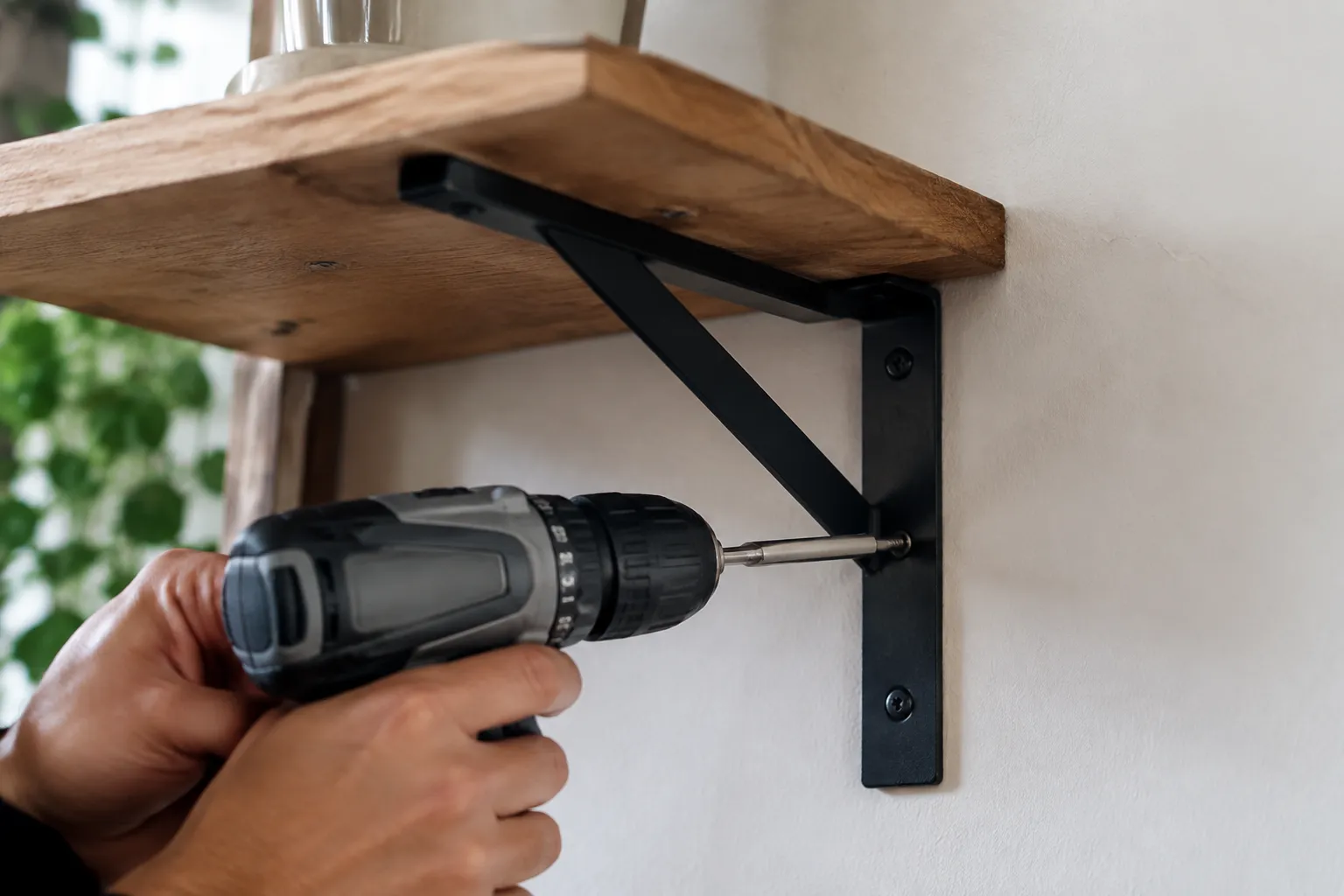
Hollow drywall is the reason most shelf brackets fail, and the fix is so simple that it borders on insulting. A person can spend good money on a thick steel bracket rated for two hundred pounds, mount it with the little plastic anchors from the hardware store, and watch the whole assembly peel out of the wall under a stack of hardcovers. The bracket was never the problem. The wall was never the problem. The connection between them was the problem, and that connection needs to go deeper than the paper-faced gypsum that most rooms are made of.
Wall anchoring for shelf brackets comes down to one honest question: what is behind the drywall? The answer determines everything from the type of fastener to the maximum load a person should trust. Guessing at this, or worse, ignoring it entirely, is how shelves end up on the floor at 2 a.m. with a thousand dollars of books and pottery in a heap.
The stud is the gold standard, but it is not always there
Wood and metal studs are the only things in a typical wall that can hold serious weight without drama. A bracket screwed directly into a stud with a coarse-thread screw can carry almost everything a person is willing to put on a shelf. The screw threads bite into solid material, not powder or compressed gypsum, so the connection does not creep or fatigue over time.
The catch is that studs land on a schedule, usually every 16 or 24 inches, and shelf brackets do not care about schedules. A person often needs a bracket precisely where no stud exists. This is not a design flaw in the wall. It is a condition of the room, and working around it requires anchoring hardware that spreads the load through the drywall itself.
Finding the stud is its own small ritual. A magnetic stud finder catches the drywall screws, a cheap electronic one senses density changes, and the old trick of knocking on the wall and listening for a solid thud still works for people who trust their ears. Once the stud is located, the bracket should be centered on it, not just overlapping its edge. A screw that catches only a quarter inch of the stud's width is a weak connection that will strip out under load.
Drywall alone can hold more than people think, within limits
Half-inch drywall is a remarkable material. It is rigid, dimensionally stable, and surprisingly strong in compression. But its tensile strength, the force that pulls the material apart, is modest. A screw driven directly into drywall with no anchor will pull out with less than a hundred pounds of force, and often far less if the screw is short or the drywall is the thinner quarter-inch variety found in some older renovations.
Anchors exist to convert that weak tensile situation into something stronger. The simplest type, the plastic expansion anchor, works by spreading its wings behind the drywall as the screw is driven in. The load then bears against the back face of the drywall panel instead of relying on the screw's threads alone. These anchors are fine for lightweight shelves holding a few small items, maybe twenty or thirty pounds total. They are not fine for a media shelf stacked with vinyl records or a pantry shelf loaded with canned goods.
The load rating on plastic anchor packaging is often misleading. That rating assumes perfect installation, fresh drywall, and a static load that never shifts. Real life involves people leaning on shelves, kids hanging from them, and the slow creep of weight over years. A sensible person halves the printed rating and treats that as the actual limit.
Molly bolts and toggle bolts handle the heavy lifting
For brackets that must live between studs and carry real weight, two anchors dominate: the molly bolt and the toggle bolt. Both work by creating a large bearing surface behind the drywall, spreading the load over a wide area so no single point has to carry everything.
The molly bolt, also called a hollow-wall anchor, is a ribbed metal sleeve with a machine screw through its center. When the screw is tightened, the sleeve crushes and folds against the back of the drywall, forming a flange. Moly bolts are clean to install, hold their position well, and can be removed and reinserted if the bracket needs to be swapped. The tradeoff is that the hole must be drilled precisely to the anchor's diameter, and the anchor does not work well in drywall thicker than its sleeve length.
Toggle bolts take a different approach. A spring-loaded winged mechanism folds flat to fit through the hole, then snaps open behind the drywall. The screw then draws the wings tight against the back surface. Toggle bolts hold more weight than moly bolts of similar size, often double, because the wings bear against a larger area of drywall. A half-inch toggle bolt can carry a surprisingly heavy shelf, though the exact limit depends on the drywall's condition and the number of attachment points.
The downside of toggles is practical annoyance. The wings fall off when the screw is fully removed, so a person cannot remove the bracket without dropping the hardware into the wall cavity. The hole also needs to be drilled to the folded-wing diameter, which is noticeably larger than the screw size. That larger hole is not a problem when the anchor is doing its job, but it becomes an ugly repair if the bracket is ever moved.
Bracket design changes how the load travels
The bracket itself matters more than most people assume. A shelf bracket is a lever. The horizontal arm carries the shelf load, the vertical leg transfers that force into the wall, and the fastener points at the intersection take the brunt of it. A bracket with a short vertical leg concentrates force into a small area of wall, while a taller leg spreads the same force across more fasteners and more anchor points.
This is why thin, minimalist brackets with a single screw hole at the top and bottom are decorative pieces, not structural ones. They look clean and modern, but they concentrate the entire shelf load into two fasteners. A heavier bracket with a full backplate, multiple holes, and a gusset or diagonal support distributes the load far more effectively. The difference is visible in the metal: a stamped steel bracket flexes under load, while a welded or solid-cast bracket stays rigid.
The number of fasteners per bracket is a direct lever on safety. Two screws in drywall anchors are the bare minimum for a light shelf. Three or four screws, each with its own anchor, spread the load and provide redundancy if one anchor fails. There is a point of diminishing returns, but a bracket with four anchor points will generally outperform the same bracket with two, all else being equal.
Matching the anchor to the bracket and the wall
Anchoring is a system, not a single component. The bracket's hole pattern, the screw size, the anchor type, and the wall construction all have to agree. A bracket with a 3/16-inch screw hole will not accept the thicker screw that a heavy-duty toggle bolt requires. A person cannot simply buy the strongest anchor on the shelf and expect it to fit the bracket. The hardware has to be selected as a set.
For a standard residential wall with half-inch drywall over wood studs, a sensible setup for a shelf carrying thirty to fifty pounds per bracket is a molly bolt or a small toggle bolt in drywall, or a #8 or #10 wood screw into a stud. For heavier loads, sixty pounds and up, the bracket should be anchored into a stud with a lag screw, or use a pair of large toggle bolts if the stud is unavailable.
Metal studs complicate the picture. A self-tapping screw into a steel stud holds reasonably well, but the thin metal does not grip threads the way wood does. For heavy shelves on metal studs, a toggle bolt that opens behind the stud's flange is often the most reliable choice, since it bites against the stud's steel rather than the drywall. Some contractors use a rivet-style anchor for this, but toggles are more forgiving of misalignment.
The shelf itself can save the whole assembly
Bracket anchoring is only part of the structural chain. The shelf board, the bracket's own mounting screws to the shelf, and the way the shelf spans the brackets all contribute to whether the system holds. A thick, stiff shelf made of solid wood or plywood distributes weight across both brackets. A flimsy shelf made of particleboard can sag between brackets, transferring more load to the inside edge of each bracket and twisting the bracket away from the wall.
Screws driven up from the bracket into the underside of the shelf connect the shelf to the bracket. These screws should be long enough to bite at least three-quarters of an inch into the shelf material. They should also be driven through any metal bracket hole and into the shelf at a slight angle, not straight vertical, to resist the shelf lifting off the bracket when weight is placed on its front edge.
Older walls and plaster change the rules
Homes built before the 1950s often have plaster over wood lath instead of drywall. Plaster is harder and more brittle than drywall, and it does not grip anchors the same way. The lath behind it provides a substrate that can sometimes catch screws, but the plaster itself crumbles under point loads. Toggle bolts work well in plaster because the wings open behind the lath and bear against the wood slats. Plastic expansion anchors are less reliable, as the plaster can crack and lose grip around the anchor's spread.
Plaster walls also tend to be uneven, which makes bracket mounting trickier. A bracket that does not sit flush against the wall will rock under load, concentrating force on one fastener. Shimming the bracket with a thin washer or a piece of cardboard behind the top or bottom edge can create a flush fit. This is a small detail that prevents a major failure.
A practical sequence for anchoring a shelf bracket
The order of operations matters more than the specific anchor chosen. A person should locate the studs first, mark the bracket positions, and then decide which anchors are needed for the holes that miss the studs. Drilling the holes before the bracket is held in place usually results in misaligned holes and a crooked shelf. Instead, hold the bracket against the wall, level it, mark all fastener points with a pencil through the holes, then drill.
Drilling into drywall requires a sharp bit and a steady hand. A pilot hole slightly smaller than the anchor's outer diameter prevents the drywall from cracking and gives the anchor a clean start. For toggle bolts, the hole must be drilled to the folded-wing diameter exactly, no smaller. For moly bolts, the hole should match the sleeve diameter so the anchor fits snugly without being hammered in.
After the anchors are set, the bracket goes on. The screws should be snug, not torqued. Over-tightening a molly bolt can collapse the sleeve too far and strip its grip. Over-tightening a toggle bolt can crush the drywall around the wings, reducing the bearing surface. Firm hand tightness is the target.
Load testing is the final honest check
No amount of packaging claims substitutes for a physical test. After the shelf and brackets are mounted, load the shelf with the heaviest items it will ever hold, then add a little more. Watch the brackets for any flex, listen for cracking sounds from the drywall, and check whether the shelf sags or pulls away from the wall. This test should happen before the shelf is declared finished and filled with valuables.
The test also reveals whether the load is distributed the way a person expected. A shelf that holds fine with weight spread evenly may fail when all the weight sits at one end, near a single bracket. Placing the heavy items near the brackets, not in the middle of the span, is a habit that extends the life of any shelf installation.
Re-checking the fasteners after a few weeks of use is another habit that pays off. Wood studs dry out and shrink slightly, loosening screws. Toggle bolts and molly bolts can settle as the drywall compresses. A quarter turn on each screw brings everything back to proper tension. This is not paranoia. It is the same maintenance a person gives a door hinge or a cabinet handle.
A failed anchor leaves a scar, but not a catastrophe
When an anchor fails, the wall usually suffers more damage than the shelf. A toggle bolt that pulls through drywall leaves a ragged hole the size of a coin. A molly bolt that strips out leaves a clean round hole that needs a drywall patch. These are repairable with a small patch kit and a bit of paint, but the repair is a reminder that the first installation was inadequate.
The better response to a failed anchor is to move the bracket to a stud location or to upgrade the anchor type entirely. A torn-out plastic expansion anchor should not be replaced with the same anchor in a slightly different spot, because the surrounding drywall is now compromised. A toggle bolt in fresh drywall a few inches away, or a screw into a nearby stud, will hold far better than a second attempt at the same location.
The deepest truth about shelf bracket anchoring is that it rewards patience. A person who takes the time to find the studs, choose the right anchor, drill clean holes, and test the load gets a shelf that stays where it was put. A person who rushes, grabs the first anchor packet off the pegboard, and drives screws through drywall into nothing gets a shelf that eventually ends up on the floor. The difference is not skill. It is the willingness to treat the wall as a structure with real limits and real capabilities.