
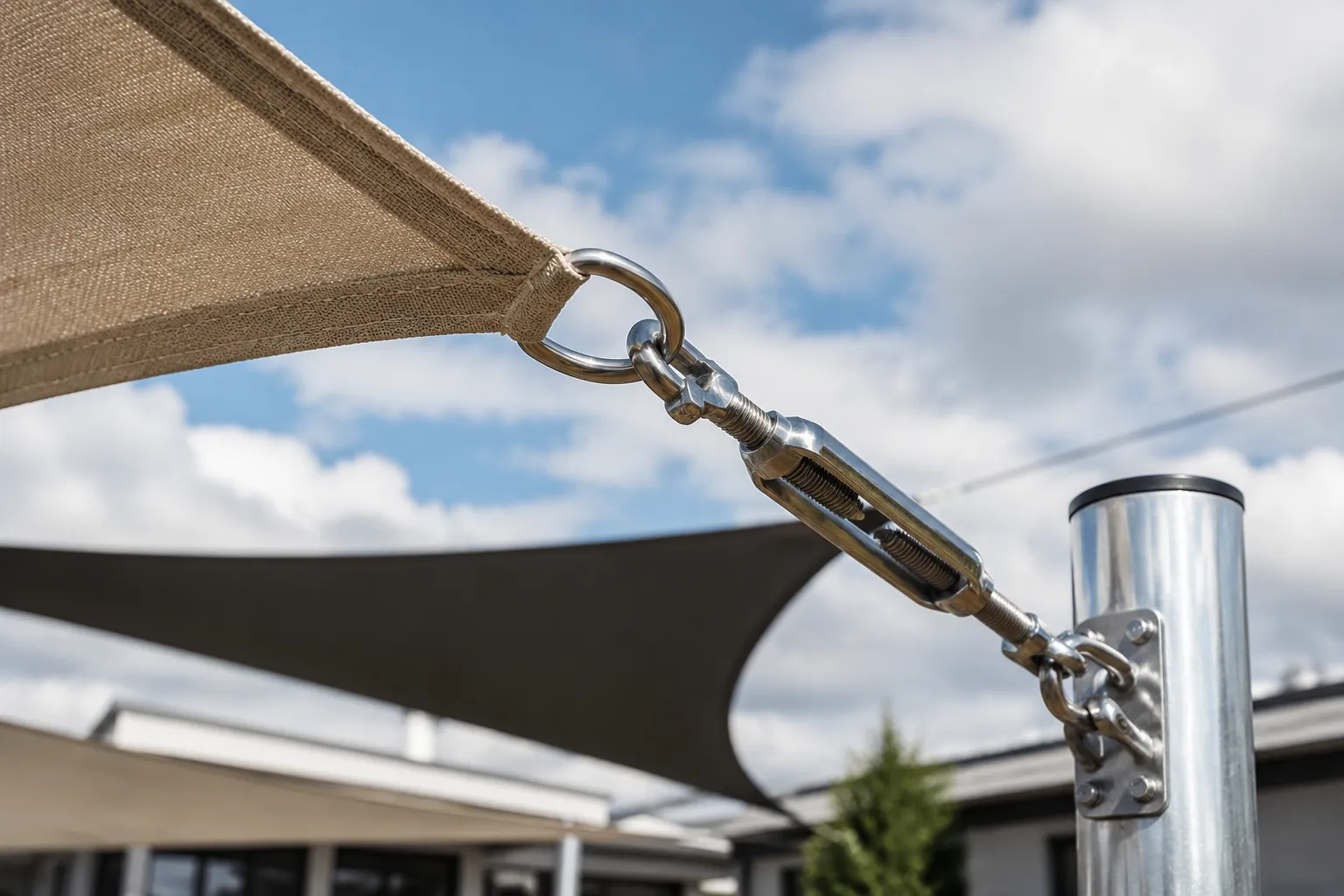
The wind does not read the spec sheet. A shade sail rated for 120 km/h will still tear a swivel out of a cheap bracket when the gusts come at an angle and the fabric starts to snap. The hardware market is full of numbers that look convincing on a package and mean almost nothing on a pole. The ratings that matter are the ones tied to a test method, a material grade, and a failure mode, and most buyers never see any of that.
Shade sails fail in three places: the fabric rips at the webbing, the webbing pulls out of the seam, or the hardware lets go. The third one is the one people blame first and understand least. A sail can look perfect and still drop a corner because a D-shackle bent, a turnbuckle unthreaded, or a screw pulled out of a post. The hardware is the weakest link in the whole system, and that is exactly where the ratings need to be read with suspicion.
Start with the load rating on the package. Most shade sail hardware sold online lists a breaking strength in kilograms or pounds. That number usually comes from a straight pull test in a laboratory, where the force is applied slowly and exactly along the axis of the part. Real wind loads do not behave that way. A gust hitting a sail at 30 degrees puts a bending moment on a clevis pin that a straight pull test never simulates. The rated number is a ceiling, not a working limit, and it is often the ceiling for the weakest component in the assembly, not the part on the label.
The 316 Stainless Distinction
Marine grade 316 stainless steel is the standard material for shade sail hardware that is expected to last. The 316 designation means the steel contains molybdenum, which gives it significantly better corrosion resistance than the more common 304 grade. Near salt water, the difference is obvious. A 304 shackle will start to show rust pits within a season in coastal air. The same part in 316 will stay clean for years. Inland, the gap is less dramatic but still real, especially where hardware sits in wet soil splash or under constant sprinkler overspray.
The problem is that not all 316 is equal. A shackle stamped "316" can be investment cast, forged, or machined from bar stock. Forged parts have a denser grain structure and handle shock loads better than cast parts, which can have internal voids. A cheap cast 316 shackle might look identical to a forged one from a distance, but it will bend under a load that the forged part shrugs off. The rating on the package rarely tells the buyer which process was used. A stamped grade mark is not a guarantee of the manufacturing method, and that distinction matters more than the decimal point in the alloy composition.
A person can check one thing without any tools: the surface finish. Forged and machined parts have a smooth, uniform surface. Cast parts often show a slightly grainy texture or small surface irregularities, especially around the eyes and the pin holes. A shackle that looks rough before it is even installed will not get smoother with age. The graininess is a clue about the production method, and the production method is a major factor in how the part behaves when a gust hits.
Load Direction and the Swivel Joint
The swivel is the most misunderstood piece of hardware in a shade sail system. It sits between the sail corner and the fixed anchor point, and its job is to let the sail rotate as the wind shifts, preventing the fabric from twisting and concentrating stress on one seam. A good swivel has a thrust bearing inside, usually a set of ball bearings captured between two races. A bad swivel has a plain pin that rotates against a metal sleeve, which means metal-on-metal friction and eventual galling.
Swivel ratings are almost always given in vertical pull, straight down along the axis of rotation. That is the correct direction for a sail corner, which hangs from the swivel. But some installers mount the swivel sideways, with the axis horizontal, to attach the sail to a wall bracket. In that orientation, the load is a bending force on the bearing races, and the rated vertical capacity is meaningless. The swivel will wear unevenly, the balls will dig grooves into the races, and the whole assembly will develop slop long before a vertical mount would show any issue.
The other swivel failure is simpler: the eye bolt at the top unscrews from the body. Swivels with a threaded eye bolt and a lock nut depend on that nut staying tight. Vibration from flapping fabric loosens it over months, and a swivel that comes apart under load drops the corner of the sail. A swivel with a forged one-piece eye cannot fail that way, and the price difference between those two designs is usually less than ten dollars. There is no reason to buy the threaded version for a permanent installation.
Turnbuckles and the Thread Engagement Problem
Turnbuckles do two jobs in a shade sail system: they tension the fabric and they provide a way to adjust that tension over time as the sail stretches. The hardware rating that matters here is not the breaking strength of the body. It is the thread engagement length between the body and the threaded rods at each end. A turnbuckle with a long body gives more thread contact, which distributes the load across more threads and reduces the chance of stripping. A short-bodied turnbuckle with the same diameter threads will fail at a much lower load because the stress concentrates on fewer threads.
A simple visual check works. Screw the rod all the way into the body and look at how much thread is left exposed on the rod. If the rod is fully engaged and still has a centimeter of thread showing before the jaw, the thread engagement is good. If the rod disappears into the body with barely any thread left to hold the jaw, the turnbuckle is too small for the rod. Some cheap turnbuckles ship with rods that are shorter than the body, which looks fine until one realizes the load is carried by maybe three threads at the end of the rod.
Another turnbuckle detail worth checking is the jaw opening. The jaw needs to fit the shackle pin or the D-shackle that passes through it with minimal side-to-side play. A wide jaw with a narrow pin creates a bending moment on the pin every time the sail moves. A tight fit keeps the load axial. This is a case where a part that looks too small is actually the right choice, because the snugger fit protects the pin from cyclic bending fatigue over years of service.
The Fastener That Holds It All
Every piece of shade sail hardware ends at a fastener. A beautiful forged stainless turnbuckle, a high-end swivel, a proper D-shackle, all of it is useless if the screw or bolt anchoring it to the structure pulls out. The rated pullout strength of a screw in wood depends on the wood species, the screw diameter, and the embedment depth. A 10-gauge screw driven 25 millimeters into soft pine holds a fraction of what the same screw holds in hardwood. The manufacturer of the shade sail hardware does not control that variable, which is why the package ratings never mention it.
For wooden posts and beams, a lag screw with a pilot hole and a washer is the standard. The pilot hole needs to be about 75 percent of the screw's minor diameter, which is the root of the thread. Too small a pilot hole and the wood splits, reducing holding power. Too large and the screw strips out. Most installers skip the pilot hole entirely on softwood, which works until the wood dries and checks, and then the screw loosens. A shade sail that is tensioned tight will pull a loosening screw out slowly over a season, and the first indication is a corner that looks droopy on a calm day.
For steel posts, the fastener question is bolt size and hole alignment. A through-bolt with a backing plate distributes the load far better than a tapped hole, because the plate doubles the shear area and prevents the bolt from ovalizing the hole. The hardware rating that matters here is the bolt's shear strength, which is usually much higher than the sail's load. The real risk is fatigue, the repeated micro-bending of the bolt as the sail flaps. A properly torqued bolt with a lock washer or a nyloc nut resists that better than a loose bolt that rattles in the hole.
Welded vs. Cast D-Shackles
The humble D-shackle, also called a screw-pin shackle, is the connector that ties the sail corner to the swivel or turnbuckle. It looks like a simple metal U with a pin threaded through the two eyes. The manufacturing method separates the good from the bad. A forged shackle has a smooth, dense structure with the grain of the metal following the curve of the U. A cast shackle has the same shape but a coarser grain, and it can hide internal shrinkage voids that only show up under load. A cast shackle will sometimes snap clean in half with no visible bending first, which is a sudden and dangerous failure mode.
Forged shackles are more expensive, usually by a factor of two or three, and the price difference is justified for any installation where a falling part could hit a person. The rating on a forged shackle from a reputable maker, like Crosby or a comparable industrial brand, is based on proof testing of every batch. The rating on a no-name cast shackle is often a copy of a number from a similar-looking product, with no test behind it. The buyer cannot tell the difference from a photo, which is why the safest move is to buy from a supplier that publishes the manufacturing standard, not just a load figure.
The screw pin itself is another weak point. The pin should be fully engaged in the threaded eye, with the head seated against the unthreaded eye. A pin that is too short, leaving threads exposed on the outside, will strip under load. A pin that is too long protrudes and catches the sail fabric, abrading it over time. Checking pin length before installation is a five-second job that prevents both failure modes.
The Tensioning Trap
A shade sail must be tensioned enough to shed water and prevent flapping, but overtensioning puts unnecessary load on every piece of hardware. The fabric stretches, the webbing creeps, and the hardware takes the residual load. A sail that is cranked down as tight as possible on a hot day will be even tighter at night when the fabric contracts with the cooler temperature. That thermal cycle can exceed the working load of a marginal swivel or turnbuckle, even though the wind speed is zero.
The better approach is to tension the sail until the fabric has a firm, drum-like surface with no visible sag, and no more. On a hot afternoon, that means the sail will develop a little slack at night, which is fine. On a cool morning, the same tension will be higher by evening. The hardware rating that matters is the one that handles the peak load, which is the coldest night after the hottest afternoon, not the average load on a mild day. A chart on the wall does not capture that, but a person who has watched a sail tighten overnight understands it immediately.
Ratchets vs. Turnbuckles for Adjustment
Some shade sail kits include a ratchet instead of a turnbuckle for tensioning. The ratchet is easier to use, a person can tighten it by pulling a strap, and it allows re-tensioning without tools. The hardware rating that matters on a ratchet is the working load limit, not the breaking strength, because ratchets are mechanical devices with internal pawls and springs that can slip or jam. A ratchet rated for 500 kg breaking strength might have a working limit of 150 kg, and that working limit is the number that governs safe use.
Ratchets also introduce a failure mode that turnbuckles do not have: the strap can wear, fray, and fail at the point where it wraps around the drum. The strap is typically polyester webbing, and it degrades in UV light even when it looks fine. A ratchet that sits in direct sun for five years will have a strap that looks fuzzy and faded, and that strap can snap under a minor gust. Turnbuckles have no such wear item. The trade-off is convenience against longevity, and for a permanent installation, the turnbuckle is the more reliable choice. For a seasonal sail that comes down in winter, the ratchet is fine.
What the Package Never Says
The rating printed on a package is a single number in a single test condition. It never tells the buyer about fatigue life, corrosion resistance over time, or the behavior of the part after it has been loaded and unloaded thousands of times. A shackle can pass a static pull test and still fail after two years of cyclic loading because the metal work-hardens and micro-cracks form at the stress concentration points. The industry standard for shade sail hardware is a static rating, and that is what the buyer gets. The practical implication is to oversize everything by a factor of two, not because the static load requires it, but because the fatigue life and the corrosion allowance need the extra material.
A person who sizes hardware based on the peak expected wind load and then doubles it will have a system that survives the decade, not just the season. The cost difference between hardware rated for 500 kg and hardware rated for 1000 kg is often small, often less than twenty percent for a full set of corners. The difference in peace of mind is large. The wind does not read the spec sheet, but the person standing under the sail on a breezy afternoon will wish the engineer who sized the hardware had thought about the gust that comes sideways, the temperature drop at 2 a.m., and the screw that was only finger-tight from last year's adjustment.