
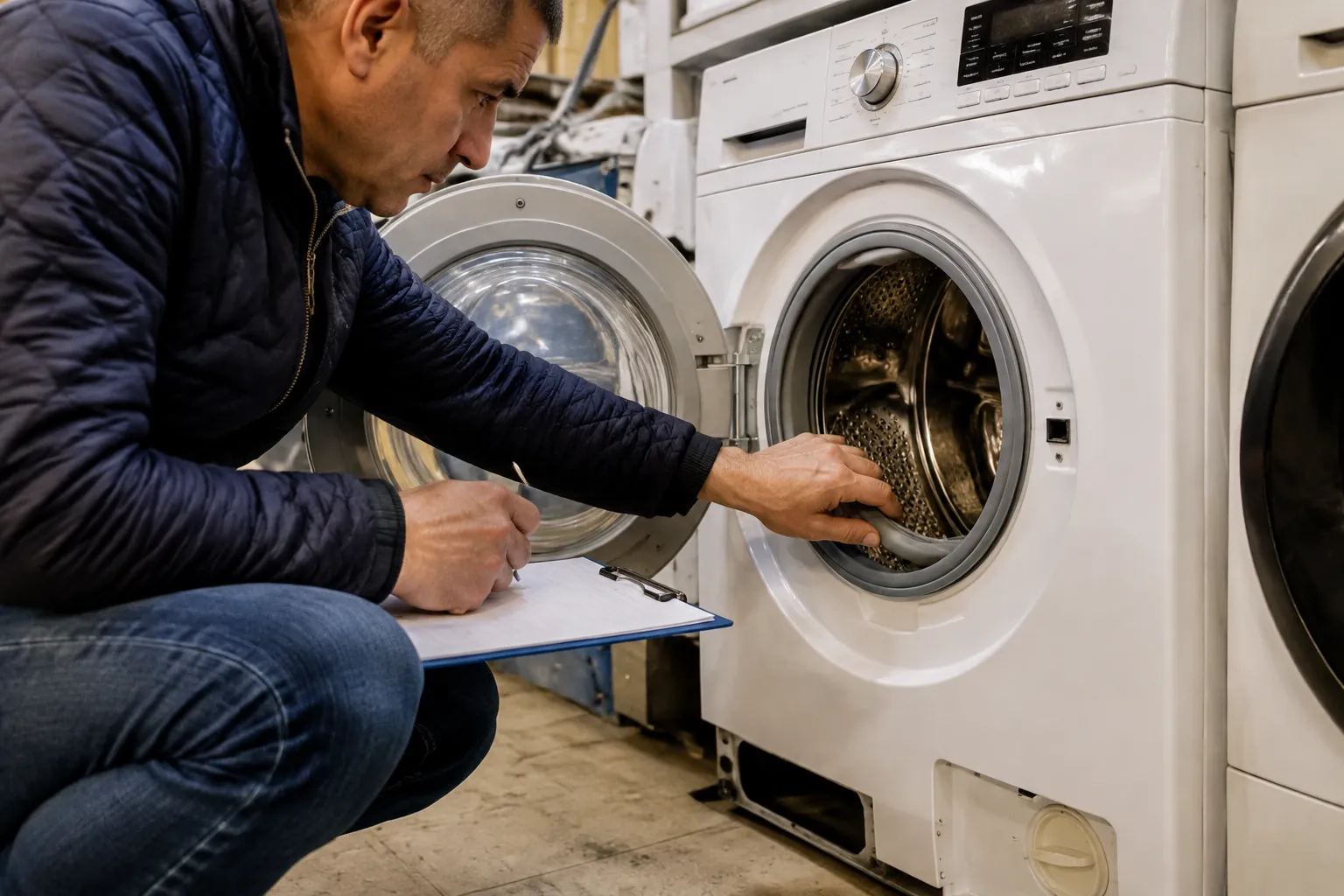
Buying a used refrigerator or washing machine is a bet against someone else's wear and tear. The seller wants the appliance gone. A buyer wants a machine that works for another five years. These two goals overlap only when the price is right, and the price is only right when the inspection is thorough. There is no way to know the true condition of a secondhand appliance from a photograph, a description, or a thirty-second demo in a bright kitchen. The machine needs to be examined in the places nobody photographs.
The checklist below is for the person who is willing to spend forty minutes on a driveway or a garage floor looking at a machine that is not theirs yet. That time is worth more than any price reduction a seller will offer for a quick sale. Skip a step and the savings can evaporate into a service call, a part, or a replacement within the year.
Start with the Power Cord and Plug
The cord is the cheapest component on the machine and the easiest one to check. A frayed cord, a cracked plug, or exposed copper wire ends the negotiation immediately. There is no repair that makes financial sense on a used appliance with a damaged cord, because the cord is a safety item and the replacement labor alone will exceed the value of the machine.
Look at the plug prongs for burn marks or discoloration. Darkened prongs indicate arcing at the outlet, which means the appliance drew more current than the cord or the outlet could handle. A machine that has been overloading its circuit once will keep doing it. Check the cord length and note where it exits the machine. A cord that has been stretched tight against a wall for years will have stress fractures near the strain relief. Bend the cord gently along its entire length and feel for hard spots, which are internal breaks.
For gas appliances, the flexible supply line matters more than the cord. A gas dryer or range with a corroded or kinked supply line is a slow leak waiting to happen. The line should be stainless steel braided, not old rubber, and the fittings should thread on smoothly without force. Any resistance means stripped threads.
The Exterior Tells the Handling Story
Dents and scratches on the sides and top are cosmetic and negotiable. Dents on the front corners, around the door, and near the handles are different. Those locations get damaged during loading and unloading, which means the machine has been moved repeatedly. Every move is a chance for internal components to shift, break, or knock loose. A machine with heavy front-corner damage has likely been dropped, and a dropped refrigerator can have a compromised sealed system even if it cools fine on the day of the test.
Check the leveling feet. All four should turn freely and have enough thread left to adjust. Rusted or seized leveling feet mean the machine sat in moisture for a long time. That moisture has been working on the underside, which is where the expensive parts live. Flip the machine forward gently, if the seller allows it, and look at the base pan. A thin film of dust is normal. A crust of rust or a puddle of oil is a deal breaker.
The door gaskets on a refrigerator deserve a close look. Run a finger along the entire seal. A gasket that is cracked, hardened, or missing chunks will leak cold air constantly, forcing the compressor to run more often and raising the electric bill beyond any savings from the purchase price. Replacement gaskets cost between fifty and a hundred dollars and take an hour to install, so factor that in before making an offer.
Open the Doors and Feel the Seals
Open and close every door on the appliance at least five times. Listen for the sound. A door that closes with a solid thunk and creates a slight suction is sealing properly. A door that closes with a hollow rattle or bounces back slightly is not seated. On a refrigerator, the suction test is simple: close the door with a piece of paper half in and half out, then pull the paper. If it slides out easily, the seal is weak. If it resists, the gasket is doing its job.
On a washer or dryer, open the door and inspect the hinge. A door that droops or wobbles on its hinge will eventually fail to latch, and the machine will refuse to start. Dryer door catches break often enough that replacement is common, but a broken catch on a used machine is a negotiating point, not a reason to walk away. A broken hinge is a reason to walk away.
Look inside the drum of the washer. Run a hand along the inner surface, especially the perforated areas. Rust flakes, sharp edges, or a rough texture indicate the drum coating is failing. That coating is what keeps clothes from snagging and what keeps the drum from rusting through. Once it starts flaking, it will not stop. A washer drum is not a replaceable part in any economic sense on a used machine.
Run the Machine Through Its Full Cycle
A seller who will not let a machine run through a complete cycle is a seller who knows something. Insist on a full cycle, not a two-minute demo. For a washer, that means a complete wash and spin. For a dryer, a full heat cycle. For a refrigerator, it means waiting long enough to see the compressor cycle on and off, which can take twenty minutes in a warm room.
During the washer cycle, listen for grinding, thumping, or high-pitched squealing. A steady hum is the motor working. A rhythmic thump during the spin cycle indicates a bearing problem or a load imbalance, and on a used machine it is usually the bearing. Bearing replacement on a washing machine costs nearly as much as a new machine because the entire tub assembly must be disassembled. Walk away.
Watch the water during the rinse cycle. The water should be clear, not cloudy or tinted. Cloudy water can mean the pump is recirculating debris. Check the floor around the machine after the spin cycle. Fresh water on the floor means a leaking tub seal or a cracked hose. Both are repairs that eat the savings.
For the dryer, let it run for ten minutes on high heat, then open the door and feel the airflow. Weak airflow means the exhaust path is restricted, either by lint buildup in the machine or by a kinked vent hose. The vent hose is the seller's responsibility to maintain, but once the machine is in a new home, the new owner inherits the restriction. Ask to see the vent hose and check it for crushing, kinks, or excessive length. A dryer that blows weak at the vent connection will take twice as long to dry clothes and will overheat.
The Compressor Run Test on a Refrigerator
A refrigerator is the hardest used appliance to evaluate because the sealed system is invisible. The compressor, condenser coils, and refrigerant lines are all sealed and inaccessible. What a buyer can do is measure the temperature inside the fridge and freezer sections with an independent thermometer. Do not trust the built-in temperature display, which can be inaccurate or deliberately optimistic.
Place a thermometer in a glass of water in the middle of the fridge section and another thermometer in a dry spot in the freezer. Close the doors and wait thirty minutes. The fridge should be between 35 and 40 degrees Fahrenheit. The freezer should be at 0 degrees or below. If the fridge is above 40 or the freezer is above 10, the sealed system is weak and the machine will only get worse. Refrigerant leaks are not repairable at a cost that makes sense.
Listen to the compressor when it kicks on. A healthy compressor hums steadily. A compressor that clicks, chatters, or vibrates loudly is struggling. Feel the side panels of the refrigerator near the compressor area. Excessive heat means the condenser coils are clogged with dust, which makes the compressor work harder and shortens its life. Clogged coils can be cleaned, but the labor is dirty and the accumulation suggests the previous owner never maintained the machine.
Check the condenser coils themselves, which on most modern refrigerators are either behind the bottom grille or on the back. A thick layer of dust and pet hair on the coils is a maintenance failure. Clean coils are a sign the owner cared. Dirty coils are a sign the machine was allowed to run itself into the ground.
Smell Is a Diagnostic Tool
Every appliance has a smell profile. A clean machine smells like metal and plastic. A machine with a musty odor has had moisture sitting inside it for a long time, which is normal for used appliances but also the root of several expensive problems.
A washing machine with a strong mildew smell has biofilm growing in the drum, the hoses, or the drain pump. That biofilm will not wash away with a single vinegar cycle. It requires a deep cleaning service or, in severe cases, hose and pump replacement. The smell is the symptom, but the cause is neglect.
A refrigerator with a sour or rotten smell means something spilled and was absorbed into the interior plastic or the gasket. Plastic is porous and will hold the odor permanently. A fridge that smells bad will keep smelling bad, no matter how many baking soda boxes are placed inside. Do not buy a refrigerator that smells wrong.
A dryer with a burnt or acrid smell is the most serious red flag on this entire list. That smell indicates lint has been burning inside the machine or the vent. A dryer that has already had an internal fire will have charred components that are visible only after disassembly. Do not run it again. Walk away and leave the seller to deal with it.
Ask About the Repair History, Then Verify
Most sellers are honest about major repairs because they have the receipts. Ask directly what has been replaced and when. A replaced compressor, motor, or control board is a positive sign, because those are the parts that fail and the new part resets the clock. A machine with no repair history is either very young or very neglected.
Verify the age of the appliance by locating the serial number and checking the date code. Most manufacturers encode the year and month in the serial number, and a quick online lookup will decode it. A ten-year-old machine with no repairs is about to need one. A five-year-old machine with a replaced compressor has a better long-term outlook than a three-year-old machine with the original compressor, because the compressor is the heart of the system and the new one is likely of better quality than the factory original.
Ask whether the appliance was in a home or a rental property. Machines from rentals take a different kind of abuse. Renters do not clean lint filters, do not level washers, and do not report small problems until they become big ones. A machine from a single-family home where the owner was present is a safer bet, all else being equal.
The Delivery Question Changes the Price
A used appliance must be transported, and the transport method is part of the inspection. Ask the seller how the machine will be moved. A refrigerator must be transported upright. Laying it on its side for an extended period can cause oil to flow into the compressor lines, and while modern units can recover if allowed to stand upright for a few hours before plugging in, the risk is real. A seller who plans to lay the refrigerator down in a truck bed is a seller who is cutting corners.
Factor delivery into the negotiation. A machine that costs two hundred dollars but requires a two-hundred-dollar delivery fee and a fifty-dollar disposal fee for the old unit is not a bargain. A machine that costs three hundred dollars with free local delivery and the seller helping to haul away the old one is the better deal even at the higher price. The total cost of ownership includes getting it into the house.
Measure the doorways and stairways before committing. A refrigerator that fits in the seller's kitchen may not fit in a buyer's hallway. A washer that clears a basement stairway in one house may not clear another. The seller will not offer a refund because the buyer failed to measure. Bring a tape measure to the inspection and compare it against the appliance dimensions and the dimensions of the home entry path.
The Final Test Is the Price of the Risk
After the inspection is complete, the buyer knows more than the seller about the machine. That information has value. A machine that passes every test is worth more than the asking price if the seller priced it low because they were tired of looking at it. A machine that fails a test is worth less, sometimes worth nothing.
The right offer reflects the remaining lifespan of the machine, not the seller's original purchase price. A refrigerator that is eight years old and running perfectly has maybe seven more years of life. A fair price is one that reflects the value of those seven years, not the original cost of the unit. The seller's emotional attachment to the machine is not the buyer's problem.
When the negotiation is over and the handshake happens, the buyer should have a clear mental image of the machine running in their own home. If that image includes a service technician, the price should be lower. If the image is simply a quiet machine doing its job, then the forty minutes spent on the driveway inspection was the best part of the transaction.