
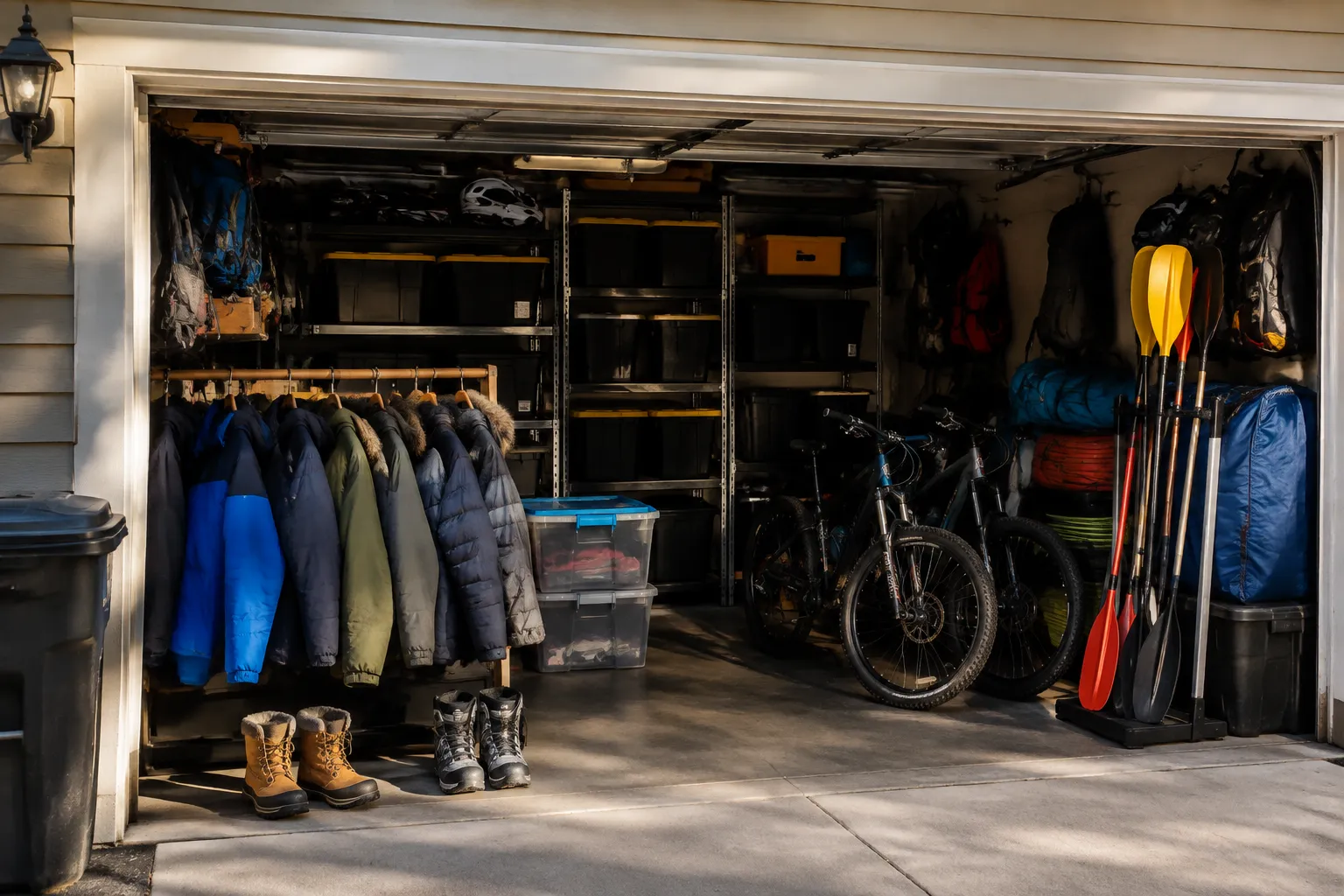
The garage in a single-family home is the least designed room in the house, and the most punished. It takes the car, the lawnmower, the bikes, the holiday bins, the freezer, the workbench, the spare building materials from a renovation that ended in 2019, and, in the colder months, everything a person does not want to carry across a snowy driveway. And then twice a year, the whole system has to shift. The shovels have to move out of the way so the sprinklers can be reached. The ice scraper has to become findable. The beach chairs need to come down from the high shelf, and the sleds have to go up. Most households do this with a vague sense of dread, shoving one pile into another corner and calling it a rotation.
The reason the seasonal gear rotation fails in a crowded garage is not a lack of storage products. It is a lack of a defined circulation path and a designated staging zone. A garage is a miniature logistics hub, and the people who treat it that way, with a real plan instead of a hope, are the ones who never have to buy a second snow shovel because the first one disappeared behind a bin of Christmas decorations.
The Failure of the Static Shelf Layout
The default garage layout treats every wall as permanent real estate. Shelving goes up, hooks go in, bins get stacked, and the system works fine for exactly one week, usually in late spring when everything is still put away. Then the lawn equipment comes out, the kids' bikes get dumped near the door, the recycling bags stack up, and the shelves become a museum of things that were once organized. The problem is that this layout is static. It assumes the same items will occupy the same spots year-round. But the whole nature of seasonal gear is that it moves. It is not decorative. It is in use, or it is in the way.
The static layout also creates a false sense of order. A person looks at a pegboard full of gardening tools in March and feels a sense of pride. By November, that same pegboard is half empty, the tools are leaning against the car door, and the space where the rake hung is now occupied by a bag of salt that was thrown there in a hurry. The wall did not change. The behavior did. And the layout did not account for the behavior.
A rotation system has to be built on the idea that the garage has a seasonal heartbeat. In the summer, the floor space near the door belongs to the hose and the cooler. In the winter, it belongs to the boots and the bin of hats. The walls stay the same, but the floor plan shifts. This is a fundamentally different design problem than "how do I store all my stuff," and it requires a different solution.
The Concept of the Active Zone and the Dead Zone
Every crowded garage needs two distinct physical areas, and the line between them has to be more than conceptual. The active zone is the space within arm's reach of the man-door or the garage door, roughly the first four to six feet of floor space. This zone holds only the gear that is in season right now. The dead zone is everything else, the far wall, the high shelves, the space behind the car's parking spot. This zone holds the out-of-season gear in clearly labeled bins that are stacked in a deliberate order.
The mistake most people make is that they put the seasonal bins in the active zone and the daily-use items in the dead zone. The bins for Christmas decorations sit on a low shelf near the door because they are heavy and someone did not want to lift them. The toolbox, which is used twice a month, gets shoved to the back. The result is that the most accessible real estate in the garage is occupied by items that are needed for a six-week window, while the stuff that needs to be reached frequently is buried.
The rotation rule is brutal: if an item has not been used in the current season, it does not live in the active zone. The exception is only for emergency items, like the fire extinguisher or the first aid kit, which get a permanent, visible hook near the door regardless of season. Everything else moves. The beach umbrella does not get to stay by the door in October. The snow brush does not get to stay by the door in June. The physical act of moving it, even if it is just a few feet to a shelf, creates the awareness that the season has changed.
The Two-Foot Shelf Rule for Heavy Bins
One of the main reasons the rotation fails is not laziness but physics. A plastic bin full of winter coats, boots, and mittens can weigh forty pounds. If that bin is stored on the top shelf, the act of rotating it requires a person to climb a step stool, wrestle the bin down, and then, six months later, do the whole thing in reverse. The body remembers this ordeal. The brain decides that the bin is fine where it is, and the system breaks down.
The fix is a simple height constraint: any bin that moves seasonally must be stored on a shelf between knee height and shoulder height. In practical terms, that means the best real estate in the garage, the middle two shelves, is reserved for the bins that travel. The upper shelves hold only items that never move, like the empty luggage or the boxes of old photographs. The lower shelves hold the heavy but immobile items, like the spare car oil or the bag of cat litter. This rule is non-negotiable. It is the single most important detail in a rotation system, and it is the one most people ignore because they put the heavy bins up high to "get them out of the way."
Getting them out of the way is exactly the wrong goal. The goal is to make the seasonal exchange take under ten minutes. If a person can grab the bin, set it on the floor, swap out the contents, and put it back in the same slot, the rotation will happen every year. If it requires a ladder and a contortionist move, it will happen once, and then the bins will live on the floor for the rest of the year.
The Swap Shelf: A Dedicated Interchange Point
Even with the two-foot rule in place, a rotation needs a place to happen. The garage floor is not a good interchange point because it gets covered in dirt, and the act of bending down to sort through a bin on the ground is unpleasant. The solution is a small, empty shelf, roughly three feet wide, that is deliberately left clear all year.
This is called the swap shelf. It is a staging area where the out-going bin and the in-coming bin both sit during the transition. The swap shelf cannot be used for storage. It cannot hold the mail, or a bag of potting soil, or the dog's leash. It is a piece of empty infrastructure, like a loading dock. When the season changes, the person pulls the winter bin down to the swap shelf, opens it, and checks the contents. Then the summer bin comes down to the swap shelf. Items that need to be transferred, like the emergency gloves or the garage door opener's spare battery, move from one bin to the other. The winter bin goes back to its slot. The summer bin moves to the active zone.
The swap shelf solves the biggest psychological barrier to the rotation: the feeling that the task is a big, undefined project. It is not. It is a two-bin exchange with a designated countertop. The shelf also forces a person to look at the gear twice a year. This is how a person discovers that the left glove has a hole in it, or that the previous year's sunscreen bottle is empty. The discovery happens in a controlled place, not at the beach or in a snowstorm.
The Outgoing Inventory List Pinned to the Wall
A garage rotation is only as good as the memory of the person doing it. Most people run the rotation from their head, which forgets that the camping stove was loaned to a neighbor in July. The fix is a cheap clipboard or a laminated sheet of paper hanging near the swap shelf, with a simple list of every item that lives in the seasonal bins.
The list is not a detailed inventory with quantities and serial numbers. That is a task for a warehouse, and it will be abandoned by February. The list is a checklist of categories: Winter (boots, gloves, hats, scarves, ice scraper, sleds, salt). Summer (beach chairs, umbrella, cooler, sunscreen, bug spray, hiking daypack). The person does a quick scan of the bin against the list during the swap. If an item is missing, the list catches it. If an item is broken, the list gets a note written in pencil.
The list also serves a second function. It ends the vague anxiety of "I think we have a shovel somewhere." The list is proof that the shovel exists and that it is in the bin. This matters more than it sounds. In a crowded garage, the most expensive time is not the time spent storing things. It is the time spent looking for them. A person who spends twenty minutes searching for the snow brush on the first snowy morning has already paid the cost of a new snow brush in lost time and frustration.
The Sled and Long-Handle Problem
Bins solve the problem of small items, but they fail for the awkward gear. Sleds, shovels, rakes, fishing rods, and beach umbrellas do not fit in a standard tote. They are also the items most likely to cause a garage to collapse into chaos, because they lean against the wall and then fall over, taking out the whole row.
The rotation answer is a dedicated vertical slot, often a pair of large hooks mounted to a wall stud or a vertical track system, placed near the back of the active zone. The rule is that this slot holds only the in-season long items. The sleds hang in the winter. The rakes hang in the summer. The off-season items get stored in a horizontal position, either on a high shelf near the ceiling or flat on a top shelf in the dead zone.
The horizontal storage is key. A sled laid flat on a high shelf is out of the way and cannot fall. A rake hung on a hook in the dead zone is reachable but still a source of clutter. The rotation forces the person to make the trade: the active slot is precious, and it is reserved for the items that are in use. Everything else is stored flat, up high, and out of the path.
The ceiling is the most underused real estate in the garage for this exact problem. A pair of simple hooks screwed into the joists can hold a ladder, a canoe paddle, or a set of skis. The items are out of the way, but they are also visible. Seeing a pair of skis on the ceiling in September is a reminder that the season is coming. It is a subtle nudge that the rotation needs to happen, rather than a surprise when the first snowflake falls.
The Holiday Bin Exception That Ruins Everything
Every garage has one bin that refuses to cooperate with the rotation calendar: the holiday decorations. This bin usually comes down in late November, goes up in early January, and then lingers in the active zone until March because the person is tired of dealing with it. The holidays are emotionally exhausting, and the bin becomes a symbol of that exhaustion.
The rotation system needs a special rule for this bin. The rule is that the holiday bin gets its own permanent home, a low shelf or a slide-out cart in the dead zone, and it never goes into the active zone at all. The holiday bin is not seasonal in the same way the beach gear is. It is a single, concentrated event. It comes down, gets used, and goes back up within a defined window. It should not participate in the gentle rhythm of the spring and fall swap.
The second part of the rule is that the holiday bin gets a hard deadline. It goes back on its shelf by the second weekend of January. This is not a storage decision. It is a mental health decision. The garage is a place of fresh starts, and a bin of tinsel sitting on the floor in February is a weight on the whole room. Giving the holiday bin an exception to the rotation, but a strict one, keeps it from becoming the wrecking ball of the system.
The One-Item Rule for the Workbench
No garage rotation survives contact with an active workbench. The workbench is a natural gathering point for random items: a screwdriver used once, a half-empty can of paint, a roll of tape, a pair of pliers that "might be useful." The workbench is the point of entropy, and the rotation system must not try to fight it directly.
The rule is simple: the workbench surface must be cleared to one item at the end of every week. The item can be a project that is in progress, like a bicycle wheel being trued or a picture frame being repaired. Anything else gets returned to a drawer, a hook, or a bin. The one-item rule is not about tidiness. It is about maintaining a clear surface so the swap shelf can be used in an emergency. The workbench is the backup plan for the rotation. If the swap shelf is occupied, the workbench is the only other viable flat surface in the garage.
The one-item rule is also the easiest rule to enforce because it is small. No one needs to clean the whole workbench. They just need to move the five things that do not belong, leaving the one thing that does. This rule keeps the garage from becoming a landing strip for random stuff, which is the death of any organized system.
The Last Step: A Permanent Marker and Five Minutes
The actual moment of the season change is where most systems fall apart. A person walks into the garage, looks at the bins, and feels the weight of the task. The trick is to shrink the task to a single, repeatable action.
That action is a five-minute check at the swap shelf. The person sets a timer, pulls down the out-going bin, and does nothing else. No repainting the shelf. No reorganizing the screws. No deciding to deep-clean the whole garage. Just the bin, a quick look, and a decision about whether anything needs to be transferred.
If the bin needs a repair, the broken item goes into a small "repair queue" bin with a piece of tape on it, not back into the rotation. That repair bin sits on the swap shelf until it has two items in it, at which point it becomes a task. This prevents the broken glove from going back into storage and being rediscovered, useless, six months later.
At the end of the five minutes, the person writes the date on the bin with a permanent marker. The date is the key. It is a small, visible record that the rotation happened. A bin with a date from last November is a bin that was forgotten. A bin with a date from two weeks ago is a bin that is on the right cycle. The marker costs a dollar. The five minutes cost almost nothing. Together, they turn a vague chore into a metered habit, and they keep the garage from ever reaching the point where the car does not fit and the shovels are buried under the summer lawn furniture. The system is not about storage. It is about the discipline of moving things on time.