
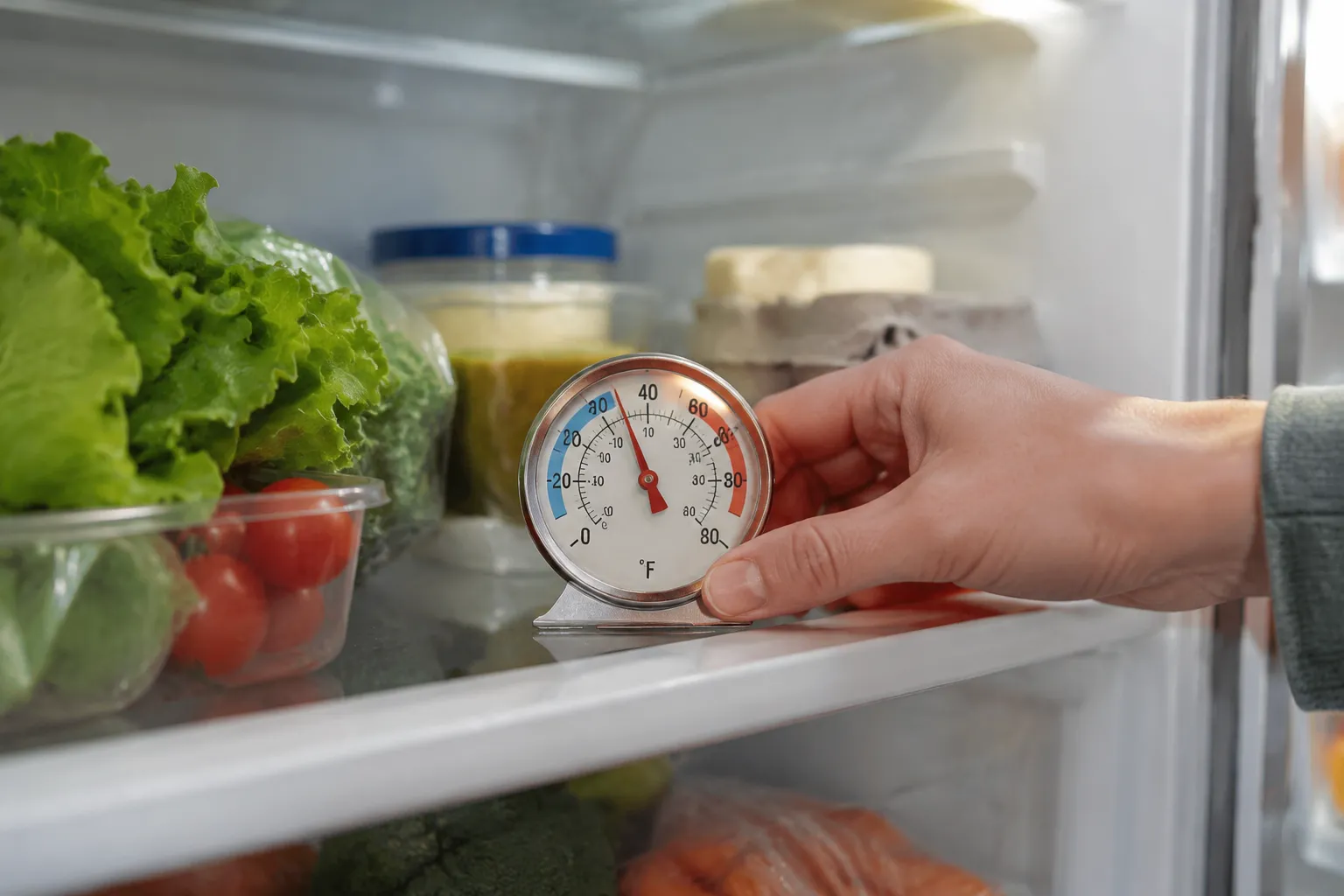
The cheapest food safety tool in most kitchens is also the most ignored one. A refrigerator thermometer costs less than a pack of chicken thighs, takes thirty seconds to install, and yet the average person will check the oil level in their car before they ever think to look at the temperature inside their fridge. That is a strange priority, because a fridge that runs too warm is not a minor inconvenience. It is a slow-moving health hazard that happens to be parked right next to the coffee maker.
Most refrigerators built after the mid-1990s have a factory dial or a digital readout on the front. People trust that dial the way they trust a landlord's promise about the plumbing. The dial is a suggestion, not a measurement. It tells the compressor roughly how hard to work, but it does not account for a door left ajar, a blocked vent, an overstuffed shelf, or a failing gasket. The only way to know what is actually happening inside the box is to put a separate thermometer in there and read it.
The target zone is well established. Food stays safe at or below 40 degrees Fahrenheit. Above that, bacteria like Salmonella and Listeria begin multiplying at a rate that should worry anyone who eats leftovers. The danger zone for perishable food sits between 40 and 140 degrees, and a refrigerator that drifts into the upper 40s or low 50s is effectively incubating whatever is sitting on its shelves.
Why the Built-In Dial Lies
Refrigerator manufacturers design their temperature controls for the average kitchen, which means they design them for a machine that is never opened, never filled with warm groceries, and never subject to a 90-degree summer day. Real kitchens do not resemble that test lab. The dial is calibrated to a sweet spot that assumes a mostly empty box with the door closed for long stretches. The moment real life intrudes, the dial becomes unreliable.
The other problem is that the dial does not measure anything. It simply adjusts the duty cycle of the compressor. Setting it to a higher number makes the compressor run longer, but the actual temperature depends on the ambient heat in the room, the amount of food inside, and how often the door swings open. A fridge in a hot garage with the dial at medium might sit at 48 degrees all day while a fridge in a cool basement with the same dial setting holds a perfect 37. The dial cannot tell the difference.
There is also the matter of temperature layering. Cold air sinks, so the bottom shelf of a refrigerator is usually several degrees colder than the top shelf. The door shelves are the warmest part of the whole unit, frequently running five to ten degrees warmer than the main cavity. A person who keeps milk in the door and eggs on the top shelf might be storing both at unsafe temperatures even when the middle shelf reads a perfect 38. A single thermometer placed in the center of the middle shelf tells only part of the story.
The built-in digital readouts found on newer models are marginally better than the old dials, but they suffer from a different flaw. The sensor is often located somewhere that does not represent the average temperature of the box, usually near the cold air inlet at the back. It reads the coldest air entering the fridge, not the temperature of the food sitting in the front of the shelves. A person could trust that display and still be storing dairy at 45 degrees.
What a Real Thermometer Actually Measures
A standalone refrigerator thermometer does not care about duty cycles or ambient room temperature. It sits inside the box and records the actual thermal conditions around it. The best ones are simple dial or liquid-filled units with a clear face, meant to be read at a glance through the glass door. They cost between five and fifteen dollars. The digital versions with probes and alarms cost a bit more, but the basic mechanical ones have been doing this job reliably for decades.
The placement of the thermometer matters more than the brand. The middle shelf, toward the front but not touching the door, gives the most honest average reading for the main storage area. That spot avoids the coldest air at the back vents and the warmest air near the door seal. A person with a large household that opens the fridge constantly might want a second thermometer on the top shelf or in the door to catch the warm zones where dairy and eggs often end up.
The reading itself needs time to stabilize. A thermometer pulled out of a 70-degree kitchen and placed into a 38-degree fridge will take a while to settle. The liquid-filled units are slower than the digital ones, often needing several hours to reach an accurate reading. That makes the first check a waiting game. The correct move is to set the thermometer, close the door, and come back in the morning. A person who checks after twenty minutes and adjusts the dial based on that reading is chasing a ghost.
The Morning Read That Tells the Truth
The single most informative thermometer reading happens before the kitchen wakes up. After the fridge has sat closed overnight, with no door openings and no warm food added, the interior reaches its baseline temperature. That morning number is the closest thing to a controlled test the appliance will ever produce. It represents what the fridge can achieve when left alone. If that number is above 40 degrees, the unit has a problem that no amount of door-opening discipline will fix.
A fridge that reads 38 or 39 degrees in the morning is in good shape. A person can then spend the day opening and closing it, adding groceries, and cooking meals, knowing the compressor can handle the load. The morning baseline gives the fridge a benefit of the doubt that an afternoon reading never can. An afternoon check that shows 44 degrees might simply reflect a busy day of meal prep. The same reading at 7 a.m. means something is genuinely wrong.
Tracking that morning number over several weeks reveals patterns that a single check never shows. A fridge that starts at 38 degrees in January but creeps up to 42 by August has a failing seal or a compressor losing efficiency. A fridge that swings six degrees between morning and evening has a defrost cycle problem. The thermometer turns a vague suspicion into a concrete trend line, and that trend line is what allows a person to act before food starts spoiling.
Adjusting the Dial in Small Steps
When the morning reading comes in too high, the natural instinct is to crank the dial to its coldest setting and walk away. That is a mistake. Refrigerators do not respond instantly to dial changes, and overshooting the target creates a different problem. A fridge running at 30 degrees will freeze lettuce, split milk cartons, and ruin the texture of leftovers. The goal is a stable 37 or 38 degrees, not a deep freeze.
The correct adjustment is a small one. Moving the dial one number or one-quarter of a rotation, then waiting a full day for the system to stabilize, gives the fridge time to find its new equilibrium. A person who adjusts daily and waits between changes will land on the right setting in about a week. A person who cranks the dial and adjusts again the next morning will spend a month chasing a temperature that never settles.
There is a seasonal component to this adjustment that most people never consider. A refrigerator in an unconditioned garage or a hot kitchen has to work harder in July than in January. The same dial setting that produced a perfect 38 degrees in winter might produce a borderline 43 degrees in summer. The morning thermometer read is the only reliable way to know when the dial needs a nudge. The appliance does not have seasons. The room around it does.
The Freezer Door Needs Its Own Check
The freezer compartment rarely gets the same scrutiny as the main fridge, which is unfortunate because it has its own thermometer requirements. A freezer should hold at 0 degrees Fahrenheit or below to keep food safely frozen. At that temperature, bacterial growth stops entirely and frozen food keeps its quality for months. At temperatures above 10 degrees, frozen food slowly degrades, ice crystals grow, and the texture of meat and vegetables suffers even if nothing becomes unsafe to eat.
Most combination refrigerator-freezer units share a single cooling system, which means the freezer temperature is set by the same dial that controls the fridge. If the fridge reads 38 degrees, the freezer is probably in the right range. But a separate thermometer in the freezer costs the same five dollars and removes the guesswork. The door-mounted ice makers and the constant opening of the main fridge door both affect freezer temperature in ways that the shared dial cannot fully compensate for.
The freezer check is also a useful diagnostic. A fridge that reads 38 degrees but a freezer that reads 15 degrees points to a defrost system failing. A freezer that reads minus 10 while the fridge sits at 45 degrees suggests the cold air is bypassing the main compartment and flowing straight to the freezer. These patterns are invisible without two thermometers. The pair of readings forms a more complete picture of what the cooling system is doing.
Testing the Warm Spots, Not Just the Average
A single thermometer on the middle shelf gives a good average, but the food that actually goes bad lives in specific places. The door shelves are the classic problem zone. Every time the fridge opens, the door swings into the warm kitchen air, and the items stored in the door are the first to feel that heat. Milk, eggs, and condiments that spend their entire lives on the door are cycling through temperature swings that never touch the middle shelf.
A person can map these warm spots by moving a single thermometer around the fridge for a week. Start it on the top shelf, then the bottom drawer, then the door shelf, reading each position after it has stabilized overnight. The map that emerges is often surprising. The bottom drawer of a fridge runs colder than the rest of the unit because cold air sinks, which means the vegetable crisper might be holding at 34 degrees while the door shelf is at 44. The food storage strategy should follow that map: hard-to-spoil items like butter and condiments in the warmest spots, dairy and raw meat in the coldest.
The same logic applies to the refrigerator after a large grocery run. Loading a warm bag of groceries into a fridge causes the internal temperature to spike, sometimes by ten degrees or more. The thermometer will catch that spike clearly. The food will warm up, then slowly come back down as the compressor runs. A fridge that takes more than a few hours to recover after a grocery run has a cooling system that is struggling. That recovery time is a health metric that most people never measure because they never have the thermometer to watch it.
The Annual Check That Prevents Waste
A refrigerator thermometer is not a one-time purchase. It is a tool that should be read on a schedule, the same way a person checks the tire pressure or the smoke alarm battery. A monthly morning read takes ten seconds and catches problems while they are still cheap to fix. A fridge that creeps from 38 to 42 degrees over six months is telling the owner that the door seal is wearing out. Catching that early means replacing a twenty-dollar gasket instead of throwing out a hundred dollars of spoiled food.
The cost equation is simple. A five-dollar thermometer prevents the loss of a single ruined carton of milk, a pack of chicken, a container of leftovers. One spoiled grocery run pays for the thermometer ten times over. The real expense is the food that gets silently wasted by a fridge running five degrees too warm. The food does not even need to be obviously spoiled. The texture changes, the flavor dulls, and a person ends up throwing away things that look fine but taste wrong, blaming the ingredients instead of the appliance.
There is a simple habit that covers all of this. On the first morning of each month, read the thermometer before opening the refrigerator door. Write the number down on the calendar or in a phone note. If the number is 40 or below, leave everything alone. If it is above 40, make a small adjustment to the dial and check again in a day. That is the entire system. It takes more time to read this paragraph than it does to perform the monthly check.
The refrigerator is the only appliance in the house that quietly decides whether the food a person feeds their family is safe to eat. A stove that runs hot burns dinner. A washing machine that leaks ruins a floor. A refrigerator that runs warm does something worse, it erodes the margin of safety on every perishable item inside it, and it does so without any visible sign of failure. A five-dollar thermometer is the difference between trusting that margin and actually knowing it exists.