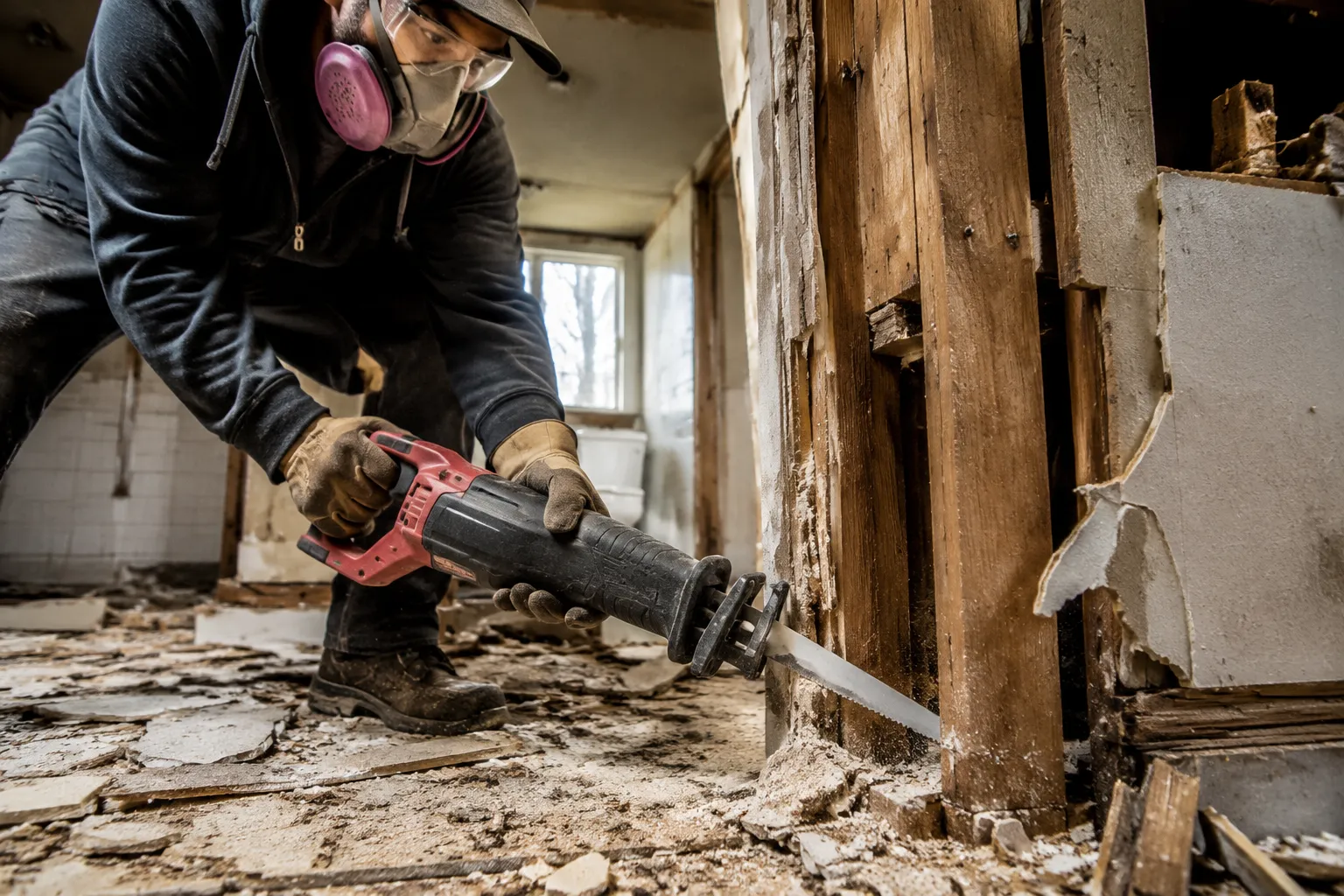
The reciprocating saw is the only demolition tool that rewards impatience. A sledgehammer demands a full swing and a clear conscience about whatever is behind the wall. A crowbar needs a gap to start. The Sawzall, as nearly everyone still calls it, just needs a blade and a willingness to cut things that were never meant to be cut. That willingness is exactly what gets people hurt. The tool does not discriminate between a nail, a pipe, a live wire, or a finger, and it will cut all of them with the same vibrating indifference.
The irony of demolition work is that the people doing it are usually in a hurry to remove something they have already decided is worthless. That mindset is the root of most bad cuts. A person who slows down for one second, plants both feet, and thinks about what is on the other side of the material will complete the tear-out faster than the person who just jams the blade in and hopes. Speed in demolition is a byproduct of control, not aggression.
The Two-Handed Grip Is Not Optional
Every reciprocating saw on the market has a trigger handle and a second grip, sometimes a boot near the blade, sometimes a rotating handle near the motor. The second grip exists for a reason, and ignoring it is the fastest way to lose a tooth or a kneecap. A one-handed grip on a saw cutting through a 2x4 stud is manageable. The same grip on a saw cutting through a cast iron pipe is a different story. The blade catches, the saw bucks, and the operator's wrist folds in a direction it was not designed to fold.
The correct grip places the support hand as close to the blade as the tool allows, with the elbow locked and the shoulder square over the cut. This is not a comfortable position. It puts the body in a slight forward lean, like a batter waiting for a pitch. But it transfers the saw's vibration into the skeleton rather than the wrist. The tool becomes an extension of the arms instead of a thing being wrestled. People who cut for a living do this without thinking. Everyone else should practice on a few scrap studs before touching anything structural.
A related habit is keeping the shoe, the flat metal plate where the blade exits, pressed hard against the work surface. The shoe is the saw's stabilizer. When it is pressed flat, the blade stays straight and the cutting action stays smooth. When it is lifted, even slightly, the blade whips and the cut wanders. The pressure should come from pulling the saw back toward the body while pushing forward into the material. This sounds contradictory but it is not. The saw needs to be seated against the work, not merely resting on it.
Blade Selection Decides the Cut Before the Saw Starts
Most demolition accidents are not caused by the saw. They are caused by the wrong blade fighting the material. A wood blade with coarse teeth will bounce off a nail and send the saw lurching sideways. A metal blade pushed through a stud will overheat, dull, and then catch, snapping the blade and leaving a jagged mess. The blade is not an accessory. It is the cutting edge of the entire operation, and it needs to match the material at hand.
For general demolition, a bi-metal blade with 10 to 14 teeth per inch handles most wood with embedded nails without destroying itself. For cast iron and heavy steel, a carbide-toothed blade with fewer teeth, around 6 to 8 per inch, chews through metal without the teeth stripping out. For nail-embedded lumber, a blade with variable tooth geometry, where the teeth are set at different angles, prevents the blade from grabbing a nail and stopping dead. The packaging on the blade says what it is for. Reading it takes five seconds and saves a trip to urgent care.
The blade length matters too. A 9-inch blade is fine for most framing tear-outs. A 12-inch blade is for cutting through thick material in one pass, but it whips more at the end, especially when the blade is fully extended. Longer blades require more control and more patience. They are not a shortcut to cutting faster. They are a way to reach deep into a wall cavity without removing the surrounding structure, and they should be used with that specific purpose in mind, not as a default choice.
The Cut Direction Is a Decision, Not a Habit
Reciprocating saws cut on the pull stroke or the push stroke depending on the blade orientation and the saw's design. Most saws cut on the pull stroke, meaning the teeth point upward and the blade cuts as it moves back toward the operator. This is important because the weight of the saw during the cut is different in each direction. On a pull stroke, the operator must resist the saw pulling itself deeper into the material. On a push stroke, the operator must push through the cut while keeping the shoe flat.
Plunge cuts, where the blade is driven straight through a wall or floor from the front, are the most dangerous maneuver in demolition. The blade tip is hidden inside the material, and the operator cannot see what it is contacting. Before a plunge cut, a person should drill a pilot hole and stick a finger through to check what is behind the surface. This takes thirty seconds. It also prevents cutting through a live wire, a water line, or a gas pipe, any of which turns a routine tear-out into an emergency call.
For cuts along a stud or a joist, the saw should be angled so the blade does not bind. A straight vertical cut into a stud will pinch the blade as the weight of the wall settles. Angling the cut, even by 10 degrees, keeps the kerf open and the blade moving. This is the kind of detail that separates a smooth demolition from a stuck saw, a smoking motor, and a string of profanity.
Cast Iron and the Patience It Demands
Cutting cast iron pipe is where the reciprocating saw earns its reputation. Cast iron is brittle and hard, and it does not cut so much as it chips. A blade moving too fast will shatter the pipe, sending sharp fragments flying and potentially cracking the fitting at the joint. The correct approach is slow, steady pressure with a carbide blade, letting the tool do the work and the teeth nibble away at the metal.
The saw should be run at a lower speed, around half throttle, with the shoe braced firmly. The cut should be made in short strokes, pulling the blade back every few seconds to clear the dust and prevent overheating. A blade that glows red is a blade that is failing. It will lose temper, dull instantly, and then catch on the next stroke. When the blade starts to smoke, stop, let it cool, and consider whether a different blade is needed.
Chainsaw-style blades, which wrap around the pipe in a loop, are a better choice for large diameter cast iron. They cut in a circular motion and reduce the chatter that destroys straight blades. But they require a saw with enough power and a firm grip, because the vibration is intense. A person cutting a 4-inch cast iron stack with a straight blade is fighting a losing battle. The loop blade is the right tool, and the difference is immediately obvious in the smoothness of the cut.
What the Extension Cord Reveals About the Job
Corded reciprocating saws are more powerful, but they come with a tether that creates a hazard of its own. The cord wraps around feet, snags on debris, and gets pinched between the blade and the material. A person backing away from a cut with the cord wrapped around a knee is a person about to fall. The cord should be draped over the shoulder, not trailing on the floor, and the work area should be cleared of loose material before the saw turns on.
Cordless saws have improved to the point where they can handle most demolition work, but they run out of battery at the worst moment. A saw that dies halfway through a cut leaves the blade stuck in the material, and extracting it requires either a second saw or a great deal of wiggling. The battery level should be checked before starting a cut, not after. A spare battery on the belt is the difference between finishing the job and waiting twenty minutes for a charge.
The weight of the saw matters more over a long day than at the start. A 12-pound corded saw feels manageable for the first ten cuts and exhausting by the fiftieth. A lighter 8-pound saw with a shorter blade will do most of the same work with less fatigue. Fatigue is the real enemy. Tired arms make sloppy cuts, and sloppy cuts are when the saw kicks or binds. If the arms are shaking, the saw needs to go down and the operator needs a break.
The Cut That Goes Wrong Happens Fast
Every reciprocating saw injury follows the same pattern. The operator is cutting something awkward, maybe overhead or in a tight corner. The body is twisted, the grip is compromised, and the saw catches on a hidden nail or a knot in the wood. The saw kicks back, the blade whips upward or sideways, and the operator's hand, which was not properly placed, meets the moving teeth. The injury is always to the non-dominant hand, the one holding the boot near the blade.
The glove is not a protection against this. A leather glove will slow the blade down, but it will not stop it. The only real protection is keeping the non-dominant hand behind the shoe, never in front of it. The shoe is the line. If the hand is behind the shoe, the blade cannot reach it. If the hand is anywhere on the material being cut, it is exposed. This is a simple rule that gets violated every single day on job sites, because people reach out to steady the workpiece without thinking.
Eyewear is non-negotiable. The chips and dust from a demolition cut fly at high speed, and they are not polite about direction. Safety glasses with side shields are the minimum. A face shield is better for overhead cuts, where the debris falls directly into the face. The cost of a face shield is about the same as the copay for a corneal abrasion, and it saves a lot of blinking and rubbing.
The Workpiece Wants to Move
A reciprocating saw transfers vibration into the material, and if the material is not secured, it will dance. A loose stud, a swinging piece of drywall, a pipe that is not anchored, all of them move with the saw and turn the cut into a fight. The work must be stabilized before the blade touches it. This is obvious, and it is ignored constantly.
For framing tear-outs, the stud or joist should be nailed or clamped to the surrounding structure before cutting. For pipe, the pipe should be supported on both sides of the cut. For drywall, the section being removed should be held or braced so it does not sag and pinch the blade. A pinch is the most common cause of a broken blade, and a broken blade at speed becomes a projectile. The saw stops, the blade snaps, and a piece of steel flies somewhere unpredictable.
A person who takes thirty seconds to set up the work will complete the cut in ten seconds. A person who skips the setup will spend five minutes wrestling, will likely break a blade, and will possibly damage the material they were trying to preserve. The choice is clear, and it is a choice made before the trigger is pulled.
Reading the House Before Cutting It
The reciprocating saw does not know the difference between a live wire and a dead one. It will cut both with equal ease, and the operator will discover the mistake when the saw bucks, the lights go out, or worse. Before cutting into any wall, ceiling, or floor, a person should know what is behind it. This requires a stud finder with a wire detection mode, or simply a careful look at the electrical panel and the plumbing layout.
In a house built before 1970, the wiring is often not where it should be. Romex runs are stapled to studs at odd heights, and junction boxes are buried behind layers of drywall and plaster. A demolition crew that assumes the wiring follows the blueprint is a crew that will find out otherwise the hard way. The saw should be started at low speed for the first few seconds of every cut, listening and feeling for resistance that suggests metal. A blade that suddenly slows down is a blade that has found something.
When the cut is finished and the section is removed, the exposed edges should be examined. A blade that cut through a nail leaves a shiny mark. A blade that cut through a wire leaves a different kind of mark, and the consequences are larger. The saw has no memory of what it cut. The operator is responsible for paying attention.
The Blade Changes at the End of a Long Day
The last cut of the day is the one that deserves the most respect. Arms are tired, the light is fading, and the temptation to just finish is strong. The reciprocating saw is unforgiving of this state of mind. A dull blade that has been cutting all day is more likely to bind and kick, and the operator's reflexes are slower than they were in the morning. The blade should be changed when it stops cutting cleanly, not when it stops cutting at all.
A hot blade must be allowed to cool before it is touched. Changing a blade immediately after a long cut is a guaranteed burn. The blade should be lifted out with pliers or gloved fingers, and the new blade should be seated firmly in the collet. A loose blade will wobble, and a wobbling blade cuts an oversized hole that weakens whatever structure it is passing through.
Demolition is dirty, loud, and satisfying work. The reciprocating saw is the best tool for it precisely because it is so direct. It takes exactly what is in front of it and removes it. But the tool demands a certain respect, and the operator who gives it that respect, who slows down, thinks about the cut, and keeps both hands in the right place, will finish the job with all their fingers and a wall that is ready to be rebuilt. The operator who does not will learn the same lesson with stitches or a trip to the emergency room. The saw does not care which lesson gets learned.