
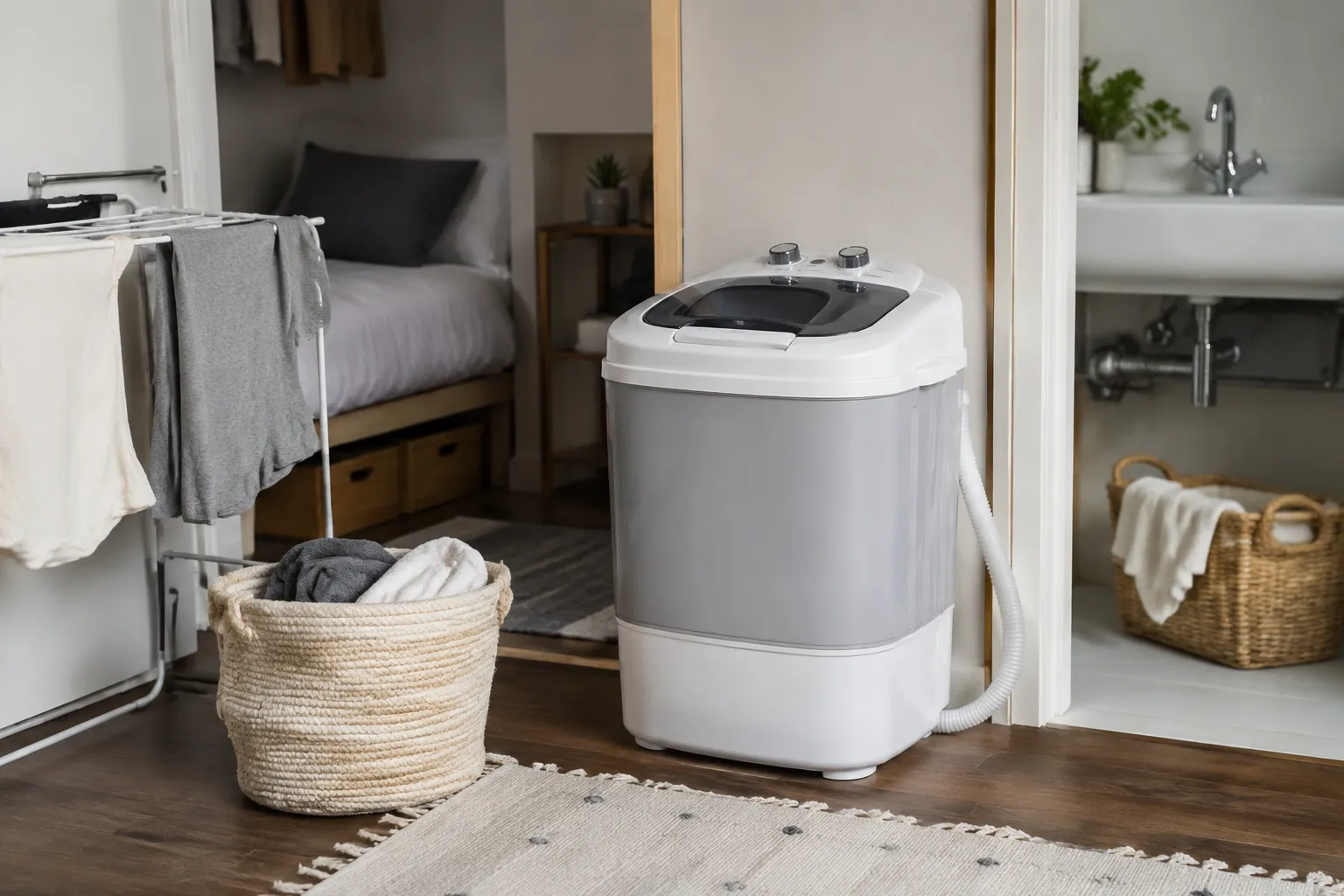
The apartment laundry situation is a specific kind of grind. Not the occasional trip to a laundromat with a full cart, which at least has a rhythm and a finish line. The daily grind is the sink-wash routine: the wet clothes hanging from every available surface, the detergent that never quite rinses out of a sweater, the backache from leaning over a tub. A portable washer does not solve all of that, but it changes the math. The question is which kind of change a person actually wants, because the category splits into two very different machines that share a name.
The first kind is the twin tub. Two drums sit side by side, one for washing, one for spinning. The wash side agitates, the spin side flings water out of the clothes, and a person physically transfers the wet load from one drum to the other with a pair of tongs or just their hands. The second kind is the all-in-one portable. It looks like a miniature front-load washer on wheels, hooks up to a kitchen faucet or a bathroom sink, and runs a complete cycle in a single drum, wash and spin in the same place.
The twin tub is cheaper, often dramatically so, and it washes faster because the wash cycle does not have to pause for draining and re-filling. The all-in-one is more expensive and slower, but it requires less hands-on attention. That is the trade in one sentence, and everything else about the category follows from it.
The twin tub is a workout with a timer
A twin tub demands presence. The wash drum fills, agitates for a set period, then stops. The clothes sit in soapy water until the person returns to drain it, lift the load into the spinner, close the lid, and start the spin cycle. Then the spun clothes come out, still damp but no longer dripping, and hang to dry. It is not a set-and-forget appliance. It is a chore with a schedule.
For a single person washing a few days of clothes at a time, that presence is manageable. The wash cycle on most twin tubs runs fifteen to twenty minutes. The spin runs three to five. A person can start the wash, go fold laundry or wipe down a counter, come back, transfer the load, start the spin, and have a load done in under half an hour. That speed is the twin tub's real advantage. An all-in-one portable takes sixty to ninety minutes to do the same work, because the open tub is smaller than the spin drum, so the transfer makes the whole process more efficient.
The catch is that the twin tub is also the louder, messier option. The machine sits on a counter or a sturdy table, and the wash action is a churning, sloshing motion that can walk the unit across a surface if it is not level. The drain hose has to be aimed into a sink or a tub, and the water comes out with force. Splashback is a fact of life. The spin drum, meanwhile, sounds like a jet engine spooling up, and on a flimsy apartment counter it can rattle the whole setup.
There is also the manual labor. Lifting a load of wet towels from the wash drum to the spinner is a wet, heavy lift, and it has to happen every single time. A person who does this every few days will build a specific kind of forearm strength. A person who does it every day will start to resent the machine.
The all-in-one portable trades speed for patience
The all-in-one portable is the closer cousin to a real washer. It connects to a faucet with a threaded adapter, fills itself, washes, drains, spins, and does it all in one drum. The person loads the machine, sets the cycle, and walks away. When the cycle ends, the clothes come out spun, not just wet, which cuts drying time significantly.
That convenience comes at a cost beyond the price tag. The cycles are long. A normal load on a portable all-in-one can run ninety minutes or more, because the drum is small and the machine has to work harder to get clothes clean in a shorter water path. The spin cycle on these machines is also gentler than a full-size washer, so clothes come out damp rather than merely moist. They still need several hours on a drying rack, but they dry faster than sink-wrung items.
Installation is the other hurdle. The machine needs a faucet with threads, and not every apartment faucet has them. The adapter kit that comes with most portables includes a universal fitting, but it does not work on every faucet. Some pull-out sprayer heads have to be removed first. Some faucets are too short or too smooth for the adapter to grip. A person who buys an all-in-one portable without checking the faucet situation first may end up with a very expensive paperweight.
There is also the water pressure question. The machine fills by running water through the inlet hose into the drum. If the faucet pressure is low, the fill takes longer, and the wash cycle may not perform as well. In an old building with pipes that wheeze, a portable washer can be an exercise in watching a gauge creep.
Capacity is measured in kilograms, not square feet
Both types of portable washer list capacity in kilograms, and the numbers are optimistic. A machine rated for 5.5 kilograms will wash a few pairs of jeans and some t-shirts, but cramming it full defeats the purpose. Clothes need room to move in the wash drum, or they come out with soap residue and dirt still embedded in the fibers. The practical rule is to halve the rating. A 5.5 kilogram twin tub handles a 2.5 to 3 kilogram load comfortably. That is a week of t-shirts and underwear for one person, or two days of clothes for a couple.
The all-in-one portable has the same issue, but it is worse, because the wash drum and the spin drum are the same drum. The load has to fit in a space that accommodates both the wash action and the spin basket. The usable volume is smaller than the spec sheet suggests. A person who wants to wash a comforter or a set of king-size sheets will find the drum full to the brim and the machine struggling.
That limitation shapes how the machine gets used. A portable washer is not a replacement for the laundromat. It is a supplement, a way to handle the small loads that pile up between trips, or a way to wash delicates and workout clothes that should not go in a commercial machine anyway. The person who expects to wash everything at home will be disappointed. The person who uses it for the targeted loads will find it earns its space.
The faucet adapter is the real gatekeeper
Before buying any portable washer, a person should look hard at the tap in the kitchen or the bathroom. The adapter that comes with the machine is a plastic fitting with a set of internal threads and a rubber gasket. It screws onto a standard threaded faucet. It does not work on a smooth, threadless faucet, and it does not work on many pull-out sprayer models.
The solution for threadless faucets is a faucet adapter set, a small box of plastic and brass fittings that clamp onto the faucet and provide threads for the washer hose. These sets cost about twenty dollars and are sold everywhere the washers are sold. They work, mostly, but they add height to the faucet, which can make the tap awkward to use for hand-washing dishes. They also have a tendency to leak if the rubber gasket is not seated perfectly.
The other installation factor is the sink itself. A portable washer drains through a hose that hangs into the sink. The sink has to be deep enough to catch the water and wide enough to hold the hose without kinking. A shallow bar sink in a studio kitchen will splash water everywhere. A bathroom sink with a narrow basin will also cause trouble. The best setup is a deep utility sink or a bathtub, where the hose can hang over the edge and the water can run freely.
The bathtub setup has its own quirks. The washer sits on the floor next to the tub, and the fill hose runs from the sink to the machine. If the sink is across the room from the tub, the hose will stretch, and the machine will pull at the faucet. The drain hose hangs over the tub edge, which works, but climbing over the tub to adjust the machine is a contortion act. A person who washes in the tub has to plan the layout carefully.
The spin cycle makes or breaks the drying rack
Apartment drying is a humidity problem. A rack full of hand-wrung clothes releases moisture into the air for hours, and in a small room, that moisture lands on windows, walls, and the ceiling. A portable washer with a decent spin cycle reduces that load dramatically. Clothes that come out of a spin drum at 800 RPM are damp, not dripping. They dry in a few hours on a rack, and they release far less humidity into the room.
The twin tub's spinner is the stronger of the two. It spins at a higher RPM than most all-in-one portables, and the clothes come out noticeably drier. The all-in-one portable, by contrast, has a spin cycle that is limited by the machine's small motor and lightweight construction. The spin is more of a brisk shake than a centrifugal squeeze. Clothes come out damp enough to hang, but they hold more water than a twin tub load.
That difference matters in a place with poor ventilation. A person in a basement studio with no window fan will feel the difference between a twin tub load and an all-in-one load. The twin tub leaves less moisture in the air, which means less condensation on the windows and less musty smell in the closet. The all-in-one leaves more, which means the drying rack has to live near an open window or a dehumidifier.
The noise is a neighbor issue
Portable washers are loud, and the noise travels through apartment floors and walls. The twin tub is the louder of the two, especially during the spin cycle. The all-in-one is quieter, but not by much, because the motor and the drum are sitting directly on the floor without the sound insulation of a full-size machine. A person who runs the washer at 11 p.m. in a wood-frame building will get a knock on the door before the cycle ends.
The workaround is to run the machine during daytime hours, which is fine for someone who works from home or has a flexible schedule. For the person who leaves for the office at 8 and returns at 7, the portable washer becomes a weekend appliance. That is a real limitation, because the machine's main appeal is the ability to wash small loads whenever needed.
There is also the vibration. A portable washer sitting on a counter or a washing machine stand will walk across the surface during the spin cycle unless it is perfectly level. The fix is a rubber anti-vibration pad, which costs a few dollars and makes a real difference. The pad also prevents the machine from scratching the countertop, which matters in a rental where the security deposit is on the line.
The realistic workload for one person
A single person who works a desk job generates about three to four loads of laundry a month, if they change clothes daily and wash towels weekly. A portable washer handles that volume easily, but it changes the rhythm. Instead of one big laundromat trip every two weeks, the portable washer user runs a load every couple of days. Each load is small, but it is always there.
The towels are the real test. A bath towel is a thick, heavy item that takes up most of a portable washer drum. A set of two bath towels and a hand towel is a full load in an all-in-one portable. In a twin tub, the wash drum can handle them, but the spin drum will struggle with the weight. The clothes come out wetter than a t-shirt load, and they take longer to dry.
The person who wants to wash a load of towels every week will find the portable washer useful but not luxurious. The person who wants to wash a week's worth of work shirts, socks, and underwear in one go will find the machine too small. The sweet spot is two to three days of clothes: a few shirts, a pair of pants, some socks and underwear. That is the load the portable washer handles best, and it is the load that most often piles up in a hamper.
The detergents and the water temperature
Portable washers work best with high-efficiency, low-sudsing detergent. Regular detergent creates too much foam, and the foam can overflow the machine and leave residue on clothes. The HE detergents are sold everywhere and cost the same, so there is no reason to buy anything else. The dosage is also smaller, which means a bottle lasts longer.
Water temperature is a separate issue. A portable washer that connects to a faucet gets water at whatever temperature the tap provides. A person who washes in cold water, which is the recommended setting for most everyday clothes, will be fine. A person who wants a hot wash for towels or sheets has to run the hot tap, and the machine's small inlet hose will deliver lukewarm water at best, because the water cools as it travels through the hose and sits in the machine's drum.
The practical result is that portable washers are cold-water machines. They clean well in cold water with a good detergent, but they do not sanitize, and they do not remove heavy grease or oil stains. The person who needs a hot wash for work clothes or kitchen rags will have to supplement with a laundromat trip or a sink soak.
The cost of entry and the cost of ownership
A twin tub runs between one hundred and two hundred dollars. An all-in-one portable runs between two hundred and four hundred. Both are cheaper than a laundromat subscription, but the math is not just the purchase price. The adapter fittings, the anti-vibration pads, the hoses that wear out and leak, the occasional replacement part, it all adds up. A person who treats the machine as a disposable appliance will get one to two years of use before something breaks. A person who cares for it, draining it after every use and wiping the seals dry, will get five years or more.
The care routine is simple: after every load, drain the machine, wipe the rubber gasket around the door or the drum lip, and leave the lid open to air out. A portable washer that stays sealed between uses will develop a musty smell within a month. That smell transfers to clothes, and it is almost impossible to remove once it sets in.
There is also the water and electricity cost, which is small. A portable washer uses less water than a full-size machine, because the drum is smaller. It uses less electricity, because the motor is smaller. The net cost per load is in the range of a few cents. The machine will pay for itself in laundromat savings within a few months, if the person was already paying per load.
The final decision is about the faucet and the floor space
The portable washer that works for one apartment will be useless in another. The deciding factors are the faucet, the sink depth, and the floor or counter space next to a power outlet. A person who has a threaded kitchen faucet, a deep sink, and a sturdy counter will do fine with any portable washer. A person who has a threadless bathroom faucet and a shallow basin will struggle no matter which machine they buy.
The other consideration is where the machine lives when it is not running. A twin tub takes up about two square feet of counter space and weighs thirty pounds. An all-in-one portable takes up slightly less floor space and weighs about the same. Neither machine is easy to move, and neither folds away. The machine has to have a permanent home, and that home has to be near a faucet and a drain.
The person who buys a portable washer without measuring the space and checking the faucet is buying a headache. The person who does the homework, reads the faucet adapter reviews, and picks the machine that fits the actual apartment will get a small, reliable appliance that takes the edge off the laundry grind. It will not replace the laundromat. It will not wash a comforter. It will wash a few days of clothes with less effort than the sink, and that is a real improvement for anyone who has spent an evening wringing out a wet t-shirt over a bathtub. The machine that sits in the corner and hums through a small load on a Tuesday evening is worth the floor space it takes up, as long as the tap it connects to has the threads to match.