
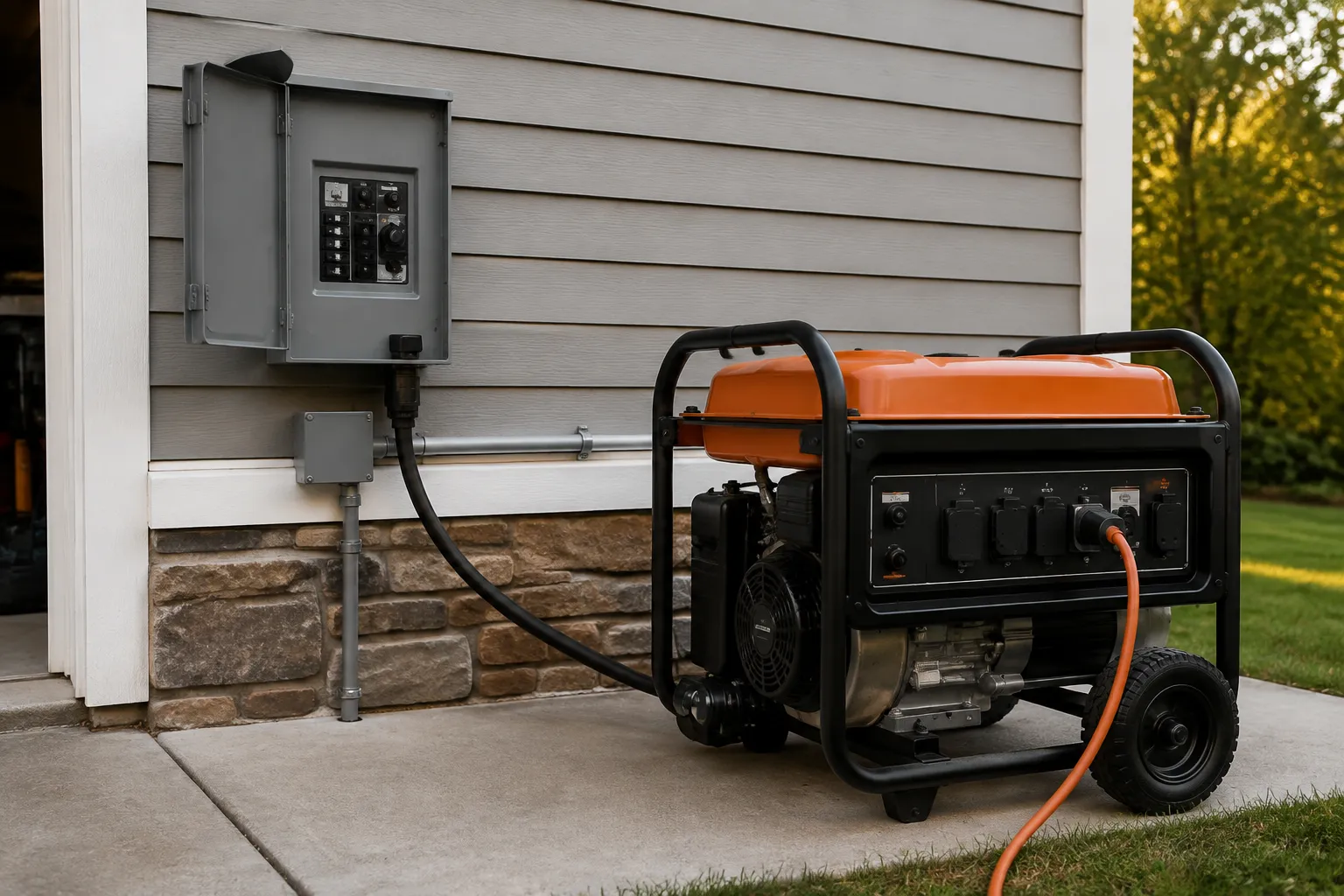
The most dangerous tool in a home is often the one that sits in a garage for eleven months doing absolutely nothing. A portable generator is a benign, greasy hunk of metal until a hurricane or an ice storm takes the grid down, and then it becomes a live wire with a spinning fan and a muffler hot enough to cook on. The problem is not the generator. The problem is the extension cord running through a half-open window, or the daisy chain of power strips under the dining room table, or the neighbor who says backfeeding is fine because his uncle did it for years. That is why the transfer switch exists, and it is worth understanding what it actually does before the lights go out, not during.
A transfer switch is a box that sits between the utility meter and the house panel, and its only job is to make it physically impossible for a portable generator to energize the neighborhood grid. When the power fails, a person flips the main breaker off, starts the generator, and then switches the transfer switch from Line to Generator. The house circuits downstream of the switch get power from the generator; the utility lines upstream get nothing. Without that switch, the generator feeds power backward through the panel, out the meter, and onto the pole. A lineman working a downed wire blocks away can get killed by a house that is doing exactly what it was designed to do.
This is the part where most homeowners tune out, because the lineman is a theoretical stranger and the risk feels abstract. So make it concrete. The transfer switch is also the difference between running a refrigerator, a furnace circulator, and a few lights, versus running one appliance at a time through a 50-foot cord that has to be re-routed every time someone wants a different outlet. Without a switch, a person is limited to plugging individual items into the generator's own outlets. With a switch, the generator plugs into the wall of the house itself, and the entire set of chosen circuits behaves like normal house wiring. It is not a safety accessory. It is the difference between camping in the living room and living in the living room.
What a transfer switch physically changes
The box itself is not complicated. Most residential units are rated for 30 amps or 50 amps, and they contain a mechanical interlock that prevents the main breaker and the generator breaker from being closed at the same time. The interlock is a sliding metal plate. To turn on the generator feed, a person must first move the main breaker to the off position. There is no way around this sequence, which is the entire point. The interlock does not rely on memory, good intentions, or a sticker that says "remember to flip this." It is a physical bar that blocks the handle.
There are two flavors of this setup, and they are not the same thing. The first is a simple interlock kit that mounts to the existing panel, with a separate breaker added for the generator inlet. This is the budget option, and it is perfectly legal in most jurisdictions when installed by a licensed electrician. The second is a dedicated transfer switch panel, a separate small subpanel mounted next to the main panel, with a handful of pre-wired circuits that the homeowner chooses ahead of time. The dedicated panel is more expensive and takes up wall space, but it makes the selection of protected circuits much easier to change later. A person who buys the interlock kit is committing to whatever circuits the electrician decides to land on the generator breaker, and changing that later is a panel job, not a switch flip.
Neither option is a DIY weekend project for a person who has never opened a panel. The work involves the main service entrance, the meter, and live bus bars, and the penalty for a mistake is not a blown fuse but an arc flash or a house fire. The National Electrical Code has specific rules about generator inlets, bonding, grounding, and the placement of the switch relative to the meter. An electrician who does this work weekly knows the local inspection quirks. A homeowner who watches a YouTube video does not.
The generator inlet is the part people forget
The transfer switch is only half the system. The other half is the inlet box, a small outdoor receptacle mounted on the exterior wall, usually with a hinged cover and a locking ring. The generator's power cord, a thick 10-gauge or 8-gauge cable with a twist-lock connector on both ends, plugs into this inlet. This is the piece that gets skipped when a person buys the cheapest generator at the big-box store and decides to improvise.
An inlet box is rated for either 30 amps or 50 amps, and it must match the generator's output receptacle. A 30-amp generator puts out 3,600 to 7,200 watts depending on the model, and a 50-amp unit puts out roughly 12,000 watts. The inlet and the cord have to be sized for the generator, not for the house. A 50-amp generator plugged into a 30-amp inlet will trip the inlet's breaker or melt something, whichever comes first. The matching is not a suggestion. The twist-lock connectors, the NEMA designations, the amperage ratings, they all exist so a person cannot accidentally plug a 50-amp machine into a 30-amp hole without noticing the physical difference in the plug shape.
There is also the question of where the inlet goes. It should be on the exterior wall near the panel, but it also needs to be close enough to the generator's parking spot that the cord does not have to stretch across a patio or under a gate. A person who stores the generator in the back shed and mounts the inlet on the front wall has created a problem that no amount of extension cord can solve. The cord is rated for a certain length, and every extra foot of run adds voltage drop. In practice, most installations keep the generator within 25 feet of the inlet, which means the generator lives on a concrete pad or a piece of plywood right outside the wall.
The inlet itself is a small detail that gets installed once and then forgotten, which is exactly why it fails. The gasket dries out. The cover hinge corrodes. The locking ring gets stiff. A person who has not touched the inlet in two years will discover, during a winter storm at 2 a.m., that the cover will not open with cold fingers. This is a maintenance item, not a purchase item. It needs a spray of silicone lubricant once a year and a visual check for rust before the storm season starts.
Choosing the circuits, not the switch
The most common mistake is buying a transfer switch that is too large for the generator. A 50-amp switch with a 30-amp generator is a mismatch that will not protect anything. The switch is rated for the maximum current that can flow through it, but the generator is the actual source. The circuits selected for backup have to add up to less than the generator's continuous output, and they have to be chosen with care about what actually needs to run.
A typical 30-amp generator in a suburban house can handle a refrigerator (about 600 watts running, 1,800 starting), a gas furnace circulator pump (300 watts), a well pump if the house has one (1,000 to 2,000 watts), a few LED lights, and maybe a television or a laptop charger. It cannot handle an electric water heater, a central air conditioner, an electric range, or a clothes dryer. Those are 240-volt loads that pull 20 amps or more by themselves. A 50-amp generator, around 12,000 watts, can add a window air conditioner or a smaller central AC unit, but even then there are limits based on starting surges.
The electrician will ask which circuits to land on the switch, and the answer has to come from the homeowner, not from the Code book. The list should be written down and physically walked through. A person should go through the house, flip every switch, open every appliance door, and ask: if the power is out for three days, what do I need? The answer is usually a mix of necessity and comfort. The refrigerator. The freezer in the garage if there is one. The furnace. The well pump. The outlet in the bathroom for a hair dryer or a space heater. The outlet near the router so the internet stays up. The microwave, because a person can live without an oven but not without reheating coffee.
The starting wattage is the piece that trips people up. A refrigerator's running load is modest, but the compressor has a startup surge that can be two to three times that. A well pump is worse. A sump pump is worse still. The transfer switch and the generator both need headroom for these surges, which means a person cannot simply add up the nameplate wattages and call it done. The electrician will size the generator based on the worst-case startup scenario, which is usually the largest motor on the circuit list starting while everything else is already running.
The extension cord temptation, and why it loses
There is a figure that gets quoted in generator circles, and it is usually wrong in the direction of optimism: the price of a transfer switch and inlet, installed, versus the price of a generator. The switch and installation run roughly 400 to 800 dollars for a 30-amp setup, and 800 to 1,500 for a 50-amp. That is a hard pill to swallow when the generator itself cost 600 dollars on sale.
The alternative, the one that looks free, is the extension cord through the window. It is free only if a person ignores the cost of the cord, the damage to the window frame, the cold air leaking in through the gap, and the fact that the refrigerator and the furnace cannot run off the same outlet. The cord method forces a triage that no one wants to perform in the dark: the refrigerator runs for an hour, then gets unplugged so the space heater can run, then the furnace gets its turn. Meanwhile, the generator sits outside under a tarp, its exhaust blowing toward the only window that opens wide enough to accept the cord.
Carbon monoxide is the other part of the extension cord argument. A generator run outside is safe enough, but a generator run near a window, even with the window closed, is not. The exhaust is heavier than air in the sense that it pools and drifts, and a window or a door cracked open for the cord is an invitation. The transfer switch, because it eliminates the need for any path between the generator and the interior, also eliminates the cracked window. The generator sits outside, the cord goes to the inlet, and the house stays sealed. That is the single biggest safety improvement the switch provides, and it is rarely mentioned in the sales literature.
What the electrician will actually do
The installation is not glamorous. The electrician will first kill the main power at the meter, which requires a call to the utility in many jurisdictions. Then the panel cover comes off, the new breaker for the generator inlet goes in, and the interlock kit is mounted to the panel door or the panel interior. If the house uses a separate transfer switch panel, that subpanel gets mounted beside the main panel, and the chosen circuits get moved from the main panel to the subpanel. The inlet box goes on the exterior wall. The ground and neutral conductors get inspected and, if necessary, re-bonded according to the current code.
The whole job takes four to six hours for a straightforward installation, longer if the panel is old, the wiring is messy, or the wall construction is unusual. A person who has an older panel with no open breaker slots will need a panel upgrade or a subpanel, which is a much bigger job. The electrician should pull a permit in most jurisdictions, which means an inspection, which means the work is checked by someone who is not the homeowner. That inspection is worth the fee. It catches the loose neutral, the undersized ground, the breaker that is slightly too large for the wire.
There is one more thing the electrician will do, and it is the step that matters most. They will run the test. The generator gets started, the breaker gets flipped, and each selected circuit gets checked one at a time. The lights come on in the kitchen. The refrigerator hums. The furnace fan spins up. This is the moment the whole system proves itself, and it is the moment that a homeowner should be standing there watching, not scrolling through a phone. The test reveals the starting surge problem, the circuit that was wired to the wrong breaker, the generator that is just a little too small for the load. That test costs nothing extra, and skipping it is how a family discovers the problem during an ice storm.
The 2 a.m. test that matters more than the install
The real evaluation of a transfer switch installation happens at 2 a.m., during a storm, in the cold, with rain or snow coming down and no streetlights. The house is dark. The quiet is the wrong kind of quiet, the kind that makes a person nervous. This is when the switch proves its worth, and it is not about the electrical engineering. It is about the sequence.
A person with a transfer switch goes outside, starts the generator, lets it warm up for a minute, then comes back inside. They walk to the panel, flip the main breaker off, flip the generator breaker on, and walk away. The whole routine takes three minutes. A person without a switch is running an extension cord through a window, deciding which single appliance to power, and re-running the cord every time they need something else. The difference between those two experiences is the difference between a minor inconvenience and a genuine ordeal.
The generator itself will still need fuel, oil checks, and a quiet spot to run, but those are generator problems, not switch problems. The switch is the one piece of the system that either never fails or fails catastrophically, and there is no middle ground. A quality unit from a known manufacturer, installed by a licensed electrician, inspected, and tested, will outlast the generator it feeds. The generator will be replaced in ten years. The switch will still be on the wall, waiting for the next storm, and the only maintenance it needs is a glance at the interlock plate to make sure nothing is bent and a check of the inlet cover gasket.
Some houses have a sticker near the panel that the previous owner left, a handwritten note that says "Generator: turn off main first." That sticker is a confession. It is a person who knew the sequence, wrote it down, and hoped that nobody would forget in the dark. The transfer switch is the version of that sticker that cannot be ignored, because the interlock plate physically stops the breaker from closing out of order. The sticker asks for a favor. The switch demands compliance. That is the entire difference, and it is worth every dollar of the installation cost.