
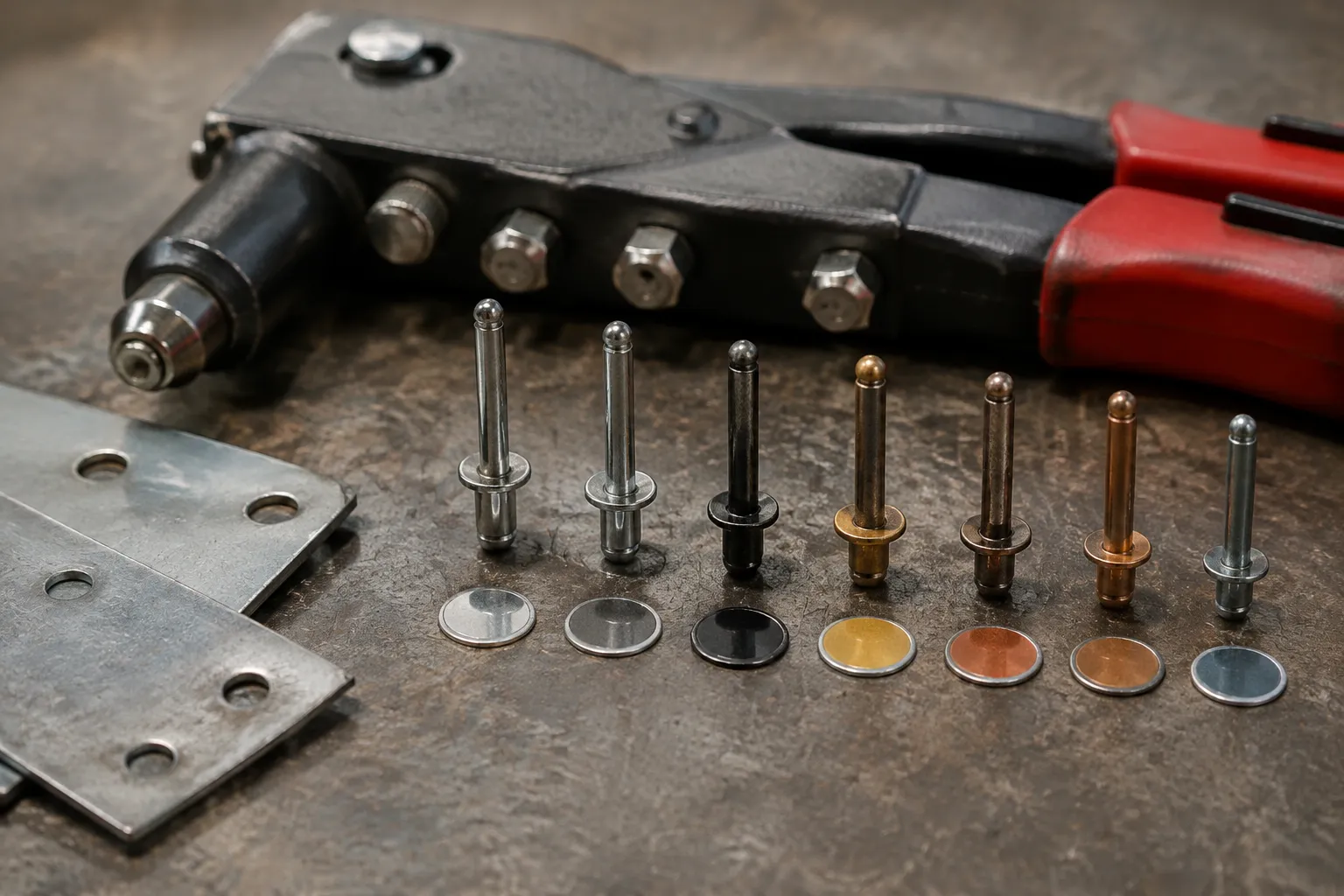
The stamped number on the head of a pop rivet is not a suggestion. For a fastener that costs pennies, the marking carries a surprising amount of legal weight, and misreading it is the difference between a joint that holds for a decade and one that lets go on a cold Tuesday morning. Most people grab a handful of rivets from a bin without looking at the head, and most of the time that works out fine. But the days it does not are the days the deck railing wobbles, the trailer fender flaps, or the HVAC duct separates and rattles around inside a wall.
The system itself is straightforward once a person understands what the numbers and letters actually mean. Pop rivets, also called blind rivets, are sorted into strength grades based on the materials of the body and the mandrel, the long pin that gets pulled through to deform the fastener. The grade stamped on the head is a shorthand for that combination, and it tells a mechanic how much shear and tensile force the installed rivet can handle before it fails. Those two numbers, shear and tensile, are the ones that matter, and they are not interchangeable.
The Material Code on the Head
The markings are not universal, but certain patterns hold across most major manufacturers. A rivet with a plain, unmarked head is usually 1100 series aluminum, soft and cheap, good for gutters and light sheet metal. A head stamped with a single dot, or sometimes two, typically indicates 5056 aluminum alloy in the body, which is harder and stronger. A cross or a plus sign points toward a stainless steel body. A rivet marked with three dots in a triangle usually means a monel body, which is a nickel-copper alloy that resists corrosion aggressively.
The mandrel is the hidden half of the equation. A 5056 aluminum body with a steel mandrel behaves differently than the same body with an aluminum mandrel. The mandrel is what gets pulled until it snaps, and the force required to snap it sets the clamping load of the finished joint. A stronger mandrel can be pulled harder before breaking, which means the rivet body swells tighter against the hole. Softer mandrels snap sooner, leaving a looser fill and a lower clamp. The grade marking on the head often includes a letter or a symbol for the mandrel material too, though many manufacturers bury that detail in the catalog rather than on the fastener itself.
This is where the confusion begins. Two rivets can look identical from the outside, same body diameter, same grip range, same head style, and one will hold twice the load of the other. The difference is purely internal, a combination of alloy and mandrel that a person cannot see until the rivet is installed and broken. The head stamp is the only way to tell them apart before committing.
Reading Shear and Tensile Numbers the Right Way
Shear strength measures how much force the rivet can resist when the two joined pieces try to slide past each other, like a bracket pulling along the face of a beam. Tensile strength measures how much force the rivet can resist when the pieces try to pull straight apart, like a hanging fixture tugging downward on the ceiling. Every pop rivet has both numbers, and they are always different. Shear is almost always the higher figure.
A typical 3/16 inch aluminum rivet with a steel mandrel might be rated around 350 pounds of shear and 250 pounds of tensile. The same size in stainless steel jumps to roughly 700 pounds of shear and 500 pounds of tensile. The monel version sits somewhere in between, with a corrosion resistance that neither aluminum nor plain stainless can match in saltwater environments. These numbers are published in every fastener catalog, and they are tested under controlled conditions with a specific hole size and a specific material thickness in the test fixture.
The practical takeaway is that the grade on the head is a promise about those numbers. A person designing a joint needs to know both values and then apply a safety factor, usually four or five to one, before deciding how many rivets to put in a row. A railing bracket carrying a few hundred pounds of load needs more than a single rivet rated at 350 pounds of shear, because real-world loads are rarely clean and static. People lean on railings. Trucks hit potholes. Ducts vibrate for years.
The Alphabet of Common Grades
Beyond the stamped symbols, the fastener industry uses letter designations that appear in catalogs and on packaging. The most common is the 51 grade, which is a 5056 aluminum body with a 5056 aluminum mandrel. It is what most hardware stores sell when a customer asks for a general-purpose pop rivet, and it is fine for light fabrication, sign mounting, and non-structural sheet metal work. The 52 grade uses a 5056 body with a steel mandrel, which bumps the shear and tensile numbers up noticeably while keeping the corrosion resistance of the aluminum exterior.
The 53 grade is where things get serious. It pairs the 5056 aluminum body with a monel mandrel, giving it the highest strength of the aluminum family while retaining the mandrel's resistance to corrosion. Then there is the 54 grade, which is a monel body with a monel mandrel, and the 55 grade, which is a stainless steel body with a stainless steel mandrel. The stainless grades are the ones used in marine hardware, trailer frames, and anything that will live outside for years.
Each step up in grade costs more money and requires more force to install. A hand riveter that works fine on 51 grade aluminum will struggle on 53 grade and may not have the leverage to snap a 55 grade stainless mandrel at all. The tool matters as much as the fastener. A person who needs stainless rivets should expect to buy a heavier riveter with longer handles, or the job becomes a series of half-set joints and aching palms.
Why the Mandrel Break Load Changes Everything
The mandrel break load is the quiet spec that separates a rivet that feels right from one that feels mushy in the hand. When the mandrel snaps, it snaps at a predetermined tension, and that tension is what sets the clamp. A rivet with a low break load does not pull the sheets together as tightly. The joint works, but there is a microscopic gap, and the rivet body is not fully expanded into the hole. Over time, vibration works the pieces against each other, the hole elongates, and the joint loosens.
This is why two rivets of identical size and material can perform differently in the same application. The difference is in the mandrel's notch, the weak point machined into the pin at the factory. The notch location and depth control where the pin snaps and how much force it takes to get there. A well-designed rivet snaps cleanly at the right load, leaving the mandrel head seated inside the body. A poorly designed one snaps too early, or worse, snaps at the head and leaves the joint under-clamped.
Some manufacturers offer structural rivets with a mechanical lock, where the mandrel head is captured inside the body and cannot shake loose even if the pin breaks at the wrong spot. These are sold under names like Multi-Grip or Magna-Lok, and they cost several times more than a standard pop rivet. For a critical joint, a roof rack anchor or a seat belt mount, the extra cost is trivial insurance against a hollow rattle that signals a loosening grip.
Grip Range and Hole Fit Override Grade
A high-grade rivet installed in the wrong hole size performs worse than a low-grade rivet in the right hole. The hole diameter sets the whole system. Too small, and the rivet body cannot expand enough to fill the hole, leaving a loose fit that frets and wears. Too large, and the body has nothing to bite into, the joint hinges on the rivet head, and the shear rating drops toward zero because the fastener is not actually carrying load across the joint.
The grip range is the total thickness of material the rivet is designed to fasten, and it is printed on the box alongside the diameter and grade. A rivet with too short a grip range will not have enough body length to form a proper head on the far side. A rivet with too long a grip range will form a sloppy, oversized head that does not clamp the sheets tightly. Either way, the stamped strength rating is meaningless because the fastener is not working as designed.
The correct procedure is to measure the total material thickness, add it to the rivet's grip allowance, and pick a rivet whose grip range brackets that number. A 3/16 inch rivet with a 1/8 to 1/4 inch grip range covers most light sheet metal work. Heavier fabrication needs a longer grip. The strength numbers in the catalog assume the rivet is used within its grip range, in a properly sized hole, in material stiff enough not to deform before the rivet does.
Stainless Does Not Solve Everything
Stainless steel rivets carry a reputation for being the best, and in many ways it is earned. The shear and tensile numbers are the highest of the common grades, and the corrosion resistance is excellent in most environments. But stainless has a specific weakness that catches people off guard: galvanic corrosion when paired with aluminum. If a stainless steel rivet is used to join aluminum sheet, the two dissimilar metals set up a small electrical cell in the presence of moisture. The aluminum, being the less noble metal, corrodes preferentially around the rivet hole.
This is not a theoretical concern. Marine builders and outdoor fabricators see it constantly, white powdery corrosion blooming around stainless fasteners in aluminum structures. The fix is not to avoid stainless but to isolate it, using a sealant or a washer to keep the metals from direct contact, or to choose a rivet with an aluminum body and a stainless mandrel, which keeps the exterior compatible with the aluminum workpiece while retaining most of the strength.
The aluminum body with a stainless mandrel, sometimes sold as a 52 grade variant, is often the smarter marine choice than a full stainless rivet. It sacrifices some ultimate strength but eliminates the galvanic problem. This is the kind of detail that appears in fine print and never on the bin label at a hardware store. A person has to know to ask.
The Cost of Guessing Wrong
A single failed rivet rarely causes catastrophic damage by itself. The failure mode is slow. One rivet loosens, the load shifts to the next one, and that one works harder until it too loosens. The process cascades over months or years, and by the time a person notices the wobble, the whole row is compromised. Replacing one rivet is easy. Replacing a row means drilling out every fastener, cleaning up the holes, and starting over, always with the risk of egging out the hole during drilling.
The cost difference between an unmarked aluminum rivet and a properly graded structural rivet is fractions of a cent per piece. A box of a hundred grade 55 stainless rivets costs a few dollars more than the same box of generic aluminum. For a one-off repair, the premium is negligible. For a production run of a thousand units, it adds up, which is why manufacturers sometimes spec the cheapest fastener that passes the drawing review and hope the real-world load conditions stay under the lab numbers.
The stamped grade is the only guardrail between a design engineer's intent and the reality of a vibrating, weather-exposed, load-cycling world. It is worth ten seconds of reading before pulling the trigger on a riveter. The head of every rivet carries the answer, but only for the person who looks at it and knows what the symbol means.