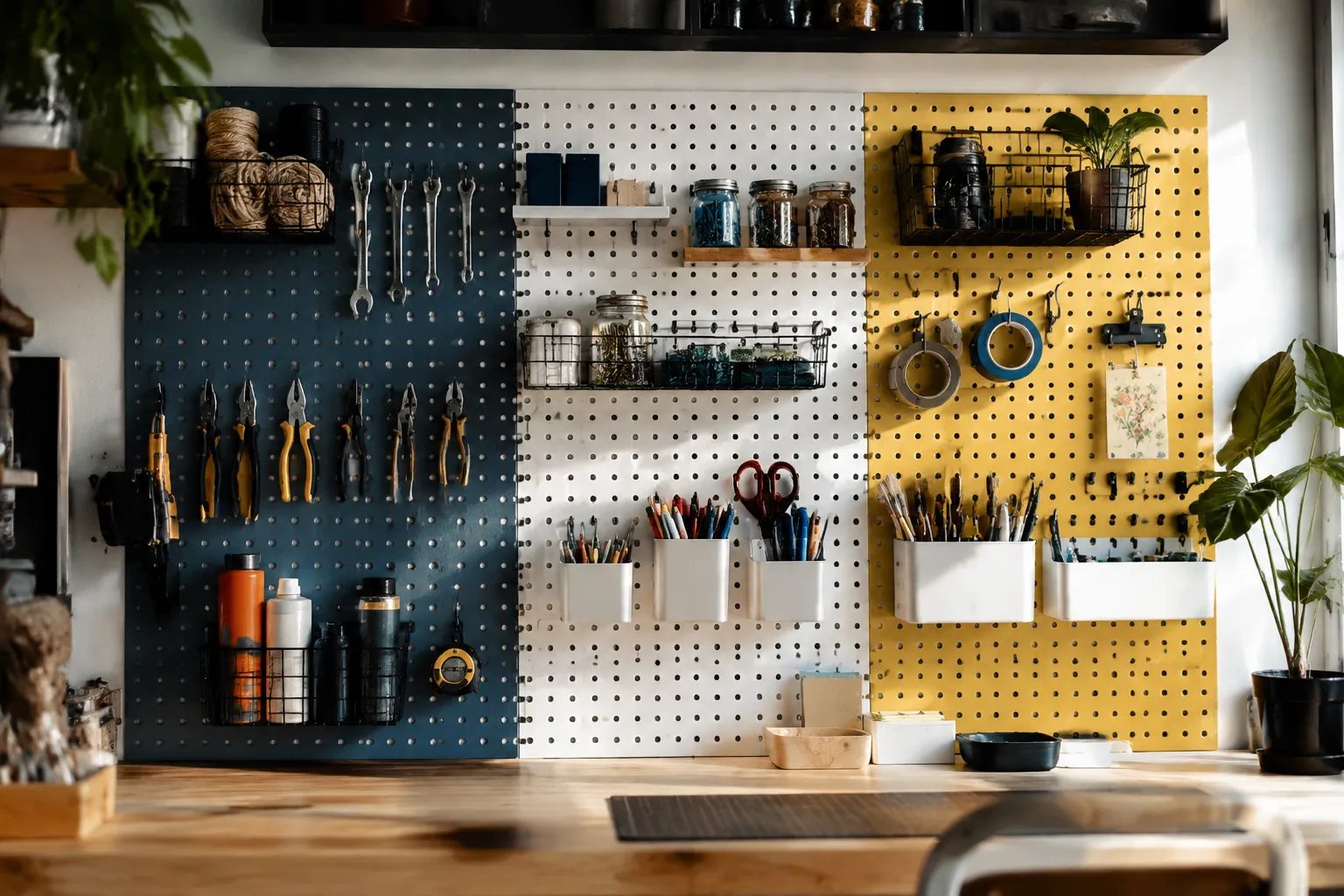
Cluttered pegboards are not a storage failure. They are an organization failure. The board itself works exactly as intended, offering a wall of perforated steel that accepts any hook, shelf, or bin a person can hang on it. The problem is that most people treat the entire surface as one undifferentiated zone, a single canvas where every tool competes for the same visual space. The result is a wall that looks busy, hides its own contents, and slowly collects items that have no business being there. The fix is not a bigger board or fancier accessories. The fix is dividing the board into deliberate zones, each with a clear job.
A pegboard zone is a defined area of the board dedicated to a specific category of items, separated by physical dividers, color coding, or simple spatial distance. The concept sounds almost too simple to matter. But the difference between a board with zones and a board without them is the difference between a kitchen where a person can find a spatula in two seconds and a kitchen where a person digs through a tangled pile of whisks and tongs for a full minute. The zoned board is not more organized because it has more hooks. It is more organized because every hook has a reason to exist.
The Rule of Three Feet
The first step in building zones is deciding what belongs on the board at all. A common mistake is treating the pegboard as a catch-all for every tool a kitchen owns. That approach guarantees clutter, because the board becomes a museum of rarely used gadgets rather than a workspace for daily cooking. The rule of three feet solves this: an item earns a spot on the board only if a person standing at the board can reach it without taking a step. Anything beyond arm's reach, or anything used less than once a week, belongs in a drawer or on a shelf.
This rule forces hard decisions. The immersion blender that gets used every other month? Drawer. The second set of measuring cups that duplicates the first set? Drawer. The decorative ladle that was a gift and has never touched a pot of soup? Drawer, or better yet, a donation box. What remains on the board is a lean collection of tools that actually get used, which makes zoning possible. A board with forty items cannot be zoned effectively. A board with fifteen items can.
Cooking Tools Get the Prime Real Estate
The center of the board, roughly at eye level, is the most valuable territory. This is where the daily cooking tools live: spatula, tongs, ladle, slotted spoon, whisk, measuring spoons. These are the items a person reaches for multiple times during a single meal prep, and they deserve the most convenient position. Placing them at eye level means the hand naturally lands on the right tool without any visual search. The eye glances up, the tool is there, the hand grabs it, the cooking continues.
This zone should be kept to no more than six or seven tools. Crowding the prime zone defeats its purpose. If a person hangs eight spatulas plus five different tongs, the eye has to sort through options, and the advantage of the zone disappears. The prime zone is for the everyday essentials only. The specialized tools, the ones used for specific tasks like carving or pastry work, get their own zones farther out on the board.
A simple test for whether a tool belongs in the prime zone: does a person reach for it during a typical weeknight dinner? If the answer is yes, it stays. If the answer is maybe, it moves to a secondary zone. If the answer is no, it leaves the board entirely. This test is brutal but effective, and it keeps the center of the board from becoming a display case for aspirational cooking.
The Left Side for Prep, The Right Side for Cook
Dividing the board into left and right halves based on task type is a simple zoning strategy that mirrors the natural flow of cooking. The left side, or the prep side, holds the tools used before heat is applied: measuring cups, measuring spoons, mixing bowls, colander, vegetable peeler, grater. The right side, or the cook side, holds the tools used at the stove: spatula, tongs, ladle, slotted spoon, thermometer, trivet.
This arrangement works because it follows the physical logic of the kitchen. A right-handed cook naturally faces the stove with their left side toward the prep area. Reaching left for a measuring cup and reaching right for a spatula is a natural motion, not a stretch. The zones also create a mental map: a person looking for a prep tool knows to scan the left half of the board, and a person looking for a cooking tool knows to scan the right half. The search space is cut in half, which is the entire point of zoning.
For a left-handed cook, the zones flip. The prep tools go on the right, the cooking tools on the left. The principle is the same, only the mirror changes. What matters is that the zones match the cook's physical habits, not some abstract ideal of kitchen design.
Vertical Stacking Within Zones
Each zone benefits from vertical organization, not just horizontal placement. The top row of a zone holds the items used least often, the middle row holds the daily drivers, and the bottom row holds the heavy or bulky items. This vertical hierarchy means the eye and hand travel the shortest possible distance to reach the most-used tools.
In the cook zone, the top row might hold the meat thermometer and the kitchen shears, tools used occasionally but not every day. The middle row holds the spatula, tongs, and ladle, the daily rotation. The bottom row holds the cast iron press and the heavy Dutch oven lid rest, items that are heavy enough that lifting them from a high hook would be awkward and slightly dangerous. The same logic applies to the prep zone: measuring spoons on top, measuring cups in the middle, mixing bowls on the bottom.
This vertical arrangement also reduces the visual chaos that makes pegboards feel cluttered. When every hook holds an item at a different height with no pattern, the eye reads the board as noise. When the items within a zone form a stepped or stacked pattern, the board reads as structured. The difference is subtle but real, and it is the difference between a wall that feels calm and a wall that feels like a hardware store exploded.
The Bottom Row for Heavy and Awkward Items
The bottom row of any pegboard is the designated zone for heavy, bulky, or awkwardly shaped items. Dutch oven lids, cast iron pans, large colanders, and cutting boards all fall into this category. These items are too heavy to hang at shoulder height without risking the hook pulling out of the board, and they are too bulky to fit in the narrow spaces between other tools.
Dedicated shelf brackets or deep wire baskets work best for this zone. A shelf bracket can hold a stack of cutting boards flat, or a wire basket can hold a colander and a few nested mixing bowls. The key is that this zone is deliberately planned, not just the leftover space at the bottom of the board. Many people hang their heavy items wherever there is a free hook, which scatters weight unevenly across the board and creates visual clutter. A single bottom-row zone for heavy items concentrates the mass in one place and keeps the upper rows light.
There is also a safety argument for this zone. Reaching up to unhook a heavy cast iron pan from a high peg is a moment of risk, especially if the hook slips or the pan swings. Keeping heavy items at waist height or below means the lift is shorter and the control is better. A heavy pan at knee height is far easier to manage than the same pan at shoulder height.
A Separate Zone for Sharp Objects
Knives and other sharp tools deserve their own zone, isolated from the rest of the board. This is not about aesthetics. It is about the simple fact that a knife hanging among spatulas and ladles is a hazard. Reaching blindly for a utensil, a person can easily graze a blade they did not see. The sharper the tool, the more isolated it should be.
This zone should be placed at the far edge of the board, away from the main cooking flow. A magnetic knife strip mounted beside the pegboard is a better choice than hanging knives on hooks, because a magnetic strip holds the blade flat against the wall with no swinging motion. If hooks are the only option, the knives should hang blade-down, with the handle pointing up, so the hand grabs the handle and never approaches the edge.
Sharp tools also include the grater, the peeler, and the kitchen shears. These smaller items can hang in the same zone, clustered together, so that a person knows to slow down and pay attention when reaching into that corner of the board. The zone becomes a mental flag: sharp objects here, handle with care.
The Corner Zones for Rarely Used Tools
The corners of the pegboard are the low-value real estate, the spots that require a full reach and a slight turn of the body. These corners are the natural home for the tools that get used weekly rather than daily: the pastry brush, the rolling pin, the citrus juicer, the melon baller, the kitchen twine dispenser. These items need to be on the board because they are used often enough that digging through a drawer is annoying, but they do not deserve prime positioning.
Grouping these rarely used tools into a single corner zone keeps them out of the way without banishing them to a drawer. The corner zone can hold a small wire basket for the miscellaneous items, or a few hooks for the longer tools. The key is that a person knows this corner is the miscellaneous zone, so when they need the melon baller, they reach for the corner without thinking. The corner zone is the catch-all, but it is a deliberate catch-all with boundaries, not a void where anything can drift.
Color Coding the Zones
Physical separation alone is enough to create zones, but color coding makes them explicit. Painting the pegboard in sections, or using colored hooks and bins, gives each zone a visual identity that the eye registers instantly. A person glancing at the board sees the blue hooks and knows those are the prep tools. They see the red hooks and know those are the cook tools. The color becomes a shortcut that bypasses conscious thought.
The color coding does not need to be elaborate. A single can of spray paint divided into sections, or a set of colored hooks from a hardware store, is enough. The point is not to make the board pretty. The point is to make the organization visible at a glance, so that returning a tool to its proper place becomes an automatic action rather than a decision. When a person finishes using the tongs, they see the red hooks and hang the tongs on a red hook. The zone maintains itself.
Color coding also helps with the family problem. In a kitchen shared by multiple people, a color-coded board communicates the organization system without requiring anyone to read a label or remember a rule. The system becomes self-evident, which means it survives contact with partners, children, and guests who do not care about the system as much as the person who built it.
Leaving Empty Hooks as Breathing Room
A zoned pegboard needs empty hooks. This sounds counterintuitive. An empty hook looks like wasted space, and the instinct is to fill every hole with something useful. But an empty hook is not wasted space. It is breathing room, a visual pause that lets the eye separate one zone from the next. It is also future space, a place to hang a new tool without rearranging the entire board.
The spacing between zones should include at least one empty row of holes, or a gap of several inches, to create a clear visual break. This gap is the boundary line that the eye reads as a division. Without the gap, the zones bleed into each other and the board looks like a random collection of tools. With the gap, the board reads as a set of distinct sections, each with its own purpose.
A good rule of thumb is to leave about ten percent of the board's holes empty at all times. This reserve capacity means the board never reaches full saturation, and the organization system never breaks down from overcrowding. When a new tool arrives, it has a designated spot in the appropriate zone, and the empty hook is right there waiting for it.
The Weekly Reset
Even the best zoned pegboard drifts. Tools get hung back in the wrong zone when a person is in a hurry. New items arrive and get placed wherever there is space. The zones blur, and the board slowly returns to its natural state of clutter. The fix is a weekly reset, a five-minute routine that restores the zones to their original arrangement.
The reset is simple: scan the board, identify any tool that has drifted into the wrong zone, and move it back. This is not a deep cleaning or a reorganization project. It is a quick correction that takes less time than brewing a pot of coffee. The reset works because the zones are clear enough that a misplaced tool is immediately obvious. A spatula hanging among the measuring cups stands out like a typo in a headline.
The weekly reset is also the moment to check whether any tool has become a permanent resident of the wrong zone. If the same item keeps drifting back to the same wrong spot, that is a signal that the zone assignment was wrong in the first place. The item is telling a person where it actually belongs, and the zones should be adjusted to match reality. The system serves the cook, not the other way around.
Pegboard zones turn a flat sheet of perforated steel into a working system with memory and intent. The center holds the daily drivers, the sides sort prep from cook, the corners catch the occasional tools, and the bottom row takes the weight. The board becomes a map a person reads without thinking, and the clutter disappears because everything has a home that is visible, reachable, and impossible to confuse with anything else.