
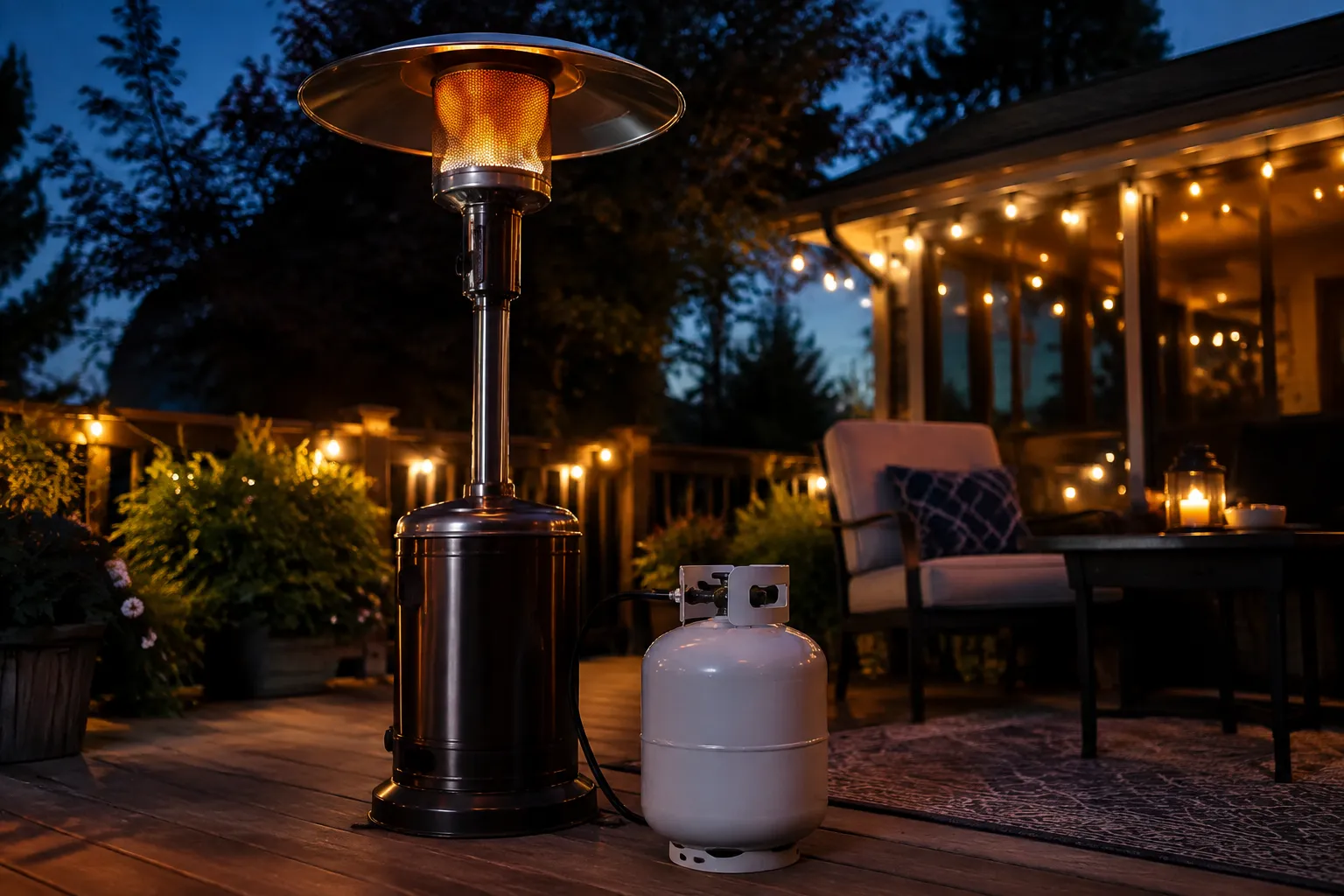
Propane patio heaters occupy a strange place in the American backyard: ubiquitous enough to be standard equipment at restaurants and home improvement stores, yet dangerous enough that every season brings a news story about a deck fire or a tipped-over unit scorching a fence. The devices work on a simple principle, but the gap between how they are sold and how they are actually used is where the trouble starts.
A typical 40,000 BTU patio heater burns roughly a pound of propane every hour at full output. That pound of fuel, when it does not ignite cleanly or when the flame licks at something it should not touch, stops being a heat source and becomes a small bomb waiting for a spark. The industry has spent years engineering guards, tip-over switches, and regulator valves into these units. The weak link has never been the hardware.
The weak link is the ritual. People assemble the heater in the fall, drag it out of the garage in April, and never once check the fittings. They store the tank in the shed over winter, then hook it up without inspecting the hose for cracks. They light it without smelling for gas. They leave it running unattended because the whole point of a patio heater is that it runs while everyone goes inside to grab another plate of food.
This piece is not a warning to abandon the backyard fire pit in favor of electric infrared units. Patio heaters work. They throw real heat, they extend the season by months, and they have a pleasantly primitive quality, the roar of a flame on a cold night that no electric coil can match. What they require is a specific kind of attention, the same attention a person gives to a charcoal grill or a wood stove. These are combustion appliances. They live on the same porch where people walk barefoot and where kids toss footballs.
The first thing to understand is how the gas actually travels from the tank to the burner. Propane sits in the cylinder as a liquid under pressure. As it leaves the tank through the valve, it expands into a gas and passes through a regulator that drops the pressure from over 200 psi inside the tank to roughly 11 inches of water column at the burner. That regulator is a precision piece of equipment. It has a diaphragm, a vent, and a spring. When a person cranks the dial on the heater to high, they are not opening a faucet wider. They are asking the regulator to flow more gas through an orifice sized for a specific BTU load.
The Two Hours After Assembly
Most patio heaters ship in a box with twenty-seven pieces and a hex wrench. The assembly takes an hour. The critical step is not the one that fastens the reflector to the pole. It is the step where the gas hose connects to the tank valve, and the step after that, where the connection gets tested.
A leak test should happen every time the tank is changed, not just at assembly. The procedure is simple: mix dish soap with water in a spray bottle, coat the connection points with the solution, open the tank valve, and watch for bubbles. A steady stream of bubbles means gas is escaping. No bubbles means the connection is sound. This takes four minutes and costs nothing. Almost nobody does it.
The reason people skip it is that the gas smell is usually enough. Propane has an odorant added specifically so humans can detect leaks. But a slow leak at a fitting can be subtle, especially outdoors on a breezy night. The nose becomes less sensitive after thirty seconds of exposure. By the time the heater has been on for an hour, a person cannot smell the leak they walked past during the first minute.
There is also the matter of how the hose sits. The flexible hose connecting the regulator to the tank should never touch the ground where it can collect water or get kicked by foot traffic. It should not be routed under the heater base. It should not be coiled tightly around the pole. Heat rises off the burner, and a hose resting against the metal reflector housing will eventually degrade its rubber exterior. Cracked rubber hoses are the second most common failure point after loose fittings.
The Tilt Column
Every modern patio heater has a tip-over switch, a mercury tilt switch or a ball-bearing mechanism that cuts the gas supply if the unit leans past a certain angle. These switches work. They are tested and certified. But they only work when the heater is on a surface that lets the switch actually trip.
On a flat concrete patio, a firm push knocks the heater over and the flame dies instantly. On grass, the base sinks slightly into the soil, and the heater can lean fifteen degrees without the switch engaging. On deck boards, a warped plank can tilt the whole unit enough to make the switch less responsive. The base of a typical patio heater is circular and weighted, but it is not a tripod. It has a surprisingly narrow footprint relative to the height of the reflector, which sits six to seven feet off the ground. That geometry makes the units inherently top-heavy.
The practical fix is to place the heater on the hardest, flattest surface available and to keep the area clear of anything that could knock it over. A dog running past, a child chasing a ball, a drunk adult leaning on the pole to steady themselves: all of these have caused tipped units. The safety switch will kill the gas, but the flame has already touched whatever was in the path of the fall. A heater that falls onto a wooden deck with the burner still hot can scorch or ignite the wood before the switch cuts the supply.
There is also the less discussed risk of the heater falling over while off. A unit left unlit but tilted against a railing can have its internal gas line dislodged. When the next person stands it upright and lights it, the connection leaks. The safest habit is to store the heater upright, indoors or under a cover, with the tank valve fully closed.
The Tank Exchange Problem
Refilling or exchanging propane tanks has become a trip to the gas station or the big-box store. A person hands over an empty tank, receives a full one, carries it home, and threads it onto the heater. The exchanged tanks have been through a series of inspections and are generally safe. The problem is not the tank. It is the debris that collects on the valve threads during storage and transport.
Dirt, dust, and moisture on the tank valve can prevent a perfect seal between the tank and the regulator. The standard connection uses a threaded nut with an O-ring or a flat gasket. A single grain of sand embedded in that gasket creates a gap that leaks. The common advice is to tighten the nut with a wrench, and that works, but it also masks the real issue. The connection should be cleaned before every use, not tightened harder.
A clean, dry cloth wiped across the tank valve threads and the inside of the regulator nut before each hookup takes ten seconds. It is the single cheapest safety intervention in this entire discussion. It also prevents the annoying problem of a heater that roars when first lit, then sputters and dies after five minutes. That symptom is often caused by a partial blockage in the orifice or a regulator that has ingested moisture. A regulator that has been flooded with water or contaminated with oil will fail gradually. The failure shows up as a yellow flame instead of a blue one, or a burner that will not stay lit.
A yellow flame is not just aesthetic. A blue flame indicates complete combustion, the gas fully mixing with oxygen. A yellow flame means incomplete combustion, which produces carbon monoxide and soot. Outdoors, an open flame will dissipate carbon monoxide into the air quickly enough to be safe. But a yellow flame is also depositing soot onto the burner and the heat shield. That soot can clog the burner ports over time, creating an uneven flame pattern and increasing the risk of a flare-up.
The Shed Storage Myth
At the end of the season, the heater gets pushed into the shed or the corner of the garage. The tank may or may not be disconnected. This is the moment where the most preventable accidents of the following year are seeded.
Propane tanks are built to hold pressure. They are rated for a service pressure of 240 psi and have a safety relief valve that vents excess pressure if the tank gets too hot or too full. Storing a tank in a shed that reaches 130 degrees in summer is legal and generally safe, because the relief valve will vent before the tank fails catastrophically. The venting, however, releases propane into an enclosed space. A shed with closed doors can fill with gas. One spark from a lawn mower starter or a drill motor can ignite it.
The smarter move is to disconnect the tank and leave it outside, upright, on a flat surface, away from doors and windows. If that is not possible, the tank should be stored with the valve fully closed and the heater hose disconnected. Leaving the tank attached to the heater over winter means the regulator and hose are left under tension. The rubber hose can develop flat spots or microcracks from being bent in the same position for months.
There is also the question of the heater itself. The reflector and burner should be cleaned before storage. Spiders are the hidden culprit here. Small insects crawl into the burner tube during idle months and build nests. When the heater is lit the following spring, the nest blocks the gas flow. The result is a delayed ignition: the gas accumulates, then ignites with a small explosion and a poof of flame that can startle a person enough to drop the lighter.
The Wind and the Clearance Rules
Every patio heater manual includes a clearance specification. The typical requirement is 24 inches of clearance from the sides and 48 inches from the top to any combustible material. These numbers are not suggestions. They are the products of fire testing that measured how much radiant heat the unit puts out in different directions.
The clearance requirement gets violated in predictable ways. A heater placed under a low-hanging tree branch, or on a covered porch with a wooden ceiling eight feet overhead, or against a vinyl fence. Vinyl is the worst offender. It melts at a lower temperature than wood, and a patio heater placed within a foot of a vinyl fence will cause the fence to warp and buckle within a single season of steady use. The damage is not immediate, which makes it worse. The fence distorts slowly over months, and by the time the homeowner notices the wavy surface, the structural integrity of the panel is already compromised.
Wind is the other variable that manual clearance charts cannot predict. A gust of wind can push the flame sideways, directing heat at a nearby table or a person's legs. The flame itself is enclosed in a mesh or glass tube on most units, but the radiant heat from the reflector is substantial. A strong gust can also blow out the pilot flame on units with electronic ignition. When that happens, the gas continues to flow for a few seconds before the safety valve closes. That unburned gas dissipates outdoors, but if the heater is in a semi-enclosed space, it can collect and ignite.
The Routine That Works
None of this requires a professional inspection or a certification course. The routine fits into five minutes before the first light of the season, and thirty seconds before each subsequent use.
First, inspect the hose along its full length. Run fingers along the rubber, feeling for cuts, bulges, or hard spots. Replace the hose if any damage is present. Hoses are cheap. Second, wipe the tank valve and the regulator nut with a clean cloth. Third, connect and hand-tighten, then use a wrench to snug the connection a quarter turn. Fourth, spray the connection with soapy water and open the tank valve. Watch for bubbles. Fifth, and only if no bubbles appear, light the burner.
The most important habit is the last one: closing the tank valve when the heater is not in use. A heater left with the tank valve open and the burner off is a heater that will leak if the fitting loosens with thermal cycling. Shut the valve at the tank every time, even if the heater will be relit in an hour. This habit alone eliminates the majority of slow leaks that go undetected until a match is struck near the unit.
The patio heater is not a complicated machine. It is a regulated gas burner on a stick. Treat it with the same respect as a gas grill, which people understand can be dangerous, and it will provide years of good service. The difference is that a gas grill is stored away after use. The patio heater sits in the open, visible, inviting, and easy to ignore.
On the first cold night of fall, when the heater roars to life and the warmth pushes back the chill, the small rituals of the hookup feel worth it. The soapy water dries on the fittings. The hose lies flat against the deck. The blue flame burns steady and clean. That is the right image to hold onto: not a vague fear of gas, but the concrete knowledge that a five-minute check is the difference between a quiet evening outside and a headline about a garage fire. The check is simple. The check is quick. The check has to happen every time, because the heater will not do it for itself.