
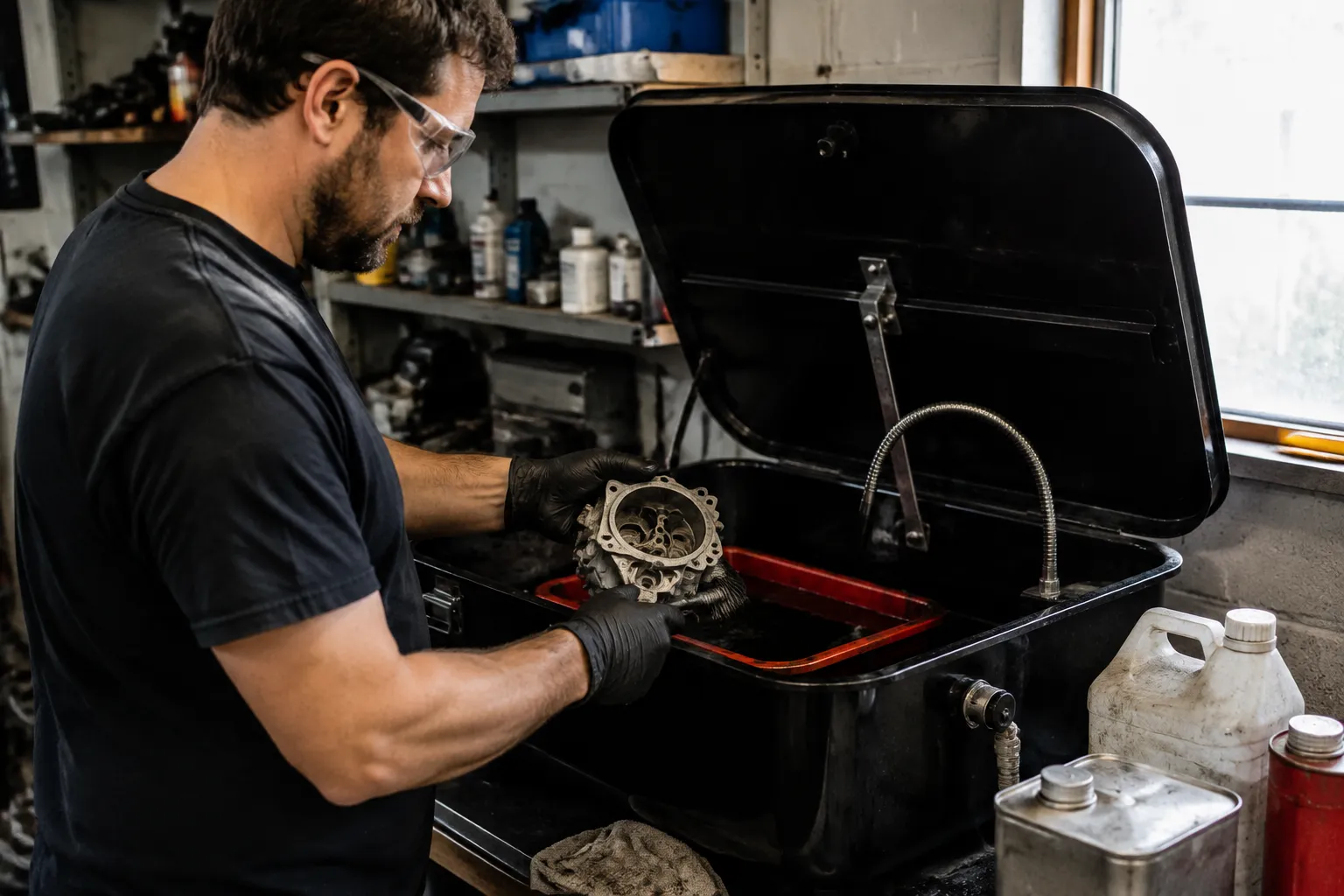
There is a moment in every home garage project where the parts washer becomes the whole room. The solvent has been sitting in the tray for a year, maybe two, and the carburetor or chain or bearing assembly sitting in it is coated in a film that no amount of scrubbing will shift. The fumes have a weight to them, a smell that gets into the sinuses and stays there. Most home mechanics accept this as the price of doing the work themselves. They should not.
The solvent in a typical home parts washer is a petroleum distillate, often the same stuff sold as mineral spirits or Stoddard solvent. It works. It dissolves grease and oil and dried-on gunk faster than almost anything else a person can buy over the counter. It also evaporates into the air of a closed garage, and every breath of that air carries a load of aromatic hydrocarbons. The health effects of chronic solvent exposure are not a mystery. The general understanding among occupational health professionals is that repeated, prolonged inhalation of these vapors can cause damage to the nervous system, the liver, and the kidneys. Nobody needs a government study to feel the headache that comes after a long afternoon leaning over a solvent bath.
The strange part is how normalized this has become. Walk into any auto parts store and the shelves are lined with five-gallon pails of solvent, sold with the same casualness as motor oil. The warning labels are there, but they are small print on the back, the kind of text a person reads once and forgets. The assumption seems to be that because the product is legal and widely available, it must be reasonably safe. That assumption does not hold up to a closer look.
What the Label Actually Says
The label on a standard pail of parts washer solvent lists the same few hazards in slightly different wording. Flammable. Harmful or fatal if swallowed. Causes skin irritation. May cause drowsiness or dizziness. The flammability is the one that gets attention, and it is a legitimate concern. A parts washer with a submerged pump can, under the wrong conditions, ignite the solvent and turn a garage into a fireball. That risk is real and worth respecting.
But the chronic risks are the ones that slip past. The label says "may cause drowsiness or dizziness," which sounds like a minor inconvenience. What that phrase means in practice is that the solvent is depressing the central nervous system. A person who spends eight hours a week bent over a washer with poor ventilation is not just getting a little lightheaded. They are accumulating exposure. The effects are cumulative, and they do not fully reverse when the garage door opens.
The other problem is skin contact. Solvent strips the natural oils from the hands, and it does so quickly. A mechanic who reaches into the tray bare-handed a few times a day will have cracked, peeling skin within a week. That cracked skin is then a direct route for the solvent to enter the bloodstream. The label calls it "skin irritation." The lived experience is a set of hands that feel like sandpaper and a dull ache in the knuckles that has nothing to do with the work itself.
The Ventilation Reality in a Home Garage
Commercial shops have ventilation systems designed by people who understand airflow. They have exhaust fans rated in cubic feet per minute, make-up air units, and often a separate room for the solvent station. Home garages have a door and a window, and the window is usually painted shut.
The math is simple. A typical home garage is maybe 20 by 20 feet with an eight-foot ceiling, which works out to 3,200 cubic feet of air. A parts washer with a two-foot-square open surface will evaporate solvent at a rate that depends on temperature and air movement, but in a warm garage in July, the vapor concentration builds fast. Opening the overhead door helps, but only if there is a cross breeze. A person working alone with the door cracked six inches is breathing air that is measurably worse than the air outside.
There is a test any home mechanic can do. Set the washer up, close the garage door, and leave the solvent sitting. Come back in an hour and take a breath right over the tray. The air has a thickness to it, a chemical presence that is immediately recognizable. That is not an illusion. That is volatile organic compounds off-gassing into an enclosed space.
The standard advice is to use the washer outdoors or with the door open. That advice is sound but impractical for a lot of people. Not everyone has a driveway or a carport that offers shelter from rain. Not everyone wants to haul a forty-pound washer outside every time a bolt needs cleaning. The realistic answer is not just "open the door." The realistic answer is to change the solvent.
The Cleaner Alternatives That Are Not a Downgrade
The home market has shifted in the last decade, and the options for a safer solvent are much better than they used to be. The two main categories are aqueous cleaners and bio-based solvents. Both have real trade-offs, but both eliminate the worst of the health concerns.
Aqueous cleaners are exactly what they sound like: water-based solutions with detergents and emulsifiers that lift grease off parts without dissolving it. They do not evaporate the way petroleum solvents do, so the vapor hazard is close to zero. A person can lean over an aqueous bath all afternoon and smell nothing more than a faint, soapy odor. The trade-off is that they are slower. Grease that would dissolve in mineral spirits in ten minutes might take twenty or thirty in a heated aqueous solution. The work takes longer, but the work does not leave a person with a headache.
Bio-based solvents are the middle ground. They are made from plant-derived esters, usually soy or citrus, and they have the dissolving power of a petroleum distillate without the aromatic hydrocarbons. They smell like lemons or oranges, and the smell is not a cover-up. The chemistry is genuinely different. These solvents are biodegradable and have a much higher flash point, which means they are less of a fire hazard. They are also more expensive, sometimes twice the price of a comparable pail of mineral spirits.
The cost difference gives some people pause, and that is fair. A five-gallon pail of bio-based solvent might run $80 to $100, where the same amount of mineral spirits is $40 or less. But the value calculation changes when a person considers what the cheaper product is doing to their body. The extra forty or fifty dollars a year is cheap insurance against a lifetime of neurological and liver issues.
How to Switch Without Wasting the Old Solvent
Making the switch does not mean dumping the old solvent down the drain, which is illegal in most places and irresponsible everywhere. A home mechanic with a half-full washer of mineral spirits has a few options. The solvent can be filtered and reused for other purposes, like cleaning brushes or thinning paint, though that just extends the exposure. It can be taken to a hazardous waste collection event, which many municipalities run a few times a year. Some auto parts stores accept used solvent for recycling, though the policies vary by location.
The better path is to run the old solvent down to a low level by using it for the dirtiest jobs, then switch the washer over to the new product when it is nearly empty. This stretches the old material to its useful end without creating a disposal problem. It also gives a person a direct comparison. The first time a carburetor comes out of a bio-based bath and wipes clean, the skepticism usually fades.
One caveat: do not mix the two. Petroleum distillate and bio-based solvent will blend into a single liquid, but the blend will not have the safety profile of the pure bio-based product. The petroleum fraction still evaporates and still carries the same vapors. The point of switching is to get the petroleum out of the garage, not to dilute it.
Gloves, Splash Guards, and the Parts Nobody Thinks About
Solvent choice matters, but it is not the whole story. A person can switch to the safest cleaner on the market and still do damage through contact. The hands are the obvious entry point. Nitrile gloves are the minimum, and they need to be the right weight. The thin disposable kind from the grocery store tear on the first sharp edge. A box of heavy-duty nitrile gloves, the kind rated for chemical handling, costs a bit more and holds up for a full session.
Beyond the hands, there is the splash factor. Every parts washer tray has a lip, and every mechanic has sloshed solvent over that lip while wrestling with a stubborn part. The solvent runs down the front of the washer and pools on the floor, and then it evaporates into the room. A splash guard, even a simple piece of sheet metal bent to fit around the tray, cuts this down significantly. Some washers come with a lid that closes when not in use. That lid is not a suggestion. Keeping the washer covered when it is idle is the single biggest step a person can take to reduce vapor buildup in a garage.
The floor is another overlooked surface. Solvent that splashes onto concrete does not just sit there. It seeps into the porous surface and keeps evaporating for days. A spill mat or a simple plastic tray under the washer catches the drips and can be wiped down. This is not obsessive neatness. It is a practical way to keep the air cleaner than the label on the pail would have a person believe is necessary.
The Heating Question for Aqueous Systems
Aqueous cleaners work better when they are warm, and some home mechanics have rigged up heaters to bring the bath up to 120 or 130 degrees Fahrenheit. This is a reasonable modification, but it comes with its own risks. A heated aqueous bath will evaporate water vapor, which is harmless, but it will also concentrate the detergent over time. The solution needs to be topped off with water regularly and changed out on a schedule. A bath that has gone sludgy and brown is not cleaning anything well, and the bacteria that can grow in a warm, wet environment are a separate concern.
A simpler approach for most home jobs is to use the aqueous cleaner at room temperature and accept that it takes a little longer. The extra time is spent scrubbing, not breathing. That trade is worth making every time.
The Disposal Problem Nobody Wants to Talk About
Used solvent is hazardous waste, no matter what kind it is. The petroleum distillate is flammable and toxic. The bio-based solvent is less toxic but still loaded with the grease and metals it has pulled off parts, and that sludge is not something to pour on the ground. A person who has been using solvent for years has probably been handling disposal wrong the whole time.
The right move is to check with the local waste authority. Many counties run permanent collection sites for household hazardous waste, and they accept solvents in sealed containers. Some will take the whole five-gallon pail. Others require it to be in smaller containers. The rules are local, and the only way to know is to check. A quick phone call or a look at the county website beats guessing.
The other option is to let the solvent sit until the particulate settles, then decant the clear liquid off the top and use it again. This works for a few cycles, but the solvent eventually reaches a point where it is more sludge than liquid. That is when it needs to go. There is no magic way to make the waste disappear. The responsible path is the one where the waste ends up in a facility that knows how to handle it.
The Real Cost of the Cheap Pail
Home mechanics like to think in terms of cost per job. The cheap pail of mineral spirits costs less upfront, and it cleans faster, so it feels like the economical choice. That math leaves out the part where a person breathes solvent vapors for years and wonders why the headaches have become a regular thing, or why the hands crack and bleed every winter, or why the garage has a permanent chemical smell that no amount of airing out can fix.
The bio-based solvent and the aqueous cleaner are not luxury items. They are the difference between a hobby that wears a person down and a hobby that stays enjoyable. A person who rebuilds one engine a year might not notice the difference in their body. A person who tinkers every weekend will. The choice is not about being trendy or following the latest safety fad. It is about deciding whether the parts washer should be a tool or a hazard.
The solvent in the tray is a chemical that goes into the air, onto the skin, and into the lungs. There is no way around that. The only question is which chemical a person chooses to live with. The answer to that question is not written on the price tag. It shows up later, in the way the body feels after years of the same routine. Picking the safer solvent is not expensive. It is just a different way of counting the cost.