
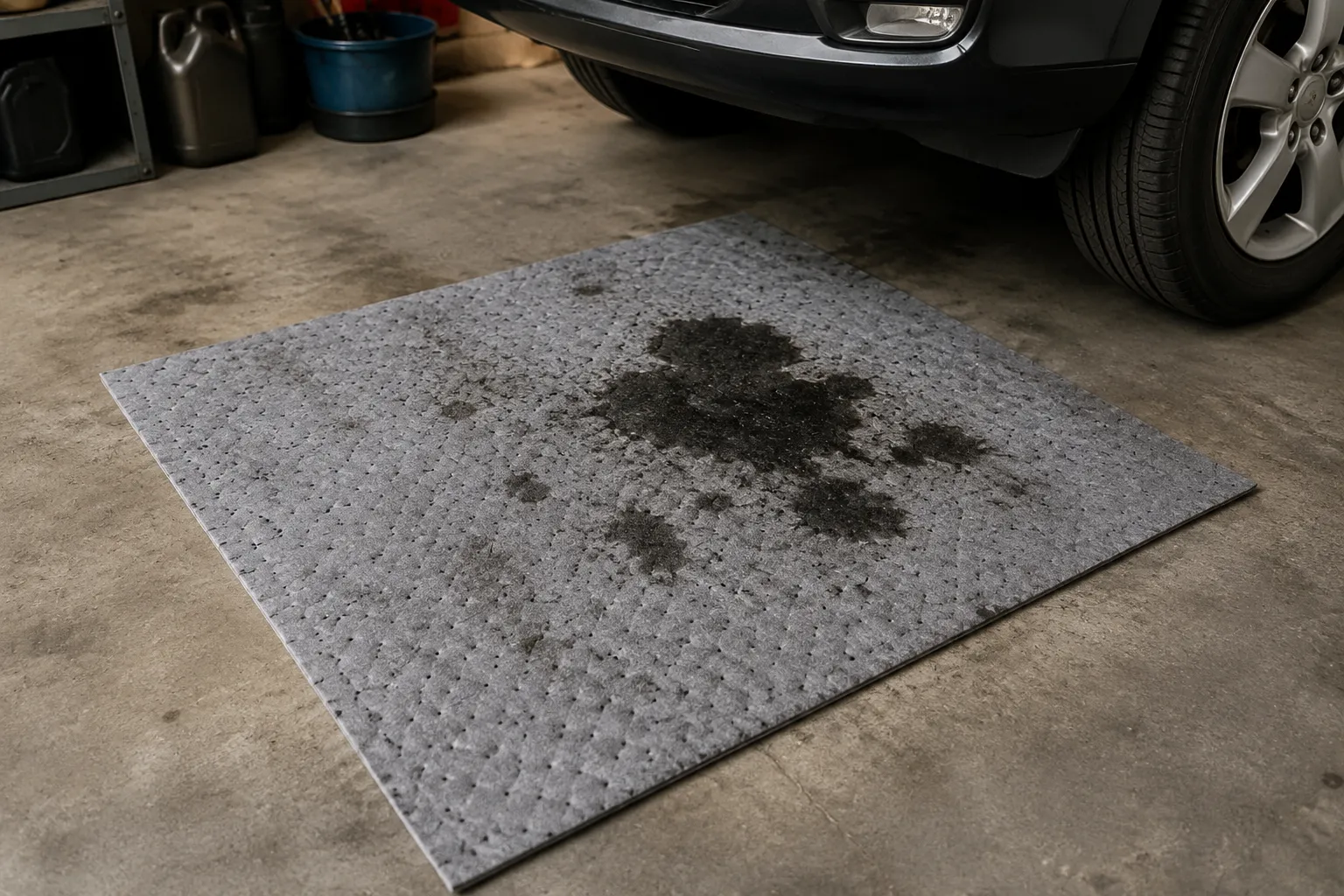
The oil stain under a parked car is one of those small household failures that everyone notices and almost no one talks about. A driveway dotted with dark patches reads as neglect, even when the car is perfectly maintained. The common response is a cardboard box flattened under the engine, which works for about a week until rain turns it into a sodden mess that sticks to the concrete. Parking mats exist precisely for this problem, but most people buy the wrong one, install it wrong, or give up after the first season. The difference between a mat that saves the driveway and a mat that becomes another piece of garage clutter comes down to a few specific choices.
A parking mat is a simple product in concept: a large, durable sheet that sits under the car's engine and transmission area to catch whatever drips. The reality is messier. The market offers rubber, polypropylene, cotton, and combinations of all three, in thicknesses from a heavy tarp to a stiff board. Prices range from twenty dollars to over a hundred. The expensive ones are not always better, and the cheap ones often fail in ways that cost more than the savings. Understanding what actually causes oil stains, and how each material handles that cause, is the only way to make a sensible purchase.
Why Concrete Stains So Easily
Concrete is porous. A fresh oil spill sits on the surface for a few hours, then slowly wicks into the material like water into a sponge. The stain is not on the surface; it is several millimeters deep, which is why pressure washing rarely removes it completely. The oil oxidizes and darkens over time, and once it has penetrated, the only real fix is grinding the surface or applying a chemical poultice. Neither is a pleasant weekend project.
This porosity is also why a mat must catch the oil immediately. A mat that absorbs slowly, or one that lets oil pool on its surface, still gives the oil time to migrate sideways and off the edge. The best mats are designed to hold the oil in place long enough for it to be dealt with, either through absorption or through a raised edge that contains the liquid. A flat, thin mat with no lip is asking for trouble, especially on any slope.
The other factor is the car itself. Modern engines leak less than older ones, but they still leak. Valve cover gaskets, oil pan seals, and transmission cooler lines all age and seep. A car driven daily in a city, parked on a slight incline, will drip at a different rate and direction than a weekend car parked on level ground. The mat has to match the car's actual behavior, not the owner's hope that nothing will happen.
The Three Material Families and Their Real Tradeoffs
Rubber mats are the most common. They are heavy, flexible, and completely impermeable to oil. A rubber mat catches the drip and holds it on its surface, where it sits as a puddle until someone wipes it up. This is both the strength and the weakness. Rubber does not stain, and it cleans easily with a rag and some solvent. But a puddle of oil on a rubber mat can be tracked onto the driveway when the car drives away, because the tires roll through the puddle as they leave.
Polypropylene mats, often sold as "absorbent" or "fiber" mats, work differently. They are made of a dense, felt-like material that soaks oil into its structure. The oil is held within the mat, not on top of it, so there is no puddle to track. This makes them better for cars that are driven regularly. The downside is capacity. A polypropylene mat holds a finite amount of oil, and once it is saturated, it stops absorbing and starts letting oil pass through. A heavy leaker can saturate a thin mat in a month.
Cotton mats, sometimes called "garage rugs", are the old-school option. They are thick, soft, and highly absorbent, but they hold moisture as well as oil. A cotton mat left in a damp garage becomes a breeding ground for mildew and smells like a wet dog. They also degrade faster than synthetic options. Cotton is a good choice for a dry, climate-controlled garage and a car that only seeps occasionally. It is a poor choice for an outdoor driveway in a rainy climate.
Thickness Matters More Than Brand Name
The single most important specification on a parking mat is its thickness, measured in millimeters. Thin mats, around 3 to 4 mm, are little more than glorified tarps. They lie flat, they fold easily, and they offer almost no protection against the weight of the car. A car's tires press down with thousands of pounds of force, and a thin mat can tear or shift under that load. The mat also develops creases and wrinkles that channel oil toward the edges.
A mat in the 6 to 8 mm range is the practical minimum for a standard sedan or crossover. This thickness provides enough structural integrity to stay put, and the extra material gives a small margin for absorption or containment. Trucks and SUVs, which are heavier and often sit higher off the ground, benefit from mats at the 10 mm mark or above. The heavier the vehicle, the thicker the mat should be, regardless of what the packaging claims.
There is a tradeoff, though. Thick mats are heavy and awkward. A 10 mm rubber mat for a full-size truck can weigh over thirty pounds and is a genuine hassle to drag out, clean, and reposition. Some owners buy a thick mat, use it once, and then leave it in the corner of the garage because they do not want to deal with it. A mat that is too heavy to use is worse than no mat at all.
Size and Placement Are the Real Test
Most parking mats are sold in sizes that assume the car is parked perfectly straight. Real life involves crooked parking, bumpers that stop short, and engines that are not centered over the front axle. A mat that is barely wider than the car's track will miss the drip if the car is even slightly off-center. The solution is to buy larger than seems necessary. A mat that extends a foot beyond the wheels on each side, and at least two feet beyond the front bumper, covers most real-world parking variations.
Placement is where most people fail. The mat needs to sit under the engine and transmission, which are not at the very front of the car. For most front-engine vehicles, the engine sits between the front bumper and the firewall, roughly over the front wheels. The mat should be positioned so the front wheels rest on it, not in front of it. A common mistake is aligning the mat with the bumper, which leaves the engine dripping onto bare concrete behind the mat's edge.
A useful trick is to park the car on the mat the first time, then mark the mat's position with a small piece of tape on the garage floor. This creates a repeatable parking guide. Without a guide, the car drifts a few inches each time, and the mat slowly migrates out of position. Within a week, the mat is doing nothing except collecting dust.
The Slope Problem and the Edge Lip
Driveways are rarely perfectly level. Even a slight slope, one or two degrees, is enough to make oil run across a flat mat and off the side. This is the most common reason a mat fails in practice. The oil does not drip through the mat; it drips onto the mat, then flows downhill and off the edge.
Mats with raised edges or a "containment lip" solve this problem. The lip acts as a small dam, holding the oil within the mat's footprint. For a slope, the lip needs to be on all four sides, not just the front and back. Some mats only have lips on two sides, which helps with front-to-back slopes but does nothing for side-to-side ones. Reading the product photos carefully is worth the time; the lip configuration is often buried in the details.
An alternative for sloped driveways is to use two mats, one under the engine and one under the transmission, with a small overlap. The overlap catches any oil that runs off the first mat. This is not elegant, but it is practical and cheap. Two mid-range mats cost less than one premium mat and offer better coverage.
Cleaning a Mat Is a Chore, Not a Ritual
Every parking mat needs cleaning eventually. A rubber mat with a puddle of oil can be wiped with a rag and mineral spirits. A polypropylene mat that has absorbed oil needs a different approach: a degreaser, a stiff brush, and a hose, with the mat propped at an angle so the dirty water runs off. This is a wet, messy job, and it needs to happen in a place where the runoff will not stain anything.
The frequency depends on the leak rate. A car that drips a few drops a week can go months between cleanings. A car that leaves a quarter-sized puddle overnight needs a mat cleaned every few weeks, or the mat will reach saturation and start leaking through. Checking the mat's underside after a heavy rain is a good way to tell if it is failing; if the concrete under the mat is wet with oil, the mat is done.
Some owners skip cleaning entirely and treat the mat as disposable. For a cheap polypropylene mat, this is a reasonable strategy. Replace it every six months for twenty dollars and never deal with the mess. For an expensive rubber mat, disposal is wasteful. Rubber mats last years if cleaned properly, and the cleaning cost is just an hour of labor and a few dollars of solvent.
The Weather Factor Nobody Mentions
Outdoor parking mats face sun, rain, and temperature swings. UV radiation degrades rubber and polypropylene over time, making them brittle and cracked. A mat left in direct sunlight for a full summer will lose flexibility and develop surface cracks. These cracks are cosmetic at first, but they eventually reach the point where the mat splits under the car's weight.
Cold weather is equally harsh. Rubber becomes stiff and less pliable at low temperatures, and a stiff rubber mat is more likely to crack when driven over. Polypropylene handles cold better but becomes slippery when wet and frozen. A mat covered in frost is a hazard to walk on and offers no grip for the tires, which can cause the car to slide slightly when parking.
Indoor mats in a garage avoid most of these problems. The temperature is stable, the UV exposure is minimal, and the mat dries quickly. For an outdoor installation, the mat should be stored flat during the summer months if the car does not leak, or replaced on a shorter cycle. A mat is a consumable item, not a permanent fixture.
The Leak Rate Test Before Buying Anything
Before spending money on a mat, a person should know how much their car actually leaks. A clean piece of cardboard placed under the engine for a week will show the drip pattern and volume. A few drops means a light mat is fine. A stain the size of a fist means a heavy-duty mat with a lip is required. A puddle means the car needs a mechanic, not a mat.
This test takes a week and costs nothing, and it prevents the most common purchasing mistake: buying a mat that matches the car's age instead of its behavior. A ten-year-old car with a clean engine bay needs less protection than a five-year-old car with a slow rear main seal leak. The mat should match the actual drip, not the car's reputation.
The other pre-purchase step is measuring the parking spot. A mat must fit the space between walls, cabinets, and other obstacles. A mat that is too large for the spot will be folded or trimmed, which defeats its purpose. A mat that is too small leaves gaps. The measurements are simple, but they are skipped often enough that a significant number of mats end up in the trash within a year of purchase.
When a Mat Is Not the Answer
There is a category of leaks that no mat can handle. A car that loses a quart of oil every week is not leaking; it is failing. The mat will fill up, the oil will find a way around the edges, and the driveway will still stain. In this situation, the mat is a bandage on a wound that needs stitches. The money spent on a heavy-duty mat is better spent on a diagnostic visit to a mechanic.
Oil stains are also a symptom, not the disease. A driveway that is already stained will not be improved by a mat; the mat only prevents new stains. Some homeowners buy a mat, install it, and then notice the old stains and assume the mat is not working. The mat was never meant to fix the past. It is an investment in the next five years, not a cleaning product.
The final consideration is the neighbor test. A parking mat is visible from the street, and a large, oil-stained mat is an eyesore. Some owners choose a dark-colored mat to hide the stains, which works visually but makes it harder to tell when the mat needs cleaning. A light-colored mat shows everything, which is annoying but informative. This is a choice between appearance and function, and there is no right answer, only a preference.
A parking mat is a small purchase that solves a specific, avoidable problem. The driveway stays clean, the car stays off the concrete, and the chore of dealing with oil becomes a ten-minute wipe instead of a weekend of scrubbing. The right mat, sized for the car, placed under the engine, and matched to the leak rate, quietly does its job for years. The wrong mat collects dust and blame in equal measure. The difference is a few minutes of measuring and a willingness to accept that the car leaks, because every car leaks eventually.