
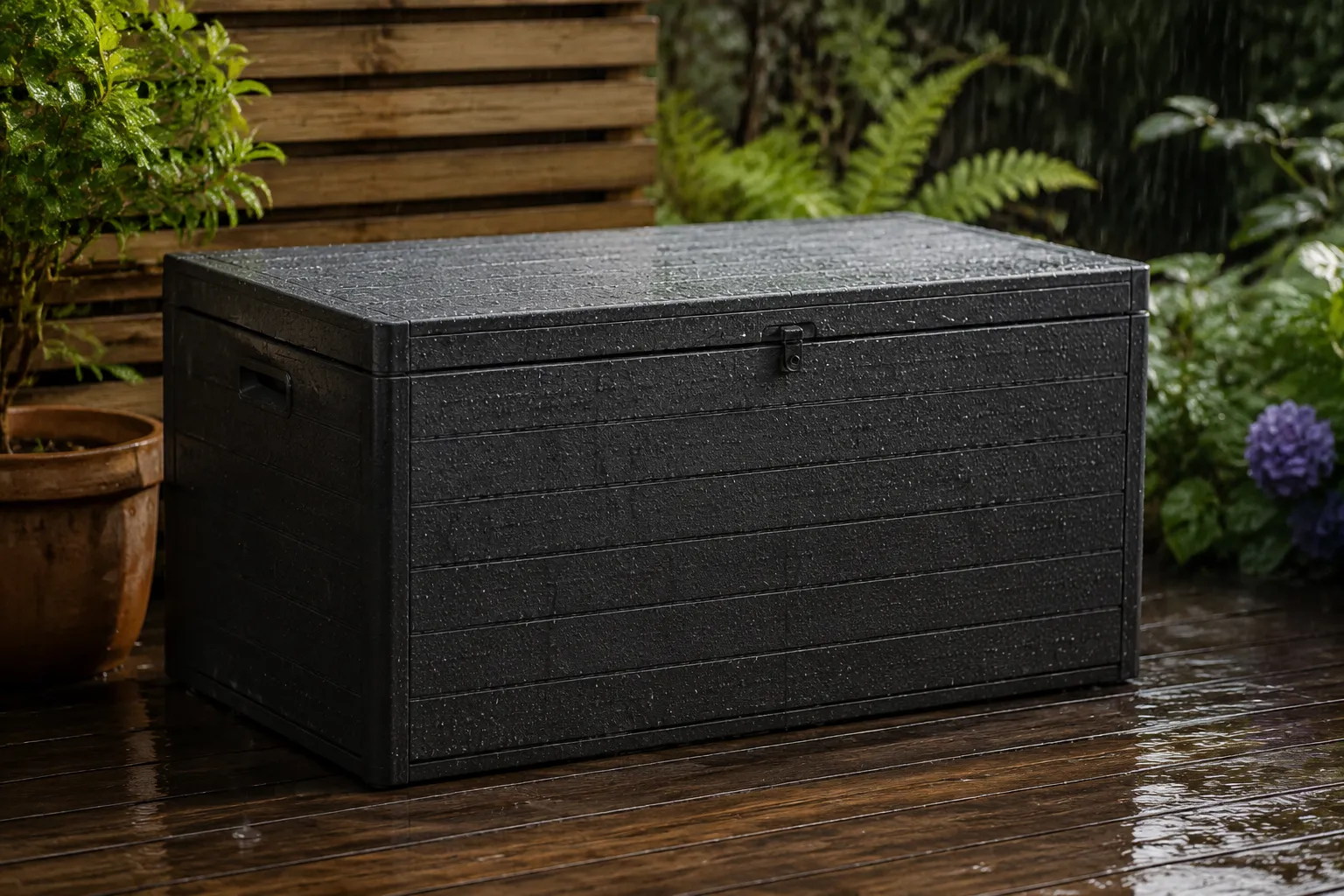
Waterproofing claims on outdoor storage boxes are the most lied-about specification in backyard retail. A box labeled "all-weather" often means it survived a light drizzle in a parking lot test, not that it will keep a downpour from pooling inside and soaking heirloom cushions. The gap between marketing language and actual water resistance is wide enough to lose a lot of expensive patio furniture through.
The first thing to understand is that most outdoor storage boxes are not waterproof, and they were never designed to be. They are water-resistant at best. A typical resin box has seams where the lid meets the base, seams where the walls are molded, and often a drainage hole in the floor that manufacturers call a feature. Water will find every one of these paths. The honest term for what most boxes offer is "sheltered storage," meaning things stay dry if rain falls straight down and the box sits on level ground.
The Real Weak Points on Every Box
Rain rarely falls straight down, and that is where the trouble starts. The lid-to-base seam is the biggest leak point on any box. Most lids overlap the base by an inch or two, which looks protective but actually creates a channel that funnels water toward the hinge side and the corners. When wind drives rain at an angle, water runs up and over that overlap and straight into the box.
The corners are worse. Molded resin boxes have seams in the corners where the plastic was joined, and those seams develop micro-cracks after a season of UV exposure. The cracks are nearly invisible from the outside, but they wick water like a sponge. A box that kept contents dry in spring can start leaking in August simply because the plastic has aged a few months in the sun.
Then there is the floor. Many boxes have a raised ribbed floor with small drainage holes so that any water that does get in can escape. That is a good design for a box meant to hold a hose or muddy boots. It is a terrible design for a box meant to hold fabric. The drainage holes guarantee that the inside of the box is connected to the ground beneath it, and ground moisture evaporates upward into the box all day long.
The Difference Between a Gasket and a Seal
A gasket is a strip of compressible material that sits between two surfaces. A seal is the actual barrier that stops water. Many boxes advertise a "weatherproof gasket" on the lid, and it is often nothing more than a thin foam strip that compresses flat after a month of the lid being closed. Once that foam compresses, it stops pressing against the lid edge, and water slides right past it.
Better boxes use a bulb gasket, which is a hollow rubber tube that keeps its shape under compression. Bulb gaskets hold up for years, but they are rare on boxes under a few hundred dollars. The price difference between a foam strip and a bulb gasket is about fifty cents in manufacturing. The difference in performance is the difference between dry cushions and moldy ones.
A person can test the gasket on a box without waiting for rain. Close the lid, then run a hand along the seam. If the lid flexes at all under light pressure, the gasket is not making full contact. Hold a flashlight inside the box in a dark room and look for light bleeding through the seam. If light gets out, water gets in.
Polyethylene Resin vs. Wood vs. Metal
The material of the box determines how long any waterproofing measures last. Polyethylene resin is the most common material, and it has one huge advantage: it does not rot or rust. The downside is that it expands and contracts with temperature swings. A resin box that seals perfectly at 70 degrees can develop gaps at 95 degrees and at 40 degrees. The plastic moves more than people expect, and the gasket has to be thick enough to absorb that movement.
Wooden boxes look beautiful and fail differently. Cedar and teak boxes are naturally rot-resistant, but the joints are the weak point. A wooden box assembled with butt joints will open up at the corners within a year, no matter how good the finish is. The only wooden boxes worth considering use ship-lap or tongue-and-groove joinery, where the boards interlock and shed water like a boat hull. Those boxes are heavy and expensive, and they still need a good lid seal.
Metal boxes, usually aluminum or powder-coated steel, are the best for waterproofing because the material does not move much and does not absorb water. But metal boxes conduct heat and cold, which means condensation forms inside them when the temperature swings. A metal box in direct sun can build up enough condensation to wet the contents even with a perfect gasket. The solution is to line the inside with a breathable barrier, which most manufacturers do not bother to include.
The Drainage Hole Question
Manufacturers put drainage holes in storage boxes for a reason, and it is not to annoy buyers. A completely sealed box will trap condensation and humidity, and the contents will mildew faster than they would in a box with some airflow. The holes are a compromise: let water escape, but also let humidity in.
For a box holding pool chemicals or gardening tools, drainage holes are correct. For a box holding fabric cushions or outdoor pillows, the holes defeat the purpose. The fix is simple. A person can seal the holes from the inside with a marine-grade sealant, then add a moisture absorber packet to handle the condensation. This creates a truly sealed environment, which is what fabric needs.
Sealing the drainage holes is a permanent modification that voids most warranties. That is a trade worth making for expensive cushions, but not for a cheap box holding a few pool noodles. The decision comes down to what is going inside, and that is exactly how a storage box should be chosen in the first place.
How to Test a Box Before You Buy
Retail stores set up displays of storage boxes, and a smart shopper can learn a lot in two minutes. Press down on the lid and watch how the seam behaves. If the lid flexes more than a quarter of an inch, the gasket will not stay engaged in a windstorm. Open and close the lid several times and listen for a solid thunk. A thin, hollow sound means thin walls.
Check the underside of the lid for a drip edge. A proper drip edge is a raised lip that runs along the inside perimeter of the lid, forcing water to drip off before it reaches the seam. Boxes without a drip edge rely entirely on the gasket, and that is a fragile defense. The drip edge is the single best design feature for waterproofing, and it costs almost nothing to mold into the plastic.
The hinges deserve scrutiny too. Cheap hinges are flat pieces of plastic that screw into the lid and base. They flex and crack, and when they fail, the lid no longer presses evenly on the gasket. Look for hinges with a metal pin running through them, or a molded hinge that is part of the lid itself. The molded hinge is actually better, because there is nothing to loosen over time.
Aftermarket Sealing Done Right
No box is truly waterproof right out of the box, but a person with basic supplies can make almost any box substantially better. The most effective upgrade is a new lid gasket. Foam weatherstripping from a hardware store, the kind with adhesive backing, can replace a worn factory gasket in about ten minutes. The key is to buy the thickest foam that still allows the lid to close, usually 3/8 inch for most boxes.
Silicone sealant is the other great equalizer. Running a bead of outdoor silicone along the interior seams of the box, where the walls meet the floor and where the corners are joined, closes the micro-cracks that develop over time. This is not a permanent fix; silicone degrades in UV and needs reapplication every couple of years. But it is cheap and effective.
For wooden boxes, the finish is everything. A penetrating oil finish protects the wood but does nothing for the joints. A person should brush a flexible sealant into every joint before applying the finish, then reapply the finish every season. The flexible sealant absorbs the wood's expansion and contraction, preventing the joints from opening up.
The Elevation Trick Nobody Uses
Where a box sits matters as much as how it is built. A box placed on bare ground sits in a puddle after every heavy rain, and the water seeps up through the floor. Even the best-drained boxes will wick moisture from the ground over time. The fix is to elevate the box on pavers or a wooden platform, lifting it an inch or two off the soil. That small gap allows air to flow underneath and stops the wicking action entirely.
The location of the box relative to the house matters too. A box placed against a wall gets splashed by rain running off the roof, and it gets the brunt of wind-driven rain bouncing off the wall. A box placed in the open gets rained on from all sides, but it also dries out faster between storms. The open position is better for waterproofing, assuming the box has a decent lid. The wall position is better for protecting the box itself from UV damage, which weakens plastic over time.
Emptying the box before winter is the final piece of the puzzle. A box full of cushions freezes and thaws through the cold season, and the expansion of ice in the seams widens any existing cracks. A box left empty, or with only rigid items inside, survives winter with far less damage. The people who complain that their box leaked in spring are often the people who left it packed full in January.
What Expensive Boxes Actually Do Differently
A premium storage box costs three to five times as much as a basic resin box, and the price difference is not just branding. The expensive boxes use thicker plastic, measured in millimeters rather than fractions of a millimeter. They use a bulb gasket instead of a foam strip. They have molded drip edges and reinforced hinges. The difference is visible when the lid closes: it seats with a firm, even pressure across the entire perimeter.
The premium boxes also use a better grade of resin that resists UV degradation. Cheap resin turns chalky and brittle within two years, and as it brittles, it shrinks and cracks. The seams open up, and the gasket no longer seats. A box that costs more upfront can be cheaper over a decade of service, purely because it does not need to be replaced every few years.
The warranty is a useful signal. A box with a one-year warranty is admitting that it will fail within a season or two. A box with a five-year or ten-year warranty is backing its construction. The warranty does not make the box waterproof, but it tells a buyer how the manufacturer expects the product to hold up. That expectation is usually accurate.
A Lid That Locks Out Water
The lid of a storage box is the single most important part, and most people do not look at it closely enough. A flat lid sheds water poorly and collects puddles that slowly seep through any imperfection in the gasket. A domed or sloped lid sheds water immediately, reducing the time water has to find a path inside. The difference is significant in a rainstorm.
The lid should also overhang the base by a solid margin. An overhang of two inches or more creates a shadow effect that keeps driving rain off the seam. A lid that barely overlaps the base, which is common on cheap boxes, gives water a direct path to the gasket. The overhang is easy to measure in a store, and it is one of the fastest ways to separate good boxes from bad ones.
Some lids have a locking mechanism that pulls the lid down tight against the base. A simple latch that clicks into place creates more consistent gasket pressure than a lid that just rests on the box. The best designs use a compression latch, which has a cam that pulls the lid down as it closes. The compression latch is rare outside of high-end boxes, but it makes a measurable difference in keeping the seal engaged during wind gusts.
Dealing With Condensation Even When the Box Is Dry
A box can be perfectly sealed and still ruin its contents through condensation. When warm, humid air gets inside a cool box, the moisture condenses on the walls and floor. This happens most often in spring and fall, when daytime temperatures swing widely. The water that condenses is clean, but it still wets fabric and promotes mildew.
Silica gel packets, the same ones that come in shoe boxes, absorb condensation effectively in a sealed storage box. A few large packets, or a rechargeable desiccant pack, will keep the interior dry for months. The packets need to be dried out periodically in a low oven, but they last for years. This is the cheapest insurance available for fabric stored outdoors.
Ventilation is the alternative to desiccation. A box with small vents near the top allows air to circulate, which keeps the interior at the same temperature and humidity as the outside air. This prevents condensation, but it also lets rain in during wind-driven storms. The vented approach only works for boxes with a gasket that seals when the lid is closed and vents that are positioned to shed water. It is a delicate balance, and most boxes do not get it right.
The One Test That Matters in the Real World
After all the gasket upgrades, sealant applications, and elevation tricks, the only test that matters is leaving the box out in a real storm. A garden hose does not simulate rain properly; it hits the box from one direction at high pressure. Real rain comes from all directions at once, and it keeps coming for hours. The deep soak of a long rainstorm is what finds the weak points.
A person who wants to know if their box is truly waterproof should put a dry towel inside, close the lid, and wait for the next heavy rain. Not a drizzle, not a sprinkle, but a proper storm. When the rain stops, the towel tells the truth. If the towel is dry, the box works. If the towel is damp, the box needs work. That simple test, repeated through a full season, is more reliable than any spec sheet or marketing claim.
Most boxes will fail that test the first time. The good news is that most failures are fixable with the right gasket, a tube of sealant, and a bit of elevation. The boxes that cannot be fixed, the ones with thin walls and weak hinges and no drip edge, are the ones that were never meant to be waterproof in the first place. They are shelves with a lid, and treating them as anything more is a setup for soggy disappointment.