
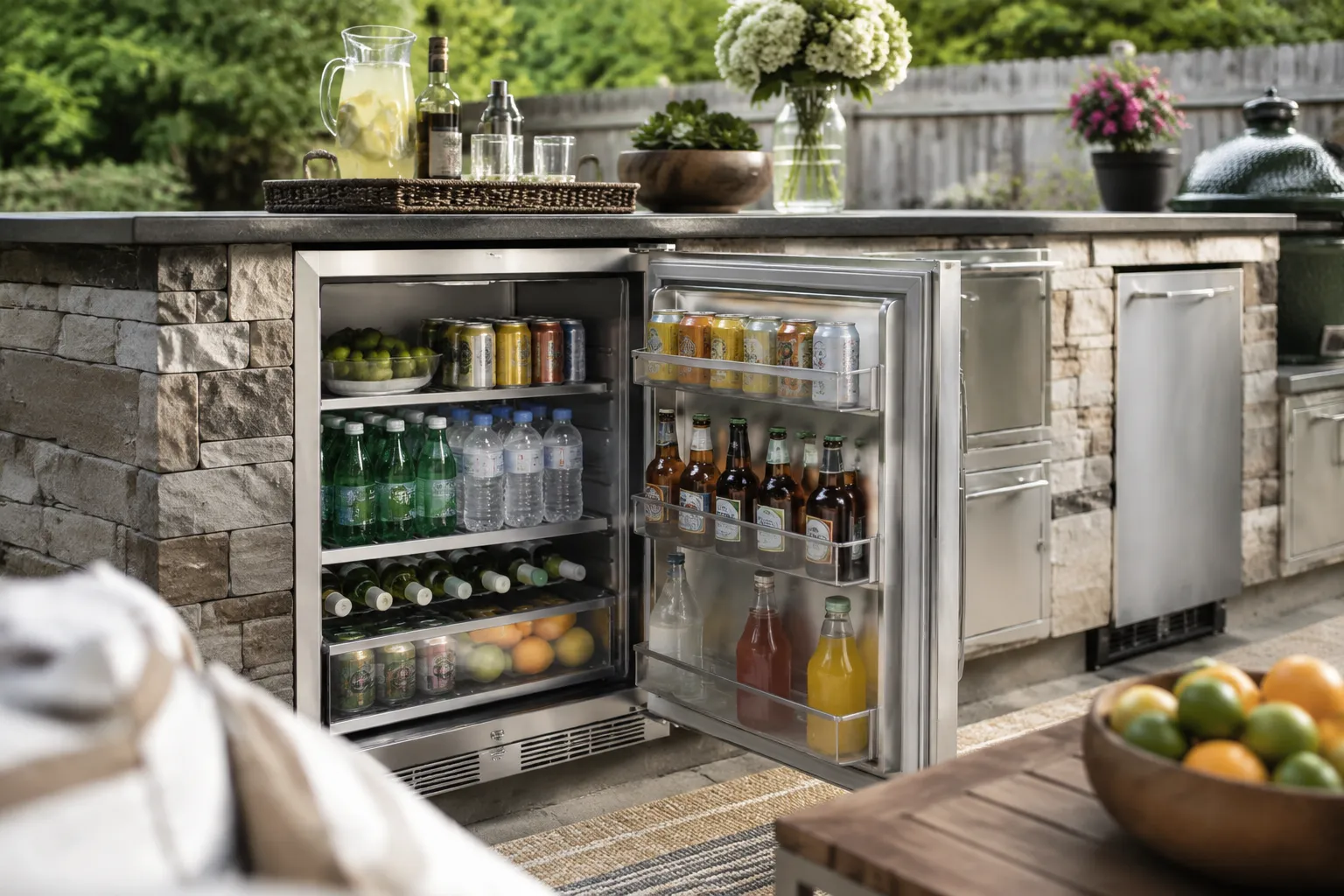
The outdoor fridge has become the great status symbol of the backyard renovation boom, but most of the ones installed in the last five years are already failing at their only real job. The failure is rarely mechanical. It is logistical. The fridge sits off in a corner beside the grill, looks handsome in the listing photos, and then requires a twelve-step program just to grab a beer while the host is mid-sentence with a guest. Beverage stations fail because they are planned as appliances instead of as traffic patterns.
Anyone who has hosted a summer party knows the actual rhythm of the event. People drift. They do not move in straight lines. The grill master stays planted in one spot, the kids orbit the yard in erratic loops, and the adults cluster wherever the shade is best. A fridge that cannot serve that chaotic flow becomes a cabinet that happens to be cold. The planning process should start with human movement, not with the dimensions of a refrigerator.
There is a difference between a fridge for the grill and a fridge for the party. The grill fridge holds raw meat, marinades, and the odd vegetable. It needs to be near the cook station, and its contents are generally not on display. The beverage station is a different creature entirely. It is a self-serve bar that happens to be refrigerated. Its success depends on how little friction exists between the moment a guest wants a drink and the moment that drink is in hand.
The first decision is location, and the first mistake is treating the fridge like a piece of furniture that needs a specific wall. The fridge should go where the people already gather, not where the architect drew a nice niche. If the patio has a natural social center, usually where the outdoor sofa or the fire pit sits, the beverage station belongs on the edge of that zone. Thirty feet away next to the grill is a walk that kills conversation. Eight feet away, across a small gap, is a lean and a reach.
The Shadow Rule for Placement
Sun exposure is the silent killer of outdoor appliances, and it gets ignored because it does not show up on the first day. A fridge sitting in direct afternoon sun runs its compressor almost constantly in July. The exterior panels get hot enough to warp in cheap units, and the internal temperature struggles to stay below 40 degrees on the worst days. The unit works harder, drinks get warmer, and the compressor burns out years ahead of schedule.
The general rule worth following is simple: if a person cannot comfortably stand in that spot at 2 p.m. in August without seeking shade, the fridge should not live there either. A north-facing wall, an overhang, or a spot under a large tree canopy all work. Some of the best beverage stations are tucked into the shade of the house itself, just outside the sliding door, rather than out in the open yard where the sun bakes everything from noon onward.
Builders and landscapers push for the outdoor kitchen package, a full run of countertop, sink, fridge, and grill all in one line. That arrangement looks impressive in a magazine but creates a functional problem for beverages. The grill puts out heat, the sink area gets cluttered with dirty dishes, and the whole line becomes a work zone. Guests instinctively avoid work zones. A beverage station that shares counter space with a hot grill and a pile of tongs will sit unused while people walk back inside to the kitchen.
Choosing the Right Size and Configuration
Beverage fridges come in two basic physical forms, and the choice between them changes everything about how the station operates. The undercounter unit, typically 24 inches wide and roughly 34 inches tall, slides beneath a countertop and disappears. The full-size refrigerator, usually 36 inches wide and 70 inches tall, stands alone like its indoor cousin. Neither is inherently better. They serve different party sizes and different hosting styles.
The undercounter unit is the right choice for the household that hosts small gatherings, a dozen people or fewer, and values counter space. A person can set a drink down on the counter while freeing a hand, and the low profile keeps sightlines open across the patio. The downside is capacity. A 24-inch undercounter fridge holds roughly 40 to 60 cans depending on the shelf layout, which sounds fine until a party hits hour three and the can supply runs dry.
The full-size unit is the workhorse for larger gatherings and for households that stock a serious variety of drinks. It can hold beer, wine, sparkling water, juices, and a few mixers all at once, and the taller interior means bottles stand upright instead of rolling around. The tradeoff is visual bulk. A full-size fridge on a patio reads as a major appliance, and it needs a spot where its presence does not dominate the entire outdoor room.
There is a middle path that does not get enough attention. A 30-inch wide undercounter unit offers more capacity than the 24-inch model while keeping the low profile. It holds about 80 cans in a standard configuration, which covers most backyard parties without requiring the visual commitment of a full-height fridge. This size hits the sweet spot for the typical suburban household that hosts a few times a month rather than every weekend.
The Countertop Is the Real Workhorse
A fridge alone does not make a beverage station. It makes a cold box. The difference between the two is a few square feet of countertop arranged with intent. That surface handles the actual work of the party: setting down a glass while opening a can, holding a cutting board for lime wedges, catching the condensation rings from a dozen cold bottles. Without it, guests balance drinks on the arm of a chair and the station fails in a different way.
The counter needs to be at least 24 inches deep to be useful, and a run of 36 to 48 inches of width gives enough room for the drink preparation tasks that always happen at a party. A person needs a spot for a bottle opener that is not also the spot where a glass is sitting. The surface should be a material that does not care about water rings or sticky spills. Sealed granite, quartz, and stainless steel all work. Unsealed concrete and certain porous tiles do not.
Drainage matters more than it seems. Outdoor counters get rained on, and a flat surface with no slope collects puddles that sit for days. A very slight pitch, even half a degree, toward the back or toward a drainage gap keeps the surface dry and prevents the countertop from developing that perpetually damp smell. Many people skip this detail and spend the next ten years wiping water off a slab that should have shed it naturally.
Ice, Ice Machines, and the Storage Hierarchy
No beverage station works without ice, and this is where most plans quietly fall apart. The fridge itself does not produce ice unless it happens to have a built-in icemaker, and most undercounter beverage units do not. The host then faces the classic party dilemma: the ice melts, the drinks get warm, and somebody volunteers to drive to the gas station mid-event. A dedicated ice maker is not a luxury. It is the difference between a station that works and a station that requires constant babysitting.
The standalone ice maker, roughly the same footprint as an undercounter fridge, produces 40 to 60 pounds of ice per day and stores it in an insulated bin. For a household that hosts regularly, this justifies its counter space immediately. The cheaper alternative is a large cooler dedicated solely to ice, positioned beside the fridge. It works fine, but it adds a step and it looks like a cooler. The built-in machine disappears into the cabinetry and makes the whole station feel permanent.
Inside the fridge, the arrangement of shelves determines whether the station actually gets used. Stacking everything on one shelf creates a jumble where every drink requires digging. The better setup uses the door for tall bottles, the top shelf for cans arranged in rows with the labels facing out, and the bottom shelf for wine or large-format bottles. A basket or two on the shelves keeps small items like fresh limes or a lemon wedge tray from rolling into dark corners.
People reach for drinks in a predictable pattern. They take the first thing they see, and if that is a can of sparkling water when they wanted a beer, they will search rather than settle. Grouping by drink category, not by whatever fits, reduces the fumbling. A label on each shelf, even a simple strip of tape with a marker, helps at a party with many guests. It sounds fussy. It works.
Power, Ventilation, and the Installation Details
The electrical requirements for outdoor refrigeration are straightforward but non-negotiable, and the details get skipped at the homeowner's peril. Every outdoor fridge needs a dedicated circuit, typically a 20-amp line, protected by a ground-fault circuit interrupter. Plugging an outdoor fridge into a regular outdoor outlet shared with string lights and a phone charger invites a tripped breaker at the worst possible moment, usually when the party is at full volume.
Ventilation is the other silent failure point. Built-in outdoor fridges require airflow around the compressor, usually at the front of the unit, and the cabinetry must allow that air to escape. Shoving a fridge into a tight enclosure with no gap in front is a setup for premature failure. The unit runs hot, the compressor short-cycles, and the warranty gets voided by the very installation. The manual specifies the clearance, and the clearance is not a suggestion.
Weather protection extends beyond the fridge itself. The electrical connection needs a weatherproof cover, and the outlet should be mounted high enough that a pressure washer does not blast water directly into it. The fridge's exterior finish matters too. Stainless steel looks great and smudges instantly. A matte or textured finish, or a cabinet panel that matches the outdoor kitchen, hides the fingerprints and the water spots that a party always produces.
The Drink Station Beyond the Fridge
Once the cold storage is handled, the station needs the support system that turns cold drinks into a functional bar. A bottle opener mounted to the underside of the counter, not the kind that requires hunting for the right angle, saves endless fumbling. A small trash bin with a lid, positioned within arm's reach of the counter, prevents the pile-up of empty cans and bottle caps. A stack of actual glasses, not just disposable cups, makes the station feel like an intentional part of the house.
The most overlooked element is the landing zone. Guests need a place to set a drink down that is not the arm of a chair or the top of a planter. A narrow shelf or a low table near the station, even a simple 18-inch-wide ledge, absorbs the chaos of a party. People set drinks down constantly, and if there is no obvious spot, they set them on the ground or on the nearest flat surface, which is often the fridge itself, leaving rings on top of the appliance.
Lighting finishes the station. A small strip of LED tape under the counter or a low-voltage spotlight aimed at the fridge door makes the station usable at night without flooding the whole patio. The light also signals the station's presence. At dusk, a dimly lit patio hides the fridge entirely. A warm glow from the beverage area draws people over, and the station becomes a natural gathering point rather than a hidden amenity.
The Temperature Reality Check
Outdoor fridges cannot hold the same temperatures as indoor units, and planning around that limitation prevents a great deal of frustration. In summer heat, an outdoor unit set to the standard 38 degrees will often run at 42 or 45 degrees, especially in direct sun. Drinks still taste cold, but perishables like dairy or cut fruit have a shorter safe window. The station should stock shelf-stable drinks, canned beverages, and well-chilled bottled items, not a week's worth of groceries.
The fridge works best when it is loaded the day of the party and emptied within a day or two after. Treating it as long-term storage for drinks bought in bulk at the warehouse store just means the compressor runs constantly and the beverages lose their edge. A fridge that is mostly empty also cools less efficiently. Stocking it the night before, letting the drinks chill overnight, and then serving from a fully loaded unit gives the coldest possible experience.
An outdoor thermometer inside the fridge, a simple wireless model with a display, costs less than twenty dollars and tells the truth that the appliance's own dial hides. The dial on many outdoor fridges is wildly inaccurate, and a unit that reads 35 degrees on the display can be sitting at 45 degrees inside. The thermometer removes the guesswork and lets the host adjust the setting before the party starts, not after the first lukewarm beer is handed out.
Planning for the Party That Actually Happens
The beverage station should be arranged for the moment of peak chaos, not for the typical quiet evening. At a party with twenty guests, a single person at the fridge creates a bottleneck. The station works best when two people can operate it simultaneously, one reaching into the fridge while the other opens bottles at the counter. That requires a fridge door that swings out of the way of the counter, not a door that opens into the prep zone and blocks it.
The door swing direction is a planning detail that gets skipped until the installation day, when it becomes a permanent annoyance. A fridge with the hinge on the left, opening toward the right, works well when the counter is on the left. Reversing the setup creates a door that blocks the workspace. The good news is that most outdoor fridges have reversible doors. The better news is that checking the swing direction before ordering saves a day of cursing during installation.
The station should also account for the guest who opens the fridge and stares, not because they are indecisive but because they cannot tell what is inside. A glass-door fridge solves this, but it costs more and lets sunlight accelerate the temperature rise inside. The cheaper fix is organization: cans in visible rows, bottles grouped by type, and the most popular drinks at eye level. A guest who finds what they want in two seconds is a guest who returns for a second drink.
The final measure of a beverage station is not how it looks in the catalog or how it photographs for the home inspector. It is whether the host spends the party in conversation or spends it shuttling between the grill and the garage refrigerator. A station that works means the drinks are cold, the ice is plentiful, the opener is within reach, and the whole system runs without the host having to think about it. When it works, nobody notices the fridge at all. They just notice that the party feels easy.