
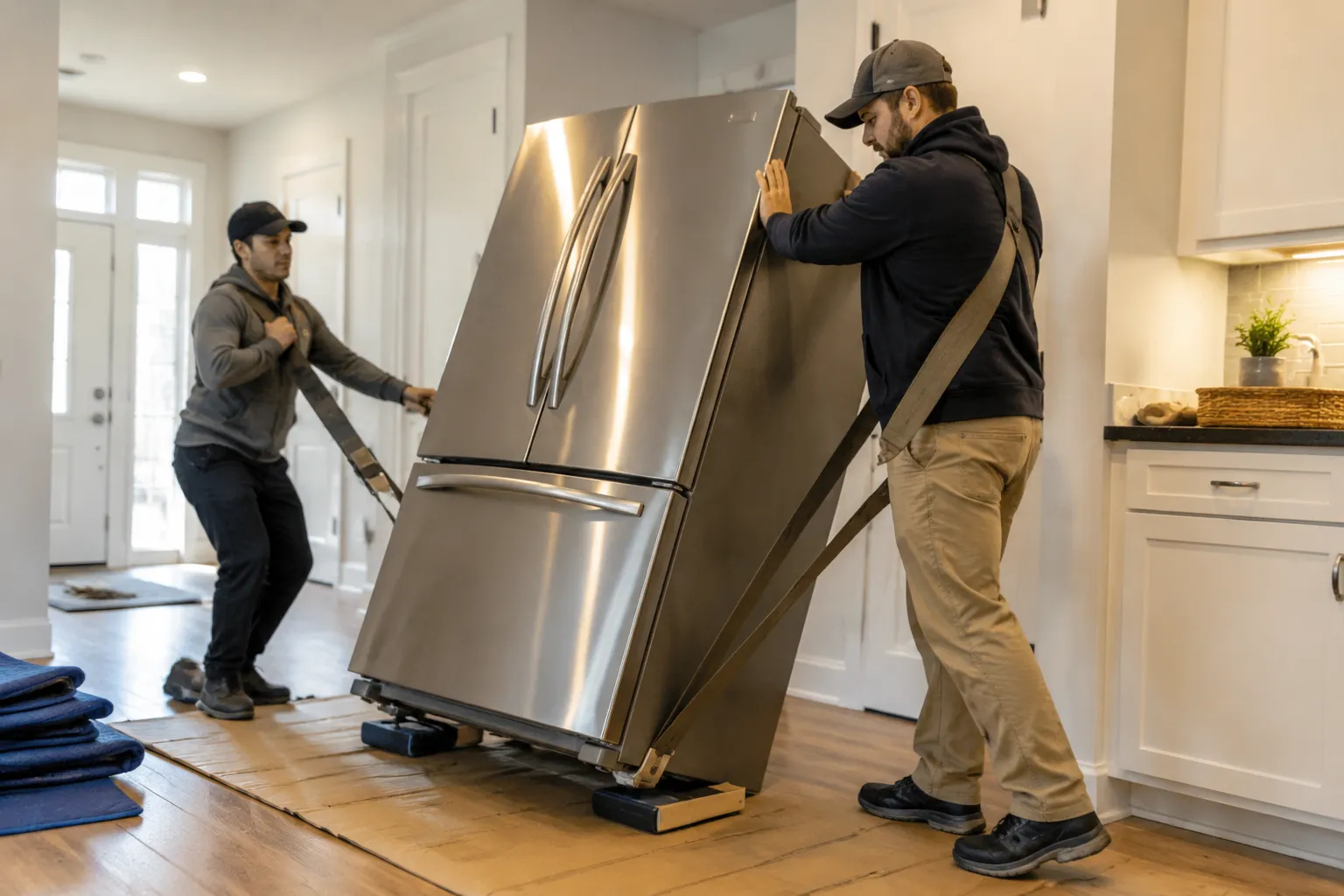
Floor damage during an appliance move is rarely the dramatic crash through the ceiling joist or the refrigerator tipping off a dolly on the stairs. It is the scuff, the gouge, the long hairline scratch across hardwood that shows up when the light hits it at a certain angle. It is the dented threshold plate and the quarter-inch depression in the vinyl plank where a corner dug in for a split second. The damage is quiet, it happens fast, and it is almost always preventable with the right combination of materials and the willingness to slow down.
The irony is that most people own the correct tools and simply do not use them. The furniture slider that has lived under the couch for three years works fine on a refrigerator. The moving blanket that gets thrown over the top of the washer to prevent scratches does nothing for the floor. People wrap the machine and ignore the ground, which is exactly backwards.
The Floor Is the Fragile Part, Not the Appliance
An appliance is built to take abuse. A refrigerator has a steel shell that shrugs off a bump. A washing machine has a cabinet that can handle contact with a doorway frame. The floor, by contrast, is a finished surface with no tolerance for concentrated pressure. A 350-pound refrigerator resting on a single hard plastic wheel exerts force measured in hundreds of pounds per square inch. Hardwood will crush under that load. Tile will chip. Luxury vinyl will dent and never recover.
This is the core problem: the weight of the appliance is fine, but the weight concentrated on a tiny contact point is not. The solution is not to lift the appliance higher, because that introduces its own risks. The solution is to spread the load and change the friction characteristics of the path.
A sheet of 1/4-inch plywood laid down as a ramp and runway does both. It distributes the weight across a wide surface, and it gives the appliance a smooth plane to travel over. A person can slide a 400-pound refrigerator across plywood with one hand if the moving pads underneath are good. The same refrigerator on bare hardwood requires two people straining, and it still leaves marks.
Why a Dolly Makes Floor Damage Worse
The appliance dolly is the most common tool for this job and the most common cause of floor damage. The dolly's wheels are small, hard, and narrow. They concentrate the entire weight of the load into two thin strips of contact. On carpet, this is tolerable. On hardwood, tile, or vinyl, it is a disaster waiting to happen.
Beyond the wheels, the dolly requires the appliance to be tilted backward to balance it. That tilt shifts the center of gravity and makes the load harder to control. A tilted refrigerator wants to keep tilting. A person holding it feels the strain in the lower back and tends to let the bottom edge drag. That dragging edge is precisely what carves a groove into the floor.
The dolly has its place. It is the right tool for moving an appliance down a flight of stairs or across a parking lot. On an interior floor, it is usually the wrong choice. The better approach is to not lift the appliance at all, but to slide it along the floor on a low-friction interface.
Furniture Sliders Are the Workhorse, If Chosen Correctly
Felt sliders are for moving a sofa across a carpeted living room. They are not for a 300-pound refrigerator, and the packaging that claims otherwise is lying. The felt compresses, the adhesive gives way, and the slider ends up stuck under the appliance while the metal foot gouges the floor.
Hard plastic sliders with a smooth, domed bottom are the ones that work. The type with a foam or rubber top that grips the appliance foot, and a slick plastic bottom that glides across the floor, are the right design. They are sold in multi-packs at hardware stores for a few dollars, and they are worth every penny.
Placement matters more than the slider itself. The sliders need to go under the leveling feet or the base of the appliance, not under a random spot on the cabinet. If the appliance has exposed feet, the slider cups around them. If it has a solid base, the slider goes under the front edge and the back edge. The appliance needs at least four contact points, ideally six for a long refrigerator.
A person should test the setup before moving anything. With the appliance in place, give it a gentle push. If it moves with a smooth glide, the sliders are seated correctly. If it resists or tilts, one of the sliders has popped off or is not bearing weight. Fix this before starting the actual move, because stopping mid-move to adjust a slider is when accidents happen.
The Plywood Runway Method for Long Distances
For moving an appliance more than a few feet, sliders alone are not enough. The sliders work, but they can pick up grit, and they require constant attention to keep them under the feet. The better system is a runway of plywood sheets laid end to end across the path.
A single sheet of 3/4-inch plywood cut into 2-foot-wide strips is ideal. The strips lay flat on the floor, and the seams between them are taped down with duct tape to prevent tripping and to keep the appliance from catching on the gap. The appliance slides across the plywood on sliders, and the plywood takes the abuse instead of the floor.
This method shines for moving a refrigerator from the kitchen through a hallway to a garage, or for getting a washer from a back door to a laundry room. The person moving the appliance walks beside it, guiding it, rather than straining to hold its weight. The appliance glides. It feels almost too easy, which is the sign that it is working correctly.
The plywood also solves the threshold problem. A threshold between rooms is a raised lip that catches sliders and stops the appliance dead. Laying a plywood strip over the threshold, angled like a small ramp, lets the appliance ride up and over without the edge digging in. This is the single most important detail for moving an appliance across a doorway, and it is the one most often skipped.
Moving Blankets Are for the Machine, Not the Floor
A standard moving blanket is a thick, quilted pad that protects the appliance's finish. It does nothing for the floor. Laying a blanket on the floor and dragging the appliance across it is a common mistake, and it fails for a simple reason: the blanket bunches up under the weight, creates a rolling ridge, and the appliance digs into the floor where the blanket folds.
If a blanket is used on the floor at all, it should be a thin, smooth drop cloth, not a thick padded one. A canvas drop cloth laid flat and taped at the edges provides a slight cushion and catches minor scuffs. It does not solve the weight concentration problem. It only handles the cosmetic scrapes.
The blanket belongs on the appliance. Wrap the sides to prevent scratches against door frames, and pad the corners. A refrigerator corner catching a drywall archway leaves a mark on the wall, not the floor, but it also causes the person guiding the appliance to jerk it sideways, which can drag a foot across the floor. Padding the corners reduces the chance of that jerk.
The Tilt-and-Shim Method for Tight Spaces
Some moves require the appliance to clear an obstacle, like a lip at the bottom of a cabinet or a tight turn in a hallway. The plywood runway handles the straight path, but a corner requires a different approach.
The correct method is to tilt the appliance onto its back edge, slide a shim or a second slider under the front feet, then lower it and repeat on the other side. This is a controlled walk, not a lift. Each tilt shifts the weight to the back edge, and the front feet come off the floor just enough to reposition the sliders underneath.
The key is to never tilt the appliance more than about 30 degrees. Beyond that angle, the center of gravity moves past the pivot point and the appliance becomes unstable. A refrigerator tilted too far can slide off its own back edge and crash down. The tilt-and-shim method is slow, deliberate, and boring. That is its virtue.
A person doing this alone should use a strap around the appliance to control the tilt, anchored to a sturdy point at the top. This prevents the sudden lurch that happens when a person's arms tire. Two people are better, with one holding the tilt and the other placing the shims.
The Stair Problem: When the Dolly Becomes Necessary
Stairs change the equation. A plywood runway cannot bridge a staircase safely, and sliders will not hold on an angled step. The dolly is the right tool here, but the floor damage risk shifts from the floor itself to the lip of each step.
The bottom edge of the dolly's frame scrapes against the stair nose as it descends. Each step is a potential gouge. The fix is to place a piece of cardboard or a thin rubber mat over each stair nose before the dolly crosses it. This is tedious, and it means stopping at every step, but it is the difference between a clean move and a staircase that needs refinishing.
Going down stairs, the person at the bottom bears most of the weight. That person should control the descent completely, with the person at the top only guiding and braking. If the bottom person loses control, the appliance and dolly slide forward and the corner digs into the stair tread. The rubber matting prevents the worst of it, but the real protection is the slow, controlled pace.
Protecting the Threshold and the Doorway Track
Sliding glass doors and exterior doors have tracks and thresholds made of aluminum or vinyl. These are softer than the appliance's steel feet. A single pass with a heavy appliance can bend an aluminum threshold irreparably.
The threshold protection is simple: a piece of 1/4-inch hardboard or a thin plastic sheet laid across the track before the appliance crosses. The hardboard bridges the gap and spreads the weight. It also prevents the appliance's sliders from catching in the track groove, which would stop the move cold.
Doorway tracks are often overlooked because they are not technically part of the floor. But a bent sliding door track means the door no longer slides, which is a much larger repair than a floor scratch. Treat the track as part of the floor's protection zone.
The Clean Path Rule: Sweep Before You Slide
A single pebble or a stray screw on the floor becomes a concentrated pressure point under a heavy appliance. The slider or the plywood does not eliminate this; it just transfers the force. A small piece of grit trapped between the slider and the floor acts like a carbide-tipped cutter.
Sweeping the path twice before starting the move is not paranoia. It is the cheapest insurance available. The move itself takes twenty minutes. The sweep takes two. Overlooking it can turn a simple move into a floor refinishing project.
The same rule applies to the top of the plywood sheets. They sit on the floor and pick up dust and debris from shoes. Wiping them down with a dry cloth before laying them flat removes the grit that would otherwise grind between the slider and the plywood surface.
When the Appliance Has Rollers vs. When It Does Not
Refrigerators often come with factory-installed rollers on the base, and washing machines have adjustable feet that can be mistaken for rollers. The factory rollers are small, hard, and designed for minor positioning, not for rolling across a room. They leave marks on any floor that is not perfectly smooth, and they pick up debris as they roll.
The common error is to assume that because the appliance has rollers, it can be rolled across the floor directly. It cannot. The rollers are meant for a few inches of adjustment during installation. For a real move, the sliders and plywood method still applies. The rollers can stay in place, but they should not be the contact point with the floor.
Washing machines and dryers typically have threaded feet with rubber pads. These feet are sharp-edged at the bottom and will gouge any floor they drag across. Sliders that cup around the feet are the only safe way to move them. The rubber pad on the foot actually helps grip the slider's top surface, which keeps the slider in place during the move.
The Real Cost of Rushing
The entire process, done correctly, takes about twice as long as the rushed version. Setting up the plywood runway, taping the seams, sweeping the path, placing the sliders, and checking each threshold adds maybe fifteen minutes to a move that would otherwise take ten. That fifteen minutes is the difference between a clean floor and a scratch that costs several hundred dollars to repair.
Hardwood scratches can sometimes be buffed out with a touch-up marker, but deep gouges require sanding and refinishing the affected boards. Tile chips mean replacing the tile, which never matches exactly. Vinyl plank denting is permanent unless the plank is replaced. None of these repairs are cheap, and none of them are covered by an appliance warranty.
The quiet satisfaction of a completed move is the appliance sitting in its new spot with no marks on the floor. That is the goal. The method is simple: plywood, sliders, a clean path, and the patience to use them. The alternative is the scratch that shows up in the afternoon light, the one that a person looks at every day and remembers exactly how it got there.