
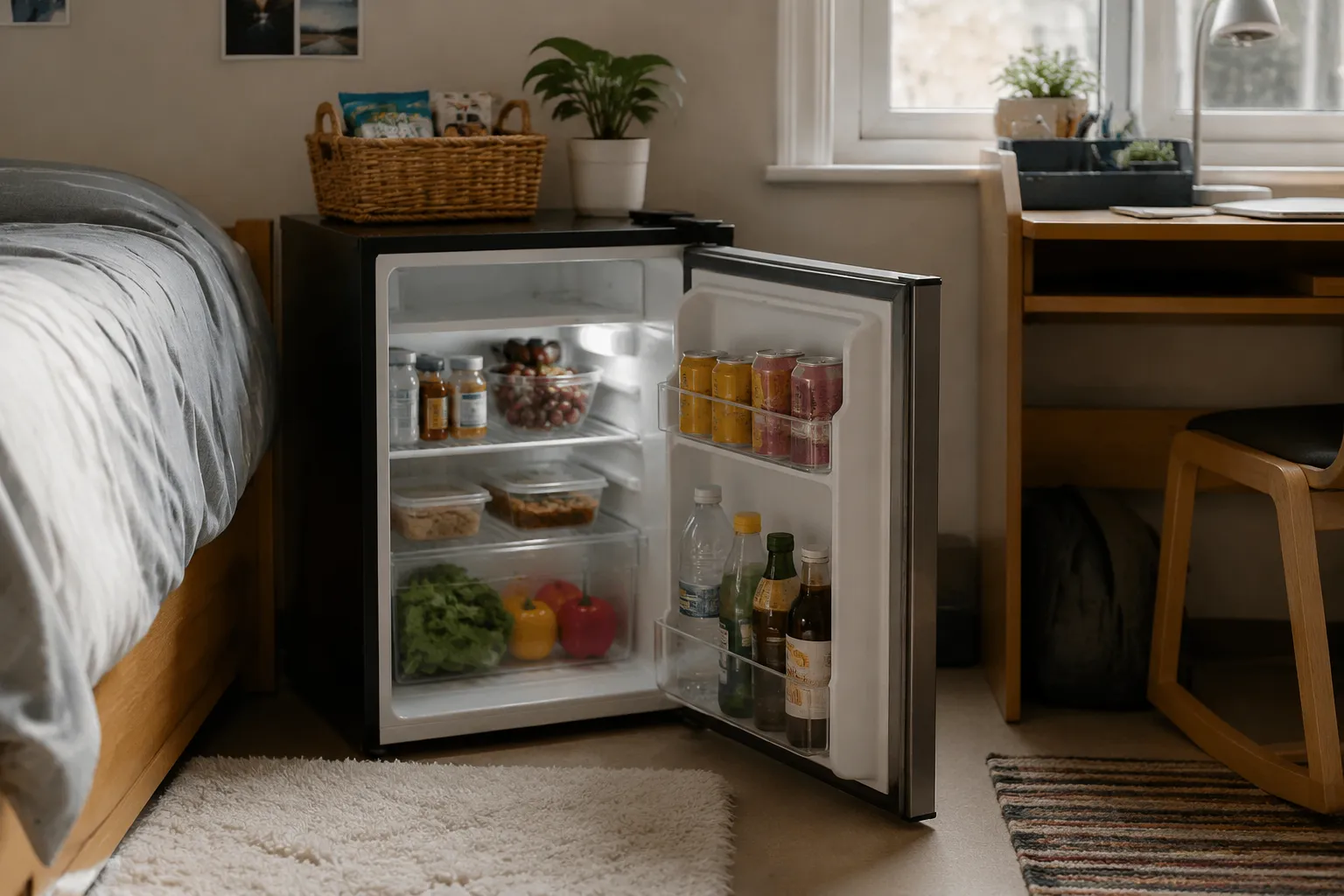
The standard advice for dorm room mini fridges is almost entirely about what to buy: get a 4.4 cubic foot model, make sure it has a freezer compartment, measure the doorway. All of that matters, but it skips the harder question, which is how to live with the machine once it is humming in the corner of a room that is roughly the size of a walk-in closet. A mini fridge is not a tiny version of a full-size refrigerator. It is a different beast with its own quirks, and the setup determines whether it becomes a reliable piece of infrastructure or a source of quiet, constant irritation.
The first mistake most people make happens before the fridge is even plugged in. They shove it against the wall, flush and proud, and then wonder why the compressor runs constantly and the motor sounds like a bag of marbles. Mini fridges need airflow around the condenser coils, which on most models are located in the back or along the sides. Without a few inches of clearance, the heat has nowhere to go, and the fridge works harder to maintain its temperature. That extra work translates into noise, higher electricity use, and a compressor that burns out long before the school year ends.
The fix is simple: pull the fridge out from the wall by at least two inches on the back and sides. If the room is small enough that every inch counts, and it always is, consider that the fridge needs to sit away from the wall anyway, so plan the layout around that gap from the start. A person who measures the space before buying, rather than after, will have a much easier time.
The Leveling Screws Are Not Optional
Most mini fridges have two adjustable feet on the front, and almost nobody touches them. The fridge gets wheeled into place, the door gets loaded with drinks, and the whole unit lists forward by a quarter of an inch. That tilt matters more than it seems. The door will close on its own, which sounds fine, but it also means the magnetic seal is not seating evenly, so cold air leaks out along the top edge. The compressor runs more to compensate, and the fridge develops frost in places frost should not be.
Spend the first five minutes with a level, or even a phone with a level app, and adjust the front feet until the unit sits true. A fridge that is level runs quieter, keeps a steadier temperature, and does not drip condensation onto the floor. This is the kind of maintenance that takes almost no time but pays off every single day for months. It is also the kind of thing that almost no one does, which means a person who does it is already ahead of the curve.
There is a related detail about the door swing. A mini fridge in a dorm room often has to sit in a corner, and the door opens against the wall, limiting how far it can swing. That seems like an inconvenience, not a dealbreaker, until the person needs to pull out a gallon of milk and cannot because the door only opens forty degrees. Check the hinge side before committing to a spot. If the room allows, position the fridge so the door opens away from the wall, giving full access to the interior. This single choice does more for daily usability than any feature listed on the box.
The Freezer Compartment Is a Trap
The little freezer shelf inside a mini fridge is where good intentions go to die. It looks like a bonus, a place to keep ice cream or frozen pizza, but it is actually the most inefficient space in the entire unit. The freezer compartment is not separately insulated on most cheap models. It is just the top section of the fridge where the evaporator coil lives, and the cold air from that coil drops down into the main compartment. Anything stored in that freezer shelf is subject to temperature swings, and the fridge has to work much harder to keep the freezer cold enough to actually freeze anything.
The smarter approach is to treat the freezer shelf as a cold spot, not a freezer. Store things that benefit from very cold temperatures but do not need to be rock solid: a can of whipped cream, a bottle of vodka, an ice pack for a sore shoulder. Skip the ice cream. It will come out soft and refreeze with ice crystals, and the fridge will run constantly trying to keep it solid. The energy that goes into the freezer shelf comes at the expense of the main compartment, which will struggle to stay cold enough for milk and leftovers if the freezer is loaded down.
If a person genuinely needs frozen food, a mini fridge is the wrong tool. There is no shame in admitting that and buying a fridge with a real, separate freezer compartment, even if it costs more and takes up more space. The alternative is a lifetime of half-frozen pizzas and a compressor that sounds like it is dying.
Positioning for Airflow Rather Than Convenience
There is a natural instinct to put the fridge right next to the desk, so a person can grab a soda without standing up. That convenience comes at a cost. A mini fridge generates heat from the back and sides, and in a small room, that heat has nowhere to go but into the living space. The fridge is essentially a small space heater that also happens to cool things down. Putting it in a spot with poor airflow, like tucked under a lofted bed or wedged between a dresser and a closet, means the heat accumulates and the room gets stuffier.
The better placement is near a window or a vent, where the heat can dissipate. If that is not possible, at least keep the fridge away from curtains and bedding, which can block airflow and pose a fire risk if the coils get too hot. The clearance requirements are not just about efficiency; they are about safety. A fridge that cannot breathe builds up heat, and heat against fabric is a recipe for trouble.
Another factor is the floor surface. Carpet is common in dorms, and it is the enemy of a mini fridge. The carpet blocks the airflow underneath the unit, and it also traps dust and lint, which get pulled into the compressor and clog the coils over time. A hard plastic mat or a piece of plywood under the fridge solves both problems. It provides a solid, level surface and keeps the carpet fibers away from the machinery. It also makes the fridge easier to slide out when it is time to clean behind it, which should happen at least once a semester.
Setting the Temperature Before Loading
Most mini fridges have a dial inside, usually numbered from one to seven, with no indication of what those numbers actually mean. People tend to set it somewhere in the middle and hope for the best. That is a mistake. The dial should be adjusted based on what is inside, and it should be set before the fridge is fully loaded, so the fridge has time to stabilize.
A fridge that is mostly empty does not need to be set very high. A dial setting of three or four is usually enough to keep drinks cold and leftovers safe. A fridge that is packed full, with dense items like milk jugs and large containers, needs a higher setting because the mass of the food absorbs cold and the fridge has to work harder to bring everything down to temperature. The key is to check the actual temperature with a thermometer, not trust the dial. A cheap fridge thermometer costs a few dollars and removes all guesswork. The ideal range is between 34 and 40 degrees Fahrenheit, and anything warmer than that is a food safety risk.
There is also the matter of the initial cooldown. Plugging in a fridge and immediately filling it with warm groceries is a common mistake. The fridge has to work much harder to cool down a full load, and the compressor runs continuously for hours. Let the fridge run empty for a few hours first, ideally overnight, and then add food. This is not just about efficiency; it is about keeping the food safe. A fridge that is struggling to cool down a full load can leave perishables in the danger zone for too long.
The Organizing System That Actually Works
Mini fridges are small enough that organization is not a luxury; it is a survival skill. Without a system, the interior becomes a chaotic pile of half-empty containers, mystery leftovers, and drinks that roll to the back and get forgotten until they expire. The solution is not fancy storage bins, though those help. The solution is a deliberate arrangement based on how the fridge is actually used.
Drinks go on the door, where they are easy to reach and do not take up shelf space. The main shelf is for food, and it should be arranged with the tallest items in the back and the shorter items in the front, so everything is visible. Leftovers go in clear containers, not opaque ones, because a person cannot see through Tupperware and will inevitably forget about the pasta buried behind the yogurt. A small bin or tray for condiments keeps them from rolling around and creates a designated zone for the tiny bottles that otherwise take over the entire shelf.
The crisper drawer, if the fridge has one, is for produce, but most mini fridge crispers are too small to hold a head of lettuce. Use it for things that benefit from humidity, like berries, herbs, and cut vegetables. If the fridge does not have a crisper, a simple plastic container with a lid works just as well. The point is to create distinct zones so that everything has a place and nothing gets lost.
There is also the matter of what should not go in the fridge at all. Hot sauce, soy sauce, and other condiments with high vinegar or salt content do not need refrigeration. Neither do whole fruits like apples and oranges, which can sit on a counter for days. Every item that stays out of the fridge frees up space for the things that actually need to be cold. This is a hard adjustment for people who grew up refrigerating everything, but it is the difference between a fridge that holds a week of groceries and one that holds two days.
The Defrosting Reality
Mini fridges frost up, and there is no avoiding it. The freezer shelf accumulates ice, the back wall develops a layer of frost, and eventually the whole interior shrinks. Many models do not have auto-defrost, so the buildup happens faster and more aggressively. A person who ignores it will find the usable space shrinking by the week.
The fix is unglamorous: unplug the fridge, empty it, and let the frost melt. Do not use a knife or screwdriver to chip it away. The evaporator coil is fragile, and puncturing it voids the warranty and fills the fridge with refrigerant, which is a hazard. A pan of hot water placed inside speeds up the process, and a towel on the floor catches the runoff. Plan for about an hour of downtime.
How often this needs to happen depends on the climate and how often the door is opened. In a humid room with frequent door swings, frost can build up in a matter of weeks. In a dry room with minimal use, it might take a couple of months. The tell is the freezer shelf: when the ice starts to encroach on the space meant for food, it is time to defrost. There is no way around this chore, and anyone who claims otherwise has never owned a cheap mini fridge.
Noise, the Hidden Cost of Placement
The hum of a mini fridge is a constant presence, and in a small room, it is impossible to ignore. Some models are louder than others, but even a quiet one makes a clicking sound when the compressor kicks on and off. The placement determines how much this matters. A fridge next to the bed is a recipe for disrupted sleep, not because the noise is deafening, but because it is intermittent. The compressor cycles on, runs for a while, and shuts off. That pattern is more distracting than a steady hum.
Putting the fridge on the opposite side of the room from the bed, or at least behind a barrier like a bookshelf, does a lot to muffle the sound. A fridge tucked into a closet will be quieter at night, though the closet door needs to stay open for airflow. There is also the option of putting a small rubber mat or vibration-dampening pad under the fridge to absorb the hum. This is the same principle as a washing machine pad, and it works surprisingly well for reducing the low-frequency vibration that travels through the floor.
None of these measures eliminate the noise entirely. A mini fridge makes sound, and that is part of the deal. But a person who chooses placement with sound in mind can reduce the annoyance from a constant irritant to a background detail. That is a meaningful difference over the course of a semester.
When to Skip the Fridge Entirely
The honest truth is that not everyone needs a mini fridge. A person who eats most meals in the dining hall, drinks water and coffee, and has no dietary restrictions can get by without one. The fridge takes up floor space, adds noise, and requires maintenance. It is not a default necessity; it is a tool for a specific set of needs.
People who need one tend to know who they are. Athletes who need to keep protein shakes cold. Students with dietary restrictions who pack their own food. Anyone who likes having cold drinks in the room, which is most people, but that alone might not justify the cost and the space. A cooler with ice, refreshed every couple of days, handles drinks for a fraction of the price and takes up no permanent floor space.
The decision comes down to what a person actually stores. A fridge that holds three yogurt cups, a half-empty bottle of ranch dressing, and a six-pack of soda is a waste of space. A fridge that holds a week of leftovers, fresh produce, and dairy is a worthwhile investment. The setup advice only matters for the second group. The first group should skip the fridge and save the money for something else.
For those who do commit, the payoff is real. A properly set up mini fridge means cold drinks without leaving the room, leftovers that do not go to waste, and the small luxury of having food on hand when the dining hall is closed. The setup takes an hour and a few inexpensive tools, and it turns a frustrating appliance into a dependable one. The fridge will still frost up, the compressor will still hum, and the door will still be a little flimsy. But it will work, day after day, and that is the best anyone can ask for from a box of cold air in the corner of a small room.