
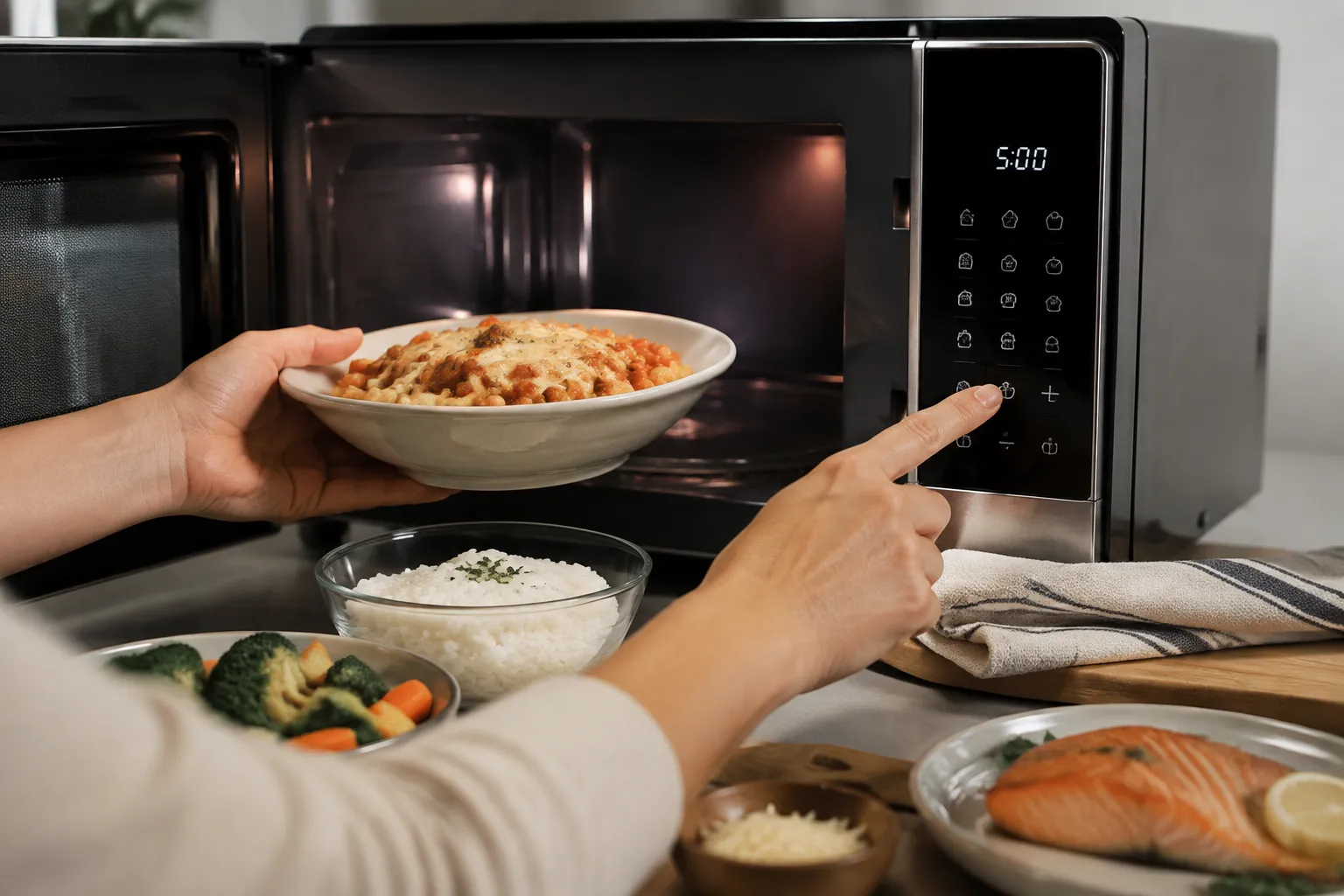
The number printed on the front of a microwave oven is one of the least useful pieces of information in a modern kitchen. A 1,200-watt unit from one brand does not heat the same way as a 1,200-watt unit from another, and the difference has almost nothing to do with the wattage rating itself. The rating is a measure of how much electrical power the magnetron draws, not how much microwave energy actually reaches the food. Some of that power is lost to the transformer, some to the waveguide, some to the stirrer fan that bounces the waves around the cavity. The efficiency of that chain is what separates a machine that boils water in two minutes from one that takes three.
Most people never think about this until the moment they follow a recipe written for a different machine. The recipe says to cook a potato for six minutes. The potato comes out raw in the center. The recipe is not wrong. The potato is not abnormal. The two machines are simply not doing the same work, and nobody explained the math that connects them.
The 10 Percent Rule That Actually Works
The standard advice for adjusting cooking time between different wattages is a simple proportionality. If a recipe calls for five minutes at 1,000 watts and the available oven is 700 watts, the time gets multiplied by the ratio of the two powers. Five minutes times 1,000 divided by 700 comes out to about seven minutes and ten seconds. That is the whole formula. Multiply the original time by the original wattage, then divide by the new wattage.
The formula has one critical flaw that nobody mentions in the explainer videos. It assumes the microwave oven is the only source of heat and that the food absorbs energy at a constant rate. Both assumptions fail in practice. Water absorbs microwaves very efficiently until it reaches a boil, then it stops absorbing and starts evaporating. A bowl of soup follows the linear model closely. A piece of bread does not, because dry food absorbs very little microwave energy and the time adjustment gets absorbed by the plate underneath instead.
For most everyday reheating, the ratio method lands in the right neighborhood. The error is usually less than a minute either way, and a person can nudge the rest. The method breaks down for precise tasks like melting chocolate or tempering butter, where 30 seconds of over-cooking ruins the batch. Those tasks need a different approach entirely, one that has nothing to do with arithmetic.
Why 700 Watts Feels Like a Different Universe
A 700-watt microwave is the most common size in dorm rooms and small apartments, and it is the one that produces the most complaints. The complaints are justified. At 700 watts, the cooking time for a typical frozen dinner stretches from the six minutes printed on the box to nine or ten, and the food still comes out with ice in the center and lava on the edges. The box instructions are written for 1,100-watt machines because that is what most test kitchens use. The small machine cannot keep up.
The physics explains why the gap feels so much larger than the numbers suggest. A 700-watt oven delivers about 64 percent of the power of a 1,100-watt oven. The time ratio says to add roughly 57 percent more cooking time. But the distribution of that energy is also worse. Lower-power ovens tend to have smaller cavities and less efficient stirrer fans, so the standing wave pattern inside the chamber leaves more cold spots. The food cooks unevenly, and the extra time needed to bring the cold spots up to temperature over-cooks the hot spots.
The fix is not to crank the time and walk away. The fix is to reduce the power setting on the low-wattage machine and cook longer at a gentler level. This sounds counterintuitive. A 700-watt oven already feels slow, so dropping the power to 50 percent seems like a punishment. But the reduced power allows heat to conduct from the hot zones into the cold zones during the pauses. The result is more even cooking in roughly the same total time, because the food spends less time sitting in a burnt spot waiting for the cold side to catch up.
The Power Level Button Is Not Useless
The power level button on a microwave is the most ignored control in the kitchen. Most people set it once when they buy the machine and never touch it again. That is a mistake, because the power level is the only tool available to control how the energy is delivered over time.
A microwave oven at 50 percent power does not produce half as much energy continuously. It cycles on and off, full power for a few seconds, then off for a few seconds. The duty cycle is what changes. The magnetron runs at full power during the on phase, then shuts down completely during the off phase. At 50 percent power, the oven might run for 10 seconds and pause for 10 seconds, depending on the model. The food receives the same peak intensity, but the pauses allow heat to spread through the food by conduction.
This distinction matters for defrosting more than any other task. Defrosting at full power is the single worst thing a person can do to a piece of meat in a microwave. The outer layer absorbs the energy first and reaches cooking temperature while the interior stays frozen. The result is a gray, rubbery exterior and a cold, raw center. Dropping the power to 30 or 40 percent gives the outer layer time to conduct heat inward, so the meat thaws more evenly. It takes longer, but the alternative is inedible.
The same logic applies to reheating leftovers. A plate of lasagna reheated at full power for three minutes will be boiling on the rim and cold in the middle. At 50 percent power for five minutes, the heat has time to travel from the edges to the center. The difference is the difference between a meal and a disappointment.
The Sensor and Inverter Difference
Higher-end microwaves often advertise inverter technology or sensor cooking. These are not marketing gimmicks, though the marketing does obscure what they actually do. A conventional microwave uses a transformer that only operates at full power, hence the on-off cycling for lower power settings. An inverter oven uses a different power supply that can actually throttle the magnetron down to a fraction of full power. This means 50 percent power is a continuous half-power delivery, not a series of full-power bursts.
The practical difference shows up in delicate foods. Melting chocolate, softening butter, or heating a custard all respond better to continuous low power than to pulsed full power. The pulses create micro-hot spots that can seize chocolate or split a sauce. Inverter ovens also tend to heat more evenly at lower power levels because the energy is distributed over the entire cooking time rather than concentrated in bursts.
Sensor cooking is a separate feature that measures humidity in the cavity and automatically adjusts the cooking time. The sensor detects when the food is releasing steam at a certain rate and stops the oven before the food dries out. The system works reasonably well for rehydrating leftovers or cooking frozen vegetables, but it is not a substitute for understanding the wattage math. The sensor has no idea what the recipe intended; it only knows when the moisture curve looks finished.
A Simple Test to Find the Real Power
The number on the label is a starting point, but the actual performance can be measured at home with nothing but a measuring cup and a thermometer. Fill a glass measuring cup with exactly 250 milliliters of tap water. Measure the starting temperature, then microwave on full power for exactly two minutes. Stir the water, measure the final temperature, and calculate the temperature rise.
One watt is one joule per second, and heating one milliliter of water by one degree Celsius requires about 4.2 joules. A 1,000-watt oven delivering perfect efficiency would raise 250 milliliters of water by about 11.4 degrees Celsius in two minutes. Most ovens will raise it by 8 to 10 degrees, which translates to roughly 700 to 900 watts of actual heating power. The difference between the label and the measured value is the system loss.
That measured number should be the one used in the time-adjustment formula, not the label. A 1,100-watt oven that measures at 900 watts will consistently undercook food if the label is used for the calculation. The same oven will overcook food if the recipe was written for a machine with true 1,100-watt output. The test takes four minutes and removes the guesswork permanently.
Container Shape Changes Everything
Wattage gets all the attention, but the shape of the cooking vessel can make a larger difference than the difference between a 700-watt and a 1,100-watt oven. Microwave energy penetrates food to a depth of only about 2 to 3 centimeters, depending on the moisture content. Everything beyond that depth heats by conduction from the outer layer. A deep, narrow container forces the center to wait for heat to travel through a thick wall of food. A shallow, wide container exposes more surface area and reduces the distance the heat must travel.
A bowl of soup in a tall mug takes noticeably longer to heat than the same soup in a wide bowl, even in the same oven at the same wattage. The mug has a small surface area and a deep volume. The wide bowl spreads the soup into a thin layer that heats quickly. The difference can be as much as 50 percent of the cooking time, entirely from the container choice.
Round containers also heat more evenly than square ones. The corners of a square dish catch more energy and tend to overcook, while the center lags behind. This is why microwave-safe plastic containers are almost always round. The manufacturers know the corners are a liability. A person cooking in a square dish should expect the edges to finish first and should stir or rotate the food accordingly.
The Resting Time Is Part of the Cooking Time
Microwave recipes almost always instruct the cook to let the food stand for two or three minutes after the beep. Most people ignore this step because it seems like a waste of time. The standing period is not optional. It is the phase where the heat continues to conduct from the outer layers into the center of the food, and it can account for 20 percent or more of the total cooking effect.
A baked potato pulled from the microwave at the moment the timer ends will have a hot skin and a firm interior. After five minutes of rest, the interior reaches steaming temperature as the heat from the skin migrates inward. The same phenomenon occurs with casseroles, dense vegetables, and any food with significant thickness. The resting time is how the center catches up without being directly cooked by microwaves.
The wattage adjustment formula should account for this. If the original recipe includes a three-minute rest, that rest is part of the total cooking process. Scaling the time up by the wattage ratio should apply to the full cycle, including the rest, not just the active heating phase. A person cooking in a lower-wattage oven should extend the resting time proportionally, not just the run time.
When the Math Stops Helping
The ratio formula has a point of diminishing returns. For a recipe that takes 20 minutes at 1,000 watts, scaling down to a 700-watt oven produces a theoretical time of about 28.5 minutes. That is a long time to babysit a microwave, and the extended exposure to pulsed energy will degrade the texture of most foods. The crust on a microwaved pizza that sits in the machine for 28 minutes will be leather. The vegetables will be mushy.
At that scale, the better strategy is to change the cooking method rather than extend the time. Use the microwave for the parts it does well, like heating a sauce or defrosting a protein, and finish the rest in a conventional oven, a toaster oven, or a stovetop pan. The microwave is a tool for quick tasks. Stretching it into a slow cooker just produces a worse version of slow-cooked food.
The other place the math fails is with frozen foods. The wattage ratio assumes the food starts at the same temperature. A frozen meal pulled from a freezer at minus 18 degrees Celsius has a completely different absorption profile than a refrigerated one at 4 degrees. The frozen food absorbs energy faster initially because ice has a different dielectric constant than liquid water, then the absorption changes abruptly when the ice melts. No linear formula can model that transition. The only reliable approach is to defrost first, then cook.
The Only Number That Matters After the Test
Once the actual wattage is measured and the container shape is understood, the last variable is the food itself. Dense foods with high moisture content, like meat and potatoes, need longer times at lower power. Light, airy foods, like bread and pastries, need very short times at full power, just long enough to warm the surface without turning the interior to rubber. The same 700-watt oven that needs eight minutes for a potato will ruin a croissant in 30 seconds.
The practical habit is to check food at 70 percent of the calculated time, then add increments of 15 to 30 seconds. This is not a failure of the math; it is the acknowledgment that the math models power, not food density, starting temperature, or container geometry. The arithmetic gets a person close enough that the final adjustment is a matter of seconds rather than minutes. That is the goal. Not perfect precision, but close enough that a person can finish the job without ruining it.
A microwave oven is a machine that converts electricity into a specific kind of heat. The wattage rating is a promise about input, not output. Measuring the real output, adjusting for container shape, respecting the rest period, and using lower power for dense foods gets more value out of the machine than buying a more expensive one ever will.