
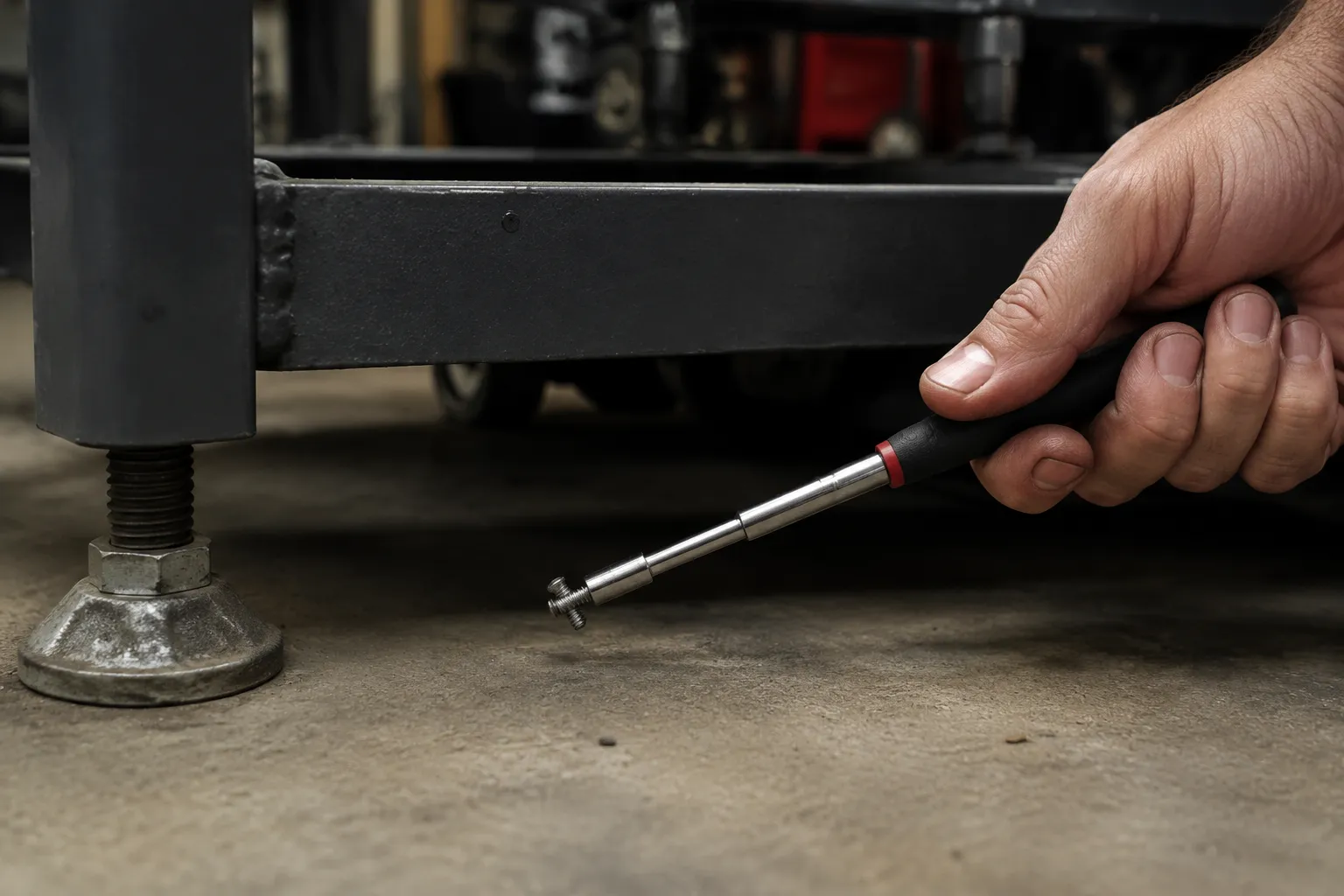
There is a specific sound a fastener makes when it drops into the wrong part of an engine bay. It is not the sharp clink of steel on concrete, which at least offers a clear location. It is the dull, muffled tick of a bolt bouncing off a plastic undertray, followed by nothing. That nothing is the expensive part. A 10 mm socket that vanishes into the gap between the intake manifold and the firewall is not a lost object. It is a promise of a future trip to the parts store, or worse, a decision to leave it there and hope it does not find a belt or a pulley.
Magnetic pickup tools are the standard answer to this problem, and the market treats them as a commodity. Hardware stores stack them in a bin near the checkout, next to the pocket knives and the rubber gloves. They cost anywhere from four dollars to forty. Most of them are bought on impulse, used once, and then thrown into a drawer where the magnet slowly collects a beard of metal filings. The assumption is that a magnet on a stick is a solved problem. That assumption is only half right.
The actual problem is not magnetism. It is reach, flexibility, and the geometry of the space around the dropped part. A rigid rod with a magnet on the end works fine when the fastener falls into an open area with a straight line of sight. The moment the drop happens behind a bracket, under a wiring harness, or inside a frame rail, the rigid rod becomes useless. The tool needs to bend, or it needs to be long enough to go around the obstacle, or it needs a head that can pivot. Most cheap pickup tools ignore this and simply offer a longer stick.
The first thing to understand is that there are three distinct families of magnetic pickup tools, and they do not overlap much. The first is the telescoping rod with a fixed magnet. The second is the flexible shaft, often with a gooseneck or a series of articulated segments. The third is the magnetic pickup wand with a swivel head, sometimes called a claw or a fingertip magnet. Each one solves a different failure mode, and buying one of each is not redundancy. It is coverage.
The telescoping rod with a fixed magnet is the most common and the least useful beyond a very narrow range. Its strength is simple reach. A good one extends to thirty inches or more, which lets a person stand upright and fish a screwdriver or a socket out of a shallow recess without kneeling. The magnet on the end is usually a neodymium disc, sometimes with a rubber or plastic cup around it to concentrate the field. The problem is the same as the problem with any rigid tool: the tip goes where the shaft points, and the shaft cannot turn a corner.
A better version of the rigid rod has a cone-shaped tip or a cup that can cradle a fastener from the side. This matters more than most people realize. A flat magnet picks up a bolt only if the bolt lands on its end. If the bolt lands on its side, the flat magnet grabs the head, but the shank sticks out at an awkward angle and often gets caught on adjacent components while being withdrawn. A cup or a cone allows the tool to approach from the side and trap the fastener against the magnet, holding it in line with the shaft. That small difference turns a frustrating ten-minute retrieval into a five-second grab.
The flexible shaft is where the real utility lives. These tools come in two basic constructions. The first is a bendable gooseneck, usually made of wound wire or a series of interlocking ball-and-socket joints, that holds whatever shape the user bends it into. The second is a flexible cable with a magnet at the end, sometimes with a push-button mechanism that extends or retracts a set of claws around the magnet. The gooseneck style is better for reaching into a fixed cavity where the path is known but not straight. The user bends the shaft to match the route, slides it in, and the magnet does the work.
The articulated claw tools, the ones with the four spring-loaded fingers that close around a dropped part, are a different beast. They are not purely magnetic. They combine a magnet in the center with mechanical fingers that can grip a non-ferrous object or a fastener that is wedged at an angle. These tools shine in the worst-case scenario: a bolt that has rolled under a bracket and come to rest against a wiring clip, where a bare magnet cannot get enough surface contact to pull it free. The claws close around the bolt, the magnet holds it centered, and the whole assembly comes out as one unit.
The swivel-head wands are the least common and often the most pleasant to use. They have a small magnet mounted on a ball joint at the tip, which lets the magnet tilt to match the angle of the surface it is approaching. This matters when fishing a screw out of a threaded hole or when trying to retrieve a washer that is sitting flat on a surface with no lip to grab. The swivel lets the magnet make full contact with the part, maximizing the holding force. A rigid magnet at an angle only touches with a fraction of its face, which cuts its pull strength dramatically.
The strength rating of the magnet itself is a source of endless confusion, and most of the numbers printed on packaging are marketing fiction. A rating of "50 pounds" on a pickup tool does not mean it can lift a fifty-pound weight. It means the magnet can hold a fifty-pound load against a perfectly flat, perfectly clean, perfectly thick steel plate in ideal conditions. In the real world, the same magnet struggles to hold a greasy bolt with a rounded head. The effective pull on a small fastener is a fraction of the rated number, often ten to twenty percent. A person should buy for the geometry of the tip, not the number on the package.
There is also the question of the magnet's shape. Disc magnets are common because they are cheap to produce, but they have a shallow field that reaches only a short distance. If a bolt is lying in a deep crevice and the tool cannot get within a quarter inch of it, a disc magnet will not pull it. A longer, cylindrical magnet, sometimes called a pencil magnet, has a field that extends further along its axis. This allows the tool to hover above a dropped part and pull it upward without touching, which is essential when the part is lying in a slot too narrow for the tool to enter.
Another overlooked detail is the magnet's coating. A bare neodymium magnet is brittle and prone to chipping. The plating, usually nickel or a nickel-copper mix, protects the magnet but also adds a thin buffer that slightly reduces the magnetic field at the surface. A rubber or plastic overmold does the same thing, and it reduces the field even more. The tradeoff is worth it, because a chipped magnet sheds particles that can get into bearings and sensors. A coated magnet is safer for the tool and safer for the engine.
The handle design matters more than it should. A telescoping tool with a cheap plastic handle that rotates freely in the hand is a frustration every single use. The magnet grabs the part, the user starts to pull, and the handle twists, dropping the part back into the abyss. A handle with a comfortable grip, preferably with a rubberized texture or an ergonomic curve, gives the user control over the rotation. Some tools add a knurled collar near the tip that can be rotated independently, which is a thoughtful touch for fine positioning.
Retrieval is only half the job. The other half is the reinstallation, and this is where pickup tools often fail in a different way. A magnet that is strong enough to lift a bolt out of a crevice is often too strong to let go of that bolt when the user wants to thread it into place. The solution is a tool with a release mechanism, either a sliding collar that pushes the part off the magnet or a twisting action that breaks the magnetic contact. Without one, the user is left to shake the tool until the bolt falls off, which defeats the precision of the task.
For this reason, the best general-purpose pickup tool is not the one with the strongest magnet. It is the one with the most controllable magnet. A tool with a moderate magnet and a release slide is more useful than a brute-force tool that grips like a vise. The person who needs to retrieve a spark plug tube bolt and then thread it back into a coil pack will use the release mechanism dozens of times in a single job. A tool without one is a one-way ticket, useful only for removal, not installation.
The flexible claw tools deserve a special mention for the specific case of non-ferrous fasteners. Aluminum bolts, brass fittings, and stainless steel hardware are not magnetic. A pure magnetic tool is useless for them. The claw mechanism, which can grip mechanically, is the only pickup tool that handles these cases. It is not a perfect solution. The claws are often too bulky to fit into very tight spaces, and they can scratch soft metals if applied with force. But for a dropped aluminum crush washer or a brass drain plug, there is no better option.
What separates a good pickup tool from a bad one is often the quality of the articulation joint. A gooseneck that is too stiff will not bend to the required shape without springing back. A gooseneck that is too loose will collapse under the weight of the tool itself, let alone the part being lifted. The sweet spot is a shaft that holds its shape when bent but still yields to firm hand pressure. This is difficult to achieve at a low price point, which is why the cheap tools are frustrating and the mid-range tools are genuinely useful.
There is a category of pickup tool that rarely gets attention: the flexible magnetic sweep. It looks like a wide, flat strip with a handle, and it is meant to be dragged across a floor or a workbench to collect a scatter of small parts. This is a different job than the retrieval wand. It is for the moment after a tray of screws tips over, or when a bearing falls and bounces across a garage floor. The sweep picks up everything in its path, saving the user from bending over a dozen times. It is not glamorous, but it is the tool that gets the job done fastest.
The right way to choose a pickup tool is to match it to the most frequent failure mode. A person who works on modern cars, with their plastic engine covers and tucked-away components, will get more use from a flexible gooseneck with a small, strong magnet. A person who works on motorcycles, where dropped parts fall into the frame or between the cylinders, needs a swivel-head tool that can angle around obstacles. A person who does general household repair, retrieving screws from behind drywall or out of a vacuum cleaner, is served well by a simple telescoping rod with a release mechanism.
The material of the shaft matters for one specific reason: conductivity. A metal shaft that touches a live terminal, a battery post, or an exposed wire can create a short circuit. This is a real risk when fishing around in an engine bay, where the battery is often in the path between the drop point and the user. A non-conductive shaft, usually made of fiberglass or a reinforced plastic, eliminates that risk entirely. It costs a few dollars more, and it is worth every cent. The alternative is a spark, a dead short, and a damaged tool or component.
There is also the matter of the magnet itself detaching from the shaft. This happens more often than it should, especially with cheap tools where the magnet is glued into a plastic cup. The first time a person pulls a tool out of a tight spot and sees the magnet still stuck to the bolt, with the shaft in their hand, they understand the value of a tool with a mechanical retention system. A magnet that is pressed into a metal ferrule or secured with a set screw is far less likely to separate. The failure mode is rare, but it is catastrophic when it happens, because the magnet and the fastener are now both stuck in the engine bay.
The telescoping feature on many pickup tools is a double-edged sword. A tool that extends from eight inches to thirty inches is versatile, but each sliding segment is a potential point of failure. The locking mechanism, usually a twisting collar or a friction fit, wears out over time. A loose segment allows the tool to collapse under load, which drops the part again. A person who needs a long reach every day would be better served by a fixed-length tool with a solid shaft. A person who needs a compact tool for a toolbag will accept the telescoping tradeoff.
The last detail worth attention is the shape of the tip itself. A flat-face magnet is good for picking up a part that is lying flat. A cone-shaped tip is better for reaching into a hole. A hook or a right-angle tip is best for fishing a part out from under a lip or a ledge. Some tools combine a magnet with a small hook, which allows the user to hook the part first and then magnetize it. This is a niche feature, but for a part wedged against a wiring harness, it is the difference between success and giving up.
A practical test for any pickup tool is simple. Take a standard 10 mm socket, drop it into the space between a workbench and the wall, and try to retrieve it. Then repeat the test with the tool positioned behind your back, forcing a reach around an obstacle. The tool that handles both scenarios without frustration is the one worth keeping. The tool that requires repeated attempts, careful angling, and a few choice words is the one that belongs in the drawer, not in the hand.
The magnet on a stick is not a solved problem. It is a solved problem only for the simple case of a part dropped in an open, reachable area. The moment the drop happens in a tight spot, the tool becomes the differentiator between a ten-second fix and a forty-minute ordeal. The tools that earn their place are the ones with a controllable magnet, a flexible or articulated shaft, and a release mechanism that lets the user place the part where it belongs. Those tools are not the cheapest on the shelf. They are also not the most expensive. They are the ones designed by someone who has actually dropped a bolt into an engine bay and had to decide whether to retrieve it or leave it for the next owner.