
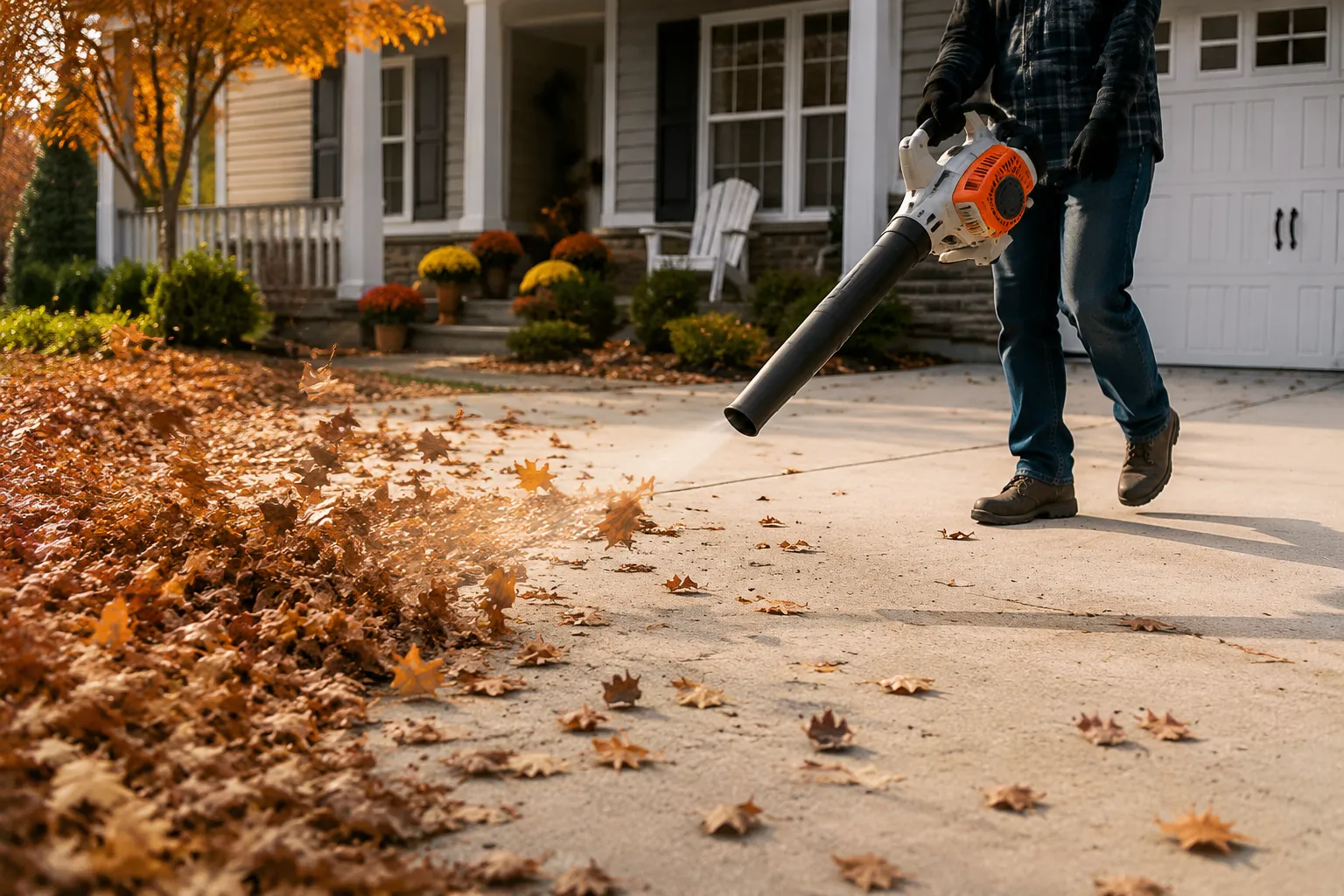
Fall cleanup has a peculiar way of turning a weekend into a full-blown project. The moment the first serious batch of leaves drops, the driveway becomes a slippery carpet of wet maple and oak, and the gutters start singing a different tune. Most people grab a rake and a tarp, spend an hour bending and dragging, and call it done. A leaf blower changes the math completely, but only if a person treats the driveway as its own separate job with its own technique, rather than an afterthought to the lawn work.
The driveway is the one surface where a blower genuinely outperforms every other tool in the shed. Rakes snag on cracks and catch on the gravel edge. Brooms push wet leaves into a slimy paste that smears across concrete. A blower moves the whole mess in one continuous sweep, no bending over, no piling, no second pass. It turns a forty-minute chore into a seven-minute job, and it does it with a kind of satisfying whoosh that never gets old. The trick is knowing how to aim the thing and when to stop.
Start Dry or Start Angry
Moisture is the enemy of every leaf-blowing operation. Wet leaves clump together, stick to concrete like glue, and turn the nozzle into a sprayer that just pushes water around. The same leaf that skitters across a dry driveway with a gentle puff becomes a sodden weight that requires the throttle wide open and a lot of patience. The best time to blow a driveway is before the morning dew burns off, or better yet, the evening before a dry night. A person who waits until after lunch on a humid day is fighting physics.
There is also a strong argument for blowing before the mower runs. Dragging a lawn mower over a layer of wet leaves on concrete is a quick way to dull blades and spray debris into the flower beds. A quick blow-down of the driveway and walkways first thing saves a lot of cussing later. The leaves on the lawn can wait; the hard surfaces are the priority because they are the ones that get slippery and dangerous when the temperatures dip below freezing.
The Geometry of the Sweep
Most people make the mistake of walking backward down the center of the driveway, blowing leaves forward in a straight line. This scatters material to both sides and leaves a trail in the middle that requires a second pass. The correct approach is to work from the edges toward the center, angling the nozzle about 45 degrees and using a side-to-side motion that resembles a slow windshield wiper. This pushes the leaves into a single manageable windrow that moves forward with each step.
The width of the driveway dictates the strategy. A single-car slab is easy enough to clear in one pass from the garage to the street. A double-wide driveway needs a different approach: split it down the middle in an imaginary line, clear one half completely, then the other. Trying to handle the whole width at once just sprays leaves back onto the already-cleaned side. The windrow between the two halves becomes the final pile, and that pile gets pushed to the curb or into the nearest garden bed in one last decisive push.
Pushing leaves to the street is a neighborly decision that requires some thought. Many municipalities frown on leaf piles in the gutter because they clog storm drains and create slip hazards for cyclists. The better move is to blow the driveways leaves to the adjacent lawn and mulch them with the mower, or corral them into a corner of the yard for composting. This is where the blower earns its keep: a person can push a windrow of leaves up over the lawn edge and into a mulching pile in under a minute, whereas hauling them by tarp takes ten times as long.
Cracks, Edges, and the Garage Lip
The concrete itself clears fast, but the details are where the chore stalls out. Expansion joints and cracks collect a layer of damp leaf dust that a wide sweep misses entirely. This is where the blowers narrow nozzle attachment matters more than its horsepower. Switching to the concentrated tip and running it slowly along every joint lifts out the packed debris that would otherwise stain the concrete over the winter and turn into a slip hazard when it rots.
The garage lip is another trouble spot. That small threshold where the concrete meets the door track traps leaves and blows them back inside every time the door opens. A good technique is to blow outward from inside the garage first, getting the debris that has drifted in over the week, then finish the lip from the outside. This prevents the classic mistake of piling leaves right at the door, only to have the next gust push them back under the rubber seal.
Edges where the driveway meets the lawn are the final frontier. Grass grows over the concrete lip and creates a natural dam that catches leaves and turns them into a wet mat. The blower needs to run at an angle that lifts these off the grass and onto the pavement, then the whole mass gets swept to the pile. A person who skips this step ends up with a ragged line of rotting leaves hugging the driveway all winter, and that line is exactly where weeds take hold in the spring.
Gas, Electric, and the Weight Question
The kind of blower a person owns changes the technique more than most people expect. A backpack gas model with serious air volume can push a foot-deep pile of wet leaves in a single pass, which means the operator can take a more aggressive angle and cover ground fast. The trade-off is the weight and the noise. A person wearing a backpack blower for thirty minutes of driveway work is going to feel it in the lower back the next day, especially if the machine is a cheaper model with poor harness padding.
A handheld electric blower, corded or battery, requires a different rhythm. The air speed is there, but the volume is lower, so the operator has to work in narrower passes and stay closer to the surface. The advantage is the weight and the freedom. A small battery unit can be swung with one hand while the other holds a tarp or a trash bag, and that two-handed capability is genuinely useful for driveway edges. The corded models are cheaper and never run out of power, but managing an extension cord across a wet driveway is its own special kind of annoying.
The right tool for the driveway is the one that a person actually picks up. A massive gas blower that sits in the shed because it is too heavy to haul out does no good whatsoever. A compact electric that lives on a wall hook in the garage and gets used for a quick five-minute sweep every other day will keep the driveway cleaner all season long. Consistency beats raw power when the goal is a driveway that stays clear rather than a once-a-month mega-clearing event.
The Wet Leaf Exception
Every rule has its exception, and the wet leaf is the one that humbles even the most experienced blower operator. After a heavy rain, the driveway becomes a slick sheet of mush that no air volume will move effectively. The leaves bond to the concrete in a way that defies physics. This is when the blower should go back on the hook and the rake comes out, or better yet, a broom with stiff bristles. Trying to force the issue just sprays water and leaf fragments everywhere, making the driveway dirtier than when it started.
The smarter play is to wait. A dry day following a rain will see those wet leaves shrink and curl as they lose moisture, and within a day or two they will lift off the concrete with minimal effort. Patience saves a lot of muscle strain. The same logic applies to frozen leaves. A hard frost locks everything to the ground, and blowing at that point is a waste of battery. Wait for the thaw, then blow.
Blowing With the Wind, Not Against It
A person who has ever tried to blow leaves into a headwind understands why this chore frustrates so many people. The blower creates a stream of air that collides with the natural breeze, and the result is a swirling vortex that deposits leaves back onto the just-cleaned surface. The fix is embarrassingly simple: check the wind direction before starting and plan the sweep accordingly. Work with the wind whenever possible, so the blowers output and the natural breeze combine into one powerful push.
On days when the wind is gusting and shifting, the best approach is to work in shorter segments and move the pile to a protected corner quickly. Leaving a windrow exposed while a person goes back for the other half of the driveway is asking for a redo. The wind will find that neat pile and scatter it like a child with a handful of confetti. Move the pile as soon as it is formed, even if it means making two trips to the curb.
The Final Blow-Down
Once the main mass of leaves is gone, the driveway still holds a fine dusting of debris. Pine needles, small twigs, and the shattered fragments of dried leaves settle into the concrete pores and make the surface look dingy. A final pass with the nozzle angled low and the throttle reduced to half power lifts this grit without launching it into the yard. This is also the time to sweep the dust off the garage floor and the front steps, because a clean driveway next to a dirty stoop looks unfinished.
The last step is the one most people skip: turning the blower off and taking a walk down the driveway to inspect the work. The eye catches what the nozzle missed. A stray leaf stuck in a crack, a line of mulch kicked onto the edge, a pile of debris gathered around the mailbox post. A minute of inspection and a quick targeted puff on each spot finishes the job properly. The driveway looks clean, the walkway looks clean, and the house looks like somebody actually cares about the details.
The blower is not a lazy persons tool. It is a smart persons tool, one that recognizes that fall cleanup is a series of small battles fought on different surfaces. The driveway is the easiest of those battles to win, and a person who wins it first sets the tone for the rest of the day. The leaves in the flower beds can wait. The driveway is visible from the street, it is the first thing guests see, and it is the surface that gets walked on a dozen times a day. Blowing it clean takes minutes, not hours, and the payoff lasts for weeks with a quick touch-up every few days.