
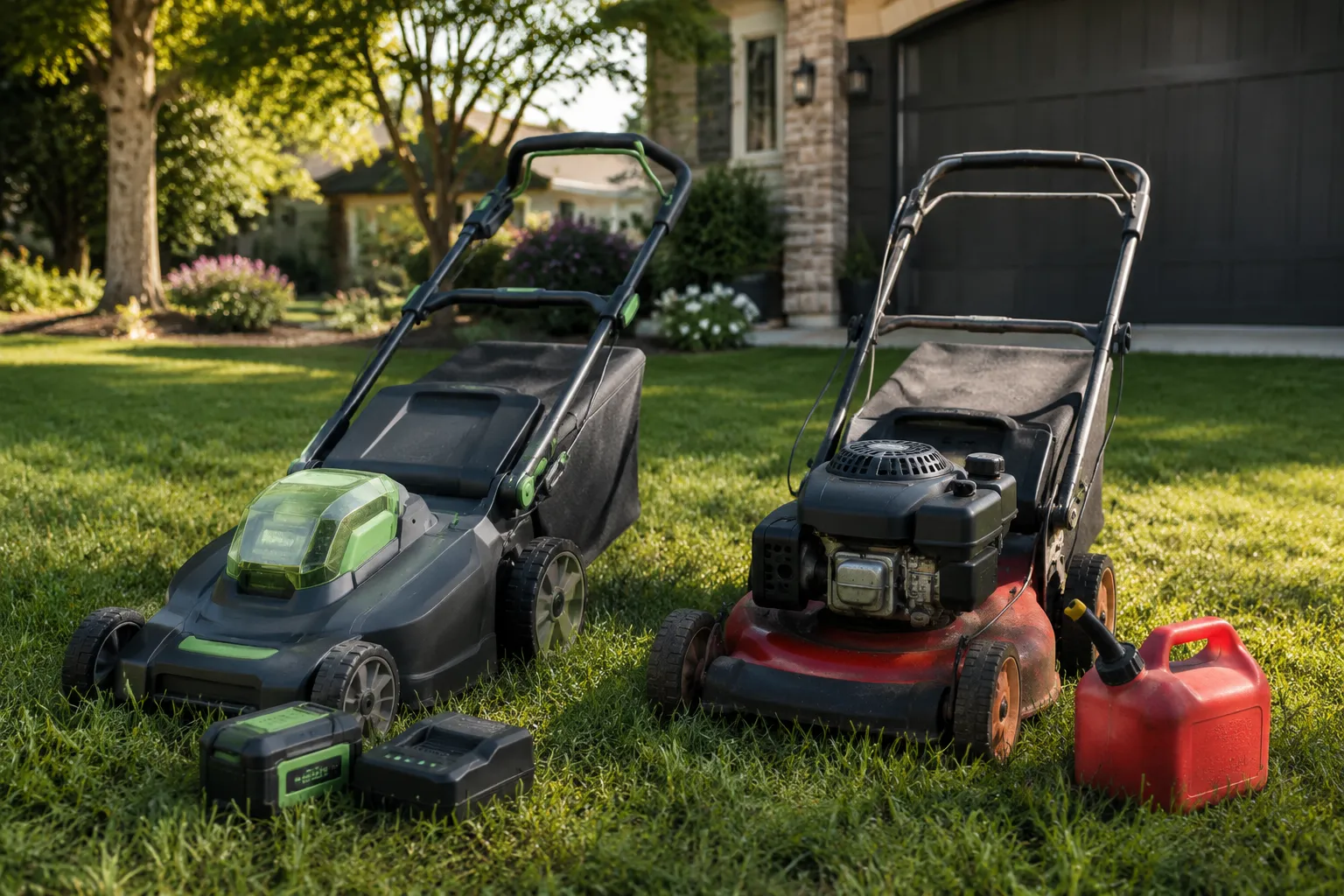
The small-engine aisle at a hardware store lays the question out in plastic and steel. On one side, a row of battery mowers in green and orange housings, quiet as furniture. On the other, the gas mowers with their metal decks and primer bulbs, looking like they could outlast the store itself. A person who needs to cut grass twice a week from April through November is not choosing between two products. They are choosing between two ways of spending the next ten years.
The battery side has won the technology argument. That much is settled. The remaining argument is about everything else: money, lifespan, repair skill, and what a person actually does on a Saturday morning.
The battery mower has already crossed the capability line
For most of the 2010s, the knock on battery mowers was honest. They stalled in thick grass. The batteries died halfway through a quarter-acre lot. The chargers took all night. That era is over, and the people who still repeat those complaints are describing a product from a decade ago.
Current 40-volt and 60-volt systems from the major brands cut damp grass, mulch leaves, and handle a third of an acre on a single charge. The brushless motors are not a marketing gimmick; they deliver torque that feels closer to a gas engine than to the old universal motors. A person who buys a battery mower this year is not making a compromise. They are buying a mower that happens to use a different fuel.
The quiet alone changes the experience. A gas mower at full throttle sits around 95 decibels, loud enough that hearing protection is a reasonable choice. A battery mower runs at roughly 70 decibels, about the level of a vacuum cleaner. Cutting grass at eight in the morning no longer creates a neighborhood incident. It becomes a chore a person can do while listening to a podcast, without shouting at the dog to get inside.
What the charge time actually means on a Tuesday
The real constraint of a battery mower is not power. It is rhythm. A gas mower sits in the shed with a full tank, ready at any moment. A battery mower needs to have been plugged in the night before, or at least a couple of hours before the grass needs cutting.
This matters more than the spec sheets admit. The person who mows on a schedule, same day every week, will find the battery routine effortless. The person who mows when the weather and mood align, maybe skipping a week and then tackling an overgrown yard, will occasionally find a dead battery and a half-charged spare. That moment, standing in the garage at 9 a.m. with the grass already tall and the battery light blinking red, is the exact moment gas mowers win.
The workaround is buying a second battery, which means another $150 to $250. That brings the total cost of the battery system close to the price of a decent gas mower, and the second battery comes with its own problem: batteries degrade whether they are used or not. A lithium-ion pack stored in a hot shed for three years will lose capacity even if it never touches grass. Gas does not expire the same way.
The gas mower's real advantage is not horsepower
Gas mowers still win on two fronts, and neither is the engine. The first is the deck. Most gas mowers use a steel deck that takes abuse for fifteen years without complaint. The second is the repair ecosystem. A small-engine mechanic can rebuild a gas mower's carburetor for $60. A person with basic tools can do it themselves with a $15 kit and a YouTube video. Batteries cannot be rebuilt. When a lithium pack dies, it is a sealed unit that goes in the trash, and the replacement costs a third of what the mower cost new.
There is also the matter of the mower itself. The cheapest gas mowers are built to a price point that shows. The plastic wheel assemblies strip, the cable adjusters rust, and the deck paint peels in the first season. But the mid-range gas mowers, the ones in the $350 to $450 bracket, are overbuilt in a way that battery mowers in the same price range are not. The engine alone is a proven design that has not fundamentally changed in forty years. A person who buys a Honda or a Toro gas mower in that range is buying a machine that will likely outlive the fence they are mowing around.
Total cost of ownership gets complicated on purpose
The cost comparison between the two systems looks simple on the surface. A battery mower with two batteries and a charger runs $400 to $700. A comparable gas mower runs $300 to $500. But the calculation changes when the batteries die, which they will, usually between years four and six depending on how many charge cycles accumulate.
Replacements for a 40-volt or 60-volt pack run $120 to $250 each. Over eight years, a person who buys a battery mower will likely replace at least one battery, and the original mower itself will eventually reach a point where the motor or electronics fail and the repair cost exceeds the replacement value. A gas mower in the same period will need oil changes, air filters, maybe a spark plug, and possibly a carburetor clean. Those parts cost maybe $40 total. The gas engine, if treated with the smallest amount of respect, will still be running at year eight.
The math flips back the other way when a person already owns battery tools from the same brand. Someone with a drill, a saw, and a string trimmer from the same battery platform can buy a bare mower for $300 and share packs. That changes the economics entirely. The mower becomes one more accessory in an existing system, not a standalone purchase. For that person, the battery mower is the obvious financial choice.
The weight and the push are a real difference
Nobody talks enough about how a mower feels at the handles, and it matters more than any spec. A typical gas walk-behind mower weighs 70 to 90 pounds, with the weight sitting over the rear wheels. The engine is heavy, the steel deck is heavy, and the whole thing pushes like a stubborn animal on an incline.
Battery mowers are lighter, usually 40 to 55 pounds, and the weight distribution is different. The battery sits low and the motor is compact, which makes the mower feel more balanced. On flat ground, a battery mower pushes noticeably easier. On a slope, the difference is significant, and for an older person or anyone with a bad back, the lighter machine is the difference between mowing and hiring someone.
Self-propelled versions change the equation again. A self-propelled gas mower is a workout machine that drags a person along at its own pace. A self-propelled battery mower is almost effortless, to the point where some models have a variable-speed trigger that lets a person walk at a natural stride while the mower keeps pace. That is a genuine quality-of-life improvement, not a spec-sheet line.
The storage and maintenance reality
Gas mowers demand a seasonal ritual that nobody enjoys. In the fall, the fuel needs stabilizer or draining. The oil needs changing once a season. The air filter needs checking. The spark plug needs a look. A person who skips these steps will eventually fight a mower that refuses to start in May, and the problem will always surface at the worst moment, usually with rain in the forecast.
Battery mowers eliminate almost all of that. There is no fuel to go stale, no oil to change, no carburetor to gum up. The maintenance is limited to keeping the deck clean and the blade sharp. For a person who hates small-engine maintenance, this alone justifies the switch. The trade is the storage of the battery itself, which needs to come inside for winter in colder climates. A lithium pack left in a freezing shed loses capacity permanently. That is a small thing, but it is a thing.
There is also the noise consideration to revisit at the end of a long season. Cutting grass every Saturday for six months produces a cumulative irritation that is hard to measure until it is gone. The gas mower's engine sound is not pleasant. It is a constant, droning, mechanical roar that requires earplugs for comfort. The battery mower's whir is unobtrusive to the point of being forgettable. Some people genuinely do not care. Others find the quiet is the single best part of the switch, and they never go back.
The yard itself decides more than the buyer does
A quarter-acre flat lot with thin soil and a decent grass type will do fine with either mower, and the choice should come down to personal preference. But a yard with steep slopes, wet spots, or a thick Bermuda or St. Augustine grass that grows fast in July will punish a weak mower regardless of power source.
A property with a serious slope is a poor fit for a non-self-propelled mower of any kind, and a battery mower with the torque to handle the incline will cost more than a comparable gas model. A yard with a lot of oak trees and heavy leaf drop in the fall needs a mower that can mulch thick, wet leaves without bogging down. The gas mower with its higher engine speed and heavier flywheel will plow through a foot of leaves where a battery mower will stall and throw a fault code. That is not a myth. It is a physics problem about stored energy in a rotating mass.
The flip side is that a battery mower handles damp grass better than an old gas mower with a worn blade. The electric motor delivers consistent torque at low speeds, where a gas engine lugs and stalls. A person who mows after a morning rain, which many people do because that is when the time exists, will find the battery mower is less finicky in the wet.
The used market and the long game
Gas mowers have a second life. A person can buy a ten-year-old gas mower for $80, spend $20 on parts, and get another five years out of it. The used market for battery mowers is thinner because the batteries are the expensive part and a used pack with unknown charge cycles is a gamble. A used mower without a battery is nearly worthless.
This matters for people who fix things, and it matters for neighborhoods where the cheapest option is the one that ends up in a garage. The gas mower ecosystem supports a whole layer of tinkerers and small repair shops. The battery ecosystem does not. It is a cleaner, better experience for the owner, but it is also a sealed box. When it fails, the whole unit goes to the curb.
The honest advice is that the decision comes down to what a person wants from the relationship. The gas mower is a tool with a personality, a machine that demands attention and pays back the attention with longevity. The battery mower is an appliance, a thing that does the job quietly and asks nothing in return until the day it stops working entirely.
For the person who wants Tuesday evening to be peaceful, who wants to cut grass without earplugs, who never wants to smell fuel on their hands, the battery mower is the right answer. For the person who wants one machine to last fifteen years, who enjoys a little wrenching, who has a big yard with leaves and slopes and thick grass, the gas mower still earns its place in the shed.
The test is simple. Walk to the shed and look at the current mower. If the thought of it brings irritation, switch to battery. If the thought of it brings nothing at all, stay with gas. Either choice cuts the grass. One of them cuts the aggravation too.