
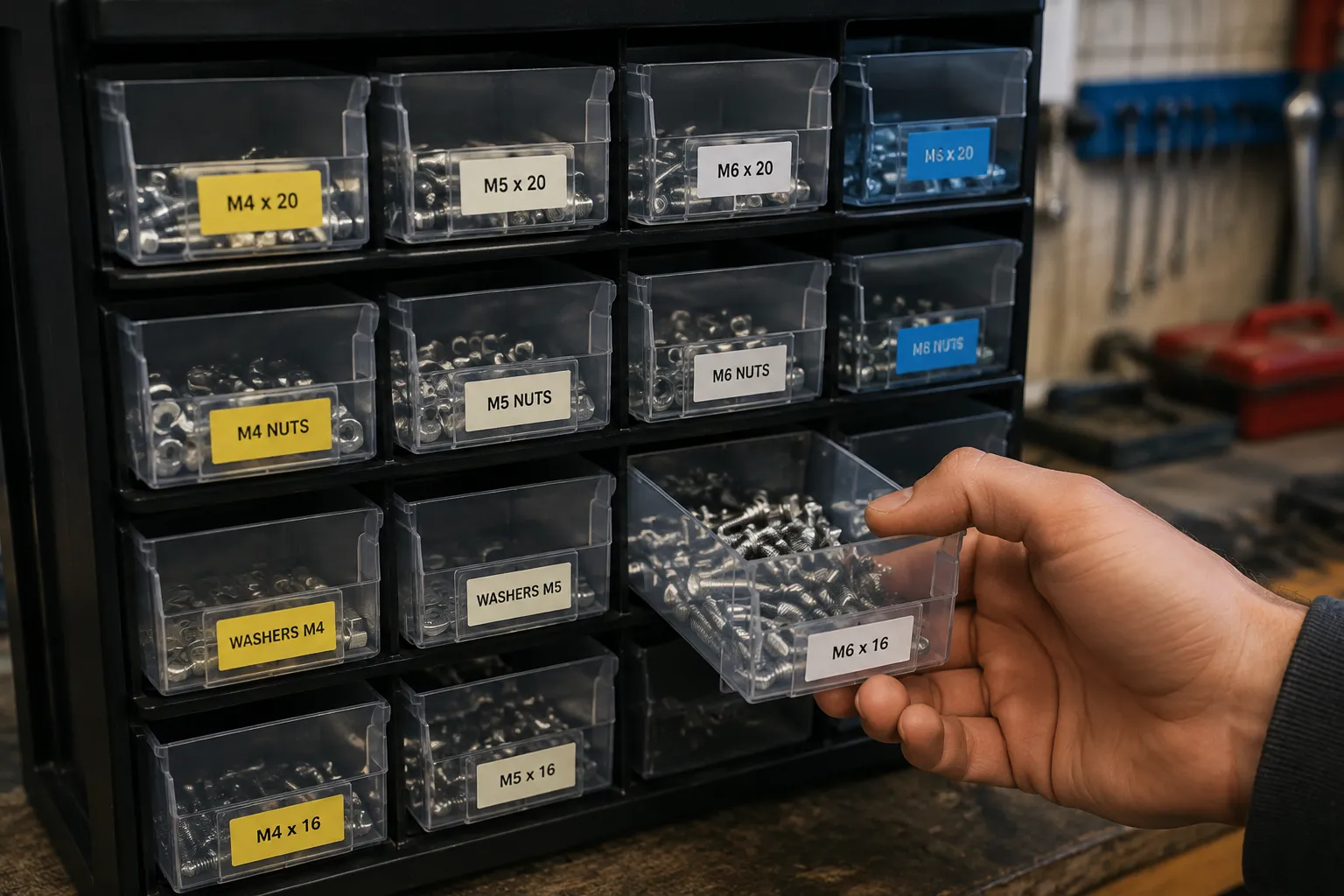
Every shop that has ever organized its fasteners has done the same dance. Sort them into trays, label the compartments, feel a warm glow of accomplishment. Then two weeks later, the 10-32 pan heads are in the 1/4-20 bin and nobody can remember what the green label meant. The system did not fail because the bins were wrong. It failed because labeling a drawer is not the same as labeling a workflow.
The Flaw in Most Labeling Schemes
Most hobbyists and small shop owners approach fastener storage the way a librarian approaches a shelf: assign a spot, write a label, and expect the item to live there. This assumes the person returning the bolt will read the label, care about the label, and have the time to sort properly. None of those assumptions hold at the end of a long day when a machine is apart on the bench and the hardware is in a coffee can.
The deeper problem is that labels answer the wrong question. A label says "what belongs here." The real question is "what am I likely to grab when I need this?" Those are different systems entirely. A person mid-project does not walk to the bin wall looking for "3/8-16 x 1-1/2 hex bolts." That person walks over holding a bolt that fell out of something, or holding a vague memory of what the old one looked like, and tries to match it against what is in front of the eyes.
A label that only names the part does not help with that matching process. It helps only after a person already knows exactly what they need, which happens mostly on the front end of a job, not the messy middle.
Size Groups Beat Part Names as the First Sort
The single highest-value change most shops can make is to stop sorting by fastener type and start sorting by thread size. A drawer full of mixed 1/4-20 hardware, regardless of head style or length, is more useful than separate drawers for hex bolts, cap screws, and washers. The reason is simple: when a person is sorting, the thread size is the first thing they check. Grabbing a bolt out of the pile, the eye goes to the head, but the hand goes to the threads. The visual check is whether the threads match the hole or the nut in the other hand.
Sorting by size means every 1/4-20 item lives in one place. That includes hex bolts, socket heads, carriage bolts, nuts, washers, and even the odd specialty piece. The label on that drawer does not say "Hex Bolts." It says "1/4-20" in large type, with a secondary line listing common lengths. This collapses the sorting decision into one question: does this thread match? Yes, into the drawer. No, keep looking.
For the most common sizes, 1/4-20, 5/16-18, 3/8-16, and the metric equivalents like M6 and M8, this system turns the entire hardware wall into a binary search. A person only needs to know the thread pitch to know the drawer. And for the truly common sizes, the pitch is stamped on the head of most bolts, readable with a glance.
Labels Need Physical Differentiation, Not Just Text
Text labels assume a person is close enough to read them and paying enough attention to do so. Both assumptions fail at ground level. The solution is to encode the label into the physical world: colored bins, colored label stock, or colored tape stripes on the drawer fronts. The color is the primary identifier. The text is the backup.
This is not decoration. Color acts as a coarse filter before the fine filter of text. A person walking to the wall with a handful of mixed hardware can sort by color from three feet away, dropping pieces into the right bins without ever reading a word. The text only matters for confirmation and for less common sizes where the color coding runs out of obvious distinctions.
Assign colors by thread family. One color for all imperial sizes, another for metric, and a third for sheet metal and wood screws. Within the imperial family, use shades to distinguish the common sizes: red for 1/4-20, yellow for 5/16-18, green for 3/8-16, blue for 1/2-13. The exact palette does not matter as long as it is consistent and the values are distinct enough to tell apart in poor light.
The label itself should carry the size in large characters, visible from across the room, with the pitch clearly written. "1/4-20" beats "Quarter-Twenty" every time. The secondary line lists lengths carried in that bin, and a third line notes any exceptions, like "shoulder bolts" or "full thread only."
Sorting Trays and the Drop Zone
The physical act of sorting needs a landing zone. A dedicated tray, a clear workspace, or a shallow pan where loose hardware gathers before it goes into bins. Shops that skip this step, where hardware goes straight from the disassembly to the bins, create the conditions for mislabeled chaos. The rush to get parts off the bench and back into storage means fasteners get dropped into the first drawer that looks close.
A drop zone changes the dynamic. Hardware sits in a tray until the person has a moment to sort properly, and the tray itself can be labeled with the date and the project name. This creates a natural checkpoint. When the tray fills, sorting happens deliberately, not reflexively. And because the tray is labeled with the source project, a stray bolt can be traced back to its origin if the right bin is uncertain.
The drop zone does not need to be elaborate. A plastic parts tray from the auto store, a sheet pan from the kitchen supply, or a shallow wooden box all work. The key is that it exists and that it is positioned between the workbench and the bin wall, so the path of least resistance is to drop there first.
The Inventory Sheet Is the Real Label
A bin label tells a person what belongs inside. It does not tell them what is supposed to exist in the shop at all. The missing layer is an inventory sheet, a single page, or a spreadsheet that lists every fastener size the shop stocks and where each one lives. This sheet is the map. The bin labels are just street signs.
This matters most when a shop runs low on a size. Without the inventory sheet, the person looking for 5/16-18 hardware walks the wall, checks a few drawers, and assumes the shop is out. With the sheet, they know that 5/16-18 lives in the yellow drawer, and if it is empty, they know exactly what to reorder and in what quantities. The sheet also prevents duplicate buying, the slow leak of money that comes from buying a box of bolts that is already sitting in an unlabeled drawer somewhere.
The inventory sheet works best when it is taped to the inside of the cabinet door or hung on the wall above the bins. It should list sizes in the same order as the drawers, top row to bottom row, so the eye scans naturally. Each entry gets three columns: size, quantity on hand, and reorder point. The quantity column gets updated, roughly, when a new box is opened or when a drawer starts looking thin. The reorder point is a judgment call, but a simple rule of thumb works: when a drawer is down to the point where it is hard to grab a single bolt without dumping the whole bin, it is time to reorder.
Labels for Mixed Bins and Overflow Storage
Not every fastener needs its own bin. Low-use items, like a partial box of 10-32 machine screws or a handful of 1/4-28 fine thread bolts, do not justify dedicated space. These go into mixed bins, and the label needs to reflect the honest reality of what is inside. A mixed bin label should say "Mixed Imperial, 10-24 to 1/4-28" or "Metric Misc, M5 to M8," not pretend at a precision the bin does not have.
Mixed bins work best on the bottom row or in a separate cabinet, because they are the last resort, the place a person goes when the dedicated size drawer is empty. The label should include a date, because mixed bins accumulate mystery hardware over time. A bin labeled "Mixed, sorted May 2024" carries a different trust level than one labeled "Mixed" with no date at all. When the bin becomes more mystery than useful, dump it and re-sort.
Overflow storage needs its own distinct labeling scheme. The bulk boxes, the unopened packages, and the partial boxes that do not fit in the main drawers all need to reference the main inventory sheet. A simple code works: the overflow box gets the same color tape and the same size label as the main bin, plus a handwritten note like "overflow, 12 boxes." This ties the overflow back to the primary location without requiring a second map.
Label Durability and Replacement
Most shop labels fail because they are printed on the wrong material. A paper label inside a plastic bin gets oily, smudged, and illegible within months, especially in a garage that sees temperature swings and moisture. The label needs to survive the environment it lives in, not the environment in the office where it was printed.
Laminated labels, or labels printed on synthetic paper, handle oil and wiping better. For the color code, colored tape stripes applied to the drawer front or the bin edge last longer than colored paper inserts. The most durable setup uses a label maker with a clear protective cover over the printed tape, which is cheap, replaceable, and readable.
The label should also be treated as a consumable, not a permanent fixture. A label that has been on the drawer for five years and is starting to peel is a label that has outlived its usefulness. Replacing labels is a five-minute job that should happen as part of a twice-yearly shop cleanup. The date on the label, written in permanent marker, tells a person whether the label is current or stale.
The Habit That Keeps the System Honest
No labeling system survives contact with a busy week unless the return habit is built in. The habit is simple: a fastener goes back to its bin immediately, or it goes to the drop zone, but it never goes into a pocket, a cup, or a random drawer. This is a behavioral rule, not a labeling rule, and it is the one that actually determines whether the system works.
Shops that maintain discipline on returns keep their labels accurate for years. Shops that let the occasional bolt slide, just this one time, find themselves re-sorting every six months. The difference is not in the quality of the labels. It is in whether the return is a reflex or a decision. A bin system becomes a reflex when the color coding is consistent, the drop zone is in the path of travel, and the inventory sheet tells the person where to look without hunting.
The moment of truth is the end of a project. That is when the drop zone is fullest and the temptation to just dump everything into the nearest drawer is strongest. Shops that resist that urge, that spend the extra ten minutes sorting before the next project starts, never need to wonder what is in that green drawer. The label says 3/8-16. The contents match the label. And the next time a person reaches for a bolt, they find what they need on the first grab.