
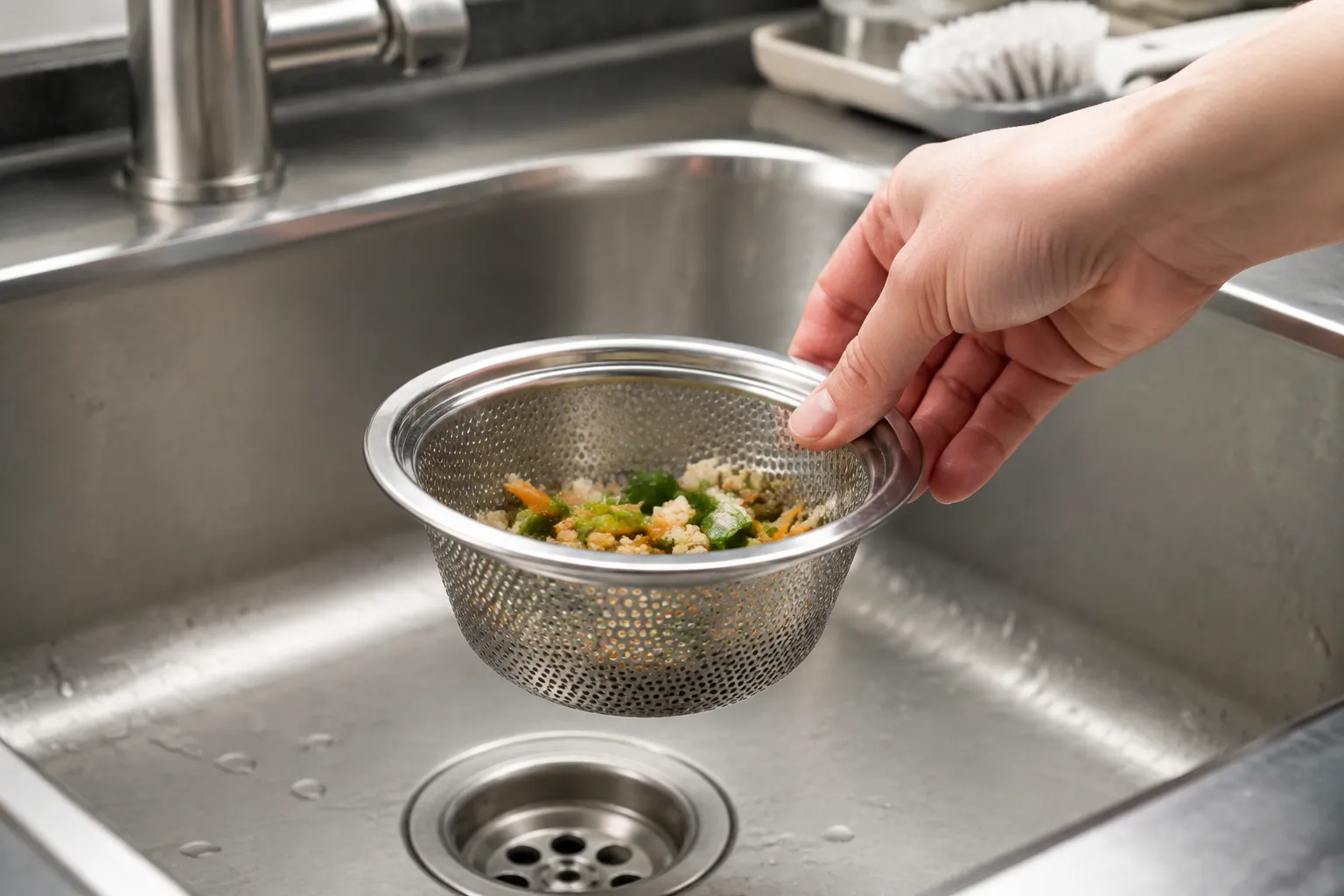
The lowly sink strainer sits at the bottom of the basin, a perforated metal disc that most people ignore until the water starts pooling around their ankles. By then, the damage is done. The drain line is already packed with rice grains, eggshell fragments, and a greasy sludge that no chemical cleaner will fully dissolve. The strainer is the first line of defense, and for most households, it is a woefully inadequate one.
The standard issue strainer, the one that comes free with the apartment or gets bought in a three-pack at the hardware store, is a shallow basket with holes punched in a uniform grid. It catches the big stuff. It stops a potato peel from disappearing into the abyss. But it fails at the exact moment it matters most: when the sink is full of soapy water and the strainer is sitting half-submerged, a film of grease has already sealed the perforations, and the water has nowhere to go but over the rim and down the overflow.
Upgrading the strainer is cheap, requires no tools, and takes about thirty seconds. It is also one of the most effective plumbing preventions available to a renter or homeowner. The trick is knowing what to look for, because the category has quietly evolved beyond the basic perforated disc, and the differences matter more than the price tags suggest.
The Flange Problem Nobody Talks About
Before looking at the strainer itself, look at the flange it sits in. Most kitchen sinks have a standard 3.5-inch drain opening, and the flange is the metal ring that connects the sink basin to the drainpipe below. The stock flange that comes with a new sink is usually a thin, stamped piece of stainless steel with a basket strainer that lifts out. The basket is fine. The flange is the weak link.
The issue is the crossbars. The stock flange has two thin metal bars crossing the opening to hold the basket in place. Those bars catch debris, sure, but they also create turbulence. When water drains, it spirals around those bars, and food particles get caught in the eddies. Over time, a layer of gunk builds up right at the junction of the bar and the flange wall. That gunk hardens, and suddenly the drain is half its original diameter.
A better flange has no crossbars at all. It is a smooth, open cylinder, and the strainer sits on a lip near the top. The absence of crossbars means water flows straight down with no obstruction. Food particles have nothing to snag on. The difference is immediately visible the first time the sink drains: the water spirals faster and empties in about half the time.
Replacing the flange requires access under the sink and a pair of pliers to loosen the locknut. It is a twenty-minute job for someone who has done it before, an hour for a first-timer. The payoff is a drain that behaves like a pipe, not a funnel with obstacles in the middle.
Mesh Strainers Catch What Holes Cannot
The classic perforated strainer has holes that are roughly 2 to 3 millimeters in diameter. That is small enough to catch a grain of rice but too large to catch the fine sediment that rinses off a cutting board after slicing a tomato or washing a bunch of cilantro. That sediment settles in the P-trap, the curved section of pipe under the sink, and over months it compacts into a dense, muddy plug.
Mesh strainers solve this with a stainless steel weave that catches particles down to about half a millimeter. The mesh is fine enough to hold back coffee grounds, which are the single most common cause of kitchen drain clogs after grease. The grounds look like they dissolve in water, but they do not. They accumulate in the trap and form a gritty paste that requires disassembly to clear.
The trade-off with mesh is flow rate. A fine mesh restricts water movement, and in a deep sink filled with dishwater, the drain can take noticeably longer to empty. Some manufacturers address this by angling the mesh or using a conical shape that increases surface area. Others just accept the slower drain and let the user deal with it.
The better approach is a two-stage system: a coarse perforated basket on top and a fine mesh cup nested below. The top basket catches the bulk of the debris, and the mesh cup catches the fines that slip through. This setup drains faster than a single fine mesh layer because the water is mostly clear by the time it hits the mesh. The mesh only has to handle the silt, not the chunks.
The Silicone Rim That Changes Everything
A strainer only works if it stays in place. The standard metal strainer sits in the flange with a friction fit, and the moment the water level rises above the strainer's rim, the basket floats. It bobs around, tilts sideways, and lets everything pour past the edge into the drain. The fix is a silicone rim.
Strainers with a silicone or rubber gasket around the outer edge create a seal against the flange wall. That seal holds the strainer in place even when the sink is full. It also prevents the small gap that normally exists between the metal strainer and the flange, a gap that catches stringy debris like celery fibers and strawberry tops.
The silicone rim has a second benefit: it cushions the metal against the flange, so the strainer does not rattle or clang when dropped into place. It is a small thing, but in a quiet kitchen at six in the morning, the difference between a metal-on-metal clatter and a soft, muted thud is noticeable.
One caution: not all silicone rims are created equal. The cheapest versions are a thin band that stretches and loses its grip within a few months. The better ones are molded directly onto the strainer body, with a thickness that holds its shape after repeated use. A person can test this in the store by pressing the rim with a thumb. If it squishes flat and stays flat, it is too soft. It should have some resistance.
Deep Baskets Hold More, Empty Less Often
The shallow strainer, the one that sits nearly flush with the bottom of the sink, fills up after a handful of scraps. Every time the cook rinses a plate, the strainer is full, and the water backs up. The cook either scoops the debris out with a bare hand or jabs at it with a spoon. Neither is pleasant.
A deep basket strainer, one that drops three or four inches into the drain opening, holds several times the volume. A person can rinse an entire dinner's worth of plates before the basket needs emptying. The depth also means the debris stays below the waterline, which keeps the sink looking cleaner and prevents the visual unpleasantness of a pile of soggy food sitting in plain sight.
The deep basket does reduce the vertical space in the drain, which can matter if the sink has a garbage disposal directly below. The disposal needs room to churn, and a deep basket can interfere with the splash guard. Most manufacturers design around this, but it is worth checking the clearance before buying.
For sinks without a disposal, the deep basket is the single best upgrade available. It is the difference between emptying the strainer three times during a meal prep session and emptying it once at the end.
The In-Sink Drain Hair Catcher, Adapted for Kitchen Use
Bathroom sinks have a specific problem: hair. Kitchen sinks have a similar problem in disguise: the stringy, fibrous material that comes from onions, celery, green beans, and any vegetable with a cell structure that resists chopping. These fibers wrap around the crossbars of a standard flange and tangle into a mat that blocks water flow.
The kitchen equivalent of the hair catcher is a strainer with slotted openings instead of round holes. The slots are long and narrow, about 1 millimeter wide and 10 millimeters long. They catch the fibers by orientation: a fiber that enters lengthwise falls through, but a fiber that enters crosswise gets caught on the edge. The slots also allow water to pass more freely than a mesh of the same cross-sectional area.
These slotted strainers are less common in hardware stores, but they are easy to find online. They look similar to a standard perforated strainer at a glance, so a buyer needs to check the pattern carefully. The slots make a visible difference in performance when the cook is dealing with leeks, which shed layers of fibrous material that clog a round-hole strainer in seconds.
The downside is that slotted strainers let through small round particles like peppercorns and corn kernels. A person needs both types on hand, or a slotted strainer with a fine mesh insert for the days when small particles are the problem.
Garbage Disposal Compatibility Matters More Than It Should
Homes with garbage disposals face a different strainer challenge. The disposal needs a steady flow of water to flush food particles through the grinding chamber, and a restrictive strainer starves it. The result is a disposal that grinds the same material over and over, producing a fine paste that coats the drainpipe walls.
The right strainer for a disposal sink is one with large openings, 5 millimeters or more, that lets water and small particles pass freely while stopping large bones and fibrous material. The goal is not to catch everything, it is to catch the things that would damage the disposal or wrap around the impeller.
A common mistake is installing a fine mesh strainer in a disposal sink because it catches more. The mesh restricts the water flow, the disposal runs dry, and the unit overheats. The mesh also catches the food particles that the disposal is designed to handle, so the cook ends up emptying the strainer every few minutes instead of letting the disposal do its job.
The better setup for a disposal sink is a wide-mouth strainer with a removable fine mesh insert. The insert comes out when the disposal is in use, and goes in when the sink is used for rinsing vegetables or soaking dishes. This two-mode approach respects the fact that a disposal sink has two very different jobs.
The Material Question: Stainless vs. Plastic vs. Coated
Stainless steel is the default material for a reason. It does not rust, it does not stain, and it holds up to repeated exposure to hot water and acidic food. The grade matters: 304 stainless is the food-safe standard, while the cheaper 430 grade is magnetic and more prone to pitting. A magnet stuck to the strainer is a quick way to tell the difference.
Plastic strainers are lighter and cheaper, and they do not conduct heat, which means they can be handled immediately after being rinsed with boiling water. But plastic scratches easily, and the scratches become harbors for bacteria and odors. A plastic strainer that has been in use for six months develops a faint, sour smell that does not come out with soap.
Coated strainers, usually stainless with a nonstick or ceramic coating, are marketed as easy-clean. The coating does help food slide off, but it chips after heavy use, and the exposed metal underneath corrodes in a pattern that looks like measles. The coating is a solution to a problem that does not exist, since a stainless strainer cleans up fine with a stiff brush.
The practical recommendation is plain 304 stainless, no coating, no colored finish. It is the boring choice, and it is the right choice. The money saved on the fancy version pays for a second strainer, so one can be in the dishwasher while the other is in the sink.
How to Test a Strainer Before Buying
Hardware stores do not have a test sink, but a person can evaluate a strainer in the package with a few simple checks. First, hold it up to the light and look at the pattern of holes. The holes should be evenly spaced, with no clusters or gaps that suggest a manufacturing defect. Second, run a finger across the rim. The edge should be smooth and rolled, not sharp or burred. A sharp edge will eventually cut a finger during a frantic dishwashing session.
Third, check the fit of the basket in the flange. If the strainer comes with a silicone rim, press it gently into the flange and see if it seats with a slight suction. A strainer that wobbles in the flange will let debris slip past the edge. Fourth, weigh it in the hand. A strainer that feels flimsy, that flexes when squeezed, will not survive the daily abuse of being dropped into a steel sink.
The final test is the most important, and it requires no store visit. In the home sink, fill the basin with a few inches of water, dump in a handful of cooked rice, and pull the plug. The water should drain completely in under fifteen seconds, and the rice should stay in the strainer. If the water pools or the rice escapes, the strainer fails the test, and it goes back.
The Thirty-Dollar Ceiling
A high-quality kitchen sink strainer, one with a deep stainless basket, a molded silicone rim, and a fine mesh insert, costs between twenty and thirty dollars. A basic perforated disc costs three dollars. The difference in performance is not proportional to the price difference, but the upgrade is worth it for one reason: the expensive version gets used.
The cheap strainer sits in the sink, and the cook removes it when it fills up, because it fills up constantly. Eventually, the cook stops replacing it, and the drain gets a direct line to the sludge. The expensive strainer, with its larger capacity and better seal, becomes a permanent fixture. It gets emptied once or twice a day, not once or twice per meal.
The plumbing under the sink rewards this consistency. A drain that receives only the water and the smallest particles stays clear for years. A drain that receives the full load of kitchen debris requires a snake or a plumber within months. The strainer is a small object, and the upgrade is a small expense, but it is the difference between a sink that drains the way it was designed to drain and one that turns every dishwashing session into a race against the rising water.