
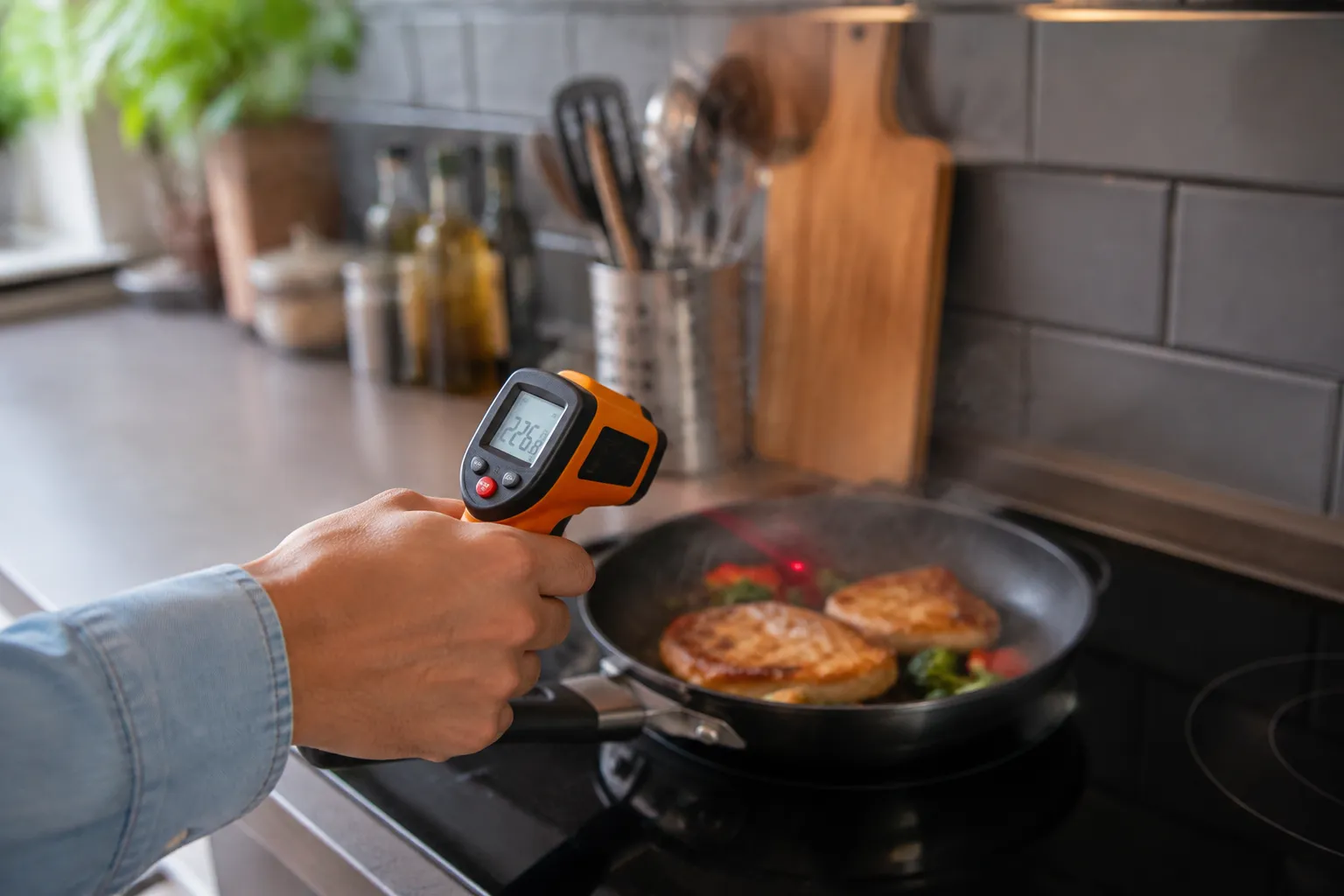
Infrared thermometers are the rare kitchen gadget that actually deserves its drawer space. A person can spend years cooking with instant-read probes and oven thermometers and still be flying blind on the surfaces that matter most: the pan before the oil goes in, the griddle that looks ready but is barely warm, the oven wall that reads 350 on the dial and 290 in reality. The infrared thermometer does not measure internal doneness. It measures surface temperature from a distance, instantly, and that narrow skill covers more household ground than most people expect.
The device works by detecting the infrared radiation emitted from a surface and converting that reading into a temperature display. A laser dot, or in many cases two lasers, shows the area being measured. The technology is not new, industrial maintenance crews have used it for decades on motors and electrical panels, but the price has dropped enough that a serviceable model now costs less than a takeout dinner for two. That price point changes the calculus for home use, because the tool stops being a professional instrument and becomes a household utility.
The Pan Is Lying, and the Thermometer Catches It
Anyone who has thrown a steak into a pan and watched it stick like glue has experienced the gap between what a pan looks like and what it is doing. The Leidenfrost effect, where a droplet of water skitters across a properly hot surface, is a decent party trick but a poor measurement. Water dances on a pan at 380 degrees, and it also dances, differently but still noticeably, at 450. The droplet test cannot tell those apart, and the difference matters for a sear versus a burn.
An infrared thermometer takes the guesswork out of preheat. Point it at the pan bottom, wait one second, and the display shows the actual surface temperature. A stainless steel pan is ready for oil at 350 to 375 degrees. A cast iron skillet for a proper sear wants 400 to 450. Nonstick should never exceed 500, and the thermometer is the only quick way to know if a burner is running hotter than the dial suggests.
The real problem is uneven burners. Electric coils develop hot spots. Gas flames heat the center more than the edges. An infrared thermometer reveals these patterns in seconds, and once a person knows the hot spot sits at the two o'clock position, they can rotate the pan or place the food accordingly. This is the kind of specific, actionable knowledge that separates a decent cook from a frustrated one.
Oil Temperature Without a Deep Fry Thermostat
Deep frying at home is a messy, rewarding project that goes wrong most often at the oil stage. A clip-on frying thermometer works, but it measures the oil near the probe, not the oil where the food will actually land. It also requires a clean, dry probe and a pot with a lip that can hold it. The infrared thermometer sidesteps all of that.
Shallow frying in a skillet, which is how most home cooks actually fry, is even better suited. A half inch of oil in a wide pan heats unevenly, and the surface temperature is what matters for the initial crust formation. Point the thermometer at the oil surface, and it reads the temperature directly. Chicken fried at 325 degrees browns slowly and thoroughly. At 375 it browns fast and may leave the center undercooked. The thermometer lets a cook target the first number and hold there by adjusting the burner before the oil gets away from them.
One caution: infrared thermometers read the surface of the oil, which can be a few degrees off from the oil just below. This is fine for home frying, where a five degree window is not the difference between success and failure. For candy making, where sugar syrup temperatures have hard physical consequences, the infrared tool is the wrong instrument entirely. That job still belongs to a proper candy thermometer.
Oven Hot Spots and the Truth About Preheating
Ovens are liars. The dial says 350, the built-in thermometer says 350, and the actual air near the rack is 325 on the left side and 380 on the right. This is not a defect of cheap ovens; it is the nature of the appliance. Heating elements cycle on and off, racks block airflow, and the temperature inside shifts constantly.
An infrared thermometer will not fix the oven, but it will map the problem. A person can check the walls, the floor, and the rack positions in under a minute. Most ovens show a distinct pattern: hotter near the back wall, cooler near the door, and a noticeable drop on the rack nearest the bottom element. Baking sheets rotated halfway through exist precisely because of these patterns, and the thermometer makes the rotation strategic instead of habitual.
Preheat verification is where the tool earns its keep. Ovens beep when the air reaches the set point, but the air is not what touches the food. The baking steel or pizza stone sitting on the rack takes much longer to come to temperature. A stone pulled from a 500 degree oven reads closer to 420 on the surface after twenty minutes of preheat. The infrared thermometer shows when the stone is actually ready, which is the difference between a blistered crust and a pale, doughy one.
The Grill and the Temperature Danger Zone
Grill grates are another surface that lies. A gas grill with the lid closed reads 500 on the built-in gauge, but the grate surface might be 350 with a cold spot where two grates meet. Infrared thermometers measure the grate, not the air, and that is the number that actually cooks the meat.
The tool also catches a problem that plagues charcoal cooks: the too-soon start. A charcoal chimney looks ready when the coals are ashed over, but the grate temperature can lag far behind. Checking the grate with an infrared thermometer before laying down the protein prevents the saddest outcome in grilling, which is food that steams instead of sears because the coals were not ready.
On the safety side, the thermometer helps with the temperature danger zone, the range between 40 and 140 degrees where bacteria multiply quickly. A cooler full of raw meat for a picnic can be checked without opening the lid and letting cold air escape. A buffet platter holding cooked food can be scanned to confirm it stays above the safe holding temperature. This is not a substitute for an instant-read probe on the food itself, but it catches the surface conditions that a probe cannot see.
Refrigerator and Freezer Gaps That Hide
Refrigerators do not fail all at once. They fail gradually, with one shelf running warm while the rest stays cold. A door gasket that seals imperfectly creates a warm band near the door edge. A clogged vent in the back leaves the lower drawers at 45 degrees while the main compartment sits at 38. These problems are invisible until food spoils early or, worse, never gets cold enough in the first place.
An infrared thermometer measures the interior surfaces, shelves, and drawer fronts without moving anything or waiting for a probe to equilibrate. The readings are not the same as air temperature, but they are close enough to flag a problem. A shelf reading 48 degrees is a shelf that needs attention, whether from the door gasket, the vent, or the thermostat setting.
Freezers have their own version of this issue. Frost buildup is a sign of warm air intrusion, and an infrared thermometer can find the leak. The gasket line around the door should read consistently cold. A section that reads noticeably warmer than the rest marks the failure point. The same tool that checks a searing pan also diagnoses the appliance that keeps leftovers safe. That range is the argument for owning one.
Drafts, Baseboards, and the Non-Cooking Uses
The same infrared sensor that reads a skillet reads a window frame. In winter, a quick scan of the rooms shows which windows leak cold air and which baseboards sit above uninsulated gaps. The ceiling reads one temperature, the floor another, and the difference explains why the thermostat keeps running. This is not a professional energy audit, but it is a starting point for a person who wants to stop guessing about why one room is always cold.
Electrical outlets on exterior walls are notorious cold spots. A scan just above the outlet cover can show a temperature drop that indicates air infiltration. The same trick works for attic hatches, door bottoms, and the corners of rooms where insulation settles. The thermometer will not fix any of these problems, but knowing where they are is the first half of the job.
The other household use is the one nobody thinks about until it matters: checking appliance temperatures. A water heater set too high scalds, one set too low grows bacteria. The external surface of the tank near the top gives a rough reading of the internal temperature. A toaster oven that runs hot burns toast every time until the dial gets adjusted, and the infrared thermometer reveals exactly how far off it runs.
What an Infrared Thermometer Cannot Do
It cannot measure internal meat temperature. This is the most common misunderstanding, and it deserves a direct statement. The laser dot reads the surface of the steak, not the center. A thick cut of meat can show 120 on the outside while the inside sits at 85. Anyone relying on an infrared thermometer for doneness will serve undercooked chicken and overcooked roasts. The instant-read probe remains the only reliable tool for internal temperature.
It also cannot see through glass, steam, or shiny metal. A pan of boiling water reads somewhere around 212 degrees on the surface, but a glass lid reads the glass temperature, which can be higher or lower. Aluminum foil reflects infrared radiation, so a reading on a foil-covered dish measures the foil, not the food underneath. The tool measures what the laser points at, and pointing it at the wrong thing produces a confident, useless number.
Emissivity is the technical term that trips up new users. Every surface emits infrared differently. Dark, matte surfaces read accurately. Shiny, polished surfaces read low because they reflect ambient radiation instead of emitting their own. Some thermometers have an emissivity adjustment, but most budget models assume a fixed value around 0.95, which works for food, cast iron, and paint but fails on bare aluminum. A person can compensate by aiming at a piece of matte tape on a shiny surface, but that is a workaround, not a feature.
Choosing a Model That Will Not Collect Dust
The cheapest infrared thermometers work fine for kitchen use. The sensor quality that matters, the detector and the optics, has become good enough in the twenty dollar range that spending more buys durability and features, not necessarily accuracy. A laser-guided model with a distance-to-spot ratio of 8:1 or 12:1 covers most household needs. That ratio means at eight inches away, the device reads a one inch spot; farther away, the spot grows and the reading averages across a wider area.
Backlit displays matter for grill use at dusk. A trigger lock helps for continuous scanning of a refrigerator interior. A decent carrying case keeps the unit from rattling around a drawer with the tongs and the whisk. None of these features are worth a premium, but all of them make the tool more likely to get used, and a tool that gets used is the only kind worth owning.
The battery question is worth a minute. Most models run on a single 9-volt or a pair of AAA batteries, and they drain slowly because the device only powers on when the trigger is pulled. A unit left in a drawer for six months usually still has enough charge for a quick reading. The larger risk is leaving it in a hot car, where the internal components can drift out of calibration. Keep it in the kitchen and it will outlast the drawer latch.
The One Reading That Changes How a Person Cooks
The first time a person points an infrared thermometer at a cast iron skillet that has been heating on medium for five minutes and sees 480 degrees, something shifts. The dial on the stove said medium. The pan looked normal, maybe a wisp of smoke. The number makes the invisible visible, and that is the whole argument for the tool. Cooking is full of surfaces that look ready and are not, or look fine and are dangerously hot.
The same person, one week later, checks the refrigerator shelf and finds a warm band. They check the pizza stone before sliding the dough on and wait another ten minutes. They check the griddle before pouring the pancake batter and save the first, sacrificial pancake that every cook knows is the test run. The infrared thermometer eliminates the test run. It turns preheat from a guess into a measurement, and it gives the cook one less thing to wonder about.
The tool has limits, and respecting those limits is what keeps it honest. It will never replace the instant-read probe, and it should not. But for every surface in the kitchen and the house that has a temperature and no way to speak it, the infrared thermometer is the interpreter. Point it, pull the trigger, and the number appears. That is all it does. That is enough.